A crooked or deviated nose is one of the trickier problems in rhinoplasty, because a nose can look bent for several different reasons (bone, cartilage, the septum, or a mix) and each is corrected differently. It is also the concern where cosmetic appearance and breathing most often overlap. Understanding what is deviating yours is the key to a straight, stable result.
The short answer
A crooked nose can come from the nasal bones, the cartilage, or a deviated septum, often more than one, which is why straightening it is structural work.
A deviated septum can cause both a bent appearance and blocked breathing; correcting it can address both, but functional airway treatment is a medical matter assessed on its own.
Straightening a nose means releasing and re-supporting the bent structures so it stays straight as it heals. Camouflaging the outside is not enough.
The same board-certified surgeon assesses the cause, plans the correction, performs it and follows your recovery through structured reviews.
A nose can deviate at any level of its structure. The upper third is bone: a bent nasal bridge often traces back to the nasal bones being pushed off-centre, frequently after an old injury the patient may not even remember. The middle and lower thirds are cartilage, and a bent or buckled cartilage framework can pull the nose into an S-shape or a C-shape even when the bone is straight.
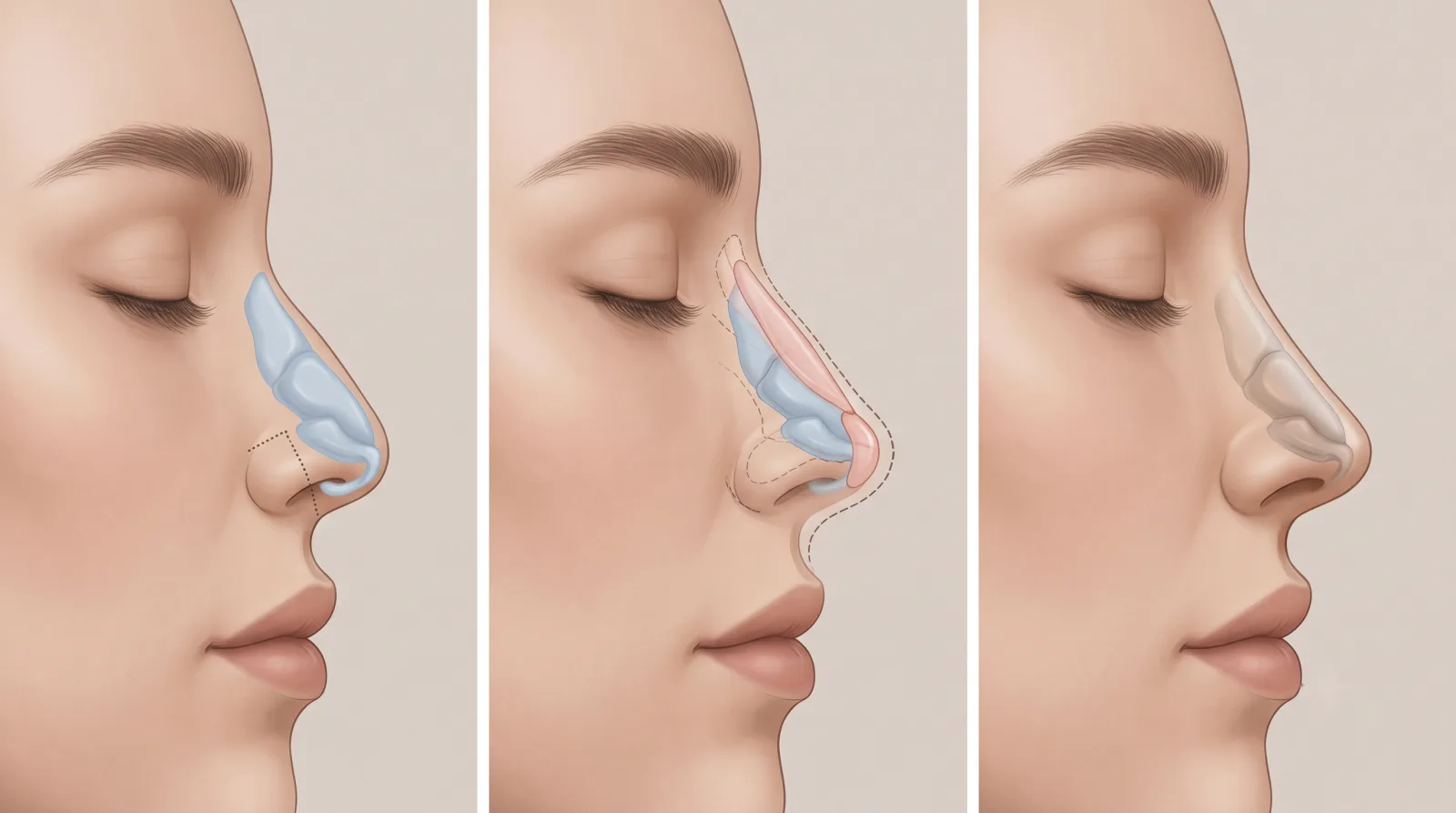
Illustration: the nasal framework (blue) is reshaped to raise the bridge and refine the tip. The dashed outline shows the original contour.
Running down the centre is the septum, the wall of cartilage and bone that divides the two nostrils. When the septum is deviated, it can bend the whole nose off the midline like a bent tent-pole, and it is one of the most common reasons a nose looks and feels crooked. Because the septum also supports the tip, a deviated septum often twists the tip as well as the bridge.
Most crooked noses are a combination of some bone, some cartilage and some septum, which is why a careful assessment matters. Straightening the outside without addressing the deviated support underneath tends not to last, so a rhinoplasty for a crooked nose is planned around the actual cause. The surface appearance alone is not the guide.
Function
Cosmetic, functional, or both
A deviated nose is often where cosmetic and functional concerns meet. A septum that is bent enough to make the nose look crooked can also narrow one airway and make breathing harder on that side, particularly when lying down or during exercise. Many patients come in focused on appearance and only then mention that they have never breathed easily through one nostril.
It is important to be clear about the distinction. Correcting the shape of a crooked nose is cosmetic surgery; treating an obstructed airway from a deviated septum is a functional, medical matter that is assessed on its own terms. The two can sometimes be considered together because the septum is involved in both, but breathing problems deserve their own evaluation and are never folded into a cosmetic promise.
At consultation the surgeon examines both the outside and, gently, the inside of the nose, and will tell you plainly if your concern is primarily cosmetic, whether the septum is contributing to your appearance, and what a realistic rhinoplasty plan can and cannot address. Where a functional airway issue is significant, that is discussed clearly.
Correction
How a crooked nose is straightened
Straightening a deviated nose is structural work. Where the nasal bones are off-centre, they are carefully repositioned toward the midline. Where the cartilage framework is bent, the surgeon releases the tension holding it in its crooked position and then re-supports it in a straight one. Cartilage has 'memory' and tends to spring back, so straightening it usually means reinforcing it as well as moving it.
The workhorse for this is often the patient's own cartilage. Septal cartilage can be straightened and used as a supporting graft, sometimes as a spreader graft along the bridge or a strut at the tip, to hold the nose straight as it heals. Where more support is needed, ear cartilage can be added. Using your own tissue for the framework is a durable way to keep the correction stable over time in a rhinoplasty.
Because a crooked nose fights back as it heals, the plan is conservative and well-supported. Dressings are checked on the first and third days and nasal sutures come out at about seven; if ear cartilage is used, that donor site heals with sutures out around ten days. The same surgeon who plans this performs it. There is no separate operating doctor.
Revision
First-time correction versus revision
For a nose that has never been operated on, straightening is planned as a first-time rhinoplasty, usually with the patient's own septal and ear cartilage providing the support to hold the correction. This is the more predictable situation, because the tissues are untouched and scarring is not a factor.
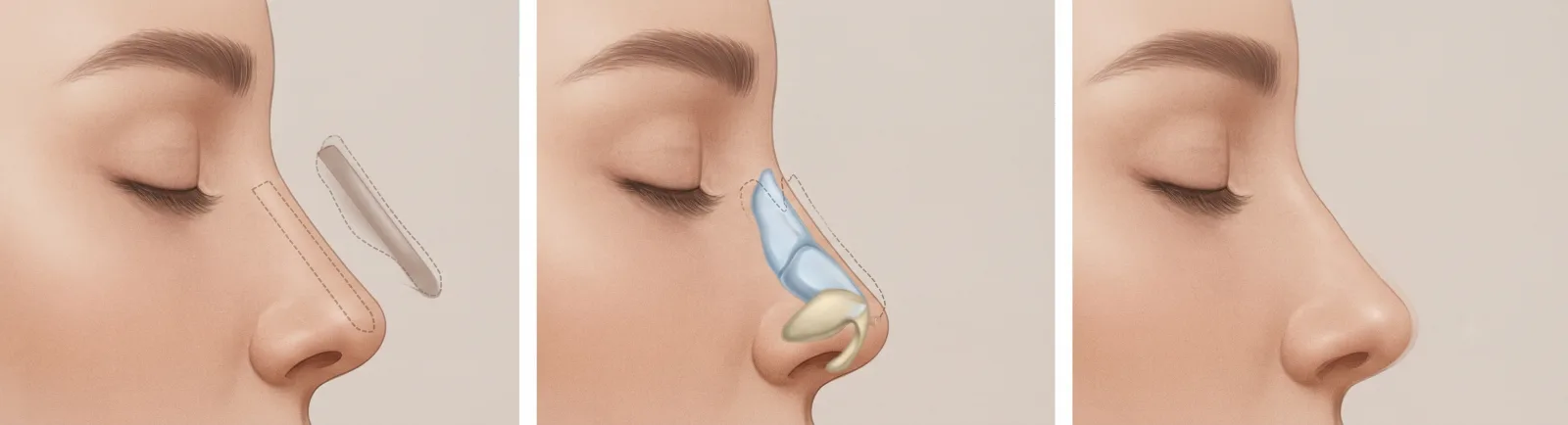
Illustration: the previous implant (outlined) is removed and the framework is rebuilt with the patient's own cartilage for support.
A nose that is crooked after previous surgery is different, and is handled as revision rhinoplasty. Here scar tissue, a shortage of usable septal cartilage, or a graft that has shifted can all be contributing to the deviation, and the correction has to work around what was done before. Revision may draw on additional material (ear, rib, donor rib or fascia) chosen case by case, and it is generally a more involved operation.
Being clear about which situation you are in matters, because the two are planned differently and carry different expectations. If you have had rhinoplasty before, bring that history to the consultation; the more the surgeon knows about your previous operation, the better the plan for straightening the result.
Expectations
Realistic expectations for a straight nose
A realistic aim is a nose that looks noticeably straighter and more symmetrical. A perfectly ruler-straight nose is not the aim, and no face truly has one. Faces are naturally a little asymmetric, and a subtle degree of that usually remains; a result that looks natural and balanced in your face is a better goal than an artificially straight line that draws attention.
Because a crooked nose is structurally under tension, there is a small chance it can drift slightly as it heals, and careful surgeons discuss this openly; no fixed outcome is guaranteed. Good support and a conservative plan reduce that risk, but it is part of why straightening a deviated nose is considered more demanding than a straightforward augmentation.
Swelling settles gradually, with the bridge clearing before the tip; the final straightness is best judged over months. Structured follow-ups at one, three and six months mean the same surgeon tracks how the correction holds, and can answer questions about symmetry and healing by messenger after you return home.
Consultation
Planning a crooked-nose correction from abroad
You can get an initial read before you travel. Send clear front, side and three-quarter photos (a straight-on photo is especially useful for a deviated nose) and note whether you also have any breathing difficulty on one side, so the surgeon can weigh whether the septum is likely involved. The consultation and CT carry no fee, and nobody will push you to book on the day.
Garnet is a single-surgeon clinic in Apgujeong, Seoul, registered with Korea's foreign-patient programme. Dr. In-Soo Baek, a board-certified plastic surgeon (Korean medical licence no. 77407), examines the cause of the deviation, plans the correction, performs it himself and reviews your recovery. Start with a no-obligation online assessment, and a full in-person examination, including an internal look at the septum, confirms the plan when you arrive.
Prices
Price at Garnet
Revision rhinoplasty
From₩4,000,000 + VATExcluding VAT (10% VAT is added at payment)Book now
Same price as Korean patients. Prices shown exclude 10% VAT; your written quote, issued after the in-person consultation, shows the full amount payable.
Dr. In-Soo Baek
Director & sole operating surgeon
Korean medical licence no. 77407
Operate on what you came for. Trained at Korea University Medical Center. Every case planned, performed and reviewed by the same hands.
1Operating surgeon
~2Surgeries per day
7Registered techniques
Board-certified plastic surgeon
Plastic surgery training at Korea University College of Medicine & graduate school
Korean Society of Plastic and Reconstructive Surgeons member, in its facial-contour, eye & rhinoplasty groups
Consults, operates and follows up each case himself
Peer-reviewed papers behind the facts on this page. Each describes findings in its own study group — not results at Garnet — and none predicts your own outcome.
Suh MK. Cosmetic Augmentation Rhinoplasty for East Asians. Facial Plastic Surgery Clinics of North America. 2021. doi:10.1016/j.fsc.2021.06.010
Hwang NH et al. Septal Extension Graft in Asian Rhinoplasty. Facial Plastic Surgery Clinics of North America. 2018. doi:10.1016/j.fsc.2018.03.007
Yap EC. Rhinoplasty for South East Asian Nose. Facial Plastic Surgery Clinics of North America. 2018. doi:10.1016/j.fsc.2018.03.012
FAQ
Common questions
Can a crooked nose be straightened?
Yes, though it is one of the more demanding rhinoplasty problems. Straightening a deviated nose means repositioning off-centre bone, releasing and re-supporting bent cartilage, and often straightening the septum, then reinforcing the framework so it stays straight as it heals. A realistic aim is a noticeably straighter, balanced nose; a perfectly ruler-straight one is not expected.
Is a deviated nose cosmetic or functional?
It can be either or both. A bent septum can make the nose look crooked and also block breathing on one side. Correcting the shape is cosmetic surgery, while an obstructed airway is a functional, medical matter assessed on its own. The two can be considered together because the septum is involved in both, but breathing issues deserve their own evaluation.
How is a crooked nose corrected?
By working on the actual cause: repositioning deviated nasal bones, releasing bent cartilage and re-supporting it in a straight position, and straightening the septum where it contributes. The patient's own septal and ear cartilage is often used as supporting grafts to hold the correction, because cartilage tends to spring back toward its old shape without reinforcement.
Does correcting my deviated septum improve breathing?
It can, when a deviated septum is genuinely narrowing an airway. However, breathing is a functional matter that is assessed on its own and is not promised as part of a cosmetic result. At consultation the surgeon examines the inside of the nose and tells you plainly if the septum is affecting your appearance, your breathing, or both.
Why do crooked noses sometimes drift back?
Cartilage has 'memory' and a deviated framework is under tension, so without good support a corrected nose can drift slightly as it heals. This is why straightening is done with reinforcement, often the patient's own cartilage as spreader grafts or struts, and a conservative plan. Careful surgeons discuss this small risk openly and do not guarantee a fixed outcome.
Will my nose be perfectly straight after surgery?
The aim is a noticeably straighter, more symmetrical nose that looks natural in your face. A perfectly straight line is not the goal. Faces are naturally a little asymmetric and a subtle degree usually remains. A balanced result that suits your features is a better and more realistic goal than an artificially straight nose that draws attention.
My nose became crooked after previous surgery: can it be fixed?
That is planned as revision rhinoplasty and not as a first-time correction, because scar tissue, limited septal cartilage or a shifted graft may be contributing. Revision may use additional material such as ear, rib or fascia, chosen case by case, and is generally more involved. Bring your previous surgical history to the consultation.
How long is recovery from crooked-nose surgery?
Dressings are checked on the first and third days and nasal sutures come out around seven days, so you look presentable within a couple of weeks. If ear cartilage is used, that donor site heals with sutures out around ten days. Swelling settles gradually, the bridge before the tip, and final straightness is best judged over months.
Can the surgeon assess my crooked nose from photos?
As a starting point, yes. Clear front, side and three-quarter photos, especially a straight-on view, let the surgeon judge where the deviation is coming from and what is realistic. Noting any one-sided breathing difficulty helps too. A full in-person examination, including an internal look at the septum, confirms the plan when you arrive.
Who performs the surgery at Garnet?
Dr. In-Soo Baek, a board-certified plastic surgeon, performs the operation himself. As a single-surgeon clinic, the same surgeon who assesses the cause of your deviation plans and performs the correction and reviews your recovery at one, three and six months. There is no separate operating doctor.
My mom recently had a brow lift and lower blepharoplasty with Dr. Baek, and our experience has been wonderful so far. The Garnet team was incredibly kind and welcoming, with Kelly assisting us as our English consultant—she made everything…
I’m so happy I chose this clinic for my lower blepharoplasty. I was traveling from abroad by myself, so I was a little nervous, but from the beginning I felt comfortable and truly cared for. Everyone was kind, patient, and professional…
Came in for an in-person consult and ended up choosing Garnet and Dr.Baek for my non-incisional DES and tiplasty/alarplasty. I communicated with Kelly (English consultant) from the start till now (3 weeks post-op). She really help me feel…
My under-eyes have been sagging and folding for years... I tried to cover it up with makeup, but it actually got stuck in the wrinkles and made it stand out even more. While going for consultations, I noticed that the bigger the hospital…
Send photos and your question before you travel. An English-speaking coordinator reviews every enquiry and replies with guidance on whether surgery is appropriate, the likely plan and timing.
✓ Reviewed by the clinic coordinator, not a bot
✓ Photo-based pre-assessment before you fly
✓ Foreign-patient scheduling & after-care
✓ One surgeon for consultation, surgery and follow-up
Prefer to chat now? Reach the coordinator directly:








 T S7 months ago



