Garnet · Apgujeong, Seoul · English coordinator · WhatsApp · LINE · Email
Garnet clinic, Apgujeong
Garnet/Rhinoplasty/Implant-free rhinoplasty

Rhinoplasty · Apgujeong, Seoul

Implant-free rhinoplasty in Korea — your own cartilage

Dr. In-Soo Baek
Dr. In-Soo BaekConsults, operates and follows up himself
10,000+rhinoplasty cases since 2011
0implants in the nose
1surgeon, every step
~1–2 weeksmost social downtime
Anaesthesia
Local / sedation
Surgery time
~2 hours
Sutures out
Nose ~7 / ear ~10 days
Social downtime
~1–2 weeks
Follow-up
1 / 3 / 6 months
10,000+ rhinoplasty cases since 2011· Rhinoplasty surgeon board-certified in plastic surgery, with accredited Korean Society of Plastic & Reconstructive Surgeons membership· Foreign-patient programme registered· Single-surgeon practice

Cartilage-only rhinoplasty: key facts

Implant-free rhinoplasty reshapes the bridge and tip using only the patient's own cartilage, with no silicone or other implant in the nose. At Garnet, board-certified plastic surgeon Dr. In-Soo Baek raises the dorsum with ear cartilage and builds the tip with septal cartilage himself, and he sees each patient from consultation through every follow-up.

What it is
A rhinoplasty that uses only the patient's own cartilage (typically ear cartilage for the bridge and septal cartilage for the tip), so no silicone or other implant is placed in the nose.
Best for
Patients who want added height and a refined tip but prefer to avoid any implant, including those with thin skin or who are wary of long-term implant concerns.
Who performs it
Dr. In-Soo Baek, board-certified and Garnet's sole operating doctor, harvests the cartilage, shapes the bridge and tip, and follows up your nose himself.
Downtime
Splint and dressings in the first days; nose sutures out at about 7 days and the ear donor site at about 10; most social downtime over by roughly 1–2 weeks; the tip settles over months.
Longevity
A structural change in living autologous tissue; alloplastic dorsal materials carry a recognised complication rate that an all-cartilage nose avoids (Oh et al, 2022).
How to start
Send front and profile photos of your nose through WhatsApp or the form below for a no-obligation pre-assessment before you travel.
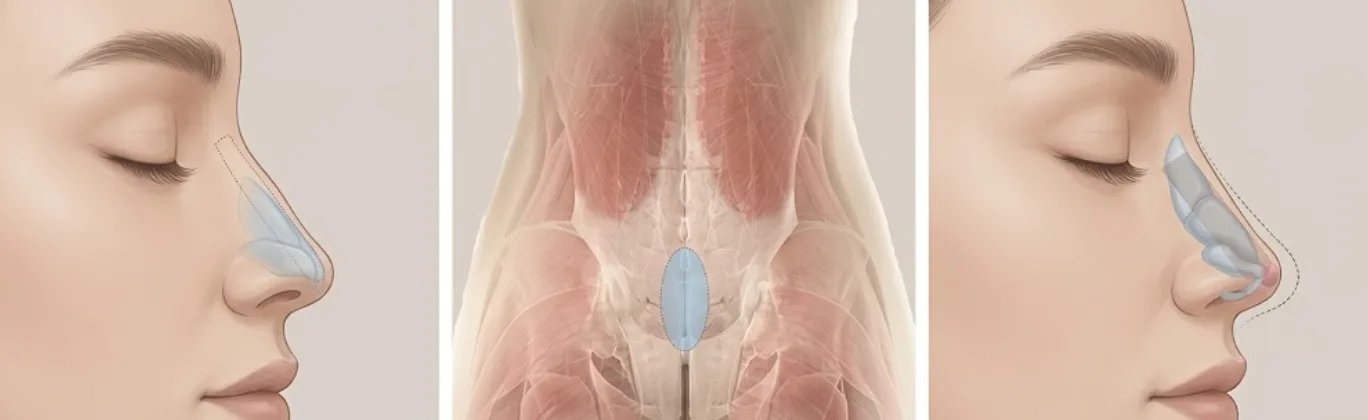
Illustrated steps of implant-free rhinoplasty at Garnet: a low nasal bridge, the framework rebuilt from the patient's own tissue, and the reshaped nose
Illustration: with no implant, the bridge and tip are built from the patient's own tissue, shaped into the nasal framework (blue). The dashed line shows the original contour.

Who an all-cartilage nose suits

Wanting height without anything artificial inside

  • A wish for a higher bridge and refined tip without any implant in the nose
  • Thin nasal skin, where an implant on the bridge is less ideal
  • A preference for the patient's own tissue and to avoid long-term implant concerns
  • Enough septal and ear cartilage to build both the bridge and the tip
  • Time for ~1–2 weeks of social downtime, the ear suture visit at about day 10 and the follow-ups

When maximum dorsal height is the priority

  • Wanting maximum, very controllable dorsal height, where an implant approach may suit better
  • Limited usable cartilage, where a different framework plan is discussed
  • A nose already operated on elsewhere, which is planned as a revision instead
  • Unrealistic expectations of a nose unlike your facial proportions
  • Uncontrolled medical conditions or active smoking, which affect graft healing and are planned around
Dr. In-Soo Baek

Dr. In-Soo Baek

Director & sole operating surgeon
Korean medical licence no. 77407

Operate on what you came for. Trained at Korea University Medical Center. Every case planned, performed and reviewed by the same hands.

1Operating surgeon
~2Surgeries per day
7Registered techniques
  • Board-certified plastic surgeon
  • Plastic surgery training: Korea University College of Medicine & graduate school
  • Member of the rhinoplasty, eye & facial-contour groups within the Korean Society of Plastic and Reconstructive Surgeons
  • Harvests, carves and places every cartilage graft himself
About the surgeon →

Before & After

Implant-free rhinoplasty before/after sets are identifiable, so they are shown privately at consultation with consent and are not published on this page. Results, recovery and suitability vary by individual and are not guaranteed.

Request before & after examples privately

A nose shaped from your own cartilage

Implant-free rhinoplasty is a surgical reshaping of the nose that uses only the patient's own (autologous) cartilage to raise the bridge and build the tip, placing no silicone or other alloplastic implant in the nose. At Garnet the dorsum is commonly augmented with ear (conchal) cartilage and the tip is supported with septal cartilage, so the entire reconstruction is living tissue from the same patient.

Many people want a higher bridge and a more defined tip but would prefer no permanent implant in the nose, because of thin skin, a wish to avoid long-term implant issues, or simply a preference for their own tissue. Implant-free rhinoplasty answers that by building the whole nose from autologous cartilage.

At Garnet the usual plan uses ear cartilage to add height to the dorsum and septal cartilage to project and define the tip. Ear cartilage has a gentle natural curve that suits the bridge, while the straighter septal cartilage supports the tip; using the patient's own tissue throughout is intended to integrate with the nose and avoid the specific concerns that come with an implant on the bridge.

This is a single-surgeon operation. Dr. Baek checks skin thickness, the existing framework and how much cartilage is available, then harvests and carves the grafts and reviews the nose and ear at set intervals. With no more than two surgeries a day, the extra carving time is available. Because cartilage must be harvested and shaped, an implant-free case usually takes a little longer than an implant case, which is the trade-off for an all-tissue nose.

From ear and septum to finished nose

From cartilage harvest to dorsal augmentation and tip work, all from your own tissue and every step by Dr. Baek.

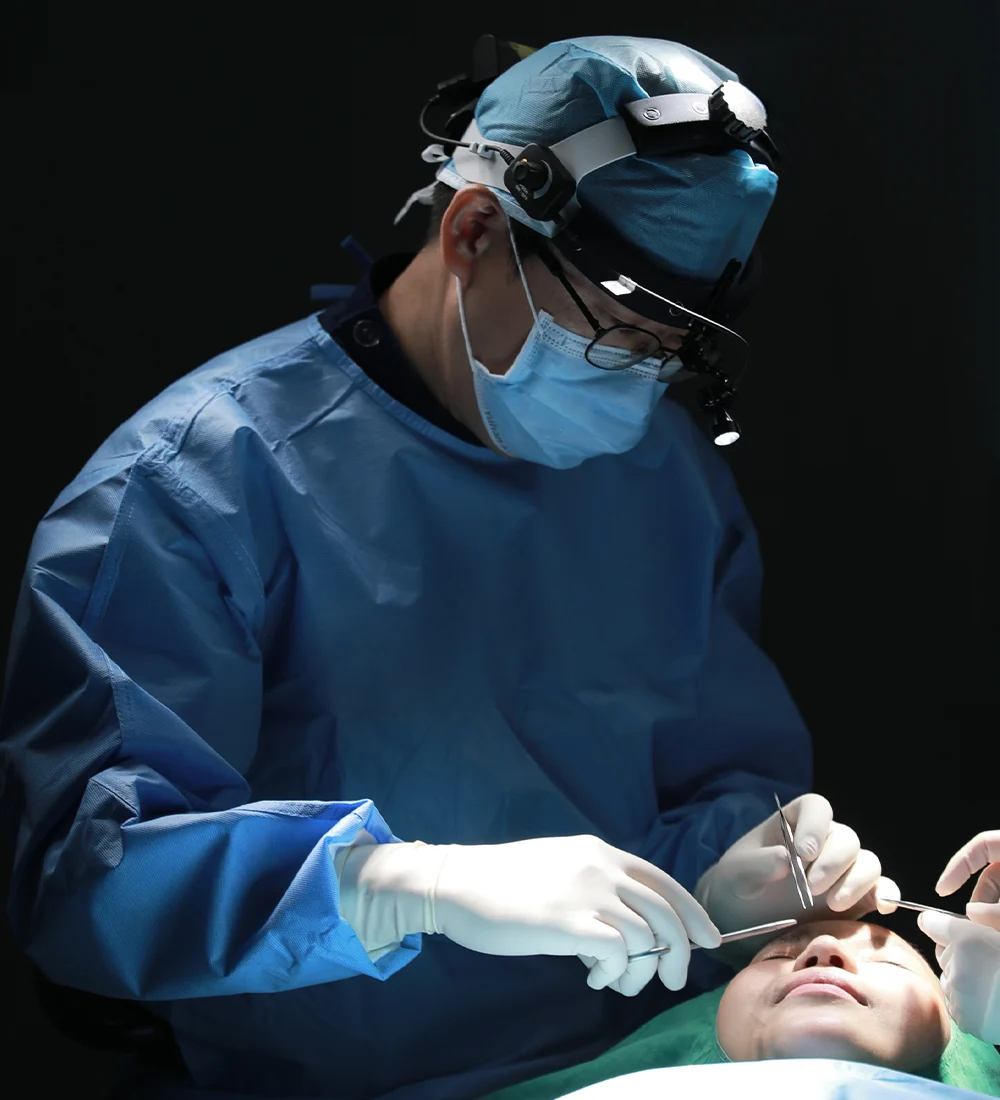
Dr. In-Soo Baek performing surgery at Garnet Plastic Surgery, Apgujeong

A single surgeon, start to finish. The ear and septal grafts are taken, shaped and fixed by Dr. Baek, who also removes the splint and checks the donor ear. A two-surgery daily limit leaves room for the careful carving cartilage needs.

An implant-free rhinoplasty at Garnet typically takes about 2 hours and is usually carried out under local anaesthesia with sedation, chosen with you beforehand; nose dressings are changed on day 1 and day 3, nose sutures come out at about 7 days and the ear donor site at about 10. Each stage is set out below.


01

Counting available cartilage and checking breathing

Dr. Baek assesses the bridge, tip, skin thickness, breathing and how much cartilage is available, and agrees the desired profile. He confirms an implant-free plan suits your goals and chooses the donor sites with you.

02

Open or closed access, case by case

The nose is approached closed (inside the nostrils) or open (a small bridging incision under the tip) depending on the tip work needed, so external scars are hidden inside the nose or in the natural under-tip crease.

03

Ear cartilage for the dorsum, septum for the tip

Ear (conchal) cartilage is taken for the dorsum and septal cartilage for the tip, through hidden incisions; the ear's natural curve suits the bridge while the straighter septum supports the tip.

04

Dorsal augmentation with cartilage

The bridge is raised to the agreed height using the shaped ear cartilage instead of an implant, carved and layered so the dorsum is smooth and matched to the new tip.

05

Projecting the tip with septal cartilage

The tip is projected, defined and fixed with the septal cartilage, with adjuncts only where the consultation shows they balance the result; the whole reconstruction is living tissue.

06

Splint on, and the ear site dressed

Fine closure at the nose and donor sites, a nasal splint and dressings. Dr. Baek changes the dressings on day 1 and day 3, removes the nose sutures around day 7 and the ear sutures around day 10.

Why cartilage source matters

The nose is bone in the upper third and cartilage below, draped with skin of varying thickness. To raise a flat bridge and refine an under-defined tip, a graft material is needed, and the body offers several of its own: septal cartilage (straight, central, good for tip support), ear or conchal cartilage (gently curved, well-suited to the dorsum), and rib cartilage for larger framework needs. The septum and ear are the usual donor sites for a primary implant-free case.

Choosing autologous cartilage over an alloplastic implant changes the long-term risk picture. Polymer-based implants used for dorsal augmentation carry a recognised, if generally manageable, rate of complications such as deviation, contour visibility and, uncommonly, infection or extrusion (Maxillofac Plast Reconstr Surg 2022; DOI 10.1186/s40902-022-00344-8); an all-cartilage nose avoids the implant-specific issues at the cost of a donor-site step. Where a patient instead prefers the controllable height an implant gives, a standard rhinoplasty pairs a soft silicone dorsum with an autologous tip.

Implant-free vs implant rhinoplasty

Implant-free (cartilage only)Implant + cartilageRevision rhinoplasty
Dorsum materialOwn ear / septal cartilageSoft silicone graftMaterial chosen per case
Tip materialOwn septal cartilageOwn septal / ear cartilageCartilage / fascia / dermis
Implant in the noseNoneYes, on the dorsumOften removed / replaced
Donor-site stepEar (and septal)None for the dorsumPer chosen material
Best suited toWanting no implant / thin skinWanting clear, controllable heightCorrecting a previous result

A meta-analysis of augmentation with autologous cartilage versus silicone prosthesis found each has its own complication trade-offs, with no single material ideal for every nose (Ann Palliat Med 2022; DOI 10.21037/apm-22-111). An implant-free nose avoids implant-specific issues at the cost of a donor step; Dr. Baek advises which fits your anatomy, and a standard implant + cartilage approach is available.

Anaesthesia, grafts and safety

Anaesthesia

An implant-free rhinoplasty is usually performed under local anaesthesia with sedation over a roughly 2 hour operation, chosen with you and the anaesthesia team once your medical history has been checked.

Unrushed harvest and grafting on a quiet day

Garnet takes at most two surgeries a day, so the cartilage harvest and grafting are not rushed. Dr. Baek, who planned your nose, operates and follows both the nose and ear, with no second operating doctor.

Pre-op checks and dates set up before you fly

Garnet is registered with Korea's foreign-patient programme, so your pre-operative checks, surgery date and the day-7 and day-10 suture visits are arranged in English.

When cartilage alone is not the answer

If your goals would be better met by an implant approach, more framework or no surgery, that is said at consultation. Whether enough cartilage is available is checked before planning, and photos can be reviewed before you travel.

Nasal incisions & the ear donor site

Nasal incisions are mostly hidden inside the nostrils with a closed approach. When tip work needs an open approach, a single fine line sits across the columella in its natural crease. Because the bridge is built from cartilage, there is no implant pocket, though there is a donor site.

The ear (conchal) cartilage is taken through an incision hidden in a natural fold of the ear, leaving the ear's shape unchanged; the donor sutures come out a little later than the nose, at about day 10. Septal cartilage is harvested from inside the nose with no external scar. All scars are designed to settle discreetly; healing varies by individual, and Dr. Baek reviews maturation and advises on scar care at the 1-, 3- and 6-month visits.

Week by week

Days 1–3
A nasal splint and dressings are in place and the ear donor site is dressed; the nose feels blocked and the mid-face is swollen. Rest with your head raised, cool the area as advised, and keep pressure off the donor ear. Dressings are changed on day 1 and day 3; discomfort is usually manageable with prescribed medication.
Days 4–7
Bruising under the eyes and swelling over the bridge start to ease. The splint stays on, and nose sutures are removed at about day 7 when it comes off. The ear remains a little tender.
Weeks 1–2
Most social downtime is over for everyday settings once the splint is off, though the nose stays firm and slightly swollen. The ear donor sutures come out around day 10. Desk work and daily routines return as advised.
Weeks 2–6
The cartilage bridge looks settled once bruising clears, while the septal-cartilage tip stays firmer and refines last. The ear donor site settles. Glasses on the new bridge, hard exercise and contact sports wait until Dr. Baek clears them.
Months 1–6
The tip continues to soften and the final shape emerges over several months as the grafted cartilage integrates. Dr. Baek checks the grafts at 1, 3 and 6 months, at the clinic or over messenger once you are home.

Do

Sleep on your back with your head raised, cool the cheeks early, take your medication, keep the splint and ear dressing dry, and come to every follow-up.

Avoid

Knocking or pressing the nose, sleeping on the treated ear, resting glasses on the bridge, blowing the nose forcefully early on, strenuous exercise and heavy lifting, alcohol and smoking, hot showers/saunas, and direct sun until cleared.

How long an all-cartilage nose lasts

Implant-free rhinoplasty makes a structural change in living autologous tissue, so the grafted cartilage integrates and the result is long-lasting. Building the whole nose from the patient's own cartilage avoids the implant-specific long-term concerns (deviation, contour visibility and, uncommonly, infection or extrusion) that polymer dorsal implants can carry (Oh et al, Maxillofac Plast Reconstr Surg 2022; DOI 10.1186/s40902-022-00344-8).

Autologous cartilage can, over years, undergo a small amount of resorption or warping, which is part of the consultation discussion; meta-analysis comparing cartilage and silicone shows each material has its own profile, with neither uniformly superior (Ann Palliat Med 2022; DOI 10.21037/apm-22-111). The nose still ages slowly, and if a previous result ever needs correcting, revision rhinoplasty is assessed individually.

Related nose plans

Implant approach

Where controllable dorsal height matters more than avoiding an implant, a standard rhinoplasty pairs a soft silicone bridge with an autologous tip; Dr. Baek explains how the two compare for your nose.

More framework

When the nose needs a stronger structure than ear and septal cartilage provide, rib-cartilage rhinoplasty supplies a larger autologous framework, still implant-free.

Tip cartilage detail

For tip projection and definition specifically, a septal / ear-cartilage plan focuses the autologous cartilage where the tip needs support.

A nose already operated on elsewhere

A nose already operated on elsewhere is planned as a revision rhinoplasty, using your operative notes and photographs to decide whether cartilage alone will do.

Garnet Plastic Surgery, Apgujeong, Seoul

Graft, donor-site and other risks

Every operation carries risk. Dr. Baek goes through each of these with you before the operation.

  • Swelling

    Takes months to settle, especially at the tip.

  • Asymmetry

    A consideration of an implant-free rhinoplasty.

  • Graft changes

    A small chance of cartilage resorption or warping over time.

  • A tender ear with a hidden incision

    A dressed ear that is tender for a while, with a hidden incision.

  • No implant risks

    Because no implant is placed, the deviation, contour and extrusion risks specific to alloplastic dorsal implants are avoided (Maxillofac Plast Reconstr Surg 2022; DOI 10.1186/s40902-022-00344-8).

  • Numbness at the nose or ear donor area

    Changes in skin sensation around the nose or the ear donor area.

  • Scars

    Scar-related issues at an open-approach or ear site.

  • Breathing and revision

    Breathing changes, and the need for revision in a minority of cases.

  • Smoking

    Raises wound-healing and skin risks.

What reduces risk in practice: confirming enough usable cartilage before planning, shaping and layering the grafts carefully, meticulous donor-site closure, and follow-up by the operating surgeon. At Garnet the grafts, the closure and the follow-up of both sites stay with one surgeon on a low-volume schedule.

10 to 14 days in Seoul for a cartilage nose

Most international patients plan roughly 10–14 days in Korea for an implant-free rhinoplasty, so the splint can come off and both the nose sutures (about day 7) and the ear donor sutures (about day 10) be removed by the surgeon before travel. Your exact stay depends on how the nose and ear heal.

Before you travel, send clear photos of your nose (front, three-quarter, side and a relaxed profile) with a note on what bothers you and your dates, through WhatsApp, LINE or the form below. The pre-assessment says whether an implant-free plan suits your skin and cartilage, without a hard sell.

Through Korea's foreign-patient programme, Garnet arranges your nose consultation, surgery date and suture visits in English. Once you are home, Dr. Baek keeps reviewing the grafted tip by messenger as it settles.

Sources

  1. Oh SH, et al. Prevalence of complications associated with polymer-based alloplastic materials in nasal dorsal augmentation: a systematic review and meta-analysis. Maxillofac Plast Reconstr Surg. 2022. DOI 10.1186/s40902-022-00344-8. link
  2. A systematic review and meta-analysis of the efficacy and complication rates of augmentation rhinoplasty with autologous cartilage and silicone prosthesis. Ann Palliat Med. 2022. DOI 10.21037/apm-22-111. link
  3. Yang HJ, et al. Comparison of Autologous vs Homologous Costal Cartilage Grafts in Dorsal Augmentation Rhinoplasty: A Systematic Review and Meta-analysis. JAMA Otolaryngol Head Neck Surg. 2020. DOI 10.1001/jamaoto.2019.4787. link
  4. Costa LMC, et al. Rhinoplasty Complications and Reoperations: Systematic Review. Int Arch Otorhinolaryngol. 2016. DOI 10.1055/s-0036-1586489. link

Citations are provided for general education. This page is informational and does not replace an in-person consultation; suitability, technique and recovery are individual.

Implant-free nose questions

What does implant-free rhinoplasty use instead of an implant?
Only your own cartilage. At Garnet the bridge is commonly raised with ear (conchal) cartilage and the tip is built with septal cartilage, so no silicone or other implant is placed in the nose. The ear's curve suits the dorsum, while the straighter septum supports the tip.
How is implant-free rhinoplasty different from implant rhinoplasty?
The two methods shape the same bridge and tip but build the dorsum from different material. An implant-free rhinoplasty raises the bridge with your own ear cartilage and builds the tip from septal cartilage, with no implant in the nose but an ear donor step. A standard implant rhinoplasty raises the bridge with a soft silicone graft and builds the tip from cartilage, giving clear, controllable height without a donor site. The implant-free route avoids implant-specific long-term concerns, while the implant route offers very controllable dorsal height. Meta-analyses show each material has its own trade-offs, so the choice depends on your skin, cartilage and goals.
Implant-free (cartilage only)Implant + cartilageRevision rhinoplasty
Dorsum materialOwn ear / septal cartilageSoft silicone graftMaterial chosen per case
Tip materialOwn septal cartilageOwn septal / ear cartilageCartilage / fascia / dermis
Implant in the noseNoneYes, on the dorsumOften removed / replaced
Donor-site stepEar (and septal)None for the dorsumPer chosen material
Best suited toWanting no implant / thin skinWanting clear, controllable heightCorrecting a previous result
Does Dr. Baek perform the surgery himself?
Yes. Dr. Baek is Garnet's only surgeon: he examines your nose, harvests and places the ear and septal cartilage, and runs every follow-up. No other doctor operates, and with two surgeries a day at most, the grafting is not rushed.
How long does implant-free rhinoplasty last?
It is a structural change in living tissue that integrates over time, so it is long-lasting. Cartilage can undergo a small amount of resorption or warping over years, which is discussed at consultation; the nose also ages slowly. If a previous result ever needs correcting, revision rhinoplasty is assessed individually.
How long should I stay in Korea?
Most international patients plan about 10–14 days, so the splint comes off and both nose sutures (about day 7) and ear donor sutures (about day 10) are removed by the surgeon before travel. Your stay is set around those two suture dates.
What anaesthesia is used for an implant-free nose, and how sore is it?
Local anaesthesia with sedation is usual for the roughly 2 hour operation, chosen once your health history is checked. Most patients describe blockage and pressure at the nose and tenderness at the ear, without sharp pain, managed with prescribed medication.
Where are the scars and donor site?
Nasal incisions hide inside the nostrils, or a fine line in the under-tip crease with an open approach. The ear donor incision sits in a natural fold and leaves the ear's shape unchanged; septal cartilage is taken from inside the nose with no external scar. All settle discreetly once mature.
When will I look presentable?
Most social downtime is over by about 1–2 weeks once the splint is off, though the nose stays firm and a little swollen and the ear is briefly tender. Bruising clears over the first couple of weeks, and the tip refines over months.
Is implant-free better than an implant rhinoplasty?
Neither is universally better; they suit different goals. Implant-free avoids implant-specific concerns and suits thin skin or a preference for your own tissue, while an implant approach gives very controllable height without a donor site. The right choice depends on your anatomy and priorities.
What if I don't have enough cartilage?
Whether enough septal and ear cartilage is available is confirmed before planning. If more framework is needed than they provide, rib-cartilage rhinoplasty supplies a larger autologous source while still avoiding an implant.
What are the main risks?
Swelling that takes months to settle at the tip, asymmetry, a small chance of cartilage resorption or warping, and a tender ear donor site. Because no implant is used, deviation and extrusion risks specific to implants are avoided. Sensation changes and the need for revision in a minority are also discussed individually.
Can I see before-and-after photos?
Noses are identifiable, so implant-free sets are shown privately at consultation with consent and are not published here. A standard rhinoplasty example is shown elsewhere on this site.
Will the result look natural?
The aim is a balanced profile in living tissue. Matching the cartilage dorsal height to the tip and using the ear's natural curve on the bridge, as in a septal / ear-cartilage plan, is intended to keep the nose proportionate to your face without over-projection.
Can you correct a nose operated on elsewhere without an implant?
Previously operated noses are assessed as a revision rhinoplasty, where an implant-free, all-cartilage plan is often possible; bring your operative history and photos so the right material can be chosen.
How do I start without flying to Korea first?
Send photos of your nose and your travel dates through WhatsApp, LINE or the form below. The pre-assessment covers whether an implant-free plan suits your skin and cartilage, before you plan a trip.

Reviews on Google Maps

★★★★★

My mom recently had a brow lift and lower blepharoplasty with Dr. Baek, and our experience has been wonderful so far. The Garnet team was incredibly kind and welcoming, with Kelly assisting us as our English consultant—she made everything…

T S7 months ago
★★★★★

I’m so happy I chose this clinic for my lower blepharoplasty. I was traveling from abroad by myself, so I was a little nervous, but from the beginning I felt comfortable and truly cared for. Everyone was kind, patient, and professional…

S L2 months ago
★★★★★

Came in for an in-person consult and ended up choosing Garnet and Dr.Baek for my non-incisional DES and tiplasty/alarplasty. I communicated with Kelly (English consultant) from the start till now (3 weeks post-op). She really help me feel…

Stephanie Li6 months ago
★★★★★

My under-eyes have been sagging and folding for years... I tried to cover it up with makeup, but it actually got stuck in the wrinkles and made it stand out even more. While going for consultations, I noticed that the bigger the hospital…

조희원2 months ago · Translated by Google

Read all reviews on Google Maps

Ask Dr. Baek’s team

Send photos and your question before you travel. An English-speaking coordinator reviews every enquiry and replies with guidance on whether surgery is appropriate, the likely plan and timing.

  • ✓ Reviewed by the clinic coordinator, not a bot
  • ✓ Photo-based pre-assessment before you fly
  • ✓ Foreign-patient scheduling & after-care
  • ✓ One surgeon for consultation, surgery and follow-up

Prefer to chat now? Reach the coordinator directly:

Request a consultation

Find the clinic

51 Apgujeong-ro 30-gil, Gangnam-gu, Seoul — near Apgujeong Station

WhatsApp