Garnet · Apgujeong, Seoul · English coordinator · WhatsApp · LINE · Email
Garnet clinic, Apgujeong
Garnet/Rhinoplasty/Rhinoplasty

Rhinoplasty · Apgujeong, Seoul

Rhinoplasty in Korea — a tip from your own cartilage

Dr. In-Soo Baek
Dr. In-Soo BaekConsults, operates and follows up himself
10,000+rhinoplasty cases since 2011
~7 daysto nose suture removal
1surgeon, every step
~1–2 weeksmost social downtime
Anaesthesia
Local / sedation
Surgery time
~1.5–2 hours
Sutures out
Nose ~7 days
Social downtime
~1–2 weeks
Follow-up
1 / 3 / 6 months
10,000+ rhinoplasty cases since 2011· Board-certified plastic surgeon; accredited member, Korean Society of Plastic & Reconstructive Surgeons· Foreign-patient programme registered· Single-surgeon practice

Rhinoplasty at a glance

Rhinoplasty reshapes the bridge and tip of the nose to balance the profile and refine the tip. At Garnet a board-certified plastic surgeon, Dr. In-Soo Baek, plans and performs every nose himself, typically pairing a soft silicone dorsal augmentation with the patient's own septal or ear cartilage at the tip, and follows each case through.

What it is
An operation that reshapes the nasal bridge and tip, usually combining a soft silicone graft along the dorsum with the patient's own cartilage to define and support the tip.
Best for
A low or flat bridge and an under-projected, bulbous or ill-defined tip, where both height on the bridge and structural support at the tip are wanted in one operation.
Who performs it
Dr. In-Soo Baek, a board-certified plastic surgeon and the only doctor who operates at Garnet. He sees your nose at consultation, in surgery and at every review.
Downtime
Splint and nose dressings in the first days; nose sutures out at about 7 days; most social downtime over by roughly 1–2 weeks; the tip settles over months.
Longevity
A structural, long-lasting change; large series report low primary-rhinoplasty reoperation rates, though revision is sometimes needed (Costa et al, 2016).
How to start
Send front and profile photos of your nose by WhatsApp or the form below for a no-obligation pre-assessment before you travel.
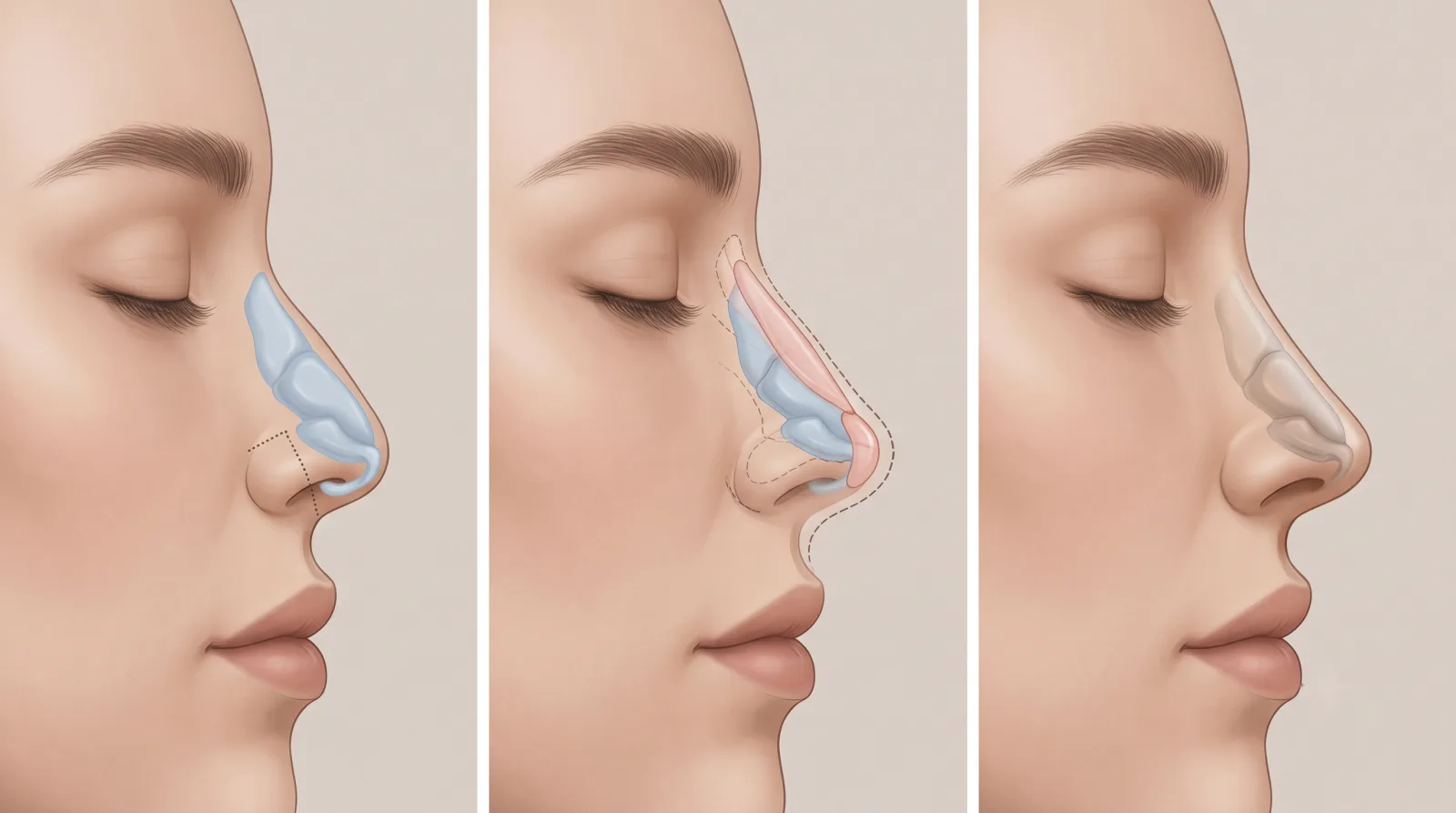
Illustrated steps of rhinoplasty at Garnet: the nasal cartilage framework in profile, reshaped bridge and tip, and the healed profile
Illustration: the nasal framework (blue) is reshaped to raise the bridge and refine the tip. The dashed outline shows the original contour.

Is rhinoplasty right for you?

A flat bridge or bulbous, under-projected tip

  • A low or flat bridge that would benefit from added height
  • An under-projected, bulbous or ill-defined tip wanting refinement and support
  • A wish to balance the whole profile in one planned operation
  • General good health and realistic, discussed expectations
  • Free to stay out of view for ~1–2 weeks while the splint and swelling settle, and to attend the nose reviews

Avoiding implants or fixing breathing first

  • A strong preference to avoid any implant, where an implant-free or revision plan may suit better
  • Mainly a breathing problem without a cosmetic concern, which is assessed individually
  • A nose already operated on elsewhere that needs correcting (a revision case)
  • Unrealistic expectations of a nose unlike your facial proportions
  • Uncontrolled medical conditions or current smoking, which have to be dealt with before nose surgery
Dr. In-Soo Baek

Dr. In-Soo Baek

Director & sole operating surgeon
Korean medical licence no. 77407

Operate on what you came for. Trained at Korea University Medical Center. Every case planned, performed and reviewed by the same hands.

1Operating surgeon
~2Surgeries per day
7Registered techniques
  • Board-certified plastic surgeon
  • Korea University College of Medicine & graduate school (plastic surgery)
  • Member, Korean Society of Plastic and Reconstructive Surgeons (facial-contour, eye & rhinoplasty groups)
  • Plans, operates on and follows up each nose personally
About the surgeon →

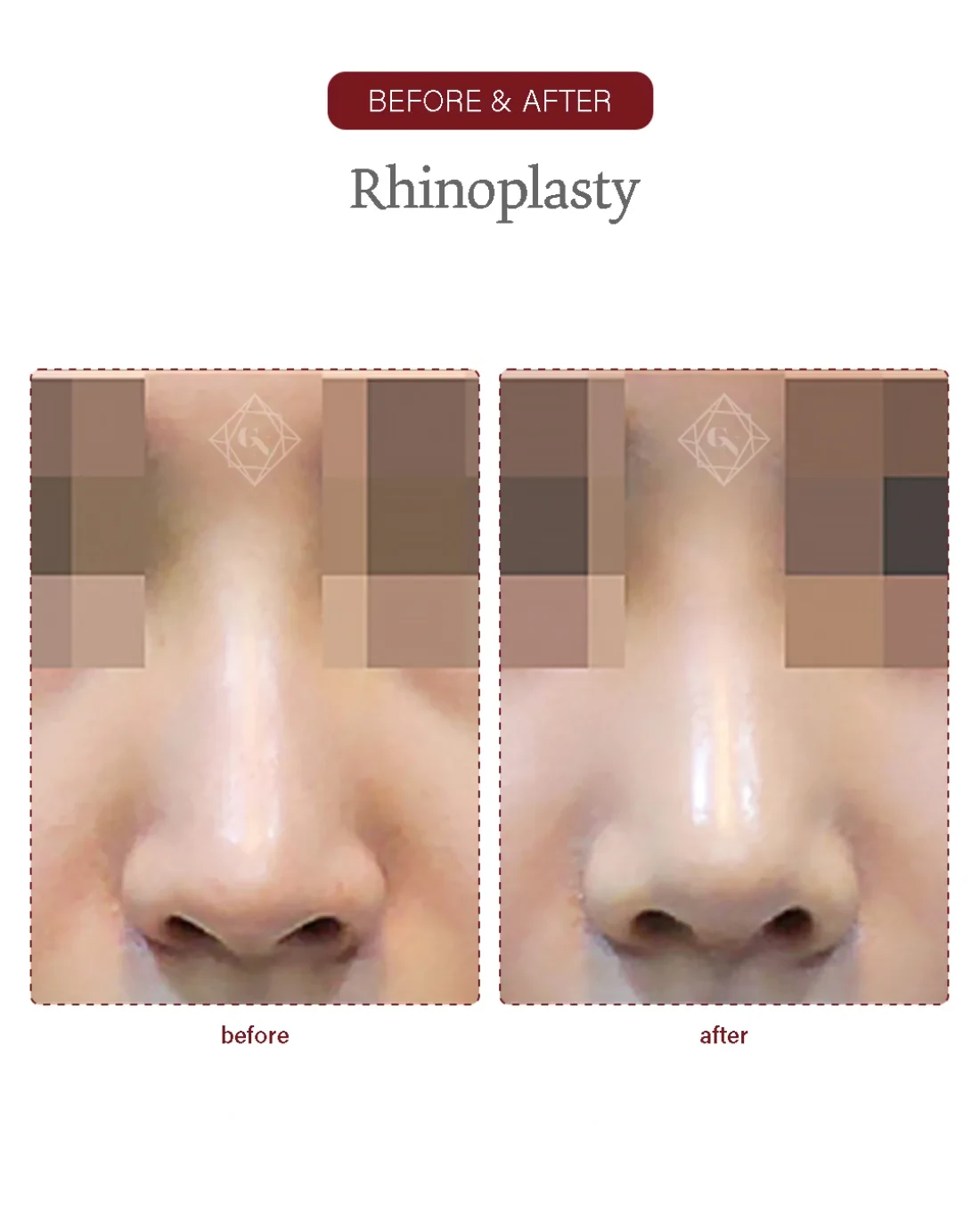
Before & After

Rhinoplasty result of an actual Garnet patient (published with consent). Date, procedure and clinic (Garnet Plastic Surgery, Apgujeong) are labelled on the image, with the usual same-condition disclaimer. Results, recovery and suitability vary by individual and are not guaranteed.

Building the bridge and tip together

Rhinoplasty is a surgical operation that reshapes the bony and cartilaginous framework of the nose to alter its height, width and tip. At Garnet a typical primary case augments the bridge with a soft silicone graft and rebuilds the tip with the patient's own septal or ear cartilage, so the dorsum gains height while the tip is defined and supported by living autologous tissue. No implant is placed in the tip.

The nose has two functional zones that age and look different. The bridge (dorsum) sets the height and the straightness of the profile; the tip sets refinement, projection and how the nose meets the lip. A flat bridge and an under-defined tip are common reasons people seek rhinoplasty, and the two are usually addressed together so the profile stays balanced.

At Garnet the common approach combines a soft silicone graft along the dorsum to raise the bridge with the patient's own cartilage (most often septal or ear cartilage) to build and support the tip. Using autologous cartilage at the tip, where skin is thin and movement is greatest, is intended to give a natural, well-supported result and keep an implant away from the most demanding part of the nose.

This is a single-surgeon operation. Dr. Baek assesses the skin thickness, the existing framework and what each patient wants, plans the operation with you, performs it himself and checks healing at fixed points; with only two operations a day, no nose is fitted into a rushed list. The depth of the plan, not the maximum possible change, is the aim.

How Dr. Baek performs a rhinoplasty

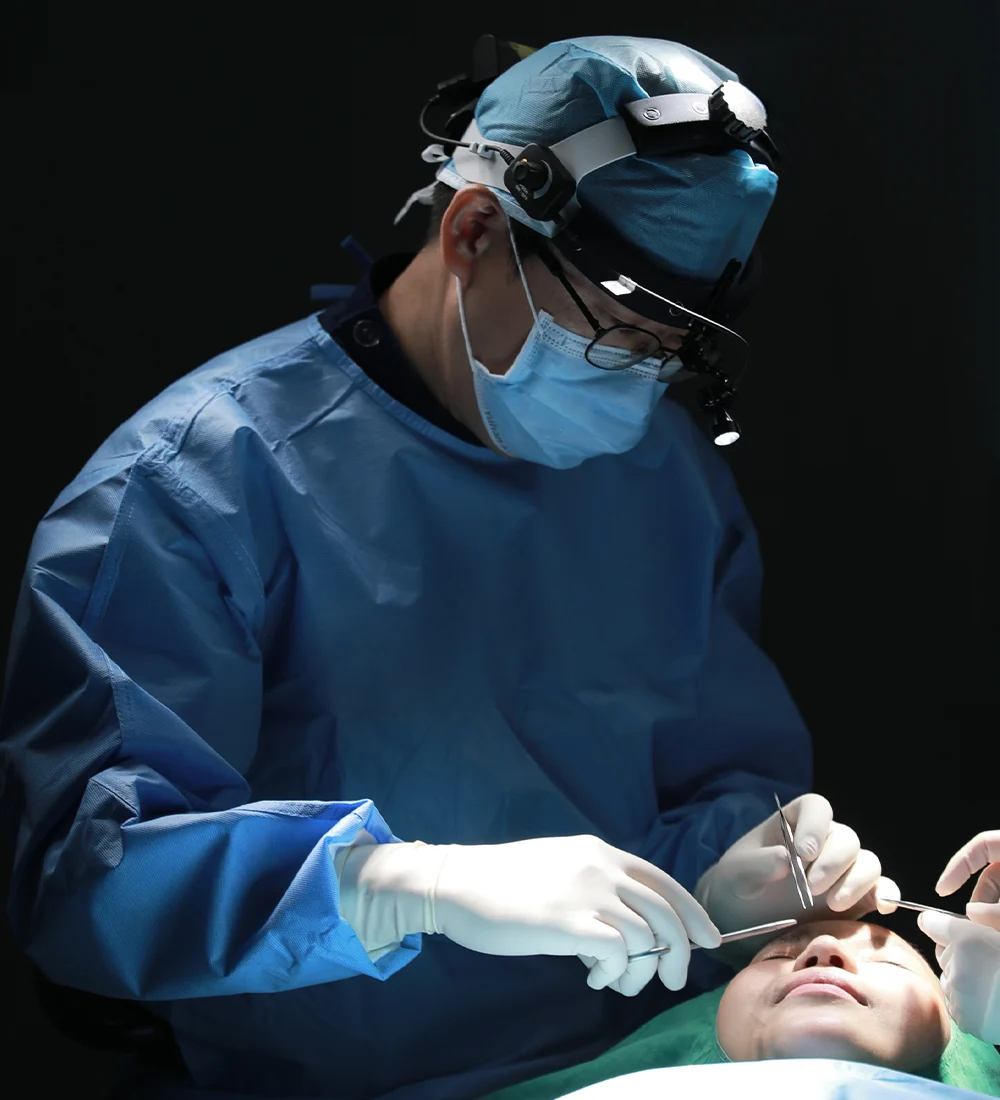
Dr. Baek handles every step himself, from planning and graft harvest to dorsal augmentation and tip work.

Dr. In-Soo Baek performing surgery at Garnet Plastic Surgery, Apgujeong

A single surgeon, start to finish. The surgeon who measures your bridge and tip is the one who carves the graft, shapes the cartilage and takes out the sutures. Garnet keeps to two operations a day, so a 1.5–2 hour rhinoplasty is never squeezed in.

A primary rhinoplasty at Garnet typically takes about 1.5–2 hours and is usually carried out under local anaesthesia with sedation, agreed with you beforehand; nose dressings are changed on day 1 and day 3 and nose sutures come out at about 7 days. Each stage of a Garnet rhinoplasty is set out below.


01

Bridge, tip, skin thickness and breathing

Dr. Baek assesses the bridge, tip, skin thickness and breathing in person, agrees the desired profile and discusses graft choice. Imaging is used where it adds to planning; he decides with you whether a closed or open approach fits the case.

02

Inside the nostrils or a small columellar cut

The nose is approached closed (inside the nostrils) or open (a small bridging incision under the tip) depending on how much tip work is needed, so external scars are hidden inside the nose or in the natural under-tip crease.

03

Taking septal or ear cartilage for the tip

The patient's own septal or ear cartilage is taken to build and support the tip; autologous tissue at the tip is chosen because the skin there is thin and the area moves the most.

04

Dorsal augmentation

The bridge is raised to the agreed height, commonly with a soft silicone graft carved to fit the dorsum, so the profile is balanced against the new tip and not over-projected.

05

Shaping and supporting the tip

The tip is shaped and supported with the harvested cartilage and fixed, with adjuncts such as fat grafting only where the consultation shows they balance the result.

06

Splint, dressings and the first changes

Fine closure, a nasal splint and dressings. Dr. Baek checks the nose himself, changes the dressings on day 1 and day 3 and takes out the nose sutures around day 7.

Dorsum, tip and the cartilage that supports it

The nose is a framework of bone in the upper third and cartilage in the lower two-thirds, draped with skin that varies in thickness from person to person. The tip is shaped by the paired lower lateral (alar) cartilages, while the septum in the midline provides central support and a source of graft cartilage. How much the tip can be refined depends heavily on skin thickness and the strength of this cartilage framework.

Augmentation rhinoplasty therefore separates the two tasks: adding height to the dorsum, and shaping plus supporting the tip. A range of graft materials can be used for the dorsum — autologous septal, ear or rib cartilage, or alloplastic implants such as silicone, and it is widely accepted that no single material is ideal for every nose (JAMA Otolaryngol Head Neck Surg 2020; DOI 10.1001/jamaoto.2019.4787). At Garnet the dorsum is commonly raised with a soft silicone graft while the tip is built from the patient's own cartilage; where a patient prefers no implant at all, an implant-free rhinoplasty uses cartilage throughout.

Implant + cartilage vs implant-free rhinoplasty

Implant + cartilage (typical)Implant-free (cartilage only)Revision rhinoplasty
Dorsum materialSoft silicone graftEar / septal / rib cartilageMaterial chosen per case
Tip materialOwn septal / ear cartilageOwn septal / ear cartilageCartilage / fascia / dermis
Implant in the noseYes, on the dorsumNoneOften removed / replaced
Best suited toLow bridge needing clear heightPreference to avoid any implantCorrecting a previous result
Donor-site stepNone for the dorsumEar / septal (sometimes rib)Per chosen material

A systematic review and meta-analysis comparing augmentation with autologous cartilage versus silicone prosthesis found each has trade-offs in complication profile, with no single material ideal for every nose (Ann Palliat Med 2022; DOI 10.21037/apm-22-111). Which material suits your nose is decided case by case; Dr. Baek gives his advice once he has examined you, and an implant-free option is available.

Safety during rhinoplasty

Anaesthesia

A primary rhinoplasty is usually performed under local anaesthesia with sedation over a roughly 1.5–2 hour operation, chosen with you and the anaesthesia team once your medical history has been checked for comfort and safety.

A capped day keeps your nose unhurried

Two operations a day is the limit, so your rhinoplasty is not hurried. Dr. Baek plans it, carries it out and follows the healing nose; no other surgeon or rotating team is involved.

Your English-speaking coordinator handles booking

Garnet is registered with Korea's foreign-patient programme, and its English-speaking coordinator books your pre-operative tests, surgery day and splint and suture visits.

A different graft plan may suit you

If your goals would be better met by a different graft plan, an implant-free approach or no surgery, Dr. Baek will tell you so. Photos can be reviewed before you travel.

Where rhinoplasty scars sit

Rhinoplasty incisions are mostly hidden inside the nostrils when a closed approach is used. When tip work needs an open approach, a single small bridging incision is placed across the columella (the strip of skin between the nostrils) in its natural crease, where it heals to a fine line that is not usually obvious once mature.

If ear cartilage is taken, the donor incision sits in a natural fold of the ear and the donor sutures come out a little later than the nose. The scars are permanent but placed to stay discreet. How they heal depends on skin type and the individual, so Dr. Baek looks at them at 1, 3 and 6 months and gives scar-care advice.

Primary rhinoplasty (open approach) price

Primary rhinoplasty (open approach)

₩3,500,000 + VATExcluding VAT (10% VAT is added at payment)Book now

Same price as Korean patients. Prices shown exclude 10% VAT; your written quote, issued after the in-person consultation, shows the full amount payable.

Week by week

Days 1–3
A nasal splint and dressings are in place; the nose feels blocked and the mid-face is swollen. Keep your head propped up and use cold compresses around the eyes as advised. Dressings are changed on day 1 and day 3, and discomfort is usually manageable with prescribed medication.
Days 4–7
The bruising under the eyes and the puffiness across the nose start to fade. The splint stays on through this period, and nose sutures are removed at about day 7 when the splint comes off.
Weeks 1–2
With the splint off, most people are comfortable being seen in daily life, though the nose is still firm and slightly swollen. If ear cartilage was used, the ear sutures come out around day 10. Office work and light routines come back as advised.
Weeks 2–6
Bruising is gone and the bridge has largely settled, while the firmer tip takes the longest to refine. Glasses, hard exercise and contact sports stay on hold until Dr. Baek clears them.
Months 1–6
The tip continues to soften and the final shape emerges over several months. Dr. Baek reviews the nose at 1, 3 and 6 months, at the clinic or by messenger photos once you are home.

Do

Sleep face-up with your head raised, cool the area around the eyes early, take medicines exactly as prescribed, keep the splint dry, and come to each review.

Avoid

Knocking or pressing the nose, resting glasses on the bridge, blowing the nose forcefully early on, strenuous exercise and heavy lifting, alcohol and smoking, hot showers/saunas, and direct sun until cleared.

How long a rhinoplasty lasts

Rhinoplasty makes a structural change to the bone-and-cartilage framework, so the result is long-lasting. Building the tip from the patient's own cartilage is intended to give durable support in the area that moves and ages most. In a systematic review, reoperation rates after primary rhinoplasty were low overall, though some patients seek revision (Costa et al, Int Arch Otorhinolaryngol 2016; DOI 10.1055/s-0036-1586489).

The nose continues to change slowly with age, and skin thickness, healing and lifestyle all influence the long-term shape. A dorsal silicone graft can, uncommonly, need attention years later; Dr. Baek covers this with you beforehand, and an implant-free approach or, if a previous result needs correcting, revision rhinoplasty are alternatives Dr. Baek will explain.

What pairs with a rhinoplasty

Implant-free option

Where a patient prefers no implant at all, an implant-free rhinoplasty builds both the dorsum and tip from the patient's own cartilage instead of a silicone graft.

Tip cartilage sources

Septal and ear cartilage are the usual tip materials; for cases needing more framework, rib-cartilage rhinoplasty or a septal / ear-cartilage plan may be discussed.

Fat grafting

Fat grafting elsewhere on the face can balance overall proportions where the consultation shows it, though it is not used to build the nose itself.

Noses first operated on at another clinic

A nose that was operated on at another clinic is planned as a revision rhinoplasty, using your earlier surgical records and photographs.

Garnet Plastic Surgery, Apgujeong, Seoul

Rhinoplasty risks

Every operation carries risk. Dr. Baek goes through each of them with you so your expectations for the nose are realistic.

  • Swelling

    Takes months to fully settle, especially at the tip.

  • Asymmetry

    A recognised consideration of any nose operation.

  • Implant on the dorsum

    A small long-term chance of deviation, contour visibility or, uncommonly, infection or extrusion that may need attention. Silicone dorsal augmentation has a recognised but generally manageable complication and revision profile in large experience (Aesthetic Surg J 2025; DOI 10.1093/asj/sjaf102).

  • Numbness around the nasal tip

    Changes in sensation around the nose.

  • Scars

    Scar-related issues at an open-approach or ear-donor site.

  • Breathing

    Breathing changes.

  • Revision

    Needed in a minority of cases.

  • Smoking

    Raises wound-healing and skin risks.

What reduces risk in practice: careful selection of graft material for the nose in front of the surgeon, building the tip from living autologous cartilage, meticulous technique, and follow-up by the operating surgeon. With one surgeon and a short daily list, Garnet can give each nose that careful planning and personal aftercare.

Planning a rhinoplasty from abroad

Most international patients plan roughly 8–12 days in Korea for a primary rhinoplasty, so the splint can come off and the surgeon can remove the nose sutures (and any ear-donor sutures shortly after) before you fly. The coordinator works out the exact dates with you.

Ahead of the trip, send photos of your nose from the front, three-quarter and side, plus a relaxed profile, with a line about your concern and dates, by WhatsApp, LINE or the form below. The reply is a pre-assessment that names the graft plan likely to suit you, with no sales pressure.

As a clinic registered under Korea's foreign-patient programme, Garnet arranges your consultation, surgery date and aftercare in English. Once you are home, Dr. Baek keeps checking the tip as it settles through photos sent by messenger.

Sources

  1. A systematic review and meta-analysis of the efficacy and complication rates of augmentation rhinoplasty with autologous cartilage and silicone prosthesis. Ann Palliat Med. 2022. DOI 10.21037/apm-22-111. link
  2. Thirty-Year Experience in Augmentation Rhinoplasty Using Silicone Implants: A Safer, Cheaper, Faster, and More Effective Technique. Aesthetic Surg J. 2025. DOI 10.1093/asj/sjaf102. link
  3. Yang HJ, et al. Comparison of Autologous vs Homologous Costal Cartilage Grafts in Dorsal Augmentation Rhinoplasty: A Systematic Review and Meta-analysis. JAMA Otolaryngol Head Neck Surg. 2020. DOI 10.1001/jamaoto.2019.4787. link
  4. Costa LMC, et al. Rhinoplasty Complications and Reoperations: Systematic Review. Int Arch Otorhinolaryngol. 2016. DOI 10.1055/s-0036-1586489. link

Citations are provided for general education. This page is informational and does not replace an in-person consultation; suitability, technique and recovery are individual.

Questions about rhinoplasty at Garnet

What does Garnet's typical rhinoplasty involve?
A common primary plan raises the bridge with a soft silicone graft and builds the tip from your own septal or ear cartilage. Autologous tissue is used at the tip because the skin there is thin and moves most, keeping an implant away from the nose's most demanding area.
How is rhinoplasty different from implant-free rhinoplasty?
Each reshapes the bridge and tip; what separates them is the material used on the dorsum. A typical rhinoplasty raises the bridge with a soft silicone graft and builds the tip from your own septal or ear cartilage, while an implant-free rhinoplasty uses cartilage throughout and places no implant in the nose, usually with an ear or septal donor step. Implant augmentation gives clear, controllable height; an implant-free approach avoids alloplastic material entirely. Reviews show each material has its own trade-offs, with none ideal for every nose, so the right choice depends on your nose.
Implant + cartilage (typical)Implant-free (cartilage only)Revision rhinoplasty
Dorsum materialSoft silicone graftEar / septal / rib cartilageMaterial chosen per case
Tip materialOwn septal / ear cartilageOwn septal / ear cartilageCartilage / fascia / dermis
Implant in the noseYes, on the dorsumNoneOften removed / replaced
Best suited toLow bridge needing clear heightPreference to avoid any implantCorrecting a previous result
Donor-site stepNone for the dorsumEar / septal (sometimes rib)Per chosen material
Does Dr. Baek perform the surgery himself?
Yes. Dr. Baek is Garnet's only surgeon: he examines your nose, operates and runs every follow-up visit himself. No other doctor operates, and with two operations a day at most, each rhinoplasty has time.
How long does rhinoplasty last?
It is a structural, long-lasting change, and building the tip from your own cartilage supports the area that ages most. The nose still changes slowly with time, and a dorsal implant can uncommonly need attention years later. Dr. Baek talks this through with you, and an implant-free option is also explained.
How long should I stay in Korea?
Most international patients plan about 8–12 days, so the splint comes off and the surgeon removes the nose sutures, and any ear-donor sutures shortly after, before travel. The coordinator confirms timing for your plan.
What anaesthesia does rhinoplasty use, and is it painful?
Most noses are done under local anaesthesia with sedation, chosen with you after a check of your health history, and the operation takes about 1.5–2 hours. In the first days people mainly feel a blocked nose and pressure, which prescribed medication keeps under control.
Where are the scars?
Mostly inside the nostrils with a closed approach. When tip work needs an open approach, a single fine line sits in the natural crease under the tip. If ear cartilage is taken, the donor incision hides in a fold of the ear; both settle discreetly once mature.
When will I look presentable?
After about 1–2 weeks, once the splint is off, most people are fine to be seen in daily life, though the nose stays firm and a little swollen. Bruising around the eyes clears over the first couple of weeks, and the tip refines over months.
Can the tip be refined without a bridge implant?
Yes. The tip is built from your own cartilage in either plan, using septal or ear cartilage as in a septal / ear-cartilage approach. If you would rather avoid an implant on the bridge too, an implant-free rhinoplasty raises the dorsum with cartilage instead of silicone.
Can you correct a nose operated on elsewhere?
Previously operated noses are assessed as a revision rhinoplasty, individually and with your operative history; bring records and photos to the consultation so the right material plan can be discussed.
What are the main risks?
Swelling that takes months to settle at the tip, asymmetry, and, with a dorsal implant, a small long-term chance of deviation or, uncommonly, infection that may need attention. Changes in sensation, and revision for a minority of patients, are also possible and are covered with you individually.
Can I see before-and-after photos?
One rhinoplasty example is shown on this page with the patient's consent and the usual labelling and disclaimer. Since a nose can identify a person, further sets are shown only in private at consultation.
Will the result look natural?
The aim is a balanced profile without over-projection. Building the tip from living autologous cartilage and matching the dorsal height to the tip is intended to keep the result proportionate to your face; fat grafting elsewhere can balance proportions but is not used to build the nose.
Can rhinoplasty improve my breathing?
A cosmetic rhinoplasty focuses on shape, but breathing is assessed at consultation, and a septal or functional element can be planned where it is part of your concern. For cases needing a stronger framework, a rib-cartilage plan may be discussed individually.
How do I start without flying to Korea first?
Send nose photos from the front and side, with your dates, through WhatsApp, LINE or the form below. You'll get a pre-assessment, including which graft plan suits your nose, before you plan a trip.

Reviews on Google Maps

★★★★★

My mom recently had a brow lift and lower blepharoplasty with Dr. Baek, and our experience has been wonderful so far. The Garnet team was incredibly kind and welcoming, with Kelly assisting us as our English consultant—she made everything…

T S7 months ago
★★★★★

I’m so happy I chose this clinic for my lower blepharoplasty. I was traveling from abroad by myself, so I was a little nervous, but from the beginning I felt comfortable and truly cared for. Everyone was kind, patient, and professional…

S L2 months ago
★★★★★

Came in for an in-person consult and ended up choosing Garnet and Dr.Baek for my non-incisional DES and tiplasty/alarplasty. I communicated with Kelly (English consultant) from the start till now (3 weeks post-op). She really help me feel…

Stephanie Li6 months ago
★★★★★

My under-eyes have been sagging and folding for years... I tried to cover it up with makeup, but it actually got stuck in the wrinkles and made it stand out even more. While going for consultations, I noticed that the bigger the hospital…

조희원2 months ago · Translated by Google

Read all reviews on Google Maps

Ask Dr. Baek’s team

Send photos and your question before you travel. An English-speaking coordinator reviews every enquiry and replies with guidance on whether surgery is appropriate, the likely plan and timing.

  • ✓ Reviewed by the clinic coordinator, not a bot
  • ✓ Photo-based pre-assessment before you fly
  • ✓ Foreign-patient scheduling & after-care
  • ✓ One surgeon for consultation, surgery and follow-up

Prefer to chat now? Reach the coordinator directly:

Request a consultation

Find the clinic

51 Apgujeong-ro 30-gil, Gangnam-gu, Seoul — near Apgujeong Station

WhatsApp