My mom recently had a brow lift and lower blepharoplasty with Dr. Baek, and our experience has been wonderful so far. The Garnet team was incredibly kind and welcoming, with Kelly assisting us as our English consultant—she made everything…
Non-incision double eyelid at a glance
A non-incision double eyelid creates the upper-lid crease with buried sutures and no skin incision, so swelling is lighter and there is no visible scar line. At Garnet, board-certified plastic surgeon Dr. In-Soo Baek designs the crease, places the sutures and sees you at every review.
- What it is
- A double-eyelid procedure that forms the crease with one or more buried sutures passed between the skin and the deeper lid tissue. No skin is cut, so there is no external scar line.
- Best for
- Thinner upper-lid skin with little excess, wanting a defined crease with the lightest swelling and the option of a more easily revised result.
- Who performs it
- Dr. In-Soo Baek only, a board-certified plastic surgeon and Garnet's sole operating doctor. The same surgeon consults, operates and follows up.
- Downtime
- Sutures out at about 5 days; most visible swelling settles within the first week; the crease softens and settles over the following weeks.
- Longevity
- A buried-suture crease is durable but, because it relies on suture fixation with no scar adhesion, can loosen in a minority of cases and be re-tied if needed.
- How to start
- Send photos through WhatsApp or the form below for a no-obligation pre-assessment before you travel.

Is a buried-suture crease right for you?
Thin lids with little excess skin
- Thinner upper-lid skin with little excess skin or fat
- Wanting a defined crease with the lightest swelling and no external scar line
- A preference for a result that can be released or re-set more readily
- General good health and realistic, discussed expectations
- Able to plan a short stay and the follow-up schedule
Heavy lids or a wish for maximum durability
- Heavier or thicker upper-lid skin, or significant excess skin or fat
- Looking for the most durable possible crease in one step
- A previous buried-suture crease that has loosened more than once
- Uncontrolled medical conditions, assessed individually
- Wanting fat or skin removed at the same time, where an incisional method fits better

Dr. In-Soo Baek
Operate on what you came for. Trained at Korea University Medical Center. Every case planned, performed and reviewed by the same hands.
- Board-certified plastic surgeon
- Korea University College of Medicine & graduate school (plastic surgery)
- Member, Korean Society of Plastic and Reconstructive Surgeons (facial-contour, eye & rhinoplasty groups)
- Each buried-suture crease designed, placed and reviewed by him personally
Before & After
Eyelid results are identifiable and individual, so non-incision double eyelid before/after sets are reviewed privately at consultation with consent and are not published here. Results, recovery and suitability vary by individual and are not guaranteed.
Request before & after examples privatelyA crease made by buried sutures
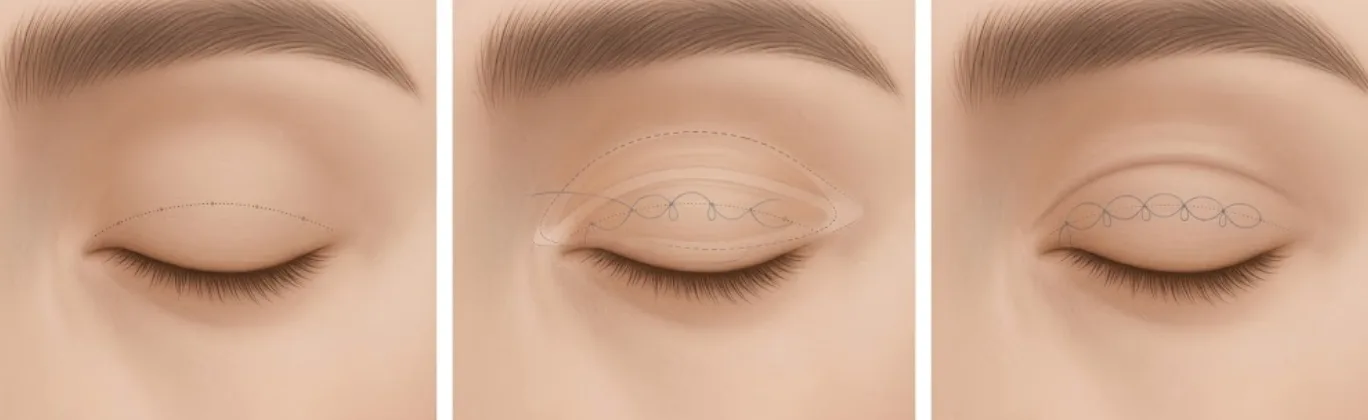
A non-incision double eyelid is an eyelid procedure that creates the upper-lid crease using buried sutures passed between the skin and the underlying levator mechanism, without cutting the skin. Because the fold is held by suture fixation rather than by a healed incision, the result causes less swelling and leaves no external scar line, and it can be adjusted more readily than an incisional crease.
Many Asian upper lids have a single eyelid (no crease) or a low, uneven one because the fibres that connect the lid-opening muscle to the overlying skin are weak or set low. A double-eyelid procedure recreates that connection so a defined crease forms each time the eye opens. The non-incision method does this with buried sutures, without opening the lid.
Through tiny puncture points, fine sutures are passed to link the deeper lid tissue to the skin at the chosen crease height, then knotted and buried out of sight. Because no skin or muscle is removed, swelling is lighter, the early result appears sooner, and the crease can be released or re-set more easily than a cut crease. That is why it suits thinner lids without much excess skin or fat.
At Garnet this is a single-surgeon procedure. Dr. Baek plans the crease design at the consultation, performs it himself, and reviews healing at set intervals; the clinic keeps an unhurried, one-patient-at-a-time schedule. The stated aim is a crease that suits your eye and opening. The deepest possible fold is not the goal.
One surgeon, one plan
From crease design and suture placement to the buried knots, every step is by Dr. Baek.
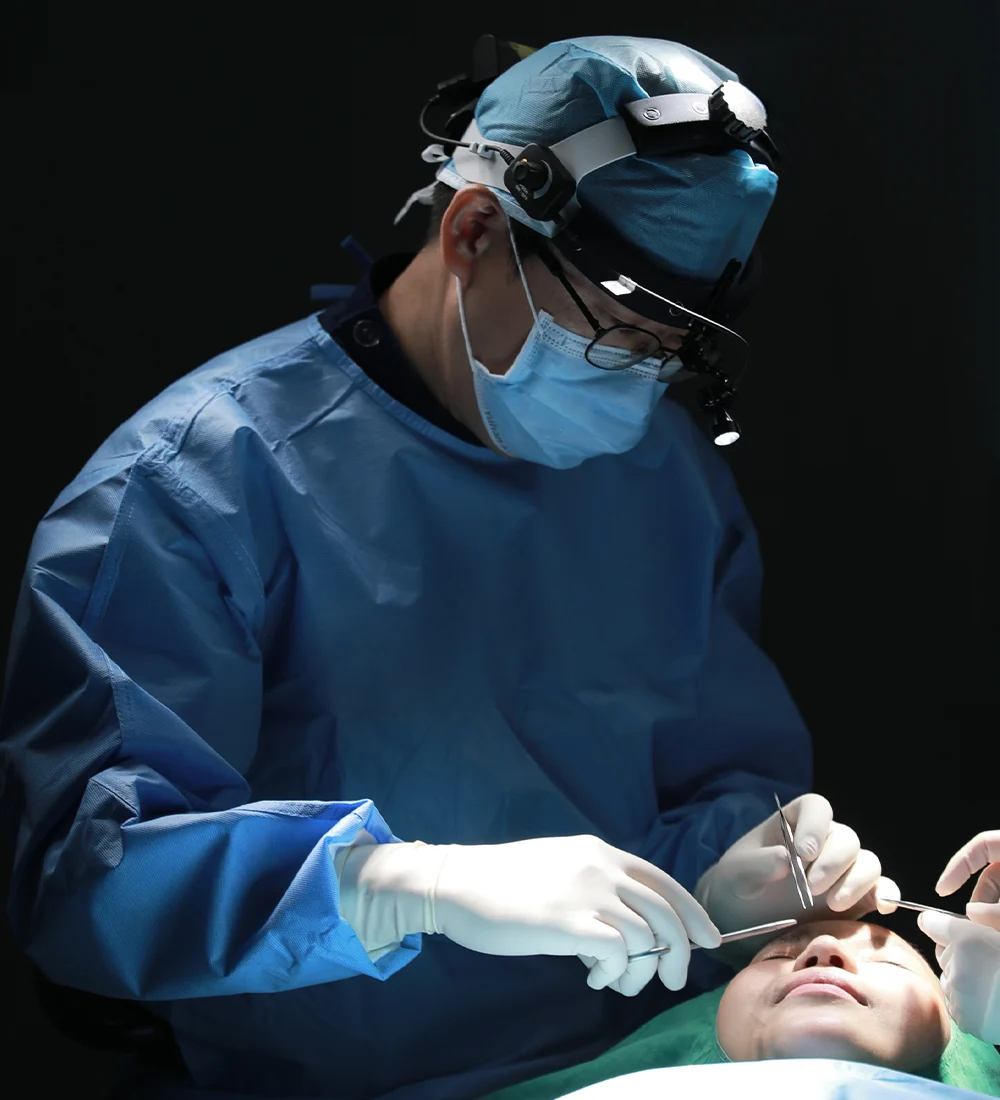
A single surgeon, start to finish. Dr. Baek designs your crease, ties the buried sutures himself and sees you at each review. With no more than two surgeries booked per day, a short buried-suture case is never squeezed in.
A non-incision double eyelid typically takes about 20–40 minutes and is usually done under local anaesthesia, with light sedation added if appropriate for comfort; the approach is confirmed with you at the consultation after your history is reviewed. Here is how a buried-suture crease is placed, step by step.

Checking lid thickness before a buried suture
Dr. Baek assesses the lid in person (skin thickness, any excess skin or fat, lid opening and symmetry) and agrees the crease height and shape with you. He also confirms whether a buried-suture approach suits your lid or an incisional method would hold better.
Testing crease height and curve upright
The crease line is marked to your eye shape and tested with you sitting up, so the height and curve match both eyes and your natural opening before anything is done.
Suture placement
Through small puncture points, fine sutures are passed to link the skin to the deeper levator mechanism at the marked crease height, without cutting the skin open.
Forming & checking the fold
The sutures are tensioned to form the crease, and the fold is checked open and closed for height, symmetry and a natural line before the knots are set.
Buried knots & adjuncts
The knots are tied and buried out of sight. Where the consultation shows it, the crease is planned alongside inner-corner or other eye work to balance the result. It is never added unnecessarily.
Review
A brief check that both creases match, then aftercare guidance. Because Garnet is single-surgeon, Dr. Baek reviews you himself before you leave and at each follow-up.
Why a crease forms, and how it's held
The upper-lid crease appears where fibres from the levator aponeurosis (the sheet that lifts the lid) reach forward to attach to the skin; when the eye opens, the skin above those attachments folds over them. In lids without a natural crease these forward attachments are absent or low, so no consistent fold forms. Recreating a reliable, well-positioned attachment is the goal of any double-eyelid technique (Arch Plast Surg 2013; DOI 10.5999/aps.2013.40.4.409).
A buried-suture technique re-establishes that skin-to-levator link with sutures instead of a scar. Because the connection is held by knots and not by an incision's adhesion, it disturbs the tissue less and is more easily revised. It also depends on those sutures holding, which is why suitability is judged by lid thickness and skin excess. Where there is heavier skin or fat, an incision double eyelid or upper blepharoplasty may hold the crease more dependably; Dr. Baek advises which approach fits your lid.
Non-incision vs incision double eyelid
| Non-incision | Partial-incision | Incision | |
|---|---|---|---|
| Skin opened | No (buried suture) | Short opening | Full lid opening |
| External scar | None visible | Short, fades | Fine crease-line scar |
| Swelling / downtime | Lightest | Moderate | Most |
| Removes skin / fat | No | Limited | Yes, where needed |
| Best lid type | Thin, little excess | Mild excess | Thicker skin / fat / excess |
Mini- and partial-incision methods were developed to bridge the two approaches, combining a less visible scar with a more durable crease (Aesthetic Surg J 2010; DOI 10.1177/1090820X10374094). The right choice depends on your lid. Dr. Baek advises at consultation, and the incision double eyelid page covers the cut approach in detail.
How your safety is handled
Anaesthesia
A non-incision double eyelid is usually performed under local anaesthesia; light sedation can be added for comfort once your medical history has been reviewed. You can typically cooperate during the procedure so the crease can be checked while you open and close the eye.
The crease planner places the sutures too
Because Garnet keeps an unhurried, one-patient-at-a-time schedule, the same surgeon who planned the crease performs it and reviews recovery. There is no separate operating doctor and no rotation of care.
Eyelid check, dates and after-care for visitors
As a registered foreign-patient clinic, Garnet arranges the eyelid check, dates and after-care for overseas visitors in English.
When a buried suture may not hold
If a buried-suture crease is not the most reliable option for your lid, or another approach suits better, that is said at the consultation. Photos can be reviewed before you travel.
Marks & healing
Because no skin is cut, a non-incision double eyelid leaves no continuous scar line. The fine puncture points used to pass the sutures usually fade to near-invisibility, which is one of the reasons the buried-suture approach is chosen for thinner lids.
What you will notice early is swelling and sometimes light bruising around the crease, which settle over the first days to weeks; the crease itself looks slightly higher and tighter at first and softens as it settles. Healing varies by individual; Dr. Baek reviews the result at the 1-, 3- and 6-month visits.
Non-incision (buried suture) double eyelid price
Non-incision (buried suture) double eyelid
₩2,000,000 + VATExcluding VAT (10% VAT is added at payment)Book nowSame price as Korean patients. Prices shown exclude 10% VAT; your written quote, issued after the in-person consultation, shows the full amount payable.
Week by week
Do
Keep the head elevated early, use cold compresses as advised, take medication as prescribed, keep the area clean and dry, and keep your follow-up visits.
Avoid
Rubbing or pressing the eyes, eye make-up until cleared, strenuous exercise and bending early on, alcohol and smoking, and very hot showers or saunas while healing.
How long does a buried-suture crease last?
A buried-suture crease can last for many years, but because it is held by suture fixation alone, a minority of patients see the fold loosen or fade over time. In long-term series of buried, continuous-suture techniques most creases held well, with a small proportion needing a touch-up or re-tie to restore symmetry (Arch Plast Surg 2013; DOI 10.5999/aps.2013.40.4.409).
How long a crease holds depends on lid thickness, skin excess and how the lid ages. Heavier lids put more load on the sutures, which is why thinner lids tend to keep a non-incision crease best. If a crease loosens, it can usually be re-set, or an incision double eyelid can give a more durable fold; Dr. Baek discusses the trade-offs at consultation.
Often planned with a non-incision crease
Opening the corners to suit the crease
A double-eyelid crease is often planned with an inner-corner (epicanthoplasty) or outer-corner opening where the consultation shows it balances the eye shape. It is not added by default.
Weak lid opening behind a faint crease
Where the lid opening itself is weak, upper-lid work or ptosis correction may be advised so the crease and the opening match, assessed individually.
Lower-lid bags and the tear trough
Under-eye fat repositioning addresses lower-lid bags and the tear-trough and is sometimes considered alongside upper-lid work for a more rested overall look.
Lower-lid skin and bags together
For lower-lid skin and bags together, lower blepharoplasty targets the lower lid; it is a separate decision from the upper-lid crease.

A plain word on buried-suture risk
Every procedure carries some risk. These are explained individually at consultation.
Crease loosening
Loosening or fading of the crease.
Asymmetry
Asymmetry between the two sides.
Suture-related problems
Less commonly, small skin nodules, a buried knot working loose, or, rarely, suture exposure that needs the stitch removed or revised (Facial Plast Surg 2020; DOI 10.1055/s-0040-1717147).
Light, short-lived swelling and bruising
Temporary swelling and light bruising.
Mild crease over- or under-correction
Mild over- or under-correction of the crease height.
Infection
Uncommon.
Revision
Because no tissue is removed, the result is generally easier to revise than an incisional crease.
What reduces risk in practice: careful crease design judged to your lid, sound suture technique, careful selection of who suits a buried-suture approach, and follow-up by the operating surgeon. With one surgeon designing and reviewing every crease, that planning and after-care stay with the same person.
Planning a non-incision double eyelid from abroad
Most international patients plan a short stay for a non-incision double eyelid, commonly about 5–7 days, so sutures can be removed by the surgeon at around day 5 and the early swelling has begun to settle before travel. The coordinator confirms the timing for your specific plan.
Before you travel, send clear photos (eyes open, closed and looking up) and a note on the crease you have in mind and your dates through WhatsApp, LINE or the form below. You'll get a pre-assessment, including whether a buried-suture method suits your lid, with no hard sell.
Garnet is registered with Korea's foreign-patient programme, and your buried-suture consultation, scheduling and after-care are arranged in English. Once you are home, send crease photos by messenger and Dr. Baek reviews how they are settling.
Sources
- Moon KC, et al. Modified Double-Eyelid Blepharoplasty Using the Single-Knot Continuous Buried Non-Incisional Technique. Arch Plast Surg. 2013. DOI 10.5999/aps.2013.40.4.409. link
- Ma FYG, Cheng MS. Mini-Incision Double Eyelidplasty. Aesthetic Surg J. 2010. DOI 10.1177/1090820X10374094. link
- Kim DW, et al. Complications of Asian Double Eyelid Surgery. Facial Plast Surg. 2020. DOI 10.1055/s-0040-1717147. link
Citations are provided for general education. This page is informational and does not replace an in-person consultation; suitability, technique and recovery are individual.
Questions about non-incision double eyelid
| Non-incision | Partial-incision | Incision | |
|---|---|---|---|
| Skin opened | No (buried suture) | Short opening | Full lid opening |
| External scar | None visible | Short, fades | Fine crease-line scar |
| Swelling / downtime | Lightest | Moderate | Most |
| Removes skin / fat | No | Limited | Yes, where needed |
| Best lid type | Thin, little excess | Mild excess | Thicker skin / fat / excess |
Reviews on Google Maps
I’m so happy I chose this clinic for my lower blepharoplasty. I was traveling from abroad by myself, so I was a little nervous, but from the beginning I felt comfortable and truly cared for. Everyone was kind, patient, and professional…
Came in for an in-person consult and ended up choosing Garnet and Dr.Baek for my non-incisional DES and tiplasty/alarplasty. I communicated with Kelly (English consultant) from the start till now (3 weeks post-op). She really help me feel…
My under-eyes have been sagging and folding for years... I tried to cover it up with makeup, but it actually got stuck in the wrinkles and made it stand out even more. While going for consultations, I noticed that the bigger the hospital…
Ask Dr. Baek’s team
Send photos and your question before you travel. An English-speaking coordinator reviews every enquiry and replies with guidance on whether surgery is appropriate, the likely plan and timing.
- ✓ Reviewed by the clinic coordinator, not a bot
- ✓ Photo-based pre-assessment before you fly
- ✓ Foreign-patient scheduling & after-care
- ✓ One surgeon for consultation, surgery and follow-up
Prefer to chat now? Reach the coordinator directly:
Request a consultation
Find the clinic
51 Apgujeong-ro 30-gil, Gangnam-gu, Seoul — near Apgujeong Station