How long you stay in Korea after eyelid, nose or facelift surgery depends on the procedure, how your healing is going, and when your surgeon is comfortable clearing you to fly. This guide helps you plan a realistic stay, so you are not booking the cheapest flight and hoping it works out.
The short answer
Plan your stay around stitch removal and a final review, not a fixed number of days. Eye stitches often come out around a week, facelift stitches a little later.
A short consult-to-surgery window plus a few recovery days, then a final check, is the usual shape of a trip, and your surgeon confirms the exact timing for you.
Booking a flexible return flight is wise; swelling and healing vary between people, and rushing home early is a common regret.
At a single-surgeon clinic the same surgeon who operated also reviews you before you fly, so the decision to travel is made by the person who knows your case.
The number of days you should spend in Korea is decided by your procedure and your own healing. No single rule fits everyone. A smaller eyelid procedure asks less of your trip than facial lifting, and two people having the same operation can heal at slightly different speeds.
The two milestones that usually shape a trip are stitch removal and a final review with your surgeon. Once those are done and your surgeon is comfortable, you are generally clear to travel home. Many international patients instead plan around a flight booked before they knew their surgery date, and that is the most common planning mistake.
Because the timing is medical, treat any number you read online as a starting estimate only. Your surgeon confirms the actual length once they have assessed you. You can get a useful first estimate during an online consultation before you book flights.
Stitches
Stitch removal and the final review
For many facial procedures, external stitches are removed somewhere in the region of a week, and for facial lifting a little later than that. Your surgeon sets the exact day from how the area is healing. Some procedures use buried or dissolving sutures and have no removal step at all.
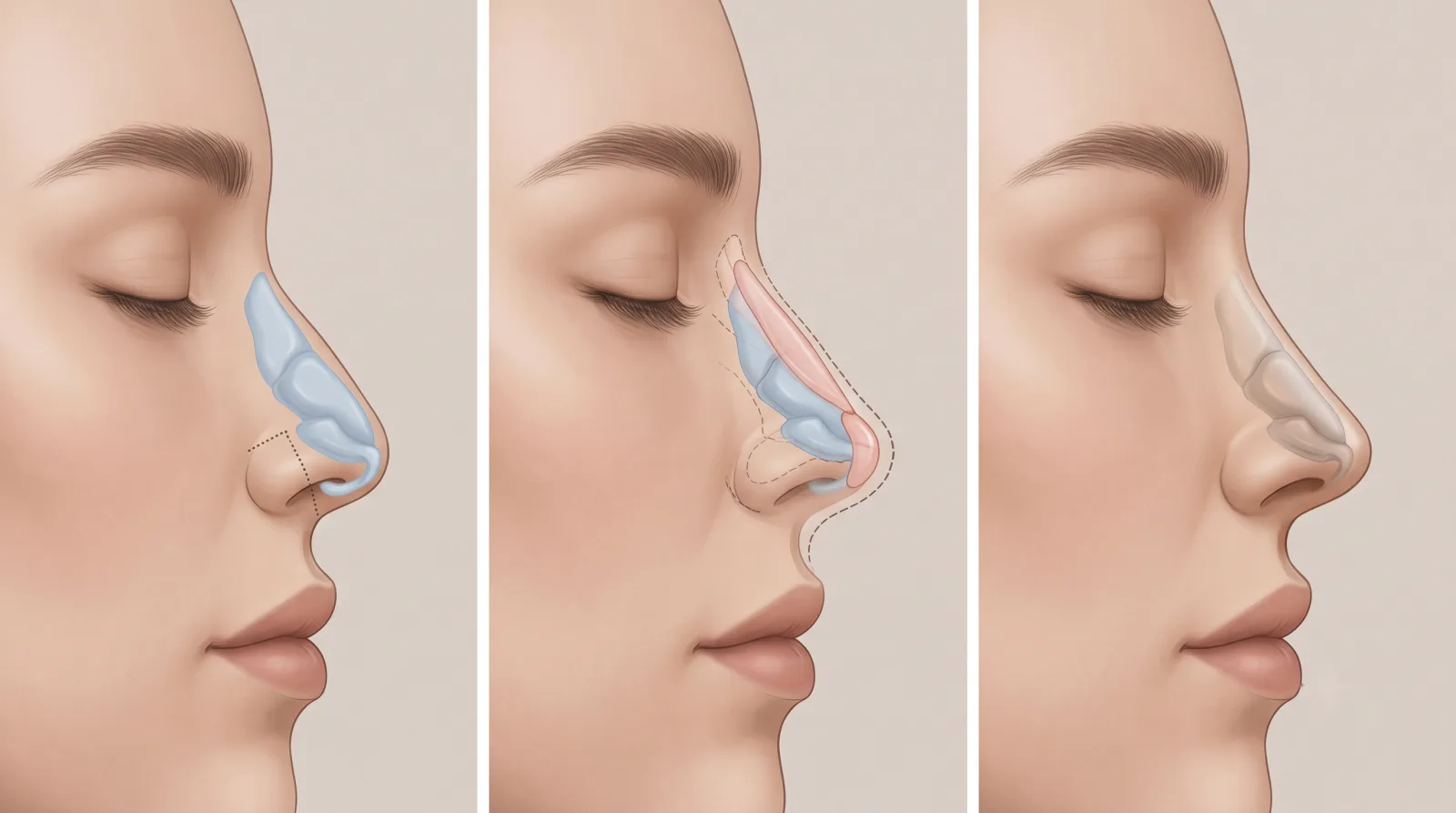
Illustration: the nasal framework (blue) is reshaped to raise the bridge and refine the tip. The dashed outline shows the original contour.
The more important milestone for planning is the final check. This is where your surgeon looks at the wound, confirms healing is on track, gives you after-care instructions for the journey, and clears you to fly. Leaving before that review means nobody has confirmed you are ready to travel, and careful planning exists to avoid exactly that.
If you want a sense of typical timing for a specific operation, the recovery sections on the procedure pages, for example rhinoplasty or a full facelift, describe the general pattern. Your own dates follow from the surgeon's examination of your case.
Trip shape
What a realistic trip tends to look like
Most trips follow a simple shape: an in-person consultation, then surgery, then a recovery window in Seoul, then a final review and clearance to fly. A face-to-face consult before surgery lets the surgeon examine you and finalise the plan, so it is worth arriving a day or two ahead. Landing and operating on the same day leaves no room for that.
How long the recovery window in the middle needs to be is the part that varies. Lighter procedures keep it short; lifting and more involved work stretch it out so swelling settles enough for the surgeon to assess you properly. The point is to keep the final review inside your trip, even if that means a few more days.
It also helps to think about where you will rest between visits. The practicalities of recovering in Seoul, from accommodation near the clinic to quiet days between check-ins, are worth planning before you arrive.
By procedure
Eyes, nose and facial lifting differ
Different procedures place different demands on your stay. Eyelid surgery is generally on the shorter end, with stitches often out around a week and a relatively contained recovery. Nose surgery involves dressings in the first days and stitch removal roughly a week later, with donor-site healing to consider when ear or rib cartilage is used.
Facial lifting asks for the most patience. Stitches come out a little later, swelling and bruising take longer to settle, and the final review is correspondingly later, so a facelift trip is naturally longer than an eyelid trip. None of this should be rushed; healing time is not something you can compress to suit a flight.
Because the differences are real, plan per procedure. If you are weighing more than one operation, ask how the timelines combine; the clinic caps the day at two surgeries, and the sequencing affects how long you should plan to stay.
Flexibility
Build flexibility into your dates
Healing does not run to a fixed schedule, so the single most useful planning habit is to keep your return flexible. A flexible or changeable return flight, and accommodation you can extend, mean that if swelling is slow to settle or your surgeon wants one more look, you are not forced to choose between your health and your booking.
Rushing home early is one of the more common regrets international patients describe. It is far easier to enjoy a couple of spare days in Seoul than to travel before you are ready, or to leave before the final review. Plan for the slightly longer case, and treat finishing early as a bonus.
When you book, it is reasonable to ask the clinic for a planning estimate so your flights and stay roughly match the expected timeline. That estimate is a guide; the surgeon confirms your actual clearance to fly at the final check.
At Garnet
How Garnet helps you plan your stay
Garnet is a single-surgeon clinic in Apgujeong, Seoul. Dr. In-Soo Baek is a board-certified plastic surgeon (Korean medical licence no. 77407) and the only operating doctor. He consults, performs the surgery and reviews every follow-up himself, including the final check before you fly. That means the person deciding you are ready to travel is the person who operated on you.
Garnet is registered with Korea's foreign-patient programme and coordinates consultation, scheduling and after-care for international visitors, with structured follow-up planned into the trip. A dedicated coordinator stays with you from consultation through recovery, which makes lining up surgery dates, recovery days and your final review more straightforward.
You can ask for a planning estimate for your specific procedure during a no-obligation online assessment, then book flexible travel around it. The final dates follow the surgeon's in-person assessment.
Dr. In-Soo Baek
Director & sole operating surgeon
Korean medical licence no. 77407
Operate on what you came for. Trained at Korea University Medical Center. Every case planned, performed and reviewed by the same hands.
1Operating surgeon
~2Surgeries per day
7Registered techniques
Board-certified plastic surgeon
Plastic surgery training at Korea University College of Medicine & graduate school
Korean Society of Plastic and Reconstructive Surgeons member, in its facial-contour, eye & rhinoplasty groups
Consults, operates and follows up each case himself
Peer-reviewed papers behind the facts on this page. Each describes findings in its own study group — not results at Garnet — and none predicts your own outcome.
Kraft CT et al. Deep Venous Thrombosis Prophylaxis. Clinics in Plastic Surgery. 2020. doi:10.1016/j.cps.2020.03.002
Pannucci CJ. Venous Thromboembolism in Aesthetic Surgery: Risk Optimization in the Preoperative, Intraoperative, and Postoperative Settings. Aesthetic Surgery Journal. 2018. doi:10.1093/asj/sjy138
Jeevan R et al. Travelling abroad for aesthetic surgery: Informing healthcare practitioners and providers while improving patient safety. Journal of Plastic, Reconstructive & Aesthetic Surgery. 2011. doi:10.1016/j.bjps.2010.04.022
FAQ
Common questions
How many days should I stay in Korea after surgery?
It depends on your procedure and your healing. Plan your stay around stitch removal and a final review with your surgeon; lighter procedures need a shorter window and facial lifting needs longer. Your surgeon confirms the exact length once they have assessed you, so a flexible return is wise.
When are stitches removed?
For many facial procedures external stitches are removed around a week after surgery, and a little later for facial lifting, with the exact day set by your surgeon based on healing. Some procedures use buried or dissolving sutures and have no removal step. The procedure pages describe the general pattern, and your own dates depend on how your wound heals.
Can the surgeon review me before I fly home?
Yes, and it is the milestone to plan your trip around. At a single-surgeon clinic the surgeon who operated also performs your final review, checks the wound, gives travel after-care instructions and confirms you are ready to fly. Keeping that review inside your trip is more important than booking the shortest possible stay.
How long after eye surgery can I travel?
Eyelid surgery is generally on the shorter end, with stitches often removed around a week, but the timing of your clearance to fly is confirmed by your surgeon at the final review. Plan a recovery window that keeps that review inside your trip, and keep your return flight flexible.
How long should I plan for after a facelift?
Facial lifting asks for more patience than eyelid or nose work: stitches come out a little later, swelling settles more slowly, and the final review is correspondingly later, so a facelift trip is naturally longer. Plan for the longer case and treat finishing early as a bonus; your surgeon confirms your travel timing.
Should I have my consultation on the same day as surgery?
It is better to arrive a day or two ahead so the surgeon can examine you in person and finalise the plan before operating. An online consultation beforehand can settle most questions, but an in-person consult lets the surgeon confirm what is right for you. You can begin with an online assessment from home.
Can I have more than one procedure on the same trip?
Sometimes, depending on the procedures and your healing. The clinic caps the day at two surgeries, and combining operations affects how long you should plan to stay, so ask how the timelines fit together. Your surgeon advises whether combining is sensible for you and how it changes your recovery window.
What if I heal more slowly than expected and need to stay longer?
This is exactly why a flexible return flight and extendable accommodation are recommended. If swelling is slow to settle or your surgeon wants one more look before clearing you, you can stay a little longer without being forced to travel before you are ready. Plan for the slightly longer case from the start.
Where do international patients recover between visits?
Most stay near the clinic so check-ins are easy, resting on quiet days between appointments. Planning your accommodation and recovery routine in advance makes the trip smoother. See our guide to recovering in Seoul for the practical side of after-care and follow-up.
Does Garnet help international patients plan their stay?
Yes. Garnet is registered with Korea's foreign-patient programme, and a dedicated coordinator helps line up your surgery date, recovery days and final review. You can ask for a planning estimate for your procedure during an online assessment, then confirm the final dates once the surgeon has seen you in person.
My mom recently had a brow lift and lower blepharoplasty with Dr. Baek, and our experience has been wonderful so far. The Garnet team was incredibly kind and welcoming, with Kelly assisting us as our English consultant—she made everything…
I’m so happy I chose this clinic for my lower blepharoplasty. I was traveling from abroad by myself, so I was a little nervous, but from the beginning I felt comfortable and truly cared for. Everyone was kind, patient, and professional…
Came in for an in-person consult and ended up choosing Garnet and Dr.Baek for my non-incisional DES and tiplasty/alarplasty. I communicated with Kelly (English consultant) from the start till now (3 weeks post-op). She really help me feel…
My under-eyes have been sagging and folding for years... I tried to cover it up with makeup, but it actually got stuck in the wrinkles and made it stand out even more. While going for consultations, I noticed that the bigger the hospital…
Send photos and your question before you travel. An English-speaking coordinator reviews every enquiry and replies with guidance on whether surgery is appropriate, the likely plan and timing.
✓ Reviewed by the clinic coordinator, not a bot
✓ Photo-based pre-assessment before you fly
✓ Foreign-patient scheduling & after-care
✓ One surgeon for consultation, surgery and follow-up
Prefer to chat now? Reach the coordinator directly:









 T S7 months ago



