A facelift trip to Korea usually means about 10 to 14 days in Seoul, and it works best when the whole journey is planned around a few fixed points beyond the surgery itself: an online pre-assessment before you book, a stay long enough for in-person suture removal, and a clear answer to who looks after you once you fly home. This page walks through that journey for the facelift family at Garnet. It does not re-explain each operation; it links to the procedure pages where you need the detail.
The short answer
You can start entirely from abroad with an online pre-assessment and photos, so the plan is clear before you commit to flights.
Plan the stay around in-person suture removal, roughly day 10 to 14 depending on which facelift you have. How quickly you feel able to travel is a poor guide.
Garnet is registered with Korea's foreign-patient programme (registration M-2023-01-08-6867), with a coordinator who stays with you from consultation to recovery.
After you travel home the same board-certified surgeon continues your follow-up remotely, with structured reviews at 1, 3 and 6 months.
Starting with an online pre-assessment from abroad
The journey begins long before you fly. For any of the facelift procedures you can have an online consultation from home: you share clear photos of your face from several angles, along with your history and what is bothering you, and you receive a pre-assessment of whether a lift suits you, what a realistic result would be, and which procedure in the facelift family fits your degree of laxity. That last point matters, because the right operation is not always the one you arrived asking for. A younger face with limited jowling may be suited to a mini facelift, while more advanced sagging usually calls for a fuller deep-plane facelift.
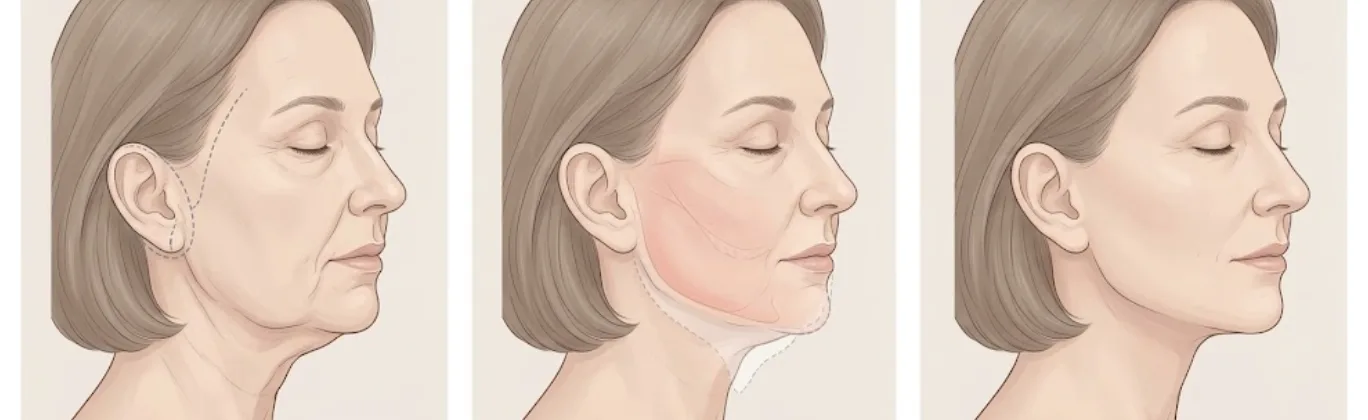
Illustration: through a shorter incision in front of the ear (dotted line), the lower face and jawline (shaded) are lifted.
The online pre-assessment is also where the practicalities get settled: the likely length of stay, the anaesthesia approach, what recovery will feel like, and the questions that protect you as an international patient: who will actually perform the surgery, and who manages your follow-up afterwards. Getting clear answers in writing before you book flights is the single most useful thing you can do, and the broader guide on whether plastic surgery in Korea is safe explains why confirming who operates and who handles after-care is the most important safety step.
At a single-surgeon clinic the surgeon who reviews your photos is the surgeon who will operate and follow you up, so the online assessment is the start of care with the doctor accountable for your result. A coordinator does not screen you for sales. There is no consultation or imaging fee and no pressure to book, which matters when you are weighing travel from abroad.
Stay length
How long to stay in Korea
Plan the trip around in-person suture removal. How quickly you feel mobile matters less. For a facelift the stay is typically in the region of 10 to 14 days in Seoul, with the exact window depending on which procedure you have: a mini facelift generally has sutures removed at about day ten, while a fuller deep-plane lift has sutures removed across roughly day ten to fourteen. You want to be in Korea for that appointment, ideally with a short buffer afterwards before a long-haul flight.
A realistic shape for the trip is: arrival and a final in-person consultation, surgery within the first day or two, the early recovery days of swelling and tightness in your accommodation, in-person suture removal towards the end of the stay, and a check before you fly home. The first week in particular is for rest, head elevation and letting swelling subside. That week is for recovery, with sightseeing left for later. The 10-to-14-day range is a sensible default and can flex, and the surgeon fits your exact plan to the facelift you have.
If your case combines a lift with other work, or involves correcting an earlier surgery, the schedule can shift and the surgeon will tell you at the assessment so your travel dates are set accordingly. The principle holds whichever facelift you have: build the stay around healing and in-person suture removal. The day you first feel reasonably well is too early a marker.
Sutures before flying
Why sutures must come out before you fly
The fixed point in the plan is in-person suture removal. You should not fly home before the sutures are out and the surgeon is satisfied with your early healing. Facelift incisions run along the temporal hairline and around the ear (pre-auricular to the jawline for a full lift, and a shorter pre- and post-auricular incision for a mini lift). Having them reviewed and the sutures removed by the surgeon who placed them is far safer than trying to arrange removal in another country.
Illustration: the deeper facial layer (SMAS, shown in yellow) is released and repositioned as one unit with the skin, rather than pulling the skin alone.
This is also why the stay is built around healing. Even if you feel reasonably well at day 5 or 6, the timeline is driven by suture removal and the surgeon's review. Flying too early means a long flight during the peak swelling and tightness phase, which is uncomfortable and best avoided. For a sense of what those early days feel like, the procedure pages for the deep-plane facelift and mini facelift set out the recovery timeline in more detail.
If a neck lift or additional procedure is part of your plan, the suture schedule may differ slightly and your stay is planned around it. The constant across the whole facelift family is the same: in-person review and suture removal in Korea before you board a flight home.
Logistics
Interpreter, travel and logistics
Once the online assessment is done and you are a suitable candidate, the trip itself is straightforward to arrange. Garnet is registered with Korea's foreign-patient programme (registration M-2023-01-08-6867), which sets expectations for coordination and record-keeping for international visitors, and a dedicated coordinator stays with you from the first consultation through to recovery, helping bridge any language gap and keeping your appointments aligned with your travel dates so nothing is left to guess on arrival.
The clinic is in Apgujeong, central Seoul, a short walk from Apgujeong Station (Line 3, Exit 3), which makes choosing nearby accommodation simple so you are not travelling far in the early recovery days. Plan to arrive a day or two before surgery for a final in-person consultation and any pre-operative checks, then base yourself somewhere quiet and close for the recovery window. The clinic runs a deliberately light daily schedule of two surgeries a day and roughly one patient per hour, so your appointments are unhurried.
Think about the small practicalities too: comfortable, easy-to-remove clothing for the swollen early days, a way to keep your head elevated where you are staying, and a realistic, low-key itinerary. This is a recovery trip with the surgery at its centre, and planning it that way makes the whole stay far less stressful.
After you return
Who manages complications once you return home
Going home does not end your care, and the question every cautious international patient should ask is who looks after you if something does not feel right after you have flown. After your in-person suture removal and final check, the same surgeon continues your follow-up remotely. You can send photos and updates by messenger and receive guidance on what is normal, what to watch for, and when something warrants seeing a local doctor where you live. Knowing the operating surgeon is still reviewing your recovery from a distance is one of the most reassuring parts of the plan.
Facelift reviews at 1, 3 and 6 months continue after you travel home. They let the surgeon track how your swelling, tightness and sensation settle over the months it takes a facelift to fully mature, so you are not left to interpret every new sensation alone. If a concern arises between those points, you have a clear route back to the surgeon who knows your case and performed your operation.
Because Garnet is a single-surgeon clinic, the doctor managing any concern is the same board-certified surgeon who assessed you online, operated and removed your sutures. No other member of staff reads your file for the first time. That continuity is exactly why confirming who manages complications, in writing, before you travel is worth doing for any clinic you consider.
At Garnet
How Garnet supports international patients
For facelift patients travelling from abroad, Garnet in Apgujeong holds registration under Korea's foreign-patient programme. The board-certified plastic surgeon Dr. In-Soo Baek (Korean medical licence no. 77407) is the only operating doctor. He consults, performs the lift himself and reviews every follow-up, and the clinic caps the day at two surgeries so each case has unhurried time. For an international patient, that means the surgeon you met online is the one in the room and the one who sees you through recovery.
A dedicated coordinator stays with you from the first online consultation through scheduling, your in-person visit and after-care, helping with language and logistics so the trip is predictable. There is no consultation or imaging fee and no pressure to book on the day, and the clinic addresses only the area you came for without recommending additional surgery. That is useful reassurance when you are planning travel around one specific concern.
If you are still deciding between procedures, the longtail on the deep mini facelift for international patients covers that specific lift's stay and follow-up in depth, while the procedure pages set out technique and candidacy. Whichever path fits, you can begin with a no-obligation online pre-assessment before you plan any travel.
Dr. In-Soo Baek
Director & sole operating surgeon
Korean medical licence no. 77407
Operate on what you came for. Trained at Korea University Medical Center. Every case planned, performed and reviewed by the same hands.
1Operating surgeon
~2Surgeries per day
7Registered techniques
Board-certified plastic surgeon
Plastic surgery training at Korea University College of Medicine & graduate school
Korean Society of Plastic and Reconstructive Surgeons member, in its facial-contour, eye & rhinoplasty groups
Consults, operates and follows up each case himself
Peer-reviewed papers behind the facts on this page. Each describes findings in its own study group — not results at Garnet — and none predicts your own outcome.
Sykes J et al. Contemporary Deep Plane Rhytidectomy. Facial Plastic Surgery. 2011. doi:10.1055/s-0030-1270426
Chaudhry O et al. Lateral SMASectomy. Clinics in Plastic Surgery. 2019. doi:10.1016/j.cps.2019.06.003
Swift A et al. The Facial Aging Process From the “Inside Out”. Aesthetic Surgery Journal. 2020. doi:10.1093/asj/sjaa339
Baker SR. Deep Plane Rhytidectomy and Variations. Facial Plastic Surgery Clinics of North America. 2009. doi:10.1016/j.fsc.2009.06.003
FAQ
Common questions
What should international patients know about getting a facelift in Korea?
Start with an online pre-assessment from abroad to confirm suitability and which facelift fits you, then plan a stay of roughly ten to fourteen days built around in-person suture removal. Confirm in writing who will operate and who manages your after-care before booking flights, and check the clinic is registered with Korea's foreign-patient programme. After you fly home, follow-up should continue remotely with the same surgeon.
How long should I stay in Korea after a facelift?
Plan for around ten to fourteen days in Seoul. The anchor is in-person suture removal, which falls at about day ten for a mini facelift and across roughly day ten to fourteen for a fuller deep-plane lift, plus a short buffer before a long flight. The first week is for rest and recovery, and the surgeon sets your exact window by the procedure you have.
Can I start a facelift consultation from abroad?
Yes. You can have an online pre-assessment entirely from home, sending clear photos from several angles and your history, and receive an opinion on suitability, realistic results and which procedure fits before booking any travel. At a single-surgeon clinic the surgeon who reviews you online is the same one who will operate, so it is the start of care.
Why can't I fly home immediately after a facelift?
Because sutures should be removed in person by the surgeon who placed them, after they are satisfied with your early healing, and that falls roughly between day ten and fourteen depending on the procedure. Flying earlier also means a long-haul flight during peak swelling and tightness. The stay is built around in-person suture removal, whatever day you first feel able to travel.
How does aftercare work once I travel home after a facelift?
After your in-person suture removal and final check, the same surgeon continues your care remotely. You can send photos and updates by messenger and receive guidance on what is normal, what to watch for, and when to seek local care. Reviews at 1, 3 and 6 months continue after you return home so your recovery is tracked as the lift settles.
Who manages complications after I return home from a facelift?
Ask this before booking. At a single-surgeon clinic the operating surgeon manages any concern and can continue to review you by messenger after you travel home, with clear guidance on what warrants seeing a local doctor and when. Because the same board-certified surgeon assessed, operated and followed you up, there is no handover to someone reading your file for the first time.
Is there an interpreter or coordinator for international patients?
Yes. Garnet is registered with Korea's foreign-patient programme, and a dedicated coordinator stays with you from the first online consultation through scheduling, your in-person visit and after-care, helping bridge any language gap and keeping your appointments aligned with your travel dates throughout the process.
Where is the clinic and is it convenient for travellers?
Garnet is in Apgujeong, central Seoul, a short walk from Apgujeong Station on Subway Line 3 (Exit 3). That makes choosing nearby accommodation easy so you are not travelling far during early recovery, and a coordinator helps align your appointments with your travel dates from the first consultation through to after-care.
Which facelift is right for an international patient?
It depends on your degree of facial laxity; your travel plans do not decide it. A mini facelift suits more limited jowling and a fuller deep-plane facelift suits more advanced sagging. The online pre-assessment is where the surgeon advises which fits you, and the procedure pages cover the technique and candidacy for each so you can plan the right trip.
Does Garnet treat international patients for a facelift?
Yes. Garnet is registered with Korea's foreign-patient programme, which sets expectations for coordination and record-keeping for international visitors, and a dedicated coordinator stays with you from consult to recovery to help with language and logistics. The same board-certified surgeon consults, operates and reviews every follow-up throughout.
My mom recently had a brow lift and lower blepharoplasty with Dr. Baek, and our experience has been wonderful so far. The Garnet team was incredibly kind and welcoming, with Kelly assisting us as our English consultant—she made everything…
I’m so happy I chose this clinic for my lower blepharoplasty. I was traveling from abroad by myself, so I was a little nervous, but from the beginning I felt comfortable and truly cared for. Everyone was kind, patient, and professional…
Came in for an in-person consult and ended up choosing Garnet and Dr.Baek for my non-incisional DES and tiplasty/alarplasty. I communicated with Kelly (English consultant) from the start till now (3 weeks post-op). She really help me feel…
My under-eyes have been sagging and folding for years... I tried to cover it up with makeup, but it actually got stuck in the wrinkles and made it stand out even more. While going for consultations, I noticed that the bigger the hospital…
Planning a facelift trip to Korea from abroad? Send photos for a no-obligation online pre-assessment and we will map out which procedure fits, your stay, suture timing and follow-up before you book anything.
Send photos and your question before you travel. An English-speaking coordinator reviews every enquiry and replies with guidance on whether surgery is appropriate, the likely plan and timing.
✓ Reviewed by the clinic coordinator, not a bot
✓ Photo-based pre-assessment before you fly
✓ Foreign-patient scheduling & after-care
✓ One surgeon for consultation, surgery and follow-up
Prefer to chat now? Reach the coordinator directly:









 T S7 months ago



