Garnet · Apgujeong, Seoul · English coordinator · WhatsApp · LINE · Email
Garnet clinic, Apgujeong
Garnet/Eye Surgery/Round eye correction

Eye Surgery · Apgujeong, Seoul

Round eye correction in Korea — the lid line restored

Dr. In-Soo Baek
Dr. In-Soo BaekConsults, operates and follows up himself
10,000+eye procedures since 2011
1-2 hrstypical procedure time
~1-2 wksmost social downtime
1surgeon, every step
Anaesthesia
Local / sedation
Surgery time
~1-2 hours
Sutures out
Typically ~5-7 days
Social downtime
~1-2 weeks
Follow-up
1 / 3 / 6 months
10,000+ eye procedures since 2011· Board-certified plastic surgeon — accredited member, Korean Society of Plastic & Reconstructive Surgeons· Foreign-patient programme registered· Single-surgeon practice

Round eye correction at a glance

Round eye correction reshapes an over-rounded or retracted lower lid - often after previous surgery - to restore a natural almond lid line and reduce scleral show. At Garnet one board-certified plastic surgeon, Dr. In-Soo Baek, handles each round-eye case from the first lower-lid assessment to the last follow-up.

What it is
A reshaping procedure that lifts and supports an over-rounded or retracted lower lid - restoring the natural lid line, reducing white-of-the-eye (scleral) show below the iris, and calming an unnaturally round eye shape.
Best for
A lower lid that sits too low or rounds outward, often after lower blepharoplasty or aggressive corner surgery, where a more almond, supported shape is wanted.
Who performs it
Dr. In-Soo Baek only - a board-certified plastic surgeon and Garnet's sole operating doctor. The same surgeon consults, operates and follows up.
Downtime
Sutures are typically removed within the first week; most social downtime is over by ~1-2 weeks; the lid position and any scar settle over several months.
Longevity
Supporting the lower lid structurally is intended to be lasting; reported lower-lid retraction repairs improve and hold lid position in most cases (Kim et al., 2017).
How to start
Send photos of your lower lids through WhatsApp or the form below for a no-obligation pre-assessment before you travel.
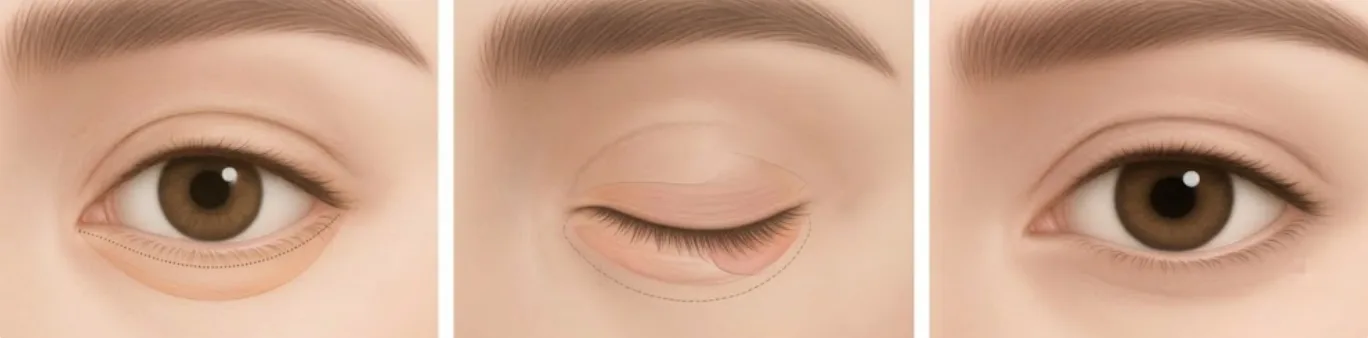
Illustrated steps of round eye correction at Garnet: rounded lower-lid line outlined, the lid line adjusted, and the calmer eye shape
Illustration: the rounded, open lower-lid line is outlined and gently brought back toward a calmer, more natural eye shape.

Is round eye correction right for you?

Low-sitting lower lids with scleral show

  • A lower lid that sits too low or rounds outward, with visible scleral show
  • A round-eye or retracted-lid appearance, often after previous lower-lid or corner surgery
  • Wanting a natural, supported almond lid line in place of an over-rounded eye
  • General good health and realistic, discussed expectations for a corrective case
  • Time for ~1-2 weeks of social downtime after lower-lid surgery, plus the follow-up visits

A lid position still within normal range

  • A lower-lid position that is within a normal range - reassurance may be all that is needed
  • Active eye-surface disease or significant dry eye - assessed and managed first
  • A wish for a guaranteed exact outcome, which corrective lid surgery cannot promise
  • Uncontrolled medical conditions - assessed individually at consultation
  • Looking for a non-surgical fix, which cannot reposition a truly retracted lid
Dr. In-Soo Baek

Dr. In-Soo Baek

Director & sole operating surgeon
Korean medical licence no. 77407

Operate on what you came for. Trained at Korea University Medical Center. Every case planned, performed and reviewed by the same hands.

1Operating surgeon
~2Surgeries per day
7Registered techniques
  • Board-certified plastic surgeon
  • Korea University College of Medicine & graduate school (plastic surgery)
  • Member, Korean Society of Plastic and Reconstructive Surgeons (facial-contour, eye & rhinoplasty groups)
  • Plans, performs and follows up each lower-lid correction himself
About the surgeon →

Before & After

Lid-correction results are identifiable, so full before/after sets are reviewed privately at consultation with consent and are not published here. Round eye and retraction cases vary widely; results, recovery and suitability are individual and are not guaranteed.

Request before & after examples privately

Restoring the lower-lid line

Round eye correction is an eye-surgery procedure that reshapes an over-rounded or retracted lower lid, restoring a natural almond lid line and reducing scleral show - the visible band of white below the iris that appears when the lower lid sits too low or rounds outward. It supports and repositions the lower lid and outer corner so the eye shape looks calmer and the lid sits where it should.

A natural lower lid sits just at or above the lower edge of the iris and curves gently. When the lid is pulled down or rounds outward - which can happen after lower blepharoplasty, an over-aggressive outer-corner procedure, or with weak lower-lid support - a band of white sclera shows below the iris and the eye looks rounder, tired or surprised. This is often called scleral show or a round-eye appearance.

Round eye correction addresses the cause beneath the surface: it releases any scar or contracted tissue pulling the lid down, supports the lid and outer corner, and where needed adds a small spacer to give the lid back its height. Lower-lid retraction has recognised causes and is correctable, with most repairs improving lid position and reducing scleral show (Kim et al., Korean J Ophthalmol 2017; DOI 10.3341/kjo.2016.0059).

At Garnet this is a single-surgeon operation. Dr. Baek works out what is pulling the lower lid down, corrects it himself and checks the healing at set intervals. Two surgeries a day at most means no lid reconstruction is rushed. The stated aim is to address the concern you arrived with, a natural, supported lid line, without over-correcting.

One surgeon for every lower-lid step

Dr. Baek carries out each step himself, from identifying the cause to releasing, supporting and reshaping the lower lid.

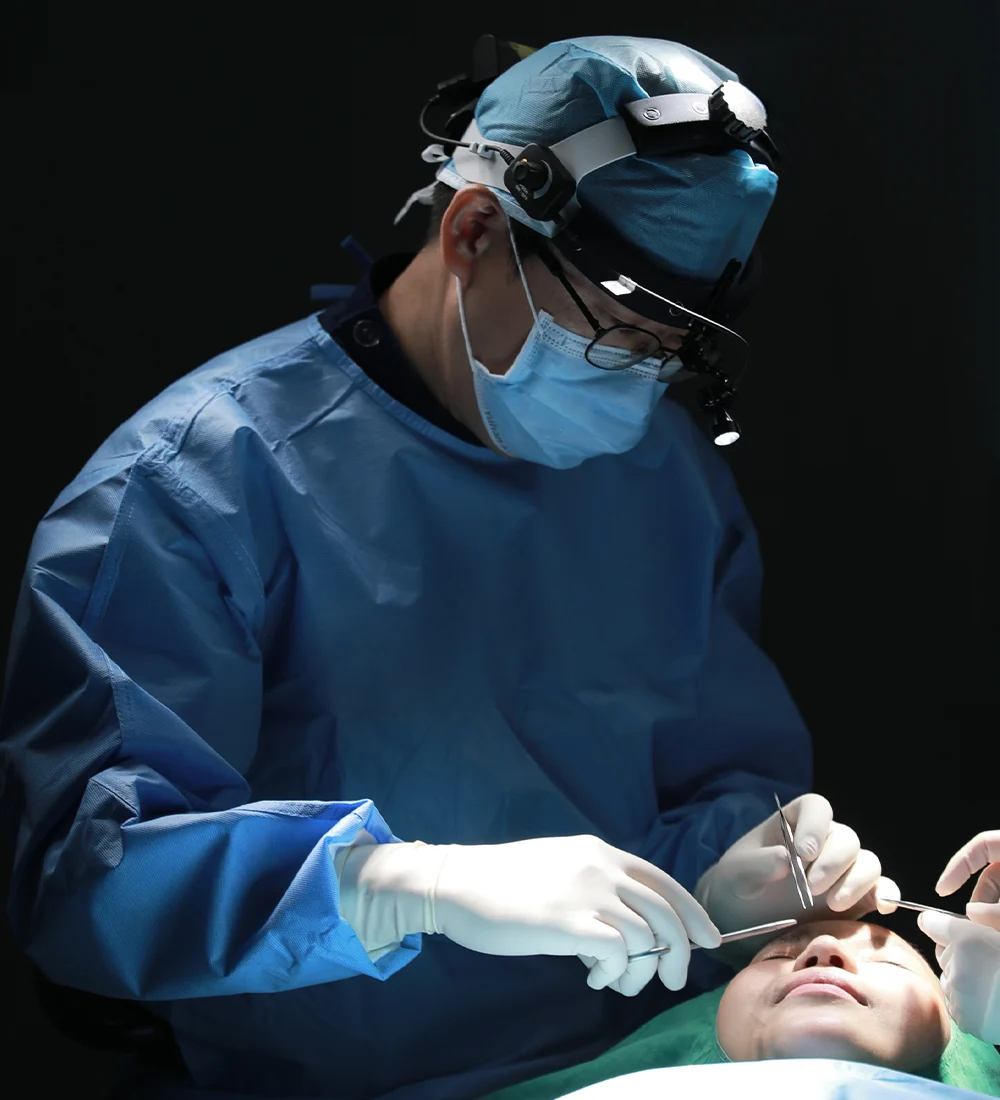
Dr. In-Soo Baek performing surgery at Garnet Plastic Surgery, Apgujeong

A single surgeon, start to finish. Dr. Baek plans your lower-lid correction, operates himself and sees you at every follow-up. Only two surgeries are booked per day, which leaves each corrective lid case unhurried.

Round eye correction is an individualised reconstruction, so the exact technique and operating time depend on what is pulling your lid down; it commonly takes around one to two hours and is usually performed under local anaesthesia with sedation, decided with you and the anaesthesia team after your history is reviewed. The steps below outline how the lid is reshaped at Garnet.


01

Scleral show, lid support and past surgery

Dr. Baek assesses the lid position, the degree of scleral show, lower-lid support and any previous surgery, and identifies what is pulling the lid down. The plan and the exact technique are agreed with you here.

02

Release of contracted tissue

Where scar or contracted retractors are holding the lid low, these are carefully released so the lid can be repositioned to its natural height. Addressing the cause is what allows the lid to stay up.

03

Outer-corner support

The outer corner and canthal support are tightened or repositioned as needed, so the lid is held in a natural almond line and does not drop again.

04

Spacer where needed

Where the lid lacks vertical height, a small spacer (using tissue chosen for your lid) can be added to give the lid back its support, reducing scleral show.

05

Corner or under-eye work built into the plan

Where the consultation shows it, a lateral canthoplasty or lower blepharoplasty is incorporated so the corner, the lid and the under-eye balance.

06

Supporting the lid in early healing

Fine closure and, where used, light support of the lid during early healing. Dr. Baek checks the lid position himself before you leave and again at each follow-up.

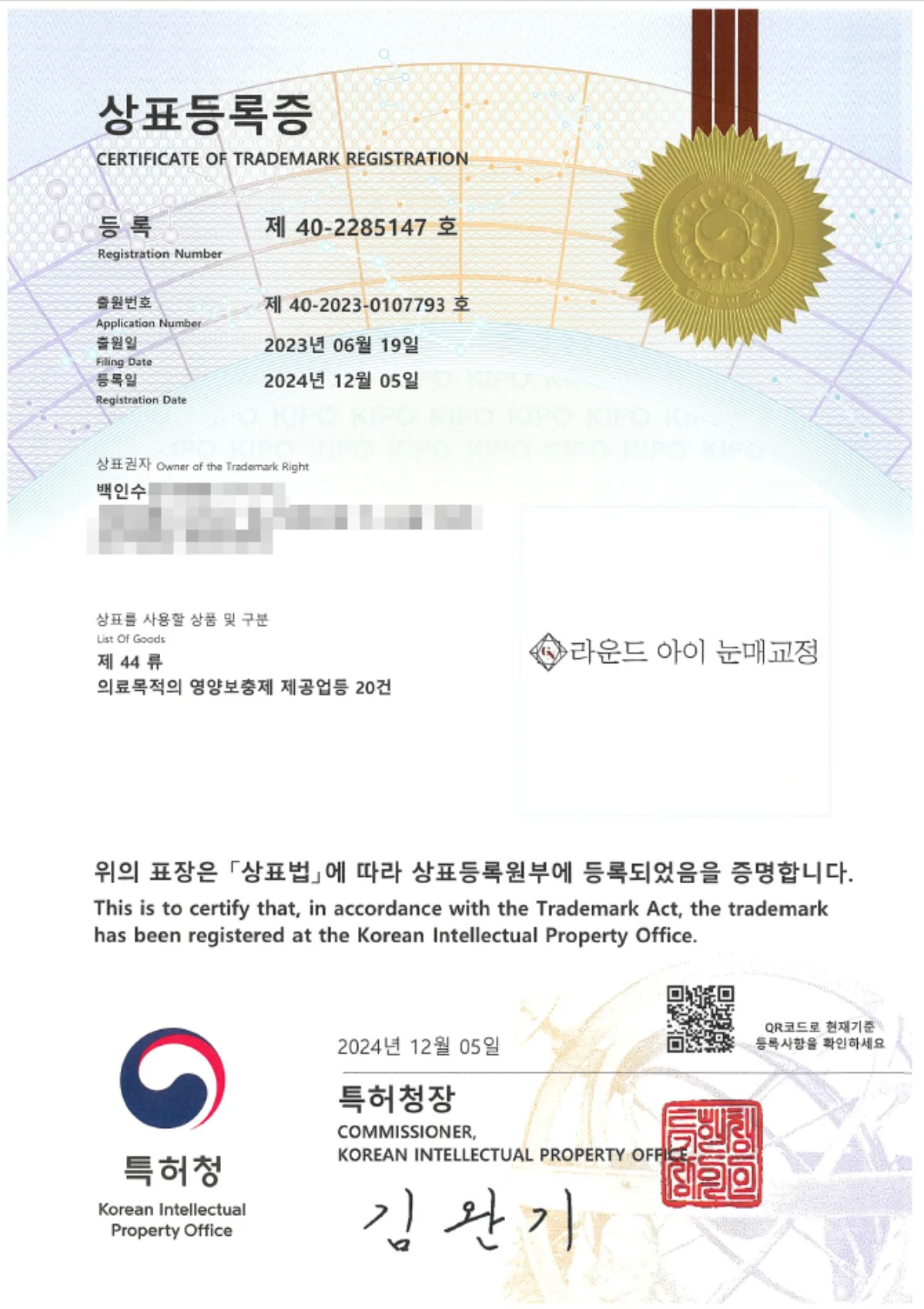
Round eye correction registered technique certificate

Garnet's lower-lid reshaping technique is registered as a trademarked round eye correction method. Trademark registration describes the named technique, not a superior outcome.

Why the lower lid drops or rounds

The lower lid is held in place by the lower-lid retractors, the tarsal plate, the lateral canthal tendon at the outer corner and the support of the orbicularis muscle and skin. When any of these is weakened, scarred or shortened - by previous surgery, tissue loss or contracted retractors - the lid loses height, drops, and rounds, exposing the sclera below the iris. Correction therefore looks at which layer is responsible, beyond the visible droop (Kim et al., Korean J Ophthalmol 2017; DOI 10.3341/kjo.2016.0059).

Garnet plans round eye correction around the underlying cause, combining release of contracted tissue, support of the outer corner, and a spacer where the lid lacks height. The same lower-lid and outer-corner principles overlap with lateral canthoplasty when the outer angle needs repositioning, and with lower blepharoplasty when the lid and under-eye are treated together; because surgical detail is individual, Garnet confirms the exact technique at consultation.

Round eye vs canthoplasty vs epicanthoplasty

Round eye correctionLateral canthoplastyEpicanthoplasty (medial)
Main goalRestore lid line, reduce scleral showExtend the outer angleRelease the inner-corner fold
Area addressedLower lid & outer cornerOuter cornerInner corner
Lengthens fissureNo - reshapes & supportsYes (outer)Yes (inner)
Often afterPrevious lid surgeryShort outer eyeProminent inner fold
Typical useRound or retracted lower lidSteep outer slantInner-corner fold

Causes and surgical outcomes of lower-eyelid retraction are reviewed in Korean J Ophthalmol 2017 (DOI 10.3341/kjo.2016.0059). The right approach is individual and often combines techniques; Dr. Baek advises at consultation, and the matching pages for lateral canthoplasty and epicanthoplasty explain each in detail.

Anaesthesia and safety in lower-lid correction

Anaesthesia

Round eye correction is usually performed under local anaesthesia with sedation, decided with you and the anaesthesia team for comfort over a reconstruction that commonly takes one to two hours. Your medical history and any previous surgery are reviewed beforehand.

Lid reconstruction at an unhurried pace

With two surgeries a day at most, your lid reconstruction is unhurried, and Dr. Baek, who planned it, operates and follows your recovery. Your lid is never handed to another doctor or a rotating team.

Coordinator-arranged care for patients from abroad

Garnet is registered with Korea's foreign-patient programme. For patients from abroad, the coordinator arranges pre-operative checks, scheduling and after-care in English.

What can be corrected, said plainly

Round eye and retraction cases vary widely; if the lid cannot be fully corrected, or a staged plan is wiser, Dr. Baek tells you so. Photos and any prior records can be reviewed before you travel.

Where the lines sit

The incisions used depend on the technique chosen for your lid: some work is done through the inner conjunctival lining and leaves no external scar, while a fine line just below the lash margin or at the outer corner may be used where skin or corner support is addressed. These lines are placed to settle into the natural lid and corner contours as they heal.

Any external mark is permanent but is designed to be inconspicuous once mature, and most are not obvious in everyday settings. Healing varies by individual, by skin type and by how much previous surgery the lid has had; Dr. Baek reviews scar maturation and lid position at the 1-, 3- and 6-month visits and advises on care and, if ever needed, further refinement.

Week by week

Days 1-3
Swelling and some bruising of the lower lid build over the first few days. Rest with your head raised and apply cold compresses as instructed. The eye may feel tight and water; discomfort is usually managed with prescribed medication.
Days 4-7
Swelling begins to ease and bruising starts to fade. Any external sutures are typically removed within this first week. The lid is still settling and may look slightly over-supported early on, which is expected.
Week 1-2
For everyday settings the social downtime is largely over; leftover swelling and firmness in the lower lid keep easing. The lid line continues to settle; make-up is resumed only when cleared.
Weeks 3-6
Swelling continues to reduce and the lid position settles toward its final shape. Strenuous exercise and anything that strains the eye wait until cleared at follow-up.
Months 1-6
The lid line and any spacer settle and the scars mature over the following months. Dr. Baek reviews healing and lid position at 1, 3 and 6 months, in person or by messenger after you return home.

Do

Keep the head elevated early, use cold then warm compresses as advised, use any prescribed eye drops, keep the area clean, sleep on your back, and keep your follow-up visits.

Avoid

Rubbing or pulling the lower lid, eye make-up until cleared, strenuous exercise and bending early on, alcohol and smoking, and direct sun on the healing lines.

How long round eye correction lasts

Because round eye correction supports the lower lid and outer corner structurally (releasing what pulled the lid down and giving it height where needed), the improved lid position is intended to be lasting. Reported lower-lid retraction repairs improve lid height and reduce scleral show in most patients, with the chosen technique matched to the cause (Kim et al., Korean J Ophthalmol 2017; DOI 10.3341/kjo.2016.0059).

Individual results depend on the original cause, the amount of previous surgery, tissue quality and healing. Some corrective cases need a staged or refining step, and you are told in advance if yours might. The surrounding face continues to age normally, and the result does not prevent other eyelid procedures later.

Procedures often combined with round eye correction

Supporting the outer corner to hold the lid

Round eye correction often includes or is combined with a lateral canthoplasty, since supporting the outer corner is central to holding the lower-lid line.

Bags or excess skin below a rounded lid

Where under-eye bags or excess lid skin are also present, a lower blepharoplasty may be planned together so the lid and under-eye are treated as one unit.

Smoothing a hollow beneath a rounded lid

Under-eye fat repositioning can smooth a hollow or shadowed under-eye that accompanies a rounded lid, for a more rested look.

When the upper lid joins the concern

An upper blepharoplasty may be added where the upper lid is also part of the overall eye concern.

Garnet Plastic Surgery, Apgujeong, Seoul

Round eye correction risks, plainly

Every operation carries risk, and corrective lid surgery especially so, because the lid is often already scarred from previous procedures. Realistic expectations are set at consultation.

  • Incomplete correction

    The correction may be incomplete.

  • Recurrence

    Recurrence of some scleral show.

  • Asymmetry

    Asymmetry between the lids.

  • Retraction or rounding

    A known complication of lower-lid surgery in general - retraction or rounding, which is the very problem being corrected (Korean J Ophthalmol 2017; DOI 10.3341/kjo.2016.0059).

  • Eye surface

    Temporary watering, dryness or irritation of the eye surface.

  • Swelling

    Swelling that takes time to settle.

  • Scarring

    Visible scarring in a minority.

  • Refining step

    A need for a refining step in difficult cases. These are explained individually, and any prior surgical history is taken into account.

What reduces risk in practice: identifying the true cause of the droop, matching the technique to it, supporting the lid without over-tightening it, and follow-up by the operating surgeon. At Garnet one surgeon with a short daily list does that planning and after-care himself.

Planning round eye correction from abroad

Because round eye correction is a corrective case, most international patients plan roughly 10-14 days in Korea so the surgeon can remove sutures and check the early lid position before travel. The coordinator confirms the timing for your specific plan, which may be longer if previous surgery is involved.

Before you travel, send clear photos (front, looking up, and a relaxed close-up of the lower lids) plus any records of previous eye surgery and your dates through WhatsApp, LINE or the form below. You'll get a pre-assessment of what is realistically correctable, with no hard sell.

Garnet holds foreign-patient programme registration in Korea, and its coordinator runs consultations, scheduling and after-care in English. Once you are home, keep sending Dr. Baek photos of your lower lids by messenger so he can follow the recovery.

Sources

  1. Kim KH, Baek JS, Lee S, et al. Causes and Surgical Outcomes of Lower Eyelid Retraction. Korean J Ophthalmol. 2017. DOI 10.3341/kjo.2016.0059. link
  2. Kim YJ, Lee KH, Choi HL, Jeong EC. Cosmetic Lateral Canthoplasty: Preserving the Lateral Canthal Angle. Arch Plast Surg. 2016. DOI 10.5999/aps.2016.43.4.316. link
  3. Xu P, et al. Integrated Lateral Canthoplasty for Simultaneous Lateral and Vertical Palpebral Fissure Enlargement. Aesthet Surg J. 2025. DOI 10.1093/asj/sjaf062. link

Citations are provided for general education. This page is informational and does not replace an in-person consultation; suitability, technique and recovery are individual.

Questions about round eye correction

What does round eye correction actually do?
It reshapes an over-rounded or retracted lower lid to restore a natural almond lid line and reduce scleral show - the band of white below the iris that appears when the lid sits too low. It releases what pulls the lid down and supports it back to its natural height.
How is round eye correction different from canthoplasty or epicanthoplasty?
Round eye correction reshapes and supports the lower lid; a lateral canthoplasty extends the outer angle; an epicanthoplasty releases the inner-corner fold. Round eye work is often corrective and may combine techniques; its aim is not simply to lengthen the eye.
Round eye correctionLateral canthoplastyEpicanthoplasty (medial)
Main goalRestore lid line, reduce scleral showExtend the outer angleRelease the inner-corner fold
Area addressedLower lid & outer cornerOuter cornerInner corner
Lengthens fissureNo - reshapes & supportsYes (outer)Yes (inner)
Often afterPrevious lid surgeryShort outer eyeProminent inner fold
Typical useRound or retracted lower lidSteep outer slantInner-corner fold
Does Dr. Baek perform the surgery himself?
Yes. Dr. Baek is Garnet's only surgeon and personally handles the consultation, the lid correction and the follow-up. No separate operating doctor is involved. The same surgeon reviews your lid position at each visit.
Can round eyes after previous surgery be fixed?
Often, yes - round-eye and scleral show frequently follow earlier lower-lid surgery or an over-aggressive lateral canthoplasty, and the lid can usually be supported back toward a natural line. How fully it can be corrected depends on the scarring and the tissue left in your lower lid.
What causes a round eye or scleral show?
A lower lid that has lost support - from previous surgery, contracted retractors, tissue loss or a weak outer corner - drops and rounds, exposing white below the iris. Correction looks at which layer is responsible, beyond the visible droop.
What anaesthesia is used and how much does it hurt?
Usually local anaesthesia with sedation, over a reconstruction that commonly takes one to two hours. Most people describe pressure and watering more than sharp pain in the first days, managed with prescribed medication; the exact plan is agreed beforehand.
How long is recovery after round eye correction?
Any external sutures usually come out within the first week and most social downtime is over by about 1-2 weeks, with residual swelling that keeps easing. The lid position settles over the following weeks and months, with reviews along the way.
How long should I stay in Korea?
Because it is corrective, most international patients plan about 10-14 days, so the surgeon can remove sutures and check the early lid position before travel. The coordinator confirms timing, which may be longer if previous surgery is involved.
Will I need a spacer or graft?
Sometimes. Where the lid lacks vertical height, a small spacer using tissue chosen for your lid can give it back support and reduce scleral show. Where under-eye bags coexist, a lower blepharoplasty may be combined; this is decided with you beforehand.
Am I a good candidate for round eye correction?
If your lower lid sits too low or rounds outward with visible scleral show - often after earlier surgery - and you want a natural, supported lid line, you may be a good candidate. If the inner corner is also a concern, an epicanthoplasty may be discussed too; suitability is assessed individually.
Will my eyes look natural afterwards?
The aim is a calmer, almond lid line that suits your face, with the lid supported at its natural height. The lid may look slightly over-supported very early on, which is expected as swelling settles toward the final, natural shape.
What are the main risks?
Possible issues include incomplete correction, some recurrence of scleral show, asymmetry, temporary dryness or watering, and, in difficult cases, a need for a refining step. These are uncommon to varying degrees and are explained individually, taking any prior surgery into account.
Can I see before-and-after photos?
Lid-correction results are identifiable, so full before/after sets are reviewed privately at consultation with consent and are not published. Because round-eye cases vary so much, Dr. Baek will show relevant examples and discuss what is realistic for your lid.
Do you perform revision round eye correction?
Yes. Many round-eye cases are themselves revisions of previous surgery, and Dr. Baek assesses each individually, including the full surgical history; bring records and photos to the consultation so the lid can be planned properly.
How do I start without flying to Korea first?
Send photos of your lower lids - including looking up - plus any records of previous eye surgery and your dates through WhatsApp, LINE or the form below. The pre-assessment tells you what is realistically correctable before you plan a trip.

Reviews on Google Maps

★★★★★

My mom recently had a brow lift and lower blepharoplasty with Dr. Baek, and our experience has been wonderful so far. The Garnet team was incredibly kind and welcoming, with Kelly assisting us as our English consultant—she made everything…

T S7 months ago
★★★★★

I’m so happy I chose this clinic for my lower blepharoplasty. I was traveling from abroad by myself, so I was a little nervous, but from the beginning I felt comfortable and truly cared for. Everyone was kind, patient, and professional…

S L2 months ago
★★★★★

Came in for an in-person consult and ended up choosing Garnet and Dr.Baek for my non-incisional DES and tiplasty/alarplasty. I communicated with Kelly (English consultant) from the start till now (3 weeks post-op). She really help me feel…

Stephanie Li6 months ago
★★★★★

My under-eyes have been sagging and folding for years... I tried to cover it up with makeup, but it actually got stuck in the wrinkles and made it stand out even more. While going for consultations, I noticed that the bigger the hospital…

조희원2 months ago · Translated by Google

Read all reviews on Google Maps

Ask Dr. Baek’s team

Send photos and your question before you travel. An English-speaking coordinator reviews every enquiry and replies with guidance on whether round eye correction is appropriate for you, the likely plan and timing.

  • ✓ Reviewed by the clinic coordinator, not a bot
  • ✓ Photo-based pre-assessment before you fly
  • ✓ Foreign-patient scheduling & after-care
  • ✓ One surgeon for consultation, surgery and follow-up

Prefer to chat now? Reach the coordinator directly:

Request a consultation

Find the clinic

51 Apgujeong-ro 30-gil, Gangnam-gu, Seoul — near Apgujeong Station

WhatsApp