



Garnet · Apgujeong, Seoul · English coordinator · WhatsApp · LINE · Email
Garnet clinic, Apgujeong

Facial Lifting · Apgujeong, Seoul

Neck lift in Korea — a defined jawline, cleaner neck

Dr. In-Soo Baek
Dr. In-Soo BaekConsults, operates and follows up himself
2,000+facial lifts since 2011
Jawlineand neck angle
10–14 dayssutures out
1surgeon, every step
Anaesthesia
Local / sedation as appropriate
Surgery time
~2–3 hours
Sutures out
~10–14 days
Social downtime
~2 weeks
Follow-up
1 / 3 / 6 months
2,000+ facial lifts since 2011· Neck lift by a board-certified plastic surgeon and accredited member of the Korean Society of Plastic & Reconstructive Surgeons· Foreign-patient programme registered· Single-surgeon practice

Neck lift at a glance

A neck lift tightens the muscle and re-drapes the skin of the neck to sharpen the jawline and the angle beneath the chin. At Garnet one board-certified plastic surgeon, Dr. In-Soo Baek, examines your neck, performs the lift and sees you at every follow-up.

What it is
A neck-rejuvenation operation that tightens the platysma muscle and the SMAS and re-drapes the neck skin, addressing neck bands, a heavy or blunted under-chin, and a softened jawline.
Best for
Neck bands, a loose or full under-chin, and a jawline that has lost definition, where muscle and skin laxity drive the change more than surface texture.
Who performs it
Only Dr. In-Soo Baek, Garnet's sole operating doctor and a board-certified plastic surgeon, who also assesses and follows up every neck.
Downtime
Sutures out at about 10–14 days; most social downtime over by roughly 2 weeks; residual swelling and firmness settle over the following months.
Longevity
Tightening and re-suspending the platysma is a durable way to sharpen the neck angle; band recurrence is low in pooled data (Cambiaso-Daniel et al., 2024).
How to start
Before you travel, send neck and jawline photos through WhatsApp or the form below for a no-obligation pre-assessment.
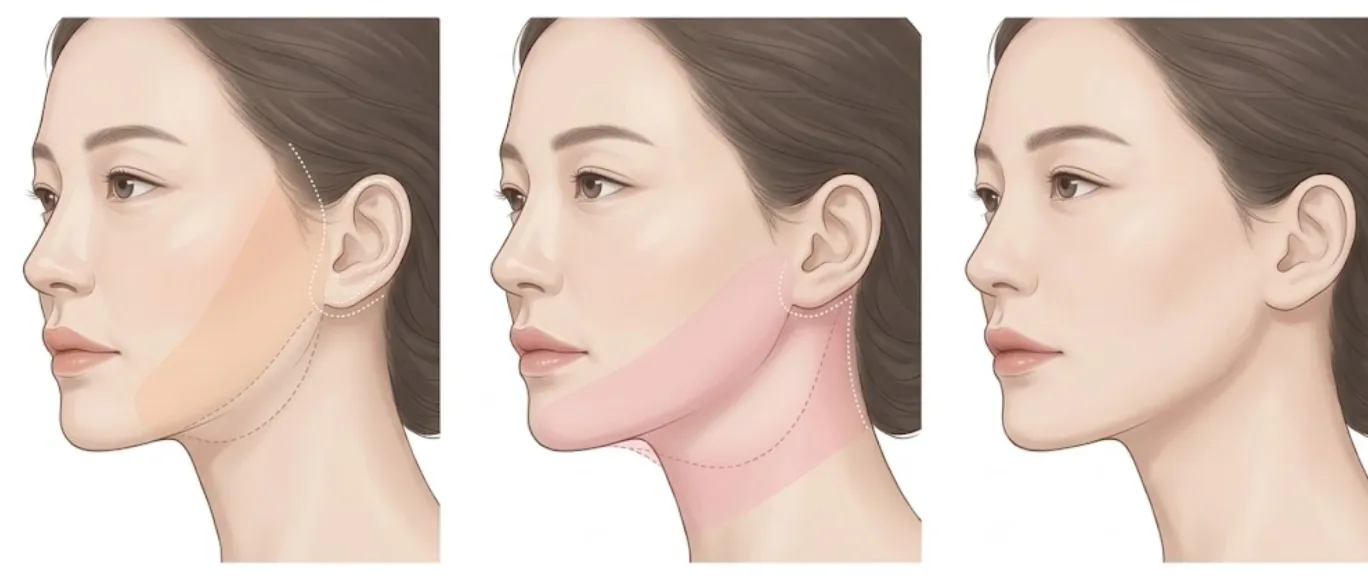
Illustrated steps of a neck lift at Garnet: sagging jowls and loose neck skin, the lower face and neck lifted back toward the ear, and the healed firm jawline
Illustration — through a fine line around the ear (dotted), the sagging lower face and neck are lifted up and back toward the ear (shaded); the dashed outline shows the old contour. The last panel shows the healed jaw and neck.

Is a neck lift right for you?

Neck bands with a loose under-chin

  • Vertical neck bands from a slackened platysma muscle
  • A loose or full under-chin and a jawline that has lost definition
  • General good health and realistic, discussed expectations
  • Can set aside ~2 weeks of social downtime plus the neck follow-up visits
  • Wanting a structural neck result that outlasts a temporary tightening

Mild, surface-only neck concerns

  • Very mild or surface-only neck concerns, where non-surgical options may suit better
  • Looking for a same-week, no-downtime result
  • Uncontrolled medical conditions, assessed individually
  • Significant excess weight, where stable weight first may improve the result
  • Active smoking, which raises the wound-healing risk under the chin and behind the ears and is planned around
Dr. In-Soo Baek

Dr. In-Soo Baek

Director & sole operating surgeon
Korean medical licence no. 77407

Operate on what you came for. Trained at Korea University Medical Center. Every case planned, performed and reviewed by the same hands.

1Operating surgeon
~2Surgeries per day
7Registered techniques
  • Board-certified plastic surgeon
  • Plastic surgery training: Korea University College of Medicine & graduate school
  • Korean Society of Plastic and Reconstructive Surgeons member, in the facial-contour, eye & rhinoplasty groups
  • Plans, performs and follows up each neck lift himself
About the surgeon →

Before & After

Neck-lift before/after sets are reviewed privately at consultation, as faces are identifiable. Results, recovery and suitability vary by individual and are not guaranteed.

Request before & after examples privately

Tightening the muscle, defining the angle

A neck lift is a surgical neck-rejuvenation operation that tightens the platysma muscle and the SMAS and re-drapes the overlying skin, through incisions beneath the chin and around the ears, to sharpen the jawline and the angle beneath the chin. It addresses neck bands and a loose or full under-chin that are driven by muscle and skin laxity more than by surface texture.

The neck shows age in a few specific ways: vertical bands appear where the platysma muscle edges separate and slacken, the under-chin loses its clean angle, and the jawline softens as the soft tissue descends. These are problems of muscle and skin support beneath the surface, so creams and surface treatments cannot reach the cause.

A neck lift works on that deeper structure. The edges of the platysma are tightened (and where indicated joined in the midline as a corset platysmaplasty), the SMAS is re-suspended, and the skin is re-draped without tension. The result is a defined jawline and a cleaner angle beneath the chin, addressing the bands and fullness directly. The same principles inform the corset platysmaplasty and the contouring Pelican™ procedure used for the under-chin.

At Garnet this is a single-surgeon operation. Dr. Baek works out whether muscle, skin, fat or a combination is changing your neck, plans for that, and then performs and reviews the lift himself. With no more than two surgeries a day, there is time to fit the neck technique to the actual concern and avoid over-treating.

One surgeon for your neck lift

From incision design to the platysma tightening and tension-free closure, every step is done by Dr. Baek.

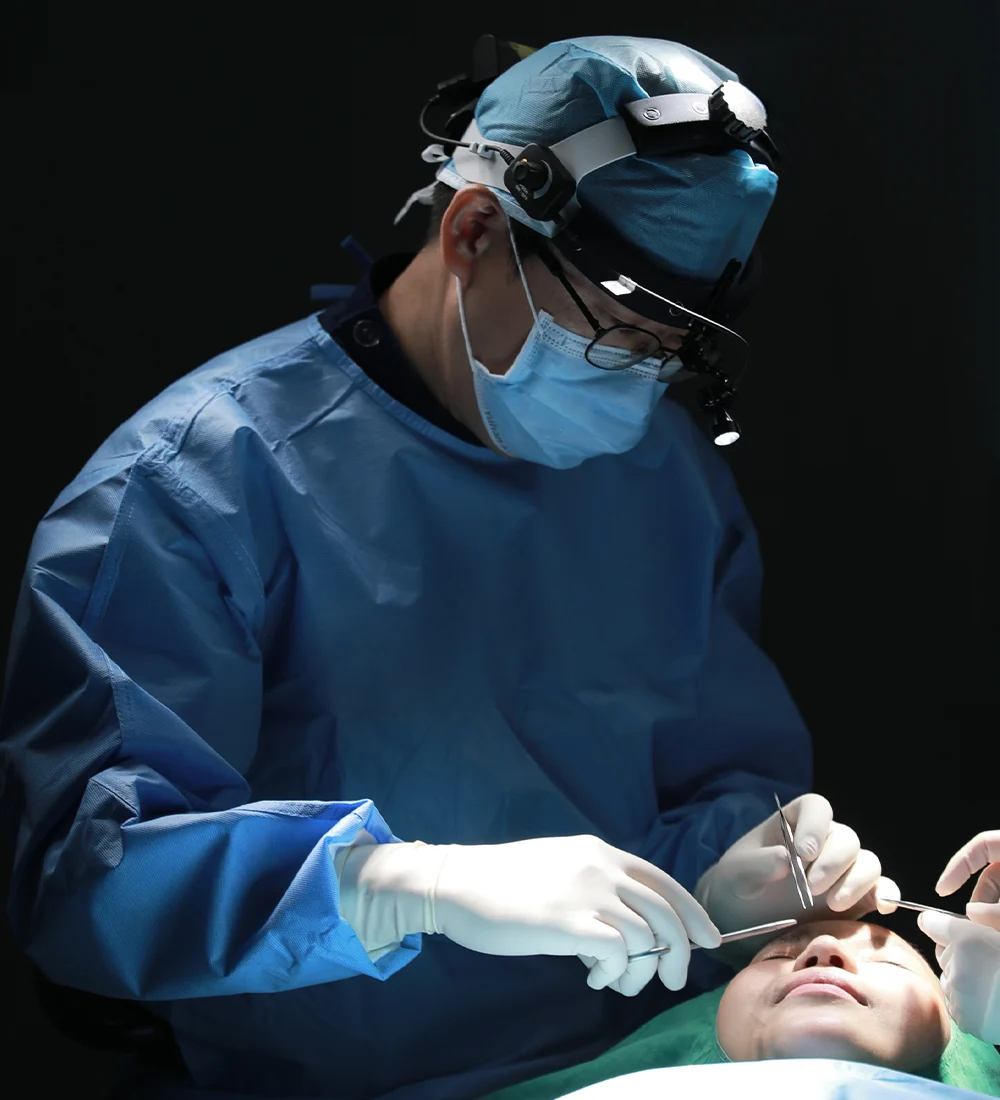
Dr. In-Soo Baek performing surgery at Garnet Plastic Surgery, Apgujeong

A single surgeon, start to finish. The surgeon who marks your platysma bands is the one who tightens them and checks your neck at each review. Two surgeries a day at most leaves each neck lift unhurried.

A neck lift typically runs about 2–3 hours and is performed under local anaesthesia with sedation or general anaesthesia as appropriate, decided with you after your history is reviewed. The steps below outline how the platysma and skin work is carried out at Garnet.

01

Platysma bands, skin laxity and jawline

Dr. Baek assesses the neck in person (the platysma bands, the under-chin fullness, skin laxity and the jawline) and agrees what to address and the incision design with you. The plan reflects whether muscle, skin, fat or a combination is driving the change.

02

Lines under the chin and behind the ears

Lines are placed beneath the chin (submental) and in the natural creases around and behind the ears (post-auricular), so they settle into existing contours and the hairline as they heal.

03

Platysma tightening

The slackened edges of the platysma are tightened and, where indicated, joined in the midline as a corset platysmaplasty; the SMAS is re-suspended so the muscle layer carries the support and the skin does not.

04

Contour & re-drape

Any sub-platysmal fullness is addressed as indicated, the under-chin angle is refined (the Pelican™ contouring step where appropriate), and the skin is re-draped and trimmed without tension.

05

Adjuncts

Where the consultation shows it, a facelift or a corset platysmaplasty is performed in the same sitting to balance the jawline and neck.

06

Support garment and a check under the chin

Fine closure, dressing and light compression or a support garment. Dr. Baek checks the closure under your chin and behind your ears himself before you leave and at every follow-up.

The platysma & why neck bands form

The platysma is a broad, thin sheet of muscle across the front of the neck; with age its paired medial edges separate and slacken, which is what produces the vertical neck bands and a blunted angle beneath the chin. Tightening and re-suspending this platysma-SMAS unit is the core of a lasting neck lift, and is what sharpens the cervicomental angle (Aesthetic Surg J 2025; DOI 10.1093/asj/sjaf023).

Depending on the neck, the change can be muscular (band laxity), skeletal-volume (fullness beneath the platysma), skin (laxity and re-draping), or a mix. The retaining ligaments along the jawline also loosen with age and contribute to the softened border (Mendelson, Aesthetic Plast Surg 2013; DOI 10.1007/s00266-013-0066-8). Garnet decides which of these to address for each neck individually, and frequently pairs neck work with a facelift since the jawline and neck age as one unit.

Neck lift vs platysmaplasty vs non-surgical

Non-surgicalCorset platysmaplastyFull neck lift
TypeEnergy / injectableMidline muscle repairMuscle + skin surgery
AddressesMild skin / fatCentral platysma bandsBands, jawline & skin
Skin re-drapingNoLimitedYes
Best stageVery early / mildBand-dominant necksCombined muscle & skin laxity
DurabilityShorter-lastingDurable for bandsWidest coverage

A systematic review of platysma neck-lift surgery reports a low pooled band-recurrence rate of about 1.4% across 2,106 patients (Facial Plast Surg 2024, DOI 10.1055/s-0044-1791690). The right choice is individual. For the jawline-and-neck picture, our guide deep-plane vs SMAS facelift helps frame it, and Dr. Baek advises at consultation.

Neck lift anaesthesia and safety

Anaesthesia

A neck lift is usually performed under local anaesthesia with sedation, or general anaesthesia where preferred, decided with you and the anaesthesia team for a roughly 2–3 hour operation. Your medical history is reviewed beforehand.

A neck operation that is never hurried

Garnet books no more than two surgeries a day, so your 2–3 hour neck lift is never hurried; the surgeon who planned it operates and follows your recovery, and no other doctor takes over.

Overseas arrangements from checks to review

As a clinic registered with Korea's foreign-patient programme, Garnet arranges the pre-operative checks, the neck-lift date and the after-care in English for visitors from abroad.

Sometimes lifting the lower face too serves better

If a lighter option or a combined facelift suits you better, that is said at the consultation. Photos can be reviewed before you travel.

Where neck-lift scars sit

Neck-lift incisions are placed where they can hide: a small line beneath the chin in the natural shadow, and lines in the creases around and behind the ears that run into the hairline. Because the neck skin is re-draped without tension, the lines under the chin and behind the ears have a better chance of settling fine and flat.

Scars are permanent but are designed to settle into existing contours, the under-chin shadow and the hairline, so they are not usually obvious in everyday settings once mature. Scar healing varies with the individual and skin type, and Dr. Baek checks how the neck scars are maturing at 1, 3 and 6 months and advises on care.

Week by week

Days 1–3
Dressing or a support garment and light compression. Neck and jaw swelling and bruising build and peak over these first days. Keep your head raised, use cold compresses as advised, and expect a check from the team before you go to your accommodation. Discomfort is usually manageable with prescribed medication.
Days 4–7
The neck swelling starts to come down and the bruising begins to fade. Gentle walking is encouraged, and a support garment may be advised. By the end of the first week most neck-lift patients feel far more like themselves.
Days 10–14
Sutures are removed in stages. Bruising fades further; residual swelling and firmness continue. Many international patients stay in Korea until this point so the surgeon can take out the neck sutures himself.
Around week 2
Most social downtime is over for everyday settings, with residual swelling and neck firmness that keep easing. Desk work and a light routine return as advised, while hard exercise that strains the neck has to wait longer.
Months 1–6
The neck angle settles and the scars mature over the following months. Dr. Baek checks the neck at one, three and six months, either in person or by messenger once you are home.

Do

Keep the head elevated, wear the support garment as advised, use cold compresses early, take medication as prescribed, sleep on your back, walk gently, and keep your follow-up visits.

Avoid

Strenuous exercise, heavy lifting and straining early on, alcohol and smoking, very hot showers/saunas, and direct sun on healing scars until cleared.

How long does a neck lift last?

No neck lift stops ageing, but tightening and re-suspending the platysma is a durable way to sharpen the neck because it addresses the muscle that produces the bands as well as the skin. In a pooled analysis of platysma neck-lift surgery, band recurrence was low — about 1.4% across 2,106 patients (Cambiaso-Daniel et al., Facial Plast Surg 2024; DOI 10.1055/s-0044-1791690).

Individual longevity depends on tissue quality, weight stability and how the neck and jawline age afterwards. Because the jawline and neck age as one unit, a neck lift planned with a facelift where indicated tends to give a more balanced and lasting result; Garnet plans the neck so it sits naturally from the start.

Procedures often paired with a neck lift

Facelift

A neck lift and a facelift are frequently planned together, since the jawline and neck age as one unit and treating them separately can leave a mismatch at the border.

Central bands joined in the midline

Where central neck bands dominate, a corset platysmaplasty joins the platysma edges in the midline as part of, or alongside, the neck lift.

Mini or deep-mini lift

For an earlier jawline concern, a mini facelift or Deep mini facelift™ may pair with neck work through shorter access.

Fat grafting

Fat grafting can restore lost volume along the jawline or lower face that lifting alone does not replace, for a more balanced look that is not only tighter.

Garnet Plastic Surgery, Apgujeong, Seoul

Neck lift risks, plainly stated

Every operation carries risk. These are explained individually at consultation.

  • Haematoma

    For facelift and neck-lift surgery the most reported early complication is haematoma (a collection of blood under the skin); in a large analysis of 11,300 facelift patients, it occurred in about 1.1% (Aesthetic Surg J 2016; DOI 10.1093/asj/sjv162).

  • Infection

    Much less common, at about 0.3% in the same analysis.

  • Blood pressure

    High blood pressure is a recognised risk factor.

  • Changed feeling in the neck skin

    Temporary changes in skin sensation.

  • Uneven contour along the neckline

    Asymmetry and contour irregularity.

  • Scars

    Scar-related issues.

  • Nerve branch

    Uncommonly, temporary or, rarely, lasting weakness of a nerve branch affecting the lower lip or neck. In pooled neck-lift data overall nerve damage was about 0.9%.

  • Smoking

    Raises wound-healing risks.

For a neck lift, risk comes down in practice through careful patient selection, blood-pressure control, meticulous technique, a skin closure without tension, and follow-up by the surgeon who operated. Garnet keeps its volume low with one surgeon so that neck planning and after-care stay unhurried and personal.

Planning a neck lift from abroad

Most international patients plan roughly 12–16 days in Korea for a neck lift, since sutures come out at about 10–14 days and are best removed by the surgeon before travel, once the early swelling has settled. The coordinator confirms the timing for your specific plan.

Before you travel, send clear photos (front, three-quarter, side and chin-down) and a note on your concern and dates through WhatsApp, LINE or the form below. You'll get a pre-assessment, including whether a neck lift alone or a combined facelift fits, and no hard sell.

Registered with Korea's foreign-patient programme, Garnet handles your neck-lift consultation, scheduling and after-care in English, and once you are home Dr. Baek keeps reviewing the neck by messenger.

Sources

  1. Cambiaso-Daniel J, Giordano S, et al. Neck Lift to Treat Platysma Bands and Defining Cervical Angle: A Systematic Review and Pooled Analysis. Facial Plast Surg. 2024. DOI 10.1055/s-0044-1791690. link
  2. Bartow MJ, Core G. Effective Recontouring of the Neck by Complete Platysmal Transection. Aesthetic Surg J. 2025. DOI 10.1093/asj/sjaf023. link
  3. Mendelson BC, et al. Anatomic Study of the Retaining Ligaments of the Face and Applications for Facial Rejuvenation. Aesthetic Plast Surg. 2013. DOI 10.1007/s00266-013-0066-8. link
  4. Preoperative Risk Factors and Complication Rates in Facelift: Analysis of 11,300 Patients. Aesthetic Surg J. 2016. DOI 10.1093/asj/sjv162. link

Citations are provided for general education. This page is informational and does not replace an in-person consultation; suitability, technique and recovery are individual.

Questions about a neck lift

Will a neck lift look pulled or unnatural?
A neck lift tightens the platysma muscle and re-suspends the SMAS so the support sits on the muscle layer, and re-drapes the skin without tension, which is intended to avoid an over-tight look. How much the neck is changed is agreed with Dr. Baek in advance.
How is a neck lift different from a platysmaplasty or non-surgical neck treatment?
Non-surgical treatments address mild skin or fat without re-draping skin; a corset platysmaplasty repairs the central platysma bands in the midline; a full neck lift combines platysma tightening with skin re-draping for bands, jawline and skin laxity together. So they differ in what they reach and how much they cover. The right choice is individual, and you can compare the jawline-and-neck techniques in our guide.
Non-surgicalCorset platysmaplastyFull neck lift
TypeEnergy / injectableMidline muscle repairMuscle + skin surgery
AddressesMild skin / fatCentral platysma bandsBands, jawline & skin
Skin re-drapingNoLimitedYes
Best stageVery early / mildBand-dominant necksCombined muscle & skin laxity
DurabilityShorter-lastingDurable for bandsWidest coverage
Does Dr. Baek perform the surgery himself?
Yes. Dr. Baek is the only surgeon at Garnet, so he sees you for the neck consultation, performs the lift and runs every follow-up himself.
How long does a neck lift last?
Tightening and re-suspending the platysma is durable, with band recurrence low in pooled data (about 1.4%). No neck lift stops ageing, and longevity depends on tissue quality, weight stability and how the neck ages afterwards.
How long should I stay in Korea?
Most international patients plan about 12–16 days, since sutures come out at roughly 10–14 days and are best removed by the surgeon before travel. The coordinator confirms timing for your plan.
What anaesthesia does a neck lift use, and how painful is it?
A neck lift takes roughly 2–3 hours, usually under local anaesthesia with sedation or under general anaesthesia if preferred, chosen once your history is reviewed. Early on most patients feel tightness and pressure across the neck more than sharp pain, and prescribed medication manages it.
Where are the scars and will they show?
Incisions sit beneath the chin in the natural shadow and in the creases around and behind the ears into the hairline, closed without tension. The scars are permanent, but they are placed to sit in the under-chin shadow and ear creases and are rarely obvious once mature.
When will I look presentable?
Most social downtime is over by about 2 weeks for everyday settings, with residual swelling and neck firmness that keep easing. The settled angle and jawline develop over the following months.
When can I exercise again?
Gentle walking early; strenuous exercise, heavy lifting and straining wait several weeks and are cleared at follow-up, since raised blood pressure early on can increase bruising risk.
Can I combine it with a facelift?
Yes, and it is common. Since the jawline and neck age as one unit, a facelift and a neck lift are often planned in the same sitting to avoid a mismatch at the jawline border.
Do I need a corset platysmaplasty as well?
It depends on your neck. Where central bands dominate, a corset platysmaplasty joins the platysma edges in the midline as part of the lift; where skin laxity dominates, the re-draping does more of the work. Dr. Baek decides with you at consultation.
What are the main risks?
The most reported early risk is haematoma (about 1% in large series), with infection less common; temporary sensation changes, contour irregularity and, rarely, nerve-branch weakness affecting the lower lip are discussed individually. Smoking raises healing risk.
Can I see neck-lift before-and-after photos?
Neck-lift results are identifiable, so full sets are reviewed privately at consultation with consent and are not published. Suitability and results vary by individual and are not guaranteed.
Will a neck lift help a double chin or jowls?
A neck lift addresses the muscle bands, under-chin angle and neck skin; jowls along the jawline are often best treated together with a mini facelift or facelift, which Dr. Baek assesses individually at consultation.
How do I start without flying to Korea first?
Share neck photos and your travel dates via WhatsApp, LINE or the form below. The pre-assessment covers whether a neck lift alone or a plan combined with a facelift fits, before you plan a trip.

Reviews on Google Maps

★★★★★

My mom recently had a brow lift and lower blepharoplasty with Dr. Baek, and our experience has been wonderful so far. The Garnet team was incredibly kind and welcoming, with Kelly assisting us as our English consultant—she made everything…

T S7 months ago

★★★★★

I’m so happy I chose this clinic for my lower blepharoplasty. I was traveling from abroad by myself, so I was a little nervous, but from the beginning I felt comfortable and truly cared for. Everyone was kind, patient, and professional…

S L2 months ago
★★★★★

Came in for an in-person consult and ended up choosing Garnet and Dr.Baek for my non-incisional DES and tiplasty/alarplasty. I communicated with Kelly (English consultant) from the start till now (3 weeks post-op). She really help me feel…

Stephanie Li6 months ago
★★★★★

My under-eyes have been sagging and folding for years... I tried to cover it up with makeup, but it actually got stuck in the wrinkles and made it stand out even more. While going for consultations, I noticed that the bigger the hospital…

조희원2 months ago · Translated by Google

Read all reviews on Google Maps

Ask Dr. Baek’s team

Send photos and your question before you travel. An English-speaking coordinator reviews every enquiry and replies with guidance on whether surgery is appropriate, the likely plan and timing.

  • ✓ Reviewed by the clinic coordinator, not a bot
  • ✓ Photo-based pre-assessment before you fly
  • ✓ Foreign-patient scheduling & after-care
  • ✓ One surgeon for consultation, surgery and follow-up

Prefer to chat now? Reach the coordinator directly:

Request a consultation

Find the clinic

51 Apgujeong-ro 30-gil, Gangnam-gu, Seoul — near Apgujeong Station

WhatsApp

