



Garnet · Apgujeong, Seoul · English coordinator · WhatsApp · LINE · Email
Garnet clinic, Apgujeong
Garnet/Fat Grafting & Contouring/Fat grafting (PRP-assisted)

Fat Grafting & Contouring · Apgujeong, Seoul

Fat grafting (PRP-assisted) in Korea — your own fat

Dr. In-Soo Baek
Dr. In-Soo BaekConsults, operates and follows up himself
10,000+fat-grafting cases since 2011
Your ownfat, PRP-assisted
Micro-fatrefined, placed in layers
1surgeon, every step
Anaesthesia
Local / sedation (as appropriate)
Surgery time
~1-2 hours
Sutures out
Minimal (cannula access)
Social downtime
~1-2 weeks (swelling)
Follow-up
1 / 3 / 6 months
10,000+ fat-grafting cases since 2011· Fat grafting by a board-certified plastic surgeon, accredited member of the Korean Society of Plastic & Reconstructive Surgeons· Foreign-patient programme registered· Single-surgeon practice

Fat grafting: the bottom line

Fat grafting restores volume to hollowed areas of the face (under-eyes, temples, cheeks or lips) with your own fat, harvested from the abdomen or thigh, refined into micro-fat and placed in small amounts. Dr. In-Soo Baek, a board-certified plastic surgeon, plans and performs every graft himself.

What it is
A volume-restoring procedure that takes your own fat from the abdomen or thigh, processes it into fine micro-fat (supplemented with PRP from your own blood), and grafts it in small amounts to hollow areas of the face.
Best for
Volume loss with age - flat or hollow under-eyes, temples, cheeks or lips - and refining contour where the issue is lost fullness and the skin itself is not sagging.
Who performs it
Only Dr. In-Soo Baek, Garnet's sole operating doctor and a board-certified plastic surgeon. The same surgeon consults, operates and follows up.
Downtime
Cannula access means minimal visible scarring; most swelling and bruising settle over roughly 1-2 weeks, with the final volume set once early swelling has resolved.
Longevity
A proportion of grafted fat resorbs in the first months and the surviving fat is long-lasting; reported facial volume retention varies widely (Aesthetic Plast Surg 2021).
How to start
Send photos of the hollow areas through WhatsApp or the form below for a no-obligation pre-assessment before you travel.
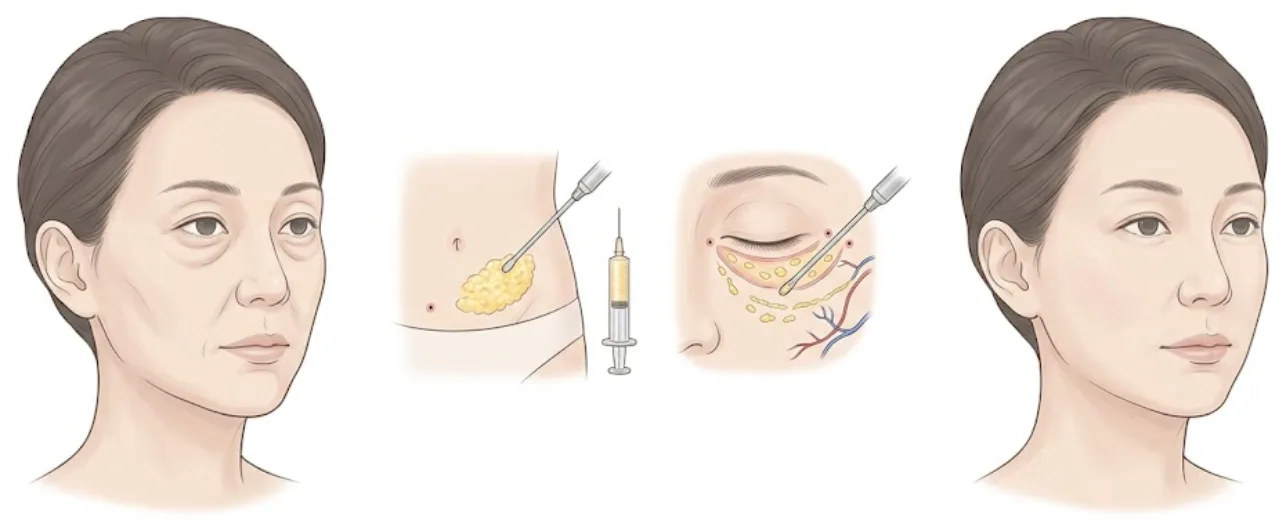
Illustrated steps of fat grafting at Garnet: facial volume loss, fat taken from the abdomen and refined, placed in small amounts, and the healed face
Illustration — the patient's own fat is gently taken from a donor area such as the abdomen, refined, and placed in small amounts where volume has been lost.

Is fat grafting right for you?

Hollow temples, deflated cheeks, thin lips

  • Volume loss with age - hollow under-eyes, flat temples, deflated cheeks or thin lips
  • A wish to restore fullness using your own tissue instead of a synthetic filler
  • Enough donor fat at the abdomen or thigh to harvest
  • General good health and realistic expectations about graft survival
  • Able to plan around 1-2 weeks for swelling and the follow-up schedule

Sagging with little lost volume

  • Mainly sagging skin with little lost volume - lifting may suit better
  • Wanting a precise, easily reversible touch-up only - a filler may fit better
  • Very little donor fat available - assessed at consultation
  • Uncontrolled medical conditions - assessed individually at consultation
  • Active smoking, which reduces graft survival and raises healing risk - discussed and planned around
Dr. In-Soo Baek

Dr. In-Soo Baek

Director & sole operating surgeon
Korean medical licence no. 77407

Operate on what you came for. Trained at Korea University Medical Center. Every case planned, performed and reviewed by the same hands.

1Operating surgeon
~2Surgeries per day
7Registered techniques
  • Board-certified plastic surgeon
  • Korea University College of Medicine & graduate school (plastic surgery)
  • Member, Korean Society of Plastic and Reconstructive Surgeons (facial-contour, eye & rhinoplasty groups)
  • Every fat graft planned, performed and followed up by the same surgeon
About the surgeon →

Before & After

Fat grafting before/after sets are reviewed privately at consultation, as faces are identifiable and results settle over months. Graft survival, final volume, recovery and suitability vary by individual and are not guaranteed.

Request before & after examples privately

Restoring volume with your own refined fat

Fat grafting (autologous fat transfer) is a procedure that restores lost facial volume by harvesting a patient's own fat - usually from the abdomen or thigh - processing it into fine micro-fat, and re-injecting it through a blunt cannula into hollow areas of the face. Because the graft is the patient's own living tissue, the fat that survives integrates and becomes a lasting part of the area.

Much of facial ageing is loss, not just descent: the deep and superficial fat pads of the face deflate, so the under-eye hollows, the temples flatten, the cheeks lose their soft fullness and the face can look tired or gaunt even when the skin is still firm. Lifting addresses sagging, but it does not replace volume that is simply gone.

Fat grafting puts volume back using the patient's own tissue. Fat is harvested gently from the abdomen or thigh, refined into micro-fat - small parcels that pass through a fine cannula and place evenly - and grafted in thin layers so each parcel sits close to a blood supply and has the greatest chance of taking. At Garnet, platelet-rich plasma (PRP) prepared from the patient's own blood is added; supplementing fat grafts has been studied as a way to support volume retention, though results vary (Aesthetic Surg J 2022; DOI 10.1093/asj/sjac122).

At Garnet this is a single-surgeon operation. Dr. Baek plans the case from the consultation - which areas, how much, and whether grafting alone or grafting plus lifting suits you - performs it himself, and reviews healing at set intervals; the clinic caps the day at two surgeries so each case has unhurried time. The aim is natural, balanced restoration of the areas you came concerned about.

One surgeon for harvest and graft

From gentle harvest to micro-fat refinement, PRP and layered placement - every step by Dr. Baek.

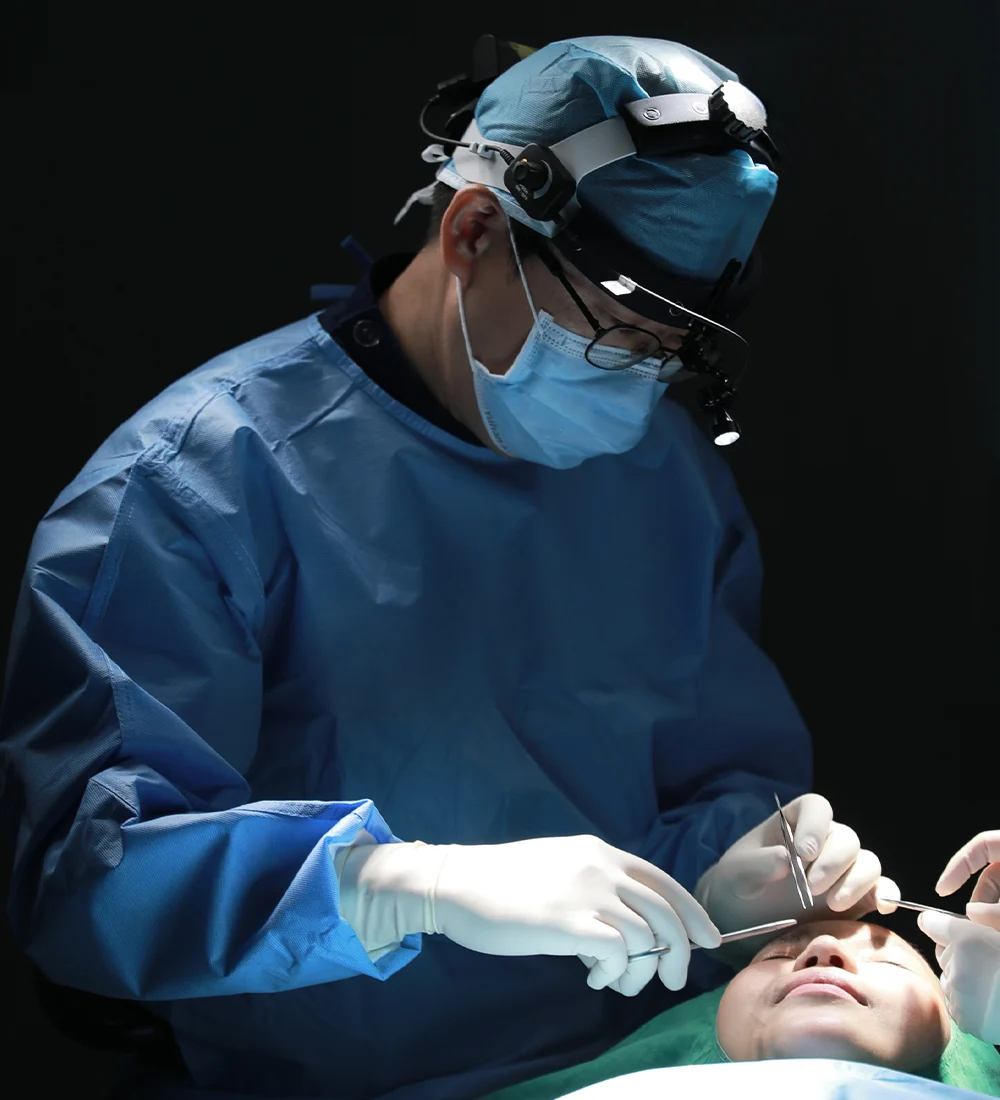
Dr. In-Soo Baek performing surgery at Garnet Plastic Surgery, Apgujeong

A single surgeon, start to finish. Dr. Baek plans the graft, performs the harvest and placement himself and reviews every follow-up. With the day capped at 2 surgeries, each grafting session has unhurried time.

Facial fat grafting at Garnet typically runs about 1-2 hours and is performed under local anaesthesia with sedation as appropriate, decided with you after your medical history is reviewed; larger or combined cases may use general anaesthesia. The steps below follow the fat from donor site to face.

01

Choosing which hollows to refill and how much

Dr. Baek assesses which areas have lost volume - under-eye, temple, cheek or lip - decides how much fat is needed and from where to harvest, and agrees whether grafting alone or grafting with lifting suits your face.

02

Donor harvest

Fat is harvested gently through small cannula access points in the abdomen or thigh, the areas with reliable donor fat, using a technique that aims to keep the fat cells intact for grafting.

03

Processing into micro-fat

The harvested fat is refined into micro-fat - small, clean parcels that pass through a fine cannula - and PRP prepared from your own blood is combined with it before grafting.

04

Thin layers through a blunt cannula

The micro-fat is grafted through a blunt cannula in thin layers and small amounts, so each parcel sits near a blood supply, which gives the graft a strong chance of surviving and avoids lumpiness.

05

Pairing volume with lifting or lid work

Where the consultation shows it, grafting is combined with a thread lift, a brow lift or eyelid surgery, since volume loss and sagging often coexist.

06

Review & settling

Access points are tiny and need little or no suturing. Because Garnet is single-surgeon, Dr. Baek reviews you himself before you settle in and at each follow-up as the volume settles.

Why grafted fat takes - or doesn't

A fat graft is living tissue moved without its own blood supply, so in the first days it survives by diffusion from the surrounding bed until new vessels grow in. This is why how the fat is handled matters: gentle harvest, careful processing into small parcels, and placement in thin layers instead of large pockets all give each graft parcel access to a blood supply. Fat placed too thickly in one spot is more likely to resorb or form a lump.

Because not all grafted fat survives, a proportion resorbs over the first few months and the volume that remains after that is durable. Reported facial volume-retention rates vary widely across studies and depend on technique and the area treated (Aesthetic Plast Surg 2021; DOI 10.1007/s00266-020-01612-6), which is why Dr. Baek plans conservatively, sometimes graduating the volume, and reviews the settled result. Where the concern is sagging more than lost volume, lifting such as a thread lift or surgical lift is discussed instead of or alongside grafting.

Fat grafting compared with dermal filler

Fat graftingHyaluronic-acid fillerCombined / staged
MaterialYour own fatGel injectedBoth, by area
ProcedureHarvest + graftIn-clinic injectionSurgery + injectable
LongevitySurviving fat is lastingMonths to a year-plusMixed by area
Volume capacityLarger areas at onceSmaller, precise touch-upsTailored
ReversibilityNot reversibleOften dissolvableDepends

Reported facial fat-graft volume retention varies widely between studies (Aesthetic Plast Surg 2021; DOI 10.1007/s00266-020-01612-6). Fat grafting and fillers suit different goals; the right choice - or a staged combination - is individual and Dr. Baek advises at consultation.

How safety is handled in fat grafting

Anaesthesia

Facial fat grafting is commonly performed under local anaesthesia with sedation as appropriate, decided with you and the team for comfort over the procedure; larger or combined cases may use general anaesthesia. Your medical history is reviewed beforehand.

Planning and placement by the same surgeon

Garnet caps the day at 2 surgeries, so the grafting is unhurried, and the surgeon who planned the case carries it out and reviews recovery. No separate operating doctor or rotating team is involved.

English-language coordination before and after

Pre-operative checks, scheduling and after-care for international fat grafting patients are coordinated in English under Garnet's registration with Korea's foreign-patient programme.

When filler or a lift fits better

If your concern is sagging more than lost volume, or a filler would suit better, you will hear that at the consultation. Photos can be reviewed before you travel.

Access points, not incisions

Fat grafting is carried out through cannula access points, with no open incisions: small entry points in the abdomen or thigh for harvest, and tiny entry points on the face for placement. These need little or no suturing and generally heal as small marks without a scar line, so there is usually no visible incision scar from the grafting itself.

The donor area may be bruised and a little tender for a couple of weeks, and the grafted areas swell while the fat settles. Healing varies by individual; Dr. Baek reviews the donor and recipient sites at the 1-, 3- and 6-month visits and advises on care as the graft matures.

Fat grafting price

Fat grafting — one area (first session)

₩1,200,000 + VAT per areaExcluding VAT (10% VAT is added at payment)Book now

Fat grafting — full face (first session)

₩2,000,000 + VATExcluding VAT (10% VAT is added at payment)Book now

Same price as Korean patients. Prices shown exclude 10% VAT; your written quote, issued after the in-person consultation, shows the full amount payable.

Week by week

Days 1-3
Swelling and bruising at the grafted areas and the donor site build then peak over the first few days; the face can look fuller than the final result because of swelling. Rest with the head elevated and use cold compresses as advised; the team checks the grafted areas before you settle in.
Days 4-7
Facial and donor-site swelling begins to ease and bruising starts to fade. Gentle walking is encouraged. The donor area may stay tender; avoid pressure on the grafted areas as advised.
Week 1-2
Most visible swelling and bruising settle over this period, though the grafted areas continue to refine. Many international patients plan their stay so the surgeon reviews them before travel.
Weeks 2-6
The face looks more natural as swelling resolves; a proportion of the grafted fat resorbs over the first months, so the volume gradually finds its settled level.
Months 1-6
The surviving graft stabilises and the final volume becomes clear over the following months. Dr. Baek checks the settling volume at 1, 3 and 6 months, in person or by messenger once you are home.

Do

Keep the head elevated early, use cold compresses as advised, take medication as prescribed, eat and stay well-nourished to support graft survival, and keep your follow-up visits.

Avoid

Pressure, massage or sleeping face-down on the grafted areas early on, strenuous exercise, alcohol and smoking, very hot showers/saunas, and aggressive facials until cleared.

How long does fat grafting last?

Fat grafting has two phases: in the first few months a proportion of the grafted fat resorbs, and the fat that survives becomes a lasting, integrated part of the area - because it is the patient's own living tissue, not a temporary gel. Reported facial volume-retention rates vary widely across studies and depend on technique and the area treated (Aesthetic Plast Surg 2021; DOI 10.1007/s00266-020-01612-6).

Because some resorption is expected, Dr. Baek plans conservatively and reviews the settled result, and a second, smaller session is sometimes discussed if more volume is wanted. Adding PRP has been studied as a way to support retention, with mixed evidence (Aesthetic Surg J 2022; DOI 10.1093/asj/sjac122). The grafted fat can still change with significant weight gain or loss, and skin-surface ageing continues independently.

Often planned with fat grafting

Thread lift

Volume loss and mild sagging often coexist; fat grafting and a thread lift can be planned together so fullness and a gentle lift are addressed in one sitting.

Brow / forehead lift

Grafting to a hollow temple complements a brow lift, restoring upper-face volume that lifting alone does not replace.

Eyelid & under-eye

Fat grafting can soften a hollow under-eye, and is sometimes considered with eyelid surgery; whether grafting, repositioning or both suits you is decided at consultation.

Stem-cell-assisted grafting

Garnet also offers stem cell fat grafting as a related option; the appropriate approach for your tissue is discussed plainly, without efficacy guarantees.

Garnet Plastic Surgery, Apgujeong, Seoul

Fat grafting risks, plainly stated

Every procedure carries risk. These are explained individually at consultation.

  • Swelling at both the face and donor site

    At both the grafted areas and the donor site, usually temporary and settling over weeks.

  • Donor-area tenderness

    Tenderness of the donor area, which settles over weeks.

  • Under- or over-correction

    Because grafted fat resorbs partly, under- or over-correction can occur; the final volume is judged only once swelling has resolved.

  • Lumps or oil cysts

    Firm lumps or oil cysts in over-filled areas are less common.

  • Contour and asymmetry

    Contour irregularity and asymmetry are less common risks.

  • Infection and donor-site changes

    Infection and donor-site changes are less common risks.

  • Intravascular injection

    A rare but serious risk specific to facial fat injection, minimised by using a blunt cannula, low-pressure layered placement and careful technique.

  • Smoking

    Reduces graft survival and raises healing risk.

What reduces risk in practice: gentle harvest, refined micro-fat, layered placement near a blood supply, conservative volumes, and follow-up by the operating surgeon. Garnet's single-surgeon, low-volume model is built around exactly this kind of unhurried planning and personal after-care; Garnet makes no graft-survival or regenerative-superiority guarantee.

Planning fat grafting from abroad

Most international patients plan roughly 7-14 days in Korea for facial fat grafting, so the surgeon can review the grafted and donor areas before travel and the early swelling has settled. The coordinator confirms the timing for your specific plan.

Before you travel, send clear photos (front, three-quarter and side, relaxed) and a note on the areas that concern you and your dates through WhatsApp, LINE or the form below. You'll get a pre-assessment of whether grafting, a filler or lifting fits best, with no hard sell.

For fat grafting patients from abroad, Garnet's registration with Korea's foreign-patient programme means consultations, scheduling and after-care are coordinated in English. After you return home, Dr. Baek can continue to review your recovery and the settling volume by messenger.

Sources

  1. Lv Q, Li X, Qi Y, et al. Volume Retention After Facial Fat Grafting and Relevant Factors: A Systematic Review and Meta-analysis. Aesthetic Plast Surg. 2021. DOI 10.1007/s00266-020-01612-6. link
  2. Vyas KS, et al. Supplementation of Facial Fat Grafting to Increase Volume Retention: A Systematic Review. Aesthetic Surg J. 2022. DOI 10.1093/asj/sjac122. link
  3. Coleman SR. Structural Fat Grafting: More Than a Permanent Filler. Plast Reconstr Surg. 2006. DOI 10.1097/01.prs.0000234610.81672.e7. link

Citations are provided for general education. This page is informational and does not replace an in-person consultation; suitability, technique and recovery are individual.

Questions about fat grafting

Where is the fat taken from for facial fat grafting?
Donor fat is harvested gently through small cannula access points, usually from the abdomen or thigh, as these have reliable fat for grafting. The fat is refined into fine micro-fat and combined with PRP from your own blood before it is grafted into the face.
What is the difference between fat grafting and filler?
Fat grafting uses your own fat, harvested and grafted, so the surviving fat is lasting; a hyaluronic-acid filler is an injected gel that lasts months to a year-plus and is often dissolvable. Fat grafting suits larger volume restoration, fillers suit precise touch-ups.
Fat graftingHyaluronic-acid fillerCombined / staged
MaterialYour own fatGel injectedBoth, by area
ProcedureHarvest + graftIn-clinic injectionSurgery + injectable
LongevitySurviving fat is lastingMonths to a year-plusMixed by area
Volume capacityLarger areas at onceSmaller, precise touch-upsTailored
ReversibilityNot reversibleOften dissolvableDepends
Does Dr. Baek perform the surgery himself?
Yes. Garnet is a single-surgeon practice, so Dr. Baek handles the consultation, the harvest, the grafting and the follow-up personally - there is no separate operating doctor and no rotation of care, and the day is capped at two surgeries.
How long does facial fat grafting last?
A proportion of the grafted fat resorbs in the first months, and the fat that survives is long-lasting because it is your own living tissue. Reported volume retention varies widely between studies, so Dr. Baek plans conservatively and reviews the settled result.
How long should I stay in Korea?
Most international patients plan about 7-14 days, so the surgeon can review the grafted and donor areas and early swelling settles before travel. Your coordinator sets the dates around your grafting plan and any combined procedures.
What anaesthesia is used for fat grafting, and how much pain is there?
Commonly local anaesthesia with sedation as appropriate; larger or combined cases may use general anaesthesia, decided with you after your history is reviewed. Most patients describe tenderness at the donor area more than sharp pain, managed with prescribed medication.
Will there be scars from fat grafting?
The procedure uses cannula access points, not open incisions, so there is usually no visible scar line - just tiny entry marks that fade. The donor area at the abdomen or thigh may bruise and feel tender for a couple of weeks.
Does adding PRP make a difference?
PRP, prepared from your own blood, is added to support graft retention. Studies of supplementing fat grafts show mixed results, so Garnet uses it as part of careful technique and does not present it as a guaranteed outcome; this is explained plainly before surgery.
Can fat grafting fix sagging skin?
Not on its own. Fat grafting restores lost volume; sagging is better addressed by lifting such as a thread lift or surgical lift. Where both volume loss and sagging are present, grafting and lifting can be planned together.
When can I exercise again?
Gentle walking early; strenuous exercise waits a couple of weeks and is cleared at follow-up, as heat, sweating and raised blood pressure early on can increase swelling and may affect graft settling.
Can I combine fat grafting with a lift?
Yes. Grafting is commonly combined with a thread lift or a brow lift, since volume loss and sagging often coexist; the plan is set with you at consultation.
How is this different from stem cell fat grafting?
Standard fat grafting places refined micro-fat with PRP. Stem cell fat grafting is a related option discussed for some cases; Garnet describes it without efficacy-superiority or graft-survival guarantees, as appropriate for your tissue.
What are the main risks?
Common effects are temporary swelling and bruising at the grafted and donor areas. Less common risks include lumps in over-filled areas, asymmetry and, rarely, intravascular injection - minimised by blunt-cannula, layered technique. These are discussed individually at consultation.
Can I see fat grafting before-and-after photos?
Faces are identifiable and results settle over months, so full sets are reviewed privately with consent and are not published. Contouring examples from other procedures are shown on this site.
How do I start without flying to Korea first?
Send photos and the areas that concern you, with your dates, through WhatsApp, LINE or the form below. You'll get a pre-assessment of whether grafting, a filler or lifting fits best before you plan a trip.

Reviews on Google Maps

★★★★★

My mom recently had a brow lift and lower blepharoplasty with Dr. Baek, and our experience has been wonderful so far. The Garnet team was incredibly kind and welcoming, with Kelly assisting us as our English consultant—she made everything…

T S7 months ago

★★★★★

I’m so happy I chose this clinic for my lower blepharoplasty. I was traveling from abroad by myself, so I was a little nervous, but from the beginning I felt comfortable and truly cared for. Everyone was kind, patient, and professional…

S L2 months ago
★★★★★

Came in for an in-person consult and ended up choosing Garnet and Dr.Baek for my non-incisional DES and tiplasty/alarplasty. I communicated with Kelly (English consultant) from the start till now (3 weeks post-op). She really help me feel…

Stephanie Li6 months ago
★★★★★

My under-eyes have been sagging and folding for years... I tried to cover it up with makeup, but it actually got stuck in the wrinkles and made it stand out even more. While going for consultations, I noticed that the bigger the hospital…

조희원2 months ago · Translated by Google

Read all reviews on Google Maps

Ask Dr. Baek’s team

Send photos and your question before you travel. An English-speaking coordinator reviews every fat grafting enquiry and replies with guidance on whether surgery is appropriate, the likely plan and timing.

  • ✓ Reviewed by the clinic coordinator, not a bot
  • ✓ Photo-based pre-assessment before you fly
  • ✓ Foreign-patient scheduling & after-care
  • ✓ One surgeon for consultation, surgery and follow-up

Prefer to chat now? Reach the coordinator directly:

Request a consultation

Find the clinic

51 Apgujeong-ro 30-gil, Gangnam-gu, Seoul — near Apgujeong Station

WhatsApp

