



Garnet · Apgujeong, Seoul · English coordinator · WhatsApp · LINE · Email
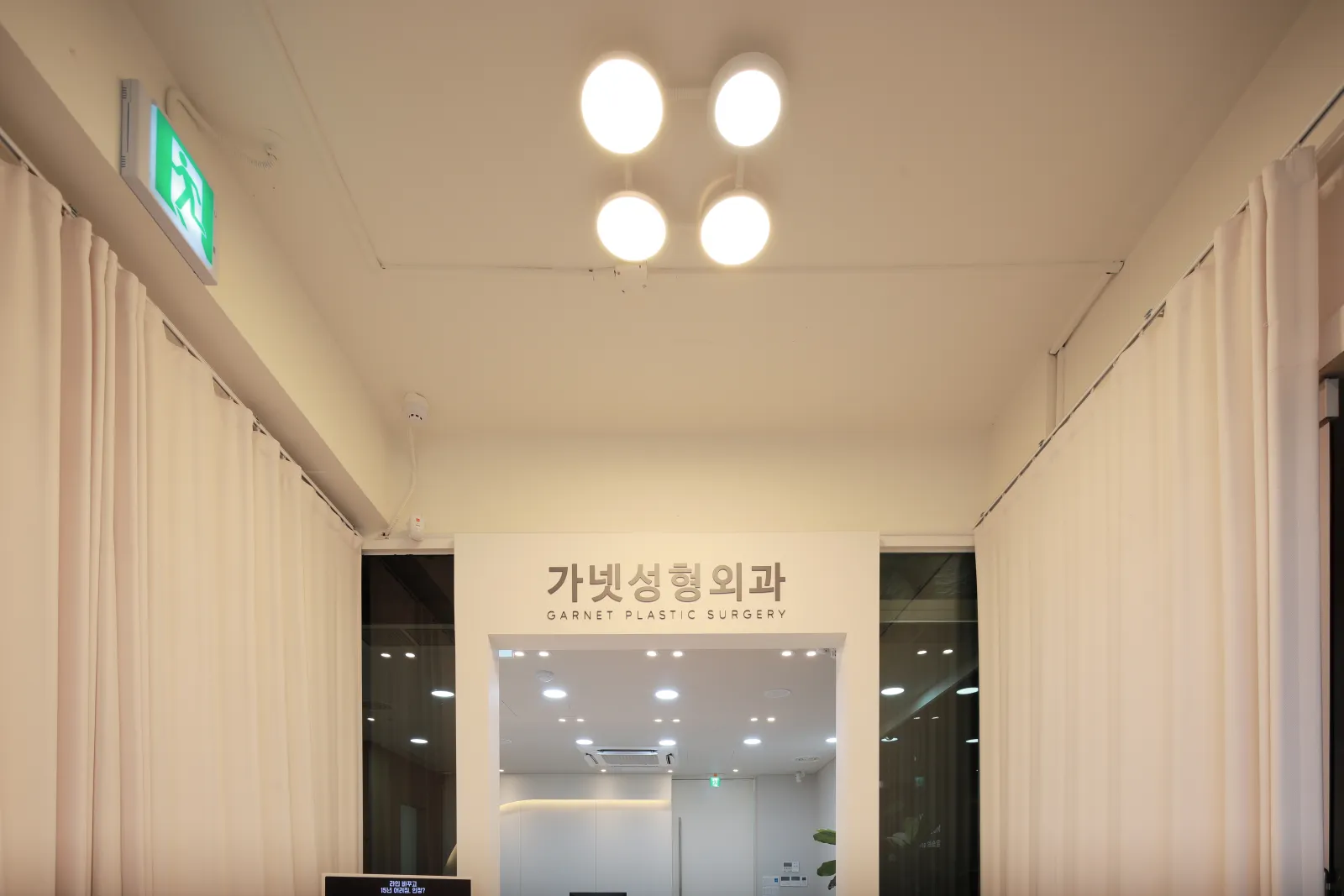
Garnet clinic, Apgujeong
Garnet/Eye Surgery/Under-eye fat repositioning

Eye Surgery · Apgujeong, Seoul

Under-eye fat repositioning in Korea — not cut away

Dr. In-Soo Baek
Dr. In-Soo BaekConsults, operates and follows up himself
10,000+eye procedures since 2011
Scarlessinner-lid approach
40–60 minprocedure time
1surgeon, every step
Anaesthesia
Local / sedation as appropriate
Surgery time
~40–60 minutes
Sutures out
None (scarless)
Social downtime
~1–2 weeks
Follow-up
1 / 3 / 6 months
10,000+ eye procedures since 2011· Plastic surgeon with board certification; accredited Korean Society of Plastic & Reconstructive Surgeons member· Foreign-patient programme registered· Single-surgeon practice

Under-eye fat repositioning at a glance

Under-eye fat repositioning moves the herniated lower-lid fat that creates an eye bag down over the orbital rim to fill the tear-trough hollow beneath it, through a scarless inner-lid approach. Board-certified plastic surgeon Dr. In-Soo Baek examines your lower lids, repositions the fat himself and reviews the contour at every follow-up.

What it is
A lower-lid procedure that releases the herniated orbital fat causing an eye bag and repositions it down over the orbital rim to fill the tear-trough hollow, smoothing the lid-cheek junction in one step.
Best for
A lower eye bag with a hollow tear trough just beneath it, where the issue is fat position and contour more than loose lower-lid skin.
Who performs it
Dr. In-Soo Baek performs every under-eye repositioning himself; he is a board-certified plastic surgeon and Garnet's sole operating doctor, and he sees you before, during and after.
Downtime
No external sutures via the inner-lid approach; most visible swelling and bruising settle over about 1–2 weeks; the contour refines over the following weeks to months.
Longevity
Repositioning keeps the fat in the under-eye, which helps avoid later hollowing; the contour is durable, though the area continues to age naturally over the years.
How to start
Send under-eye photos through WhatsApp or the form below; a no-obligation pre-assessment comes back before you travel.
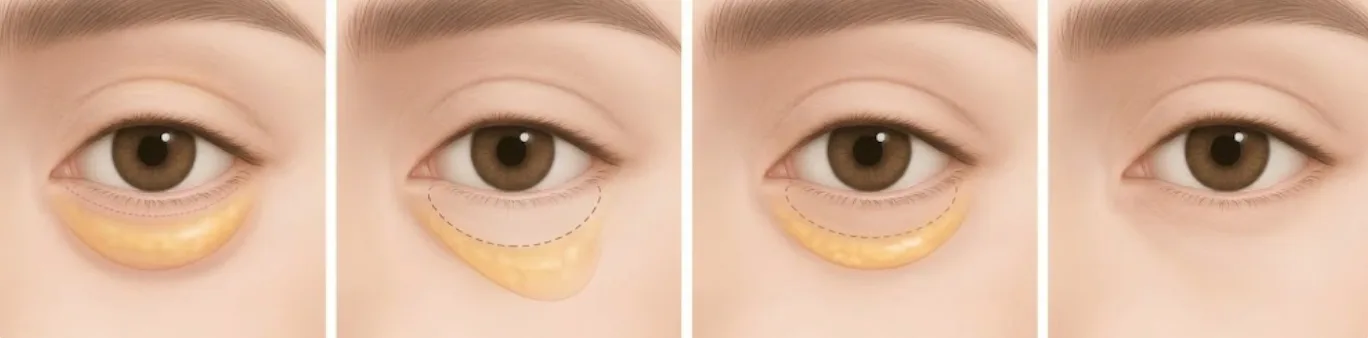
Illustrated steps of under-eye fat repositioning at Garnet: the under-eye fat pad, its new position over the hollow, and the smooth healed lower lid
Illustration: working from inside the lower lid, the under-eye fat (yellow) is moved down into the hollow instead of being removed; the dashed line shows where it sat. The last panel shows the smooth lower lid.

Is fat repositioning right for your lower lids?

A bag with a hollow trough just below

  • A lower eye bag with a hollow tear trough just beneath it
  • Good lower-lid skin tone, where the issue is fat position and the skin is not loose
  • Wanting to keep volume in the under-eye without having fat removed
  • General good health and realistic, discussed expectations
  • Looking for a lasting contour in place of repeated filler

Loose lower-lid skin needing a skin approach

  • Significant loose lower-lid skin, where a skin-based approach may suit better
  • Poor lower-lid tone or a tendency to lid laxity (assessed individually)
  • A hollow with no real fat bag to reposition
  • Uncontrolled medical conditions or bleeding tendency (assessed at consultation)
  • Wanting a same-week, no-swelling result
Dr. In-Soo Baek

Dr. In-Soo Baek

Director & sole operating surgeon
Korean medical licence no. 77407

Operate on what you came for. Trained at Korea University Medical Center. Every case planned, performed and reviewed by the same hands.

1Operating surgeon
~2Surgeries per day
7Registered techniques
  • Board-certified plastic surgeon
  • Studied at Korea University College of Medicine & graduate school (plastic surgery)
  • Belongs to the Korean Society of Plastic and Reconstructive Surgeons (facial-contour, eye & rhinoplasty groups)
  • Every under-eye case planned, performed and followed up by the same surgeon
About the surgeon →

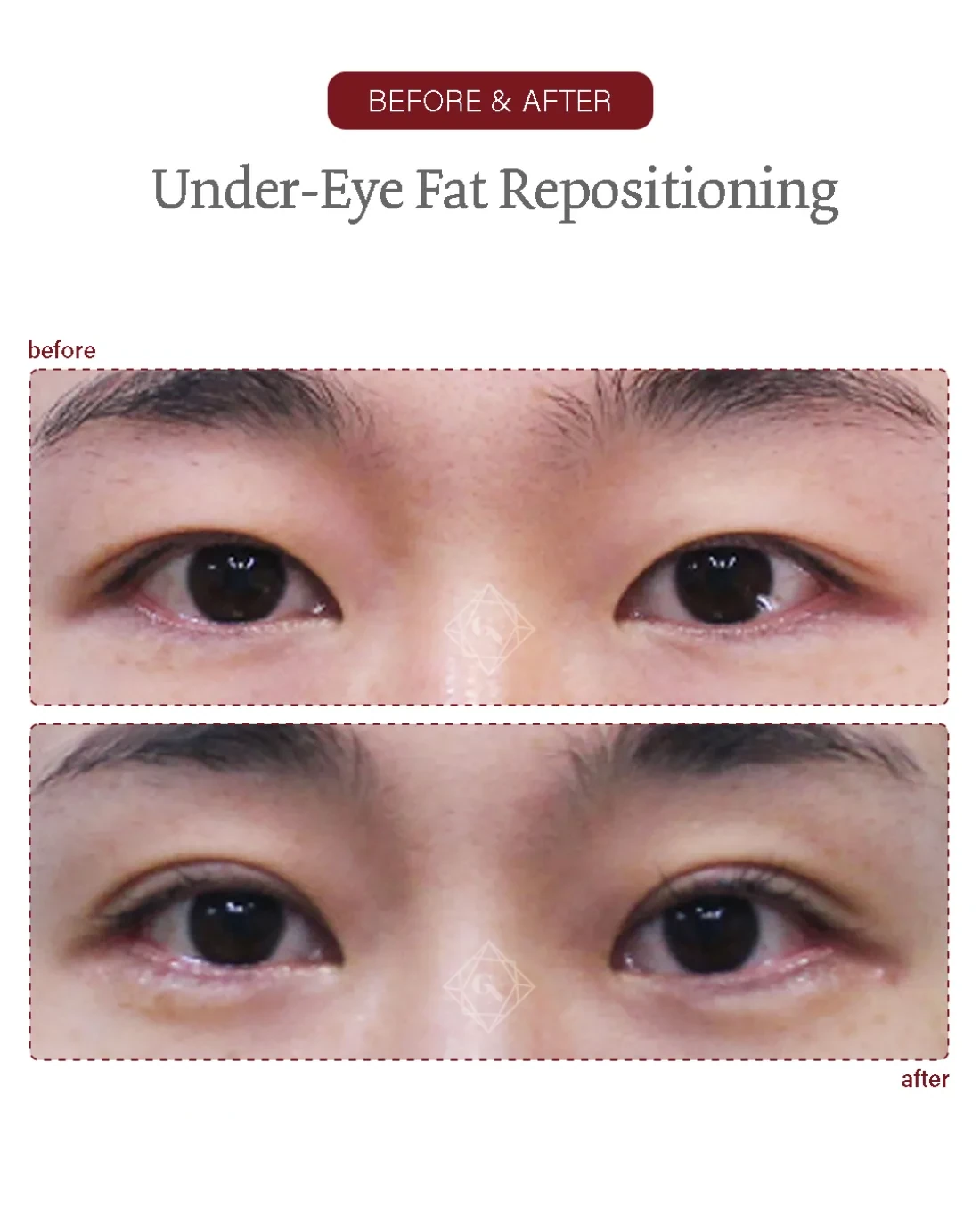
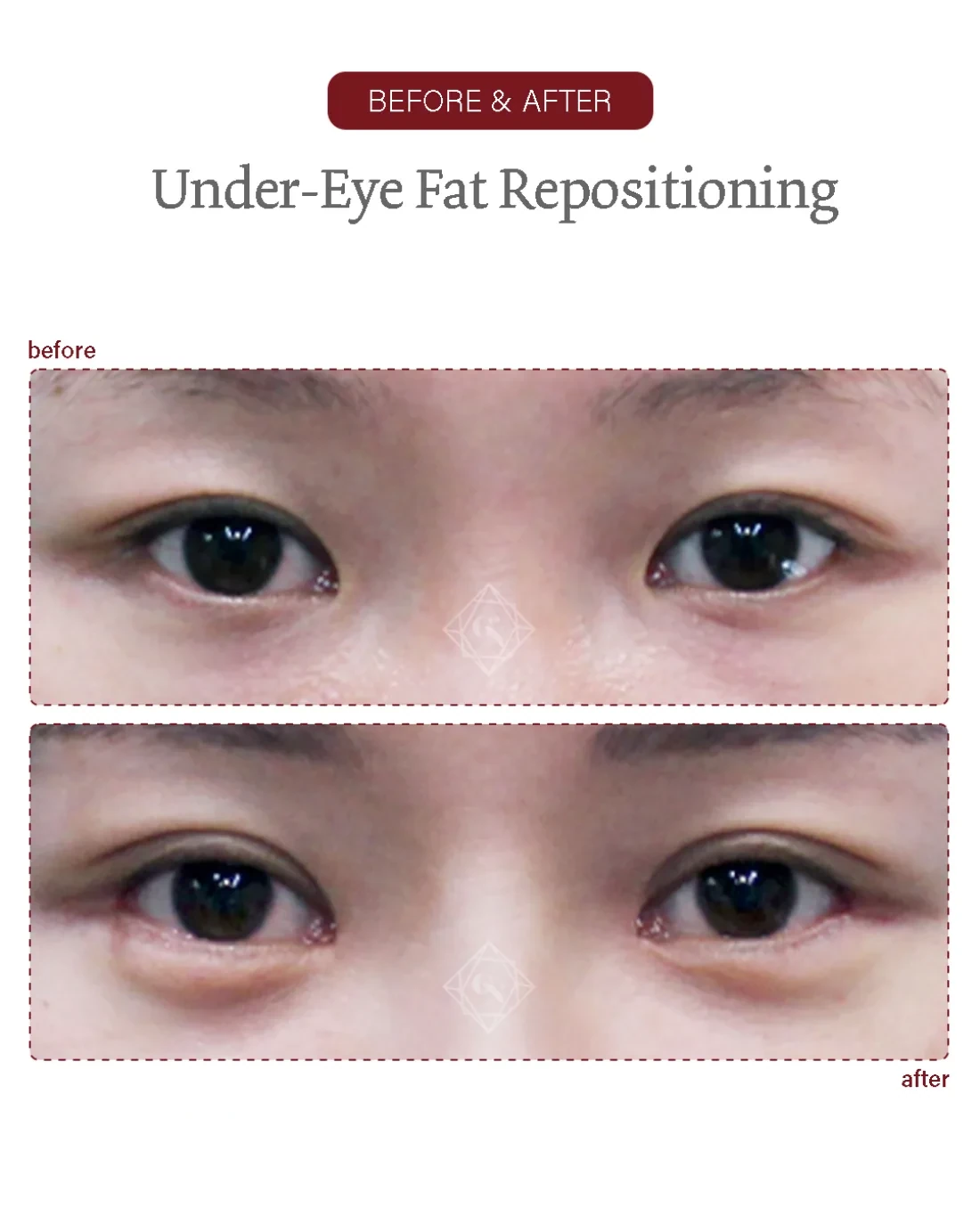
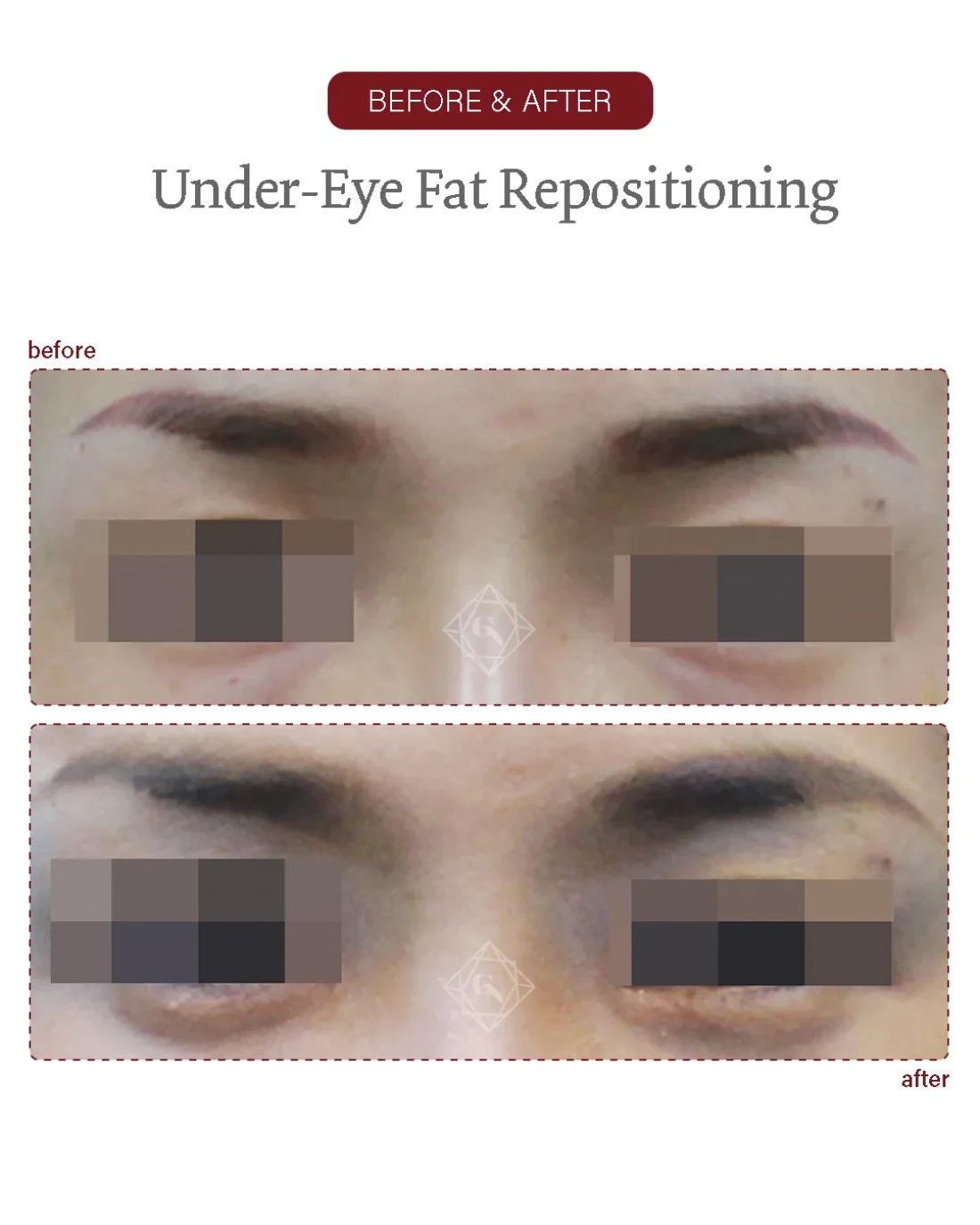
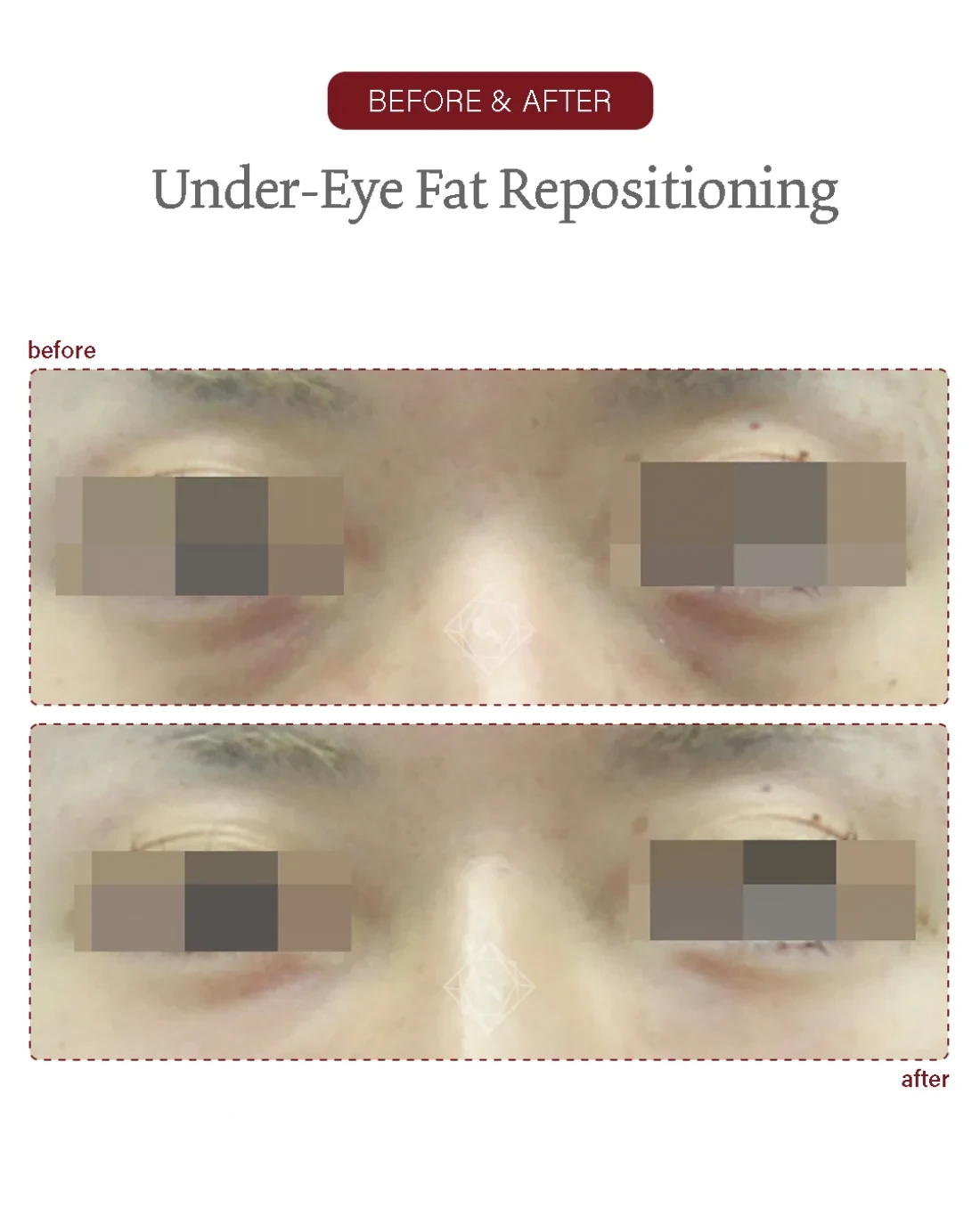
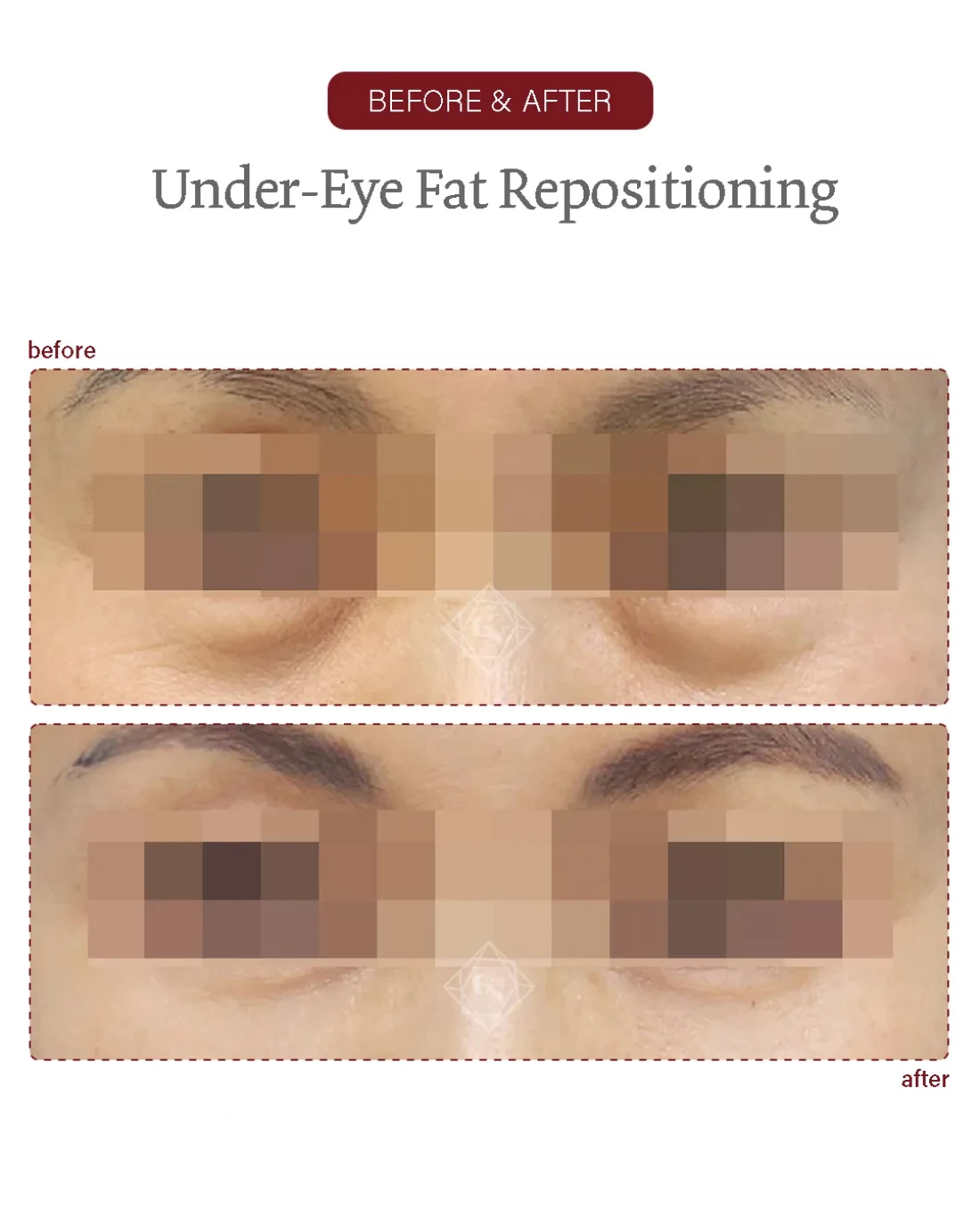
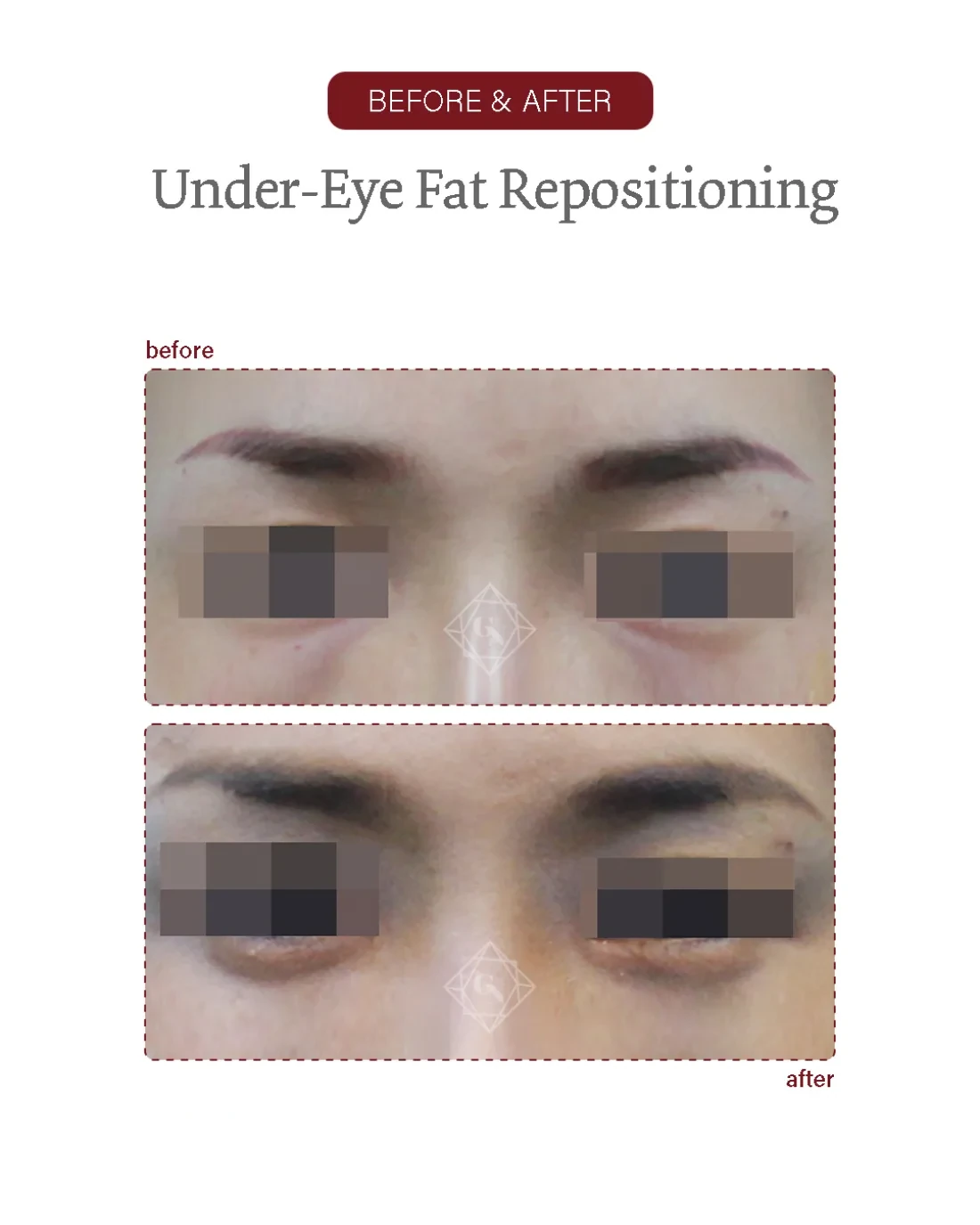
Before & After

Under-eye fat repositioning before/after of actual Garnet patients (published with consent; each set labelled with date, procedure and clinic). Photographed under comparable conditions. Results, recovery and suitability vary by individual and are not guaranteed.

Repositioning the bag instead of removing it

Under-eye fat repositioning is a lower-lid procedure that releases the herniated orbital fat responsible for an eye bag and transposes it down over the infraorbital rim to fill the tear-trough hollow beneath, keeping the fat that would otherwise be excised. Performed through a transconjunctival (inner-lid) approach, it leaves no external scar and smooths the abrupt lid-cheek transition that an eye bag and an adjacent hollow create together.

A tired-looking lower lid is often two problems at once: a bulge (the eye bag), where orbital fat pushes forward, and a groove just below it (the tear trough), where the soft tissue is tethered to the rim and sits hollow. Simply cutting the fat away flattens the bag but can deepen the hollow and leave the under-eye looking gaunt over time.

Fat repositioning treats both together. The fat that forms the bag is released and moved down to fill the hollow over the rim, so the bulge is reduced and the groove is filled with the patient's own tissue in one move. Because the fat is preserved, the under-eye is less likely to look hollow later. The contour between lid and cheek is smoothed, and the lid is not just deflated.

At Garnet this is a single-surgeon procedure done through the inner surface of the lid, so there is no skin incision or visible scar. Dr. Baek plans the case at the consultation, performs it himself, and reviews healing at set intervals; the clinic keeps an unhurried, one-patient-at-a-time schedule. The stated aim is a smoother, more rested lid-cheek contour. Removing every trace of fat is not the goal.

One surgeon for every step of the lower lid

From release of the herniated fat to fixation over the rim, each scarless step is done by Dr. Baek.

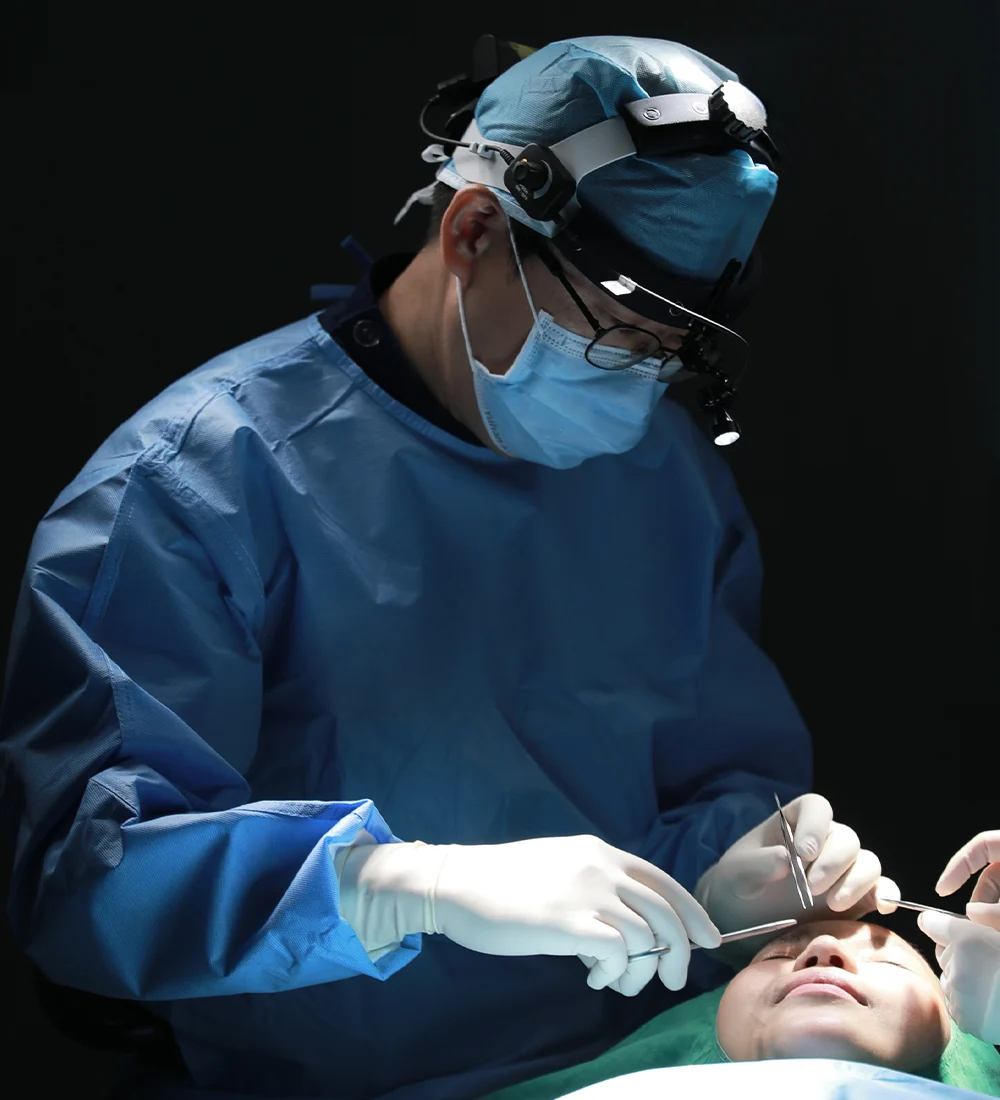
Dr. In-Soo Baek performing surgery at Garnet Plastic Surgery, Apgujeong

A single surgeon, start to finish. Dr. Baek maps the fat pads and the trough, moves the fat himself and checks the lid at each follow-up. With two procedures at most in a day, each lower lid gets unhurried time.

Under-eye fat repositioning typically takes about 40–60 minutes and is usually done under local anaesthesia, with light sedation added if appropriate for comfort; the approach is confirmed with you at the consultation after your history is reviewed. Six steps take the fat from the bag into the tear trough.

01

Sizing the bags and tear-trough depth

Dr. Baek assesses the lower lid in person (the size and position of the fat bags, the depth of the tear trough, lid tone and skin quality) and confirms whether repositioning suits you or a skin-based approach is needed.

02

Inner-lid approach

Access is made through the inner surface of the lower lid (transconjunctival), so the fat is reached without any skin incision and there is no external scar.

03

Release of the fat & rim

The herniated fat pads are gently released and the attachment along the orbital rim is opened, so the fat can be advanced down into the hollow and is not cut away.

04

Moving fat across the rim into the trough

The released fat is repositioned across the rim to fill the tear trough and fixed in place, smoothing the step between the bulge and the groove into one contour.

05

Checking & adjuncts

The contour is checked for symmetry and over- or under-fill. Where the consultation shows it, fine fat grafting or other eye work is planned to balance the result; nothing is added unnecessarily.

06

Review

Because the approach is internal there are usually no skin sutures to remove. Dr. Baek, the only surgeon, checks your lower lids himself before you leave and at each follow-up.

Why the under-eye hollows and bulges

The lower-lid bulge comes from orbital fat herniating forward as the orbital septum that holds it weakens. Just below, the tear trough sits where the orbicularis muscle and overlying skin are anchored to the rim by ligamentous attachments (the arcus marginalis), creating a fixed groove. Releasing that attachment and advancing fat across the rim to fill the groove is the principle behind modern fat-repositioning lower blepharoplasty (Hamra, Plast Reconstr Surg 1995; DOI 10.1097/00006534-199508000-00014).

Doing this through the inner surface of the lid (transconjunctival) reaches the fat without a skin incision and, by preserving fat, keeps volume in an area that thins with age. Where there is also loose lower-lid skin, that is a different problem: a lower blepharoplasty (Quad Plus™) addresses skin, muscle and bags through a skin approach. Dr. Baek advises which fits your lid at the consultation; the right answer depends on whether skin laxity is part of the picture.

Repositioning vs removal vs filler

Fat repositioningFat removal onlyTear-trough filler
What it doesMoves bag fat into the hollowCuts the bag fat awayAdds gel to the groove
Tear troughFilled with own fatMay look deeperFilled temporarily
PermanenceLasting (own tissue)LastingTemporary, repeated
Hollowing risk laterLower (fat preserved)HigherNot surgical
Best forBag + adjacent hollowIsolated bulge, no hollowMild groove, no real bag

Modern transconjunctival techniques transpose and stabilise the orbital fat over the rim to address bag and trough together (Aesthetic Plast Surg 2024; DOI 10.1007/s00266-024-04409-z). The right choice depends on whether you have a true bag, a hollow, or both, and Dr. Baek advises at consultation.

Safety in under-eye fat repositioning

Anaesthesia

Under-eye fat repositioning is usually performed under local anaesthesia, sometimes with light sedation for comfort, decided with you after your medical history is reviewed. The procedure is carried out through the inner lid, so there is no external incision to close.

Your lower-lid planner also performs it

Because Garnet keeps an unhurried, one-patient-at-a-time schedule, the surgeon who planned your lower-lid work performs it and reviews recovery. A second operating doctor is never brought in.

Booking and checks handled for overseas patients

Garnet is registered with Korea's foreign-patient programme; for overseas patients the pre-procedure checks, booking and after-care for the under-eye are handled in English.

Lid assessment

If repositioning is not the right option, for instance where loose skin dominates, you are told so at the consultation, and a skin-based approach is discussed. Photos can be reviewed before you travel.

A scarless, inner-lid approach

Because the procedure is performed through the inner surface of the lower lid, there is no skin incision and no external scar. This is one of the reasons the transconjunctival route is chosen when the problem is fat position and contour and not loose skin.

What you will notice early is swelling and bruising of the lower lid, sometimes with redness of the white of the eye, which settle over the first days to weeks. Where loose lower-lid skin is also a concern, a skin approach with a fine sub-lash scar may be more appropriate; Dr. Baek reviews this at the 1-, 3- and 6-month visits and advises accordingly.

Garnet Plastic Surgery, Apgujeong, Seoul

Under-eye fat repositioning price

Under-eye fat repositioning

From₩2,500,000 + VATExcluding VAT (10% VAT is added at payment)Book now

Same price as Korean patients. Prices shown exclude 10% VAT; your written quote, issued after the in-person consultation, shows the full amount payable.

Week by week

Days 1–3
Swelling and bruising of the lower lid build over the first few days, and the white of the eye may look pink. Keep your head up when resting and apply cold compresses as you were shown. Discomfort is usually mild and managed with prescribed medication.
Days 4–7
Swelling and bruising begin to ease. Because the approach is internal, there are usually no skin sutures to remove. Gentle routine activity resumes as advised.
Weeks 1–2
Most visible swelling and bruising settle enough for everyday settings, though some puffiness and firmness over the rim remain. Light eye make-up resumes once the surgeon confirms healing.
Weeks 2–6
The contour refines as the repositioned fat settles and residual swelling clears. Any unevenness from swelling continues to even out through this window.
Months 1–6
The lid-cheek contour matures and settles fully. Dr. Baek looks at the lid-cheek contour at 1, 3 and 6 months, at the clinic or over messenger after you have gone home.

Do

Keep the head elevated early, use cold compresses as advised, take medication as prescribed, keep the eyes clean, use any prescribed drops, and keep your follow-up visits.

Avoid

Rubbing or pressing the eyes, eye make-up until cleared, strenuous exercise and bending early on, alcohol and smoking, very hot showers or saunas, and direct sun on the area while healing.

How long does repositioned under-eye fat last?

Because the fat is repositioned and kept, the volume that fills the tear trough is the patient's own tissue, which generally gives a lasting contour and helps avoid the hollow, gaunt look that can follow fat removal alone. Transconjunctival repositioning has been reported to correct the bag and trough together with durable improvement and high satisfaction (J Cosmet Dermatol 2025; DOI 10.1111/jocd.70054).

The under-eye continues to age naturally over the years (skin thins, volume shifts and the rim can become more prominent), so the result is durable but not frozen. How it ages depends on tissue quality and lifestyle. Where a hollow recurs years later, fine fat grafting can refine it; where skin laxity becomes the issue, a lower blepharoplasty addresses skin and bags together. Dr. Baek discusses the long view at consultation.

Often planned with fat repositioning

Fat grafting

Where a hollow remains after repositioning, fine fat grafting can refine the contour; it is planned only where the consultation shows it adds something.

When loose lower-lid skin is also present

Where loose lower-lid skin is also present, a lower blepharoplasty (Quad Plus™) addresses skin, muscle and bags through a skin approach and may be the better single option.

Upper-lid work

Double-eyelid surgery or upper blepharoplasty is sometimes planned for a balanced, rested overall eye when the upper lid is also a concern.

Dark-circle care

Repositioning improves contour but not pigment; where shadowing is partly pigment-related, that is discussed separately, as surgery does not treat skin colour.

Garnet Plastic Surgery, Apgujeong, Seoul

Under-eye fat repositioning risks

Every procedure carries some risk. These are explained individually at consultation.

  • Expected swelling and contour unevenness

    Temporary swelling and bruising are expected.

  • Asymmetry

    Asymmetry or unevenness of the contour. Most contour irregularities are minor and settle or can be refined.

  • A residual bulge or remaining hollow

    A residual bulge or a remaining hollow.

  • Eye redness

    Temporary redness of the white of the eye.

  • Lower-lid retraction

    Lower-lid retraction or pulling-down of the lid is uncommon with the inner-lid approach and is part of why it is chosen (J Cosmet Dermatol 2025; DOI 10.1111/jocd.70054).

  • Watering or dryness

    Temporary watering or dryness of the eye.

  • Tightness

    A feeling of tightness over the rim early on.

  • Fluid collection or infection

    Uncommonly, a small fluid collection or, rarely, infection. Significant complications are rare in appropriately selected lower lids.

What reduces risk in practice: careful selection of who suits repositioning versus a skin approach, careful release and fixation of the fat, conservative correction judged to your contour, and follow-up by the operating surgeon. One surgeon and an unhurried schedule let each lower-lid case get this kind of personal planning and after-care.

Planning under-eye fat repositioning from abroad

Most international patients plan about 7–10 days in Korea for under-eye fat repositioning, so the early swelling and bruising settle enough before travel; because the approach is internal, there are usually no skin sutures to remove. The coordinator confirms the timing for your specific plan.

Before you travel, send clear photos (looking straight, up and to the side, in even light) and a note on your concern and your dates through WhatsApp, LINE or the form below. The pre-assessment you receive says whether repositioning or a skin approach suits your lid, and there is no hard sell.

Under Korea's foreign-patient programme, which Garnet is registered with, your under-eye consultation, procedure date and after-care are arranged in English. Back home, you can keep sending Dr. Baek photos of your lower lids by messenger.

Sources

  1. Hamra ST. Arcus Marginalis Release and Orbital Fat Preservation in Midface Rejuvenation. Plast Reconstr Surg. 1995. DOI 10.1097/00006534-199508000-00014. link
  2. Intraorbital Fat Transposition and Stabilization in Enhanced Transconjunctival Lower Blepharoplasty. Aesthetic Plast Surg. 2024. DOI 10.1007/s00266-024-04409-z. link
  3. Transconjunctival Lower Blepharoplasty Combined With Orbital Fat Release: Outcomes and Satisfaction. J Cosmet Dermatol. 2025. DOI 10.1111/jocd.70054. link

Citations are provided for general education. This page is informational and does not replace an in-person consultation; suitability, technique and recovery are individual.

Questions about under-eye fat repositioning

Does under-eye fat repositioning leave a scar?
No external scar. The procedure is done through the inner surface of the lower lid (transconjunctival), so the fat is reached and repositioned without any skin incision. That is one of the reasons this approach is chosen when the issue is fat position and the skin is not loose.
How is fat repositioning different from removing the fat or having filler?
All three address the under-eye but differently. Repositioning moves your own bag fat down to fill the tear-trough hollow, treating bulge and groove together and preserving volume, which lowers the chance of hollowing later. Removing the fat flattens the bag but can deepen an adjacent hollow over time. Tear-trough filler adds temporary gel and is repeated. The right choice depends on whether you have a true bag, a hollow, or both, as the comparison below summarises.
Fat repositioningFat removal onlyTear-trough filler
What it doesMoves bag fat into the hollowCuts the bag fat awayAdds gel to the groove
Tear troughFilled with own fatMay look deeperFilled temporarily
PermanenceLasting (own tissue)LastingTemporary, repeated
Hollowing risk laterLower (fat preserved)HigherNot surgical
Best forBag + adjacent hollowIsolated bulge, no hollowMild groove, no real bag
Does Dr. Baek perform the procedure himself?
Yes. Garnet is a single-surgeon practice, so Dr. Baek handles the consultation, the procedure and the follow-up personally, with no separate operating doctor and no rotation of care.
How long does under-eye fat repositioning last?
Because the fat is preserved, the contour is generally lasting and the area is less likely to look hollow later. The under-eye still ages naturally over the years, so the result is durable but not permanent; any later change is reviewed individually.
How long should I stay in Korea?
Most international patients plan about 7–10 days, so the early swelling and bruising settle before travel; the internal approach usually means no skin sutures to remove. The coordinator at Garnet confirms timing for your plan, and you can ask using the form below.
What anaesthesia is used for fat repositioning, and does it hurt?
Usually local anaesthesia, sometimes with light sedation for comfort, decided after your history is reviewed. Most people describe pressure more than sharp pain, and any discomfort afterwards is mild and managed with prescribed medication.
Am I a good candidate for under-eye fat repositioning?
It suits a lower eye bag with a hollow tear trough beneath it and good lower-lid skin tone, where the issue is fat position and not loose skin. Where skin laxity dominates, a lower blepharoplasty may suit better. Suitability is judged at consultation.
When will I look presentable?
Most visible swelling and bruising settle enough for everyday settings within about 1–2 weeks, though some puffiness over the rim remains; this is similar to recovery after a lower blepharoplasty. The contour refines as the repositioned fat settles over the following weeks.
Will it help my dark circles?
It improves contour and the shadow cast by a bag and hollow, but it does not change skin pigment. Where dark circles are partly pigment-related, that is discussed separately, since surgery does not treat skin colour.
Can I combine it with eyelid surgery?
Yes, where the consultation shows it balances the eye. It is sometimes planned with upper-lid work or fine fat grafting for a rested overall look; it is never added by default.
What if I also have loose lower-lid skin?
Repositioning addresses fat and contour, not skin. Where loose skin is also present, a lower blepharoplasty (Quad Plus™) treats skin, muscle and bags through a skin approach and may be the better single option, as assessed at consultation.
What are the main risks?
The relevant ones are temporary swelling and bruising, contour unevenness, over- or under-correction, and brief redness of the eye; lid retraction is uncommon with the inner-lid route. Most irregularities are minor and settle or can be refined, and are explained individually.
Can I see before-and-after photos?
Yes. Labelled under-eye fat repositioning examples of actual Garnet patients, shown with consent, appear in the before-and-after section above. Results are individual, and your own realistic outcome is discussed at consultation.
Can a previous lower-lid surgery be improved?
Yes. Dr. Baek assesses revision and post-removal cases individually, including any earlier lower-lid surgery or fat removal that has left a hollow; bring records and photos to the consultation.
How do I start without flying to Korea first?
Send lower-lid photos and your travel dates by WhatsApp, LINE or the form below. You'll get a pre-assessment, including whether repositioning or a skin approach suits your lid, before you plan a trip.

Reviews on Google Maps

★★★★★

My mom recently had a brow lift and lower blepharoplasty with Dr. Baek, and our experience has been wonderful so far. The Garnet team was incredibly kind and welcoming, with Kelly assisting us as our English consultant—she made everything…

T S7 months ago

★★★★★

I’m so happy I chose this clinic for my lower blepharoplasty. I was traveling from abroad by myself, so I was a little nervous, but from the beginning I felt comfortable and truly cared for. Everyone was kind, patient, and professional…

S L2 months ago
★★★★★

Came in for an in-person consult and ended up choosing Garnet and Dr.Baek for my non-incisional DES and tiplasty/alarplasty. I communicated with Kelly (English consultant) from the start till now (3 weeks post-op). She really help me feel…

Stephanie Li6 months ago
★★★★★

My under-eyes have been sagging and folding for years... I tried to cover it up with makeup, but it actually got stuck in the wrinkles and made it stand out even more. While going for consultations, I noticed that the bigger the hospital…

조희원2 months ago · Translated by Google

Read all reviews on Google Maps

Ask Dr. Baek’s team

Send photos and your question before you travel. An English-speaking coordinator reviews every enquiry and replies with plain guidance on whether fat repositioning suits your under-eye, the likely plan and timing.

  • ✓ Reviewed by the clinic coordinator, not a bot
  • ✓ Photo-based pre-assessment before you fly
  • ✓ Foreign-patient scheduling & after-care
  • ✓ One surgeon for consultation, surgery and follow-up

Prefer to chat now? Reach the coordinator directly:

Request a consultation

Find the clinic

51 Apgujeong-ro 30-gil, Gangnam-gu, Seoul — near Apgujeong Station

WhatsApp

