




My mom recently had a brow lift and lower blepharoplasty with Dr. Baek, and our experience has been wonderful so far. The Garnet team was incredibly kind and welcoming, with Kelly assisting us as our English consultant—she made everything…

Deep-plane facelift at a glance
A deep-plane facelift repositions the deeper facial layer (the SMAS) and the ligaments that hold it; it does not work by pulling the skin. At Garnet one board-certified plastic surgeon, Dr. In-Soo Baek, plans and performs the lift and sees you at every follow-up.
- What it is
- A facelift that releases and repositions the deeper layer of the face (SMAS) and its retaining ligaments as one unit with the skin, so the tension sits on the deep tissue and the skin surface stays free of it.
- Best for
- Sagging of the mid-face, jowls and jawline where the deeper support has loosened, in someone who prefers a natural look to a pulled one.
- Who performs it
- Only Dr. In-Soo Baek, a board-certified plastic surgeon and the one doctor who operates at Garnet. He consults, operates and follows up.
- Downtime
- Sutures out at ~10 / ~14 days (two stages); most social downtime over by ~2–3 weeks; the deeper result settles over several months.
- Longevity
- Published 30-year data report a median of roughly 11 years before patients seek a revision (Levin & Frankel, 2026).
- How to start
- Before you travel, send photos of your jowls and mid-face by WhatsApp or the form below for a no-obligation pre-assessment.

Is a deep-plane facelift right for you?
Mid-face, jowls and jawline losing deep support
- Sagging of the mid-face, jowls or jawline that the deeper layer no longer supports
- A wish for a change that sits naturally, without a tight, pulled look
- General good health and realistic, discussed expectations
- Time to set aside ~2–3 weeks away from social plans, plus the follow-up visits
- Looking for a longer-lasting structural result over a temporary lift
When the concern is only texture or fine lines
- Concerns limited to skin texture or fine lines, where a non-surgical option may suit better
- Looking for a same-week, no-downtime result
- Uncontrolled medical conditions, which are assessed case by case
- Earlier or localised change, where a thread, mini or deep-mini approach may be more proportionate
- Current smoking, which raises the risk of wound-healing problems in the lifted skin and has to be planned around

Dr. In-Soo Baek
Operate on what you came for. Trained at Korea University Medical Center. Every case planned, performed and reviewed by the same hands.
- Board-certified plastic surgeon
- Korea University: College of Medicine and graduate school (plastic surgery)
- Korean Society of Plastic and Reconstructive Surgeons: member of the facial-contour, eye and rhinoplasty groups
- Plans, performs and follows up each facelift himself
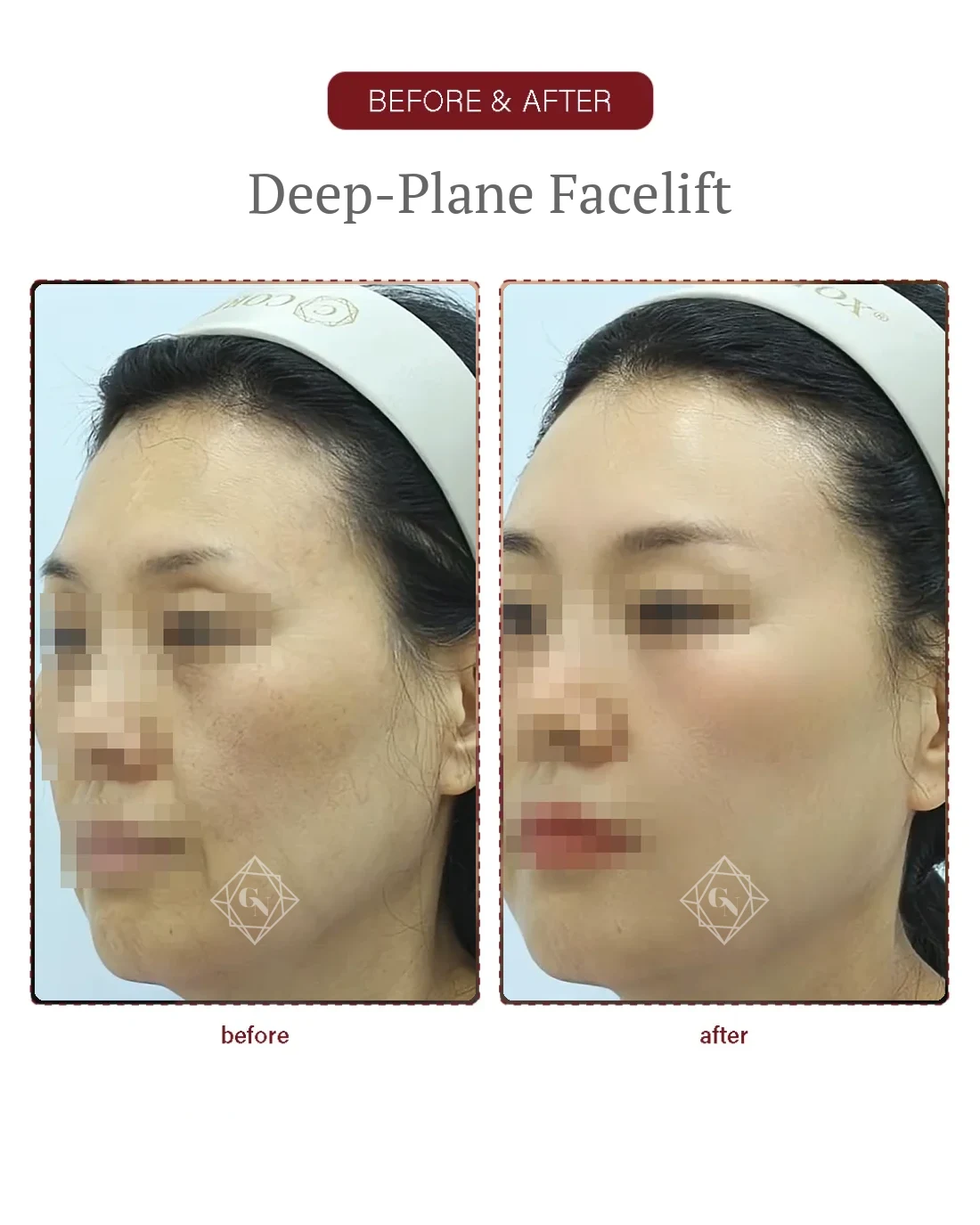
Before & After
Deep-plane facelift before and after of an actual Garnet patient, taken from the clinic's own published video (face partly blurred). More facelift sets are reviewed privately at consultation, as faces are identifiable. Results, recovery and suitability vary by individual and are not guaranteed.
A lift in the deeper layer
A deep-plane facelift is a facial-rejuvenation operation that releases and repositions the deeper musculo-aponeurotic layer of the face (the SMAS) together with the overlying skin as a single unit, after dividing the retaining ligaments that tether it. Because the lift is carried in a plane beneath the SMAS, the deep tissue carries the tension and the skin itself does not.
As the face ages, the visible change (flattening of the cheek, deepening of the nasolabial fold, jowls along the jawline) is driven by descent of the deeper tissues, with the skin only part of the story. A skin-only lift pulls a layer that was never the cause; it can look tight, and because skin stretches, the effect tends to fade.
The deep-plane approach works one layer down. The SMAS (superficial musculo-aponeurotic system) is a continuous sheet that links the superficial muscles of the face; it is anchored to the deeper structures by retaining ligaments. Releasing those ligaments and moving the SMAS and skin together lets the surgeon reposition the cheek and jawline where their support naturally belongs, and re-drape the skin without putting it under tension.
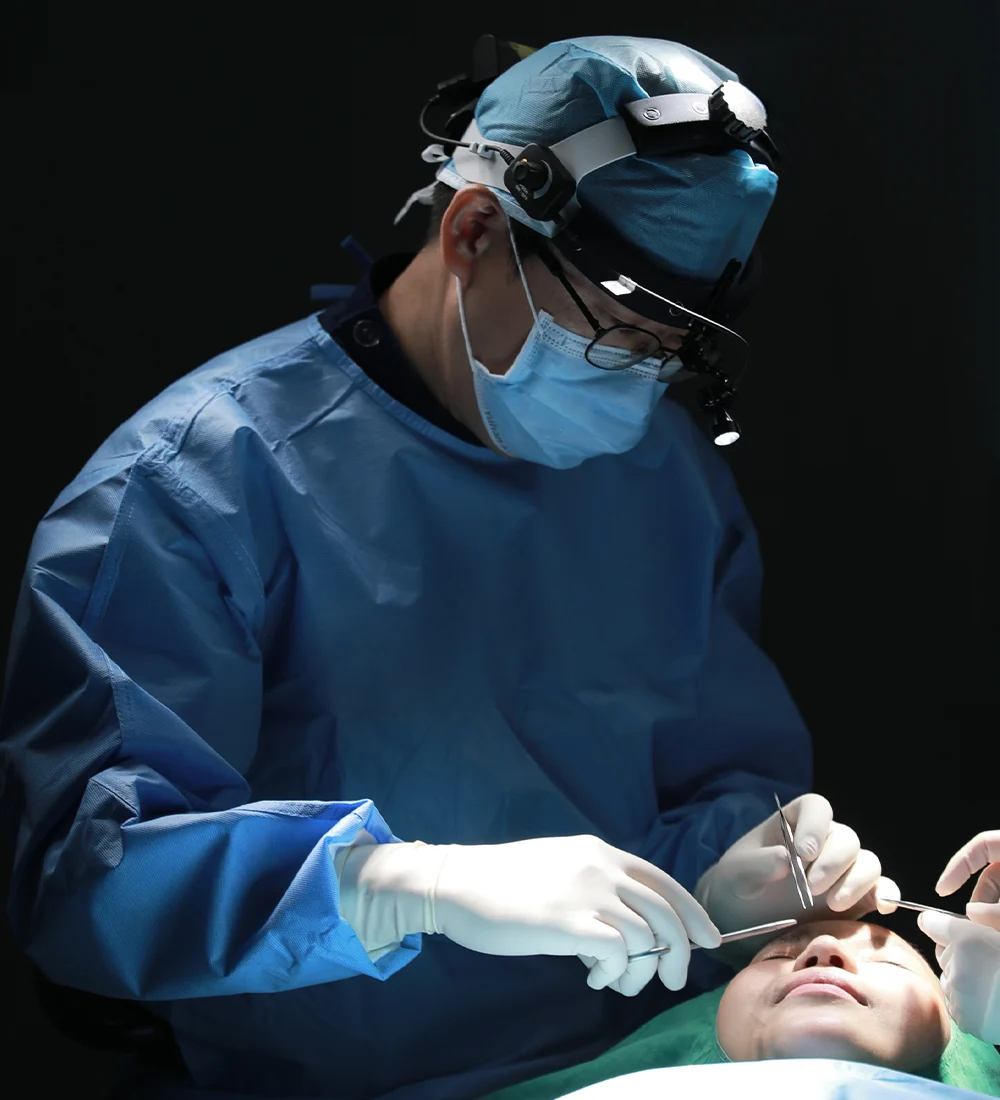
At Garnet this is a single-surgeon operation. Dr. Baek plans your lift at the consultation, operates himself and checks healing at fixed points afterwards. With no more than two surgeries scheduled a day, a facelift is never squeezed into a crowded list. The aim is to treat the sagging you came in with and to prevent foreseeable complications. Chasing the largest possible change is not the goal.
How Dr. Baek performs a deep-plane lift
Every step, from incision design to the sub-SMAS release and fixation, is carried out by Dr. Baek.
A single surgeon, start to finish. From the first assessment to the last follow-up, your deep-plane lift is Dr. Baek's case alone. He schedules no more than two surgeries a day, so the ligament release is never rushed.
The operation typically runs 3–4 hours under sedation or general anaesthesia. The steps below outline how a deep-plane lift is carried out at Garnet.
Mapping ligament laxity, jawline and neck
Dr. Baek assesses the face in person (skin quality, the degree of ligament laxity, the jawline and neck) and agrees the plan and incision design with you. Imaging (3D / CT / ultrasound) is used only where it adds something.
Lines hidden along the hairline and ear creases
Lines are placed along the hairline and in the natural creases in front of and behind the ear, so they settle into existing contours as they heal. Each line is drawn to follow your own hairline and the shape of your ear.
Dividing the retaining ligaments underneath
Working in the deeper plane, the retaining ligaments are divided and the SMAS is released so the deep layer and skin move together as one composite flap, without separating the skin from the tissue beneath it.
Moving the SMAS back without skin tension
The SMAS is repositioned along its natural vector and fixed; the skin is then re-draped and trimmed without tension, which is what helps avoid the over-tight look of a skin-only lift.
Neck & adjuncts
Where the consultation shows it, a neck lift (with platysma work) or fat grafting is performed in the same sitting to balance the result.
Light compression and a same-day face check
Fine closure, dressing and light compression. Dr. Baek checks the face himself before you leave to rest and again at each follow-up.

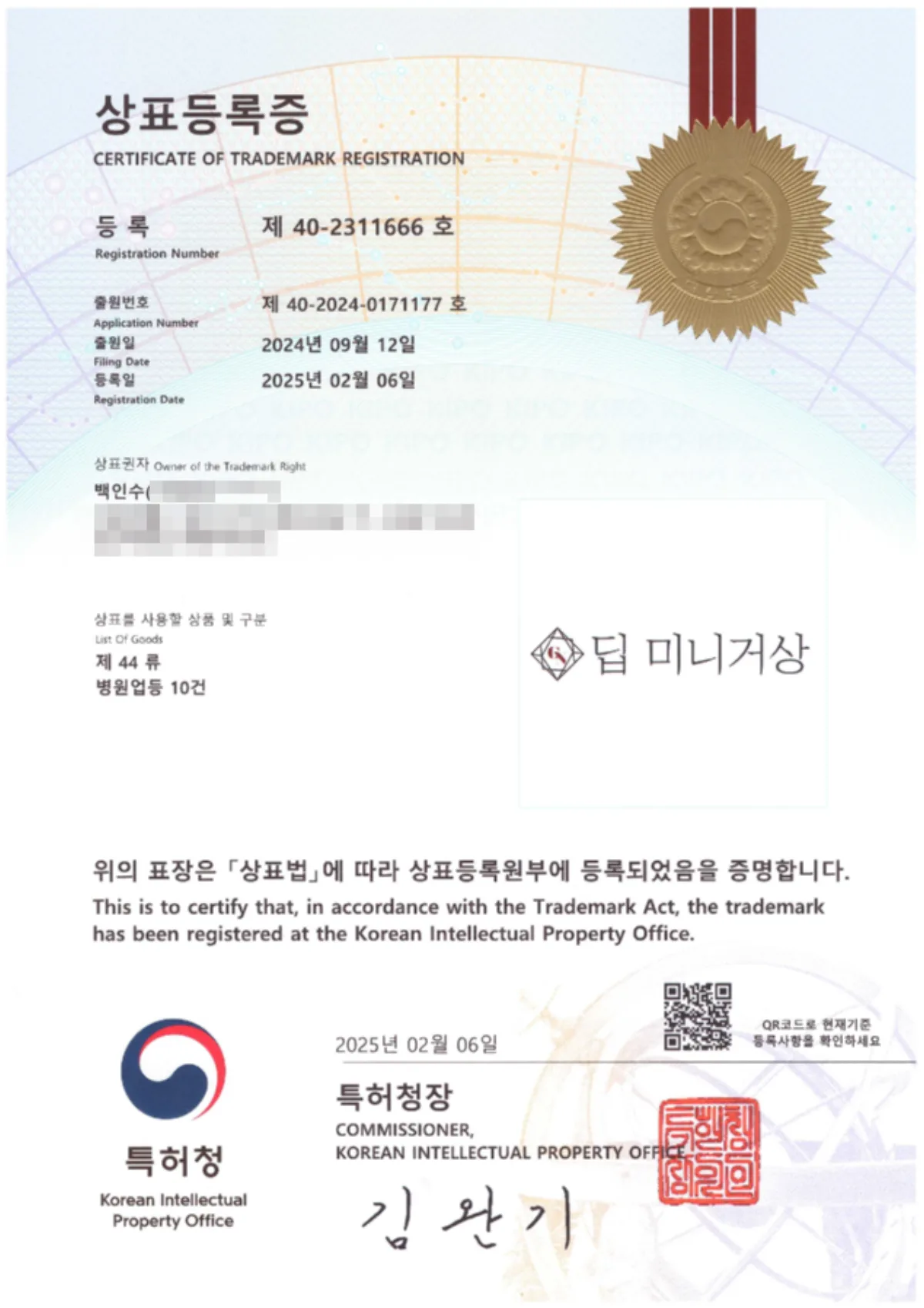
The trademarked Deep mini facelift™ applies the same deep-plane principle through a shorter approach for earlier change. The registration covers the name of the technique and makes no claim about outcomes.
SMAS, ligaments & why it holds
Three structures explain why a deep-plane lift behaves differently from a skin or standard SMAS lift: the SMAS sheet, the retaining ligaments, and the spaces (glide planes) between them. The retaining ligaments (temporal, lateral-orbital, zygomatic, masseteric and mandibular) anchor the soft tissue to the facial skeleton, and their age-related laxity is a major contributor to sagging, jowling and volume descent (Mendelson, Aesthetic Plast Surg 2013; DOI 10.1007/s00266-013-0066-8).
In a deep-plane lift the dissection enters the natural space beneath the SMAS and divides the relevant ligaments so the whole composite flap of skin, fat and SMAS can be moved as a unit. Because the released ligaments are what allowed the descent in the first place, addressing them directly is what lets the result sit naturally and hold. Garnet plans the release for each face individually; the same principles also inform the trademarked Deep mini facelift™ used for earlier, more localised change.
Deep-plane vs SMAS vs skin
| Skin-only lift | SMAS facelift | Deep-plane facelift | |
|---|---|---|---|
| Layer addressed | Skin | SMAS folded / sutured | Sub-SMAS + ligaments released |
| Tension on | Skin | SMAS & skin | Deep tissue (skin tension-free) |
| Natural-looking | Can look tight | Good | Designed to avoid a pulled look |
| Mid-face lift | Limited | Moderate | Greater elevation |
| Typical use | Rarely alone now | Many cases | Mid-face / jowl descent |
A systematic review and meta-analysis comparing the two deeper techniques is published in Aesthetic Plast Surg 2025 (DOI 10.1007/s00266-025-05118-x). Which technique fits depends on your face. Our guide deep-plane vs SMAS facelift walks through it, and Dr. Baek advises you in person.
Safety during a 3–4 hour facelift
Anaesthesia
A deep-plane facelift is usually performed under deep sedation or general anaesthesia, decided with you and the anaesthesia team for comfort and safety over a 3–4 hour operation. Your medical history is reviewed beforehand.
Time set aside for a long, careful lift
With at most two surgeries a day, the 3–4 hour lift is not rushed. Dr. Baek, who planned it, operates and checks your recovery. No second surgeon or rotating team is involved.
Coordinator-led checks for international patients
Garnet holds registration under Korea's foreign-patient programme, and the coordinator handles pre-operative checks, dates and after-care for visitors in English.
Hearing early if surgery is not right
If surgery is not appropriate, or a lighter option suits you better, that is said at the consultation. Photos can be reviewed before you travel.
Where deep-plane facelift scars sit
Facelift incisions are placed where they can hide: within the hairline at the temple, following the natural fold in front of the ear, around the earlobe and into the crease behind the ear, then back into the hairline. The deep-plane technique re-drapes the skin without tension, which is one of the factors associated with finer, flatter scars over time.
The scars are permanent, but because they follow existing contours and the hairline, they are not usually obvious in everyday settings once mature. How they heal differs with skin type and from person to person, so Dr. Baek checks how they are maturing at the 1-, 3- and 6-month visits and gives scar-care advice.
Week by week
Do
Sleep on your back with your head raised, apply cold compresses in the early days, take the prescribed medication, go for gentle walks, and attend every follow-up visit.
Avoid
In the early weeks: hard exercise, bending, heavy lifting, alcohol, smoking, saunas or very hot showers, and sun on the healing scars until you are cleared.
How long a deep-plane facelift lasts
No facelift stops ageing, but a deep-plane lift is associated with durable structural support because it repositions the deep layer and does not rely on the skin. In a 30-year series characterising outcomes and longevity, patients waited a median of roughly 11 years before seeking a revision, with some going far longer (Levin & Frankel, Facial Plast Surg Aesthet Med 2026; DOI 10.1177/26893614261422044).
Individual longevity depends on tissue quality, lifestyle (sun, smoking, weight change) and how the face ages afterwards. Garnet's approach is to plan the lift so it sits naturally from the start, since a result that was never over-pulled tends to age more gracefully. Skin-surface ageing continues independently and can be maintained separately over time.
What pairs with a deep-plane facelift
Neck lift
A facelift and a neck lift are frequently planned together, since the jawline and neck age as one unit; platysma work addresses neck bands and the Pelican™ procedure refines the under-chin.
Fat grafting
Fat grafting adds back mid-face or temple volume that a lift cannot replace on its own, so the face looks more rested as well as tighter.
Upper-face work alongside the lower-face lift
Upper or lower eyelid surgery or a brow/forehead lift may be combined where the upper face is part of the concern.
Deep mini option
For earlier or more localised change, the trademarked Deep mini facelift™ uses the same deep-plane principle through a shorter approach.

Deep-plane facelift risks
Every operation carries risk. These are explained individually at consultation.
Haematoma risk after lifting the deep layer
For facelift surgery the most reported early complication is haematoma (a collection of blood under the skin), with infection much less common; in a large analysis of 11,300 facelift patients, haematoma occurred in about 1.1% and infection in about 0.3% (Aesthetic Surg J 2016; DOI 10.1093/asj/sjv162).
Risk factors
Male sex and high blood pressure are recognised risk factors.
Short-term change in facial skin feeling
Temporary changes in skin sensation.
Asymmetry
Another possible risk.
Scars
Scar-related issues.
Facial nerve
Less commonly, a facial-nerve branch can be weakened; this is usually temporary and rarely lasting.
Smoking
Raises wound-healing and skin risks.
For a facelift, risk is lowered in practice by careful patient selection, control of blood pressure, meticulous technique, closing the skin without tension, and follow-up by the surgeon who operated. With one surgeon and a small daily list, Garnet is set up for this kind of unhurried planning and personal after-care.
Planning a deep-plane facelift from abroad
Most international patients plan roughly 10–14 days in Korea for a deep-plane facelift, so sutures can be removed by the surgeon before travel and the early swelling has settled. The coordinator confirms the timing for your specific plan.
Ahead of your trip, share clear photos of your face from the front, three-quarter and side angles, with a short note on your concern and dates, by WhatsApp, LINE or the form below. You'll get a pre-assessment that covers whether surgery is appropriate at all, with no hard sell.
As a clinic registered with Korea's foreign-patient programme, Garnet arranges your consultation, surgery dates and after-care in English. Once you are home, Dr. Baek can keep checking your facelift recovery over messenger.
Sources
- Levin M, Frankel A. Thirty Years of Deep Plane Facelifts: Characterizing Outcomes and Longevity. Facial Plast Surg Aesthet Med. 2026. DOI 10.1177/26893614261422044. link
- Deep Plane versus SMAS Facelift: A Systematic Review and Meta-Analysis. Aesthetic Plast Surg. 2025. DOI 10.1007/s00266-025-05118-x. link
- Mendelson BC, et al. Anatomic Study of the Retaining Ligaments of the Face and Applications for Facial Rejuvenation. Aesthetic Plast Surg. 2013. DOI 10.1007/s00266-013-0066-8. link
- Preoperative Risk Factors and Complication Rates in Facelift: Analysis of 11,300 Patients. Aesthetic Surg J. 2016. DOI 10.1093/asj/sjv162. link
Citations are provided for general education. This page is informational and does not replace an in-person consultation; suitability, technique and recovery are individual.
Questions about the deep-plane facelift
| Skin-only lift | SMAS facelift | Deep-plane facelift | |
|---|---|---|---|
| Layer addressed | Skin | SMAS folded / sutured | Sub-SMAS + ligaments released |
| Tension on | Skin | SMAS & skin | Deep tissue (skin tension-free) |
| Natural-looking | Can look tight | Good | Designed to avoid a pulled look |
| Mid-face lift | Limited | Moderate | Greater elevation |
| Typical use | Rarely alone now | Many cases | Mid-face / jowl descent |
Reviews on Google Maps
I’m so happy I chose this clinic for my lower blepharoplasty. I was traveling from abroad by myself, so I was a little nervous, but from the beginning I felt comfortable and truly cared for. Everyone was kind, patient, and professional…
Came in for an in-person consult and ended up choosing Garnet and Dr.Baek for my non-incisional DES and tiplasty/alarplasty. I communicated with Kelly (English consultant) from the start till now (3 weeks post-op). She really help me feel…
My under-eyes have been sagging and folding for years... I tried to cover it up with makeup, but it actually got stuck in the wrinkles and made it stand out even more. While going for consultations, I noticed that the bigger the hospital…
Ask Dr. Baek’s team
Send photos and your question before you travel. An English-speaking coordinator reviews every enquiry and replies with guidance on whether surgery is appropriate, the likely plan and timing.
- ✓ Reviewed by the clinic coordinator, not a bot
- ✓ Photo-based pre-assessment before you fly
- ✓ Foreign-patient scheduling & after-care
- ✓ One surgeon for consultation, surgery and follow-up
Prefer to chat now? Reach the coordinator directly:
Request a consultation
Find the clinic
51 Apgujeong-ro 30-gil, Gangnam-gu, Seoul — near Apgujeong Station




