





Garnet · Apgujeong, Seoul · English coordinator · WhatsApp · LINE · Email
Garnet clinic, Apgujeong
Garnet/Fat Grafting & Contouring/Stem cell fat grafting

Fat Grafting & Contouring · Apgujeong, Seoul

Stem cell fat grafting in Korea — your fat, enriched

Dr. In-Soo Baek
Dr. In-Soo BaekConsults, operates and follows up himself
10,000+fat-grafting cases since 2011
1–2 hrstypical operating time
Autologousyour own tissue
1surgeon, every step
Anaesthesia
Local / sedation as appropriate
Surgery time
~1–2 hours
Sutures out
No suture line (cannula access)
Social downtime
~1–2 weeks (bruising)
Follow-up
1 / 3 / 6 months
10,000+ fat-grafting cases since 2011· Board-certified plastic surgeon and accredited member, Korean Society of Plastic & Reconstructive Surgeons· Foreign-patient programme registered· Single-surgeon practice

Stem cell fat grafting: the bottom line

Stem cell fat grafting transfers your own fat, supplemented with the cell-rich stromal fraction taken from the same harvest, to restore lost volume in the cheeks and temples. One board-certified plastic surgeon, Dr. In-Soo Baek, handles every step from consultation to follow-up.

What it is
A fat-transfer procedure that moves your own fat from one area to the face, supplemented with the stromal vascular fraction (the cell-rich portion) separated from the same harvested fat, to restore volume that has been lost with age.
Best for
Loss of volume in the cheeks, temples, under-eye area or the love-band, where soft, natural-feeling fill from your own tissue is preferred over a synthetic filler.
Who performs it
Dr. In-Soo Baek only. He is a board-certified plastic surgeon and Garnet's sole operating doctor, and he consults, harvests and places the fat, and follows up.
Downtime
No suture line, as access is through fine cannula points; bruising and swelling at the donor and recipient sites typically settle over about one to two weeks.
Longevity
A proportion of any grafted fat is reabsorbed in the early months; the fat that survives tends to persist. The amount retained varies by individual and is not guaranteed.
How to start
Send photos of the cheeks, temples or under-eye area through WhatsApp or the form below for a no-obligation pre-assessment before you travel.
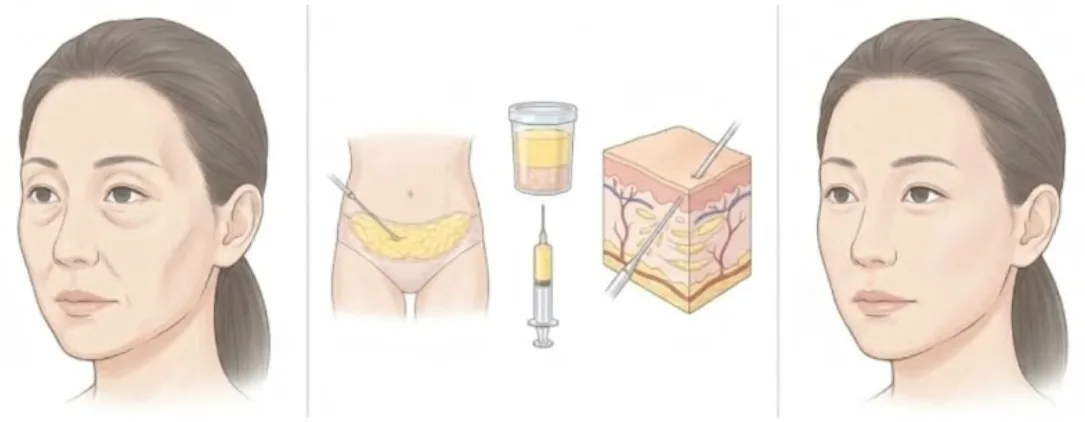
Illustrated steps of stem cell fat grafting at Garnet: facial volume loss, fat taken and processed, re-placed beneath the skin, and the healed face
Illustration: the patient's own fat is taken, processed, and re-placed beneath the skin where volume has been lost.

Is stem cell fat grafting right for you?

Lost volume in cheeks, temples or under-eyes

  • Loss of facial volume in the cheeks, temples, under-eye area or love-band
  • A preference for soft fill from your own tissue over a synthetic filler
  • An available donor site and general good health
  • Realistic, discussed expectations, accepting that a portion of any graft reabsorbs
  • Able to plan about one to two weeks for bruising to settle

Laxity or sag rather than volume loss

  • Mainly skin laxity or structural sag: lifting options may suit better
  • Looking for a fully predictable, fixed volume with no early reabsorption
  • Wanting a small, easily adjustable change: a temporary filler may be more proportionate
  • Uncontrolled medical conditions (assessed individually)
  • Active smoking, which can affect graft healing and is discussed and planned around
Dr. In-Soo Baek

Dr. In-Soo Baek

Director & sole operating surgeon
Korean medical licence no. 77407

Operate on what you came for. Trained at Korea University Medical Center. Every case planned, performed and reviewed by the same hands.

1Operating surgeon
~2Surgeries per day
7Registered techniques
  • Board-certified plastic surgeon
  • Korea University College of Medicine & graduate school (plastic surgery)
  • Member, Korean Society of Plastic and Reconstructive Surgeons (facial-contour, eye & rhinoplasty groups)
  • Plans, performs and follows up each fat graft himself
About the surgeon →

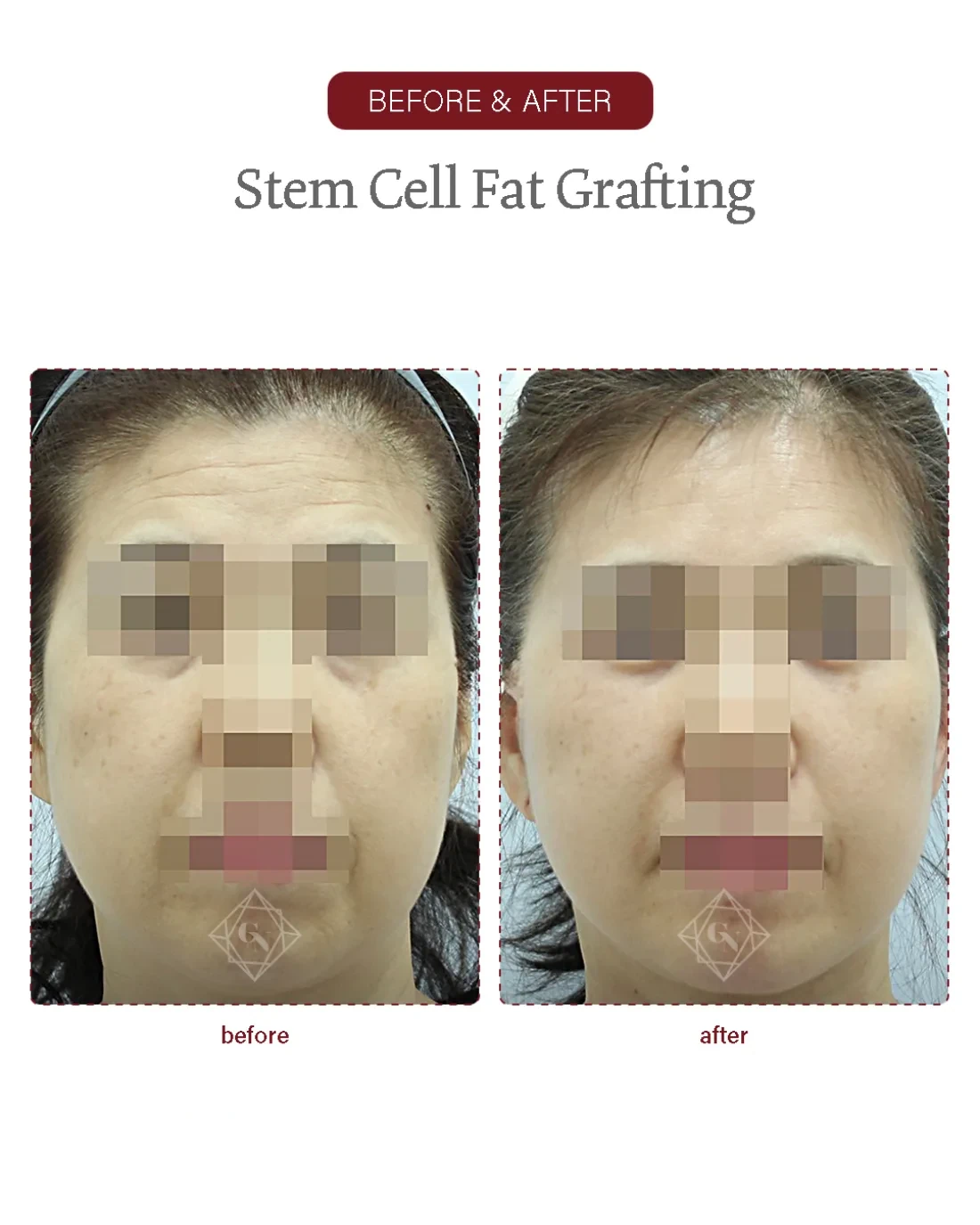
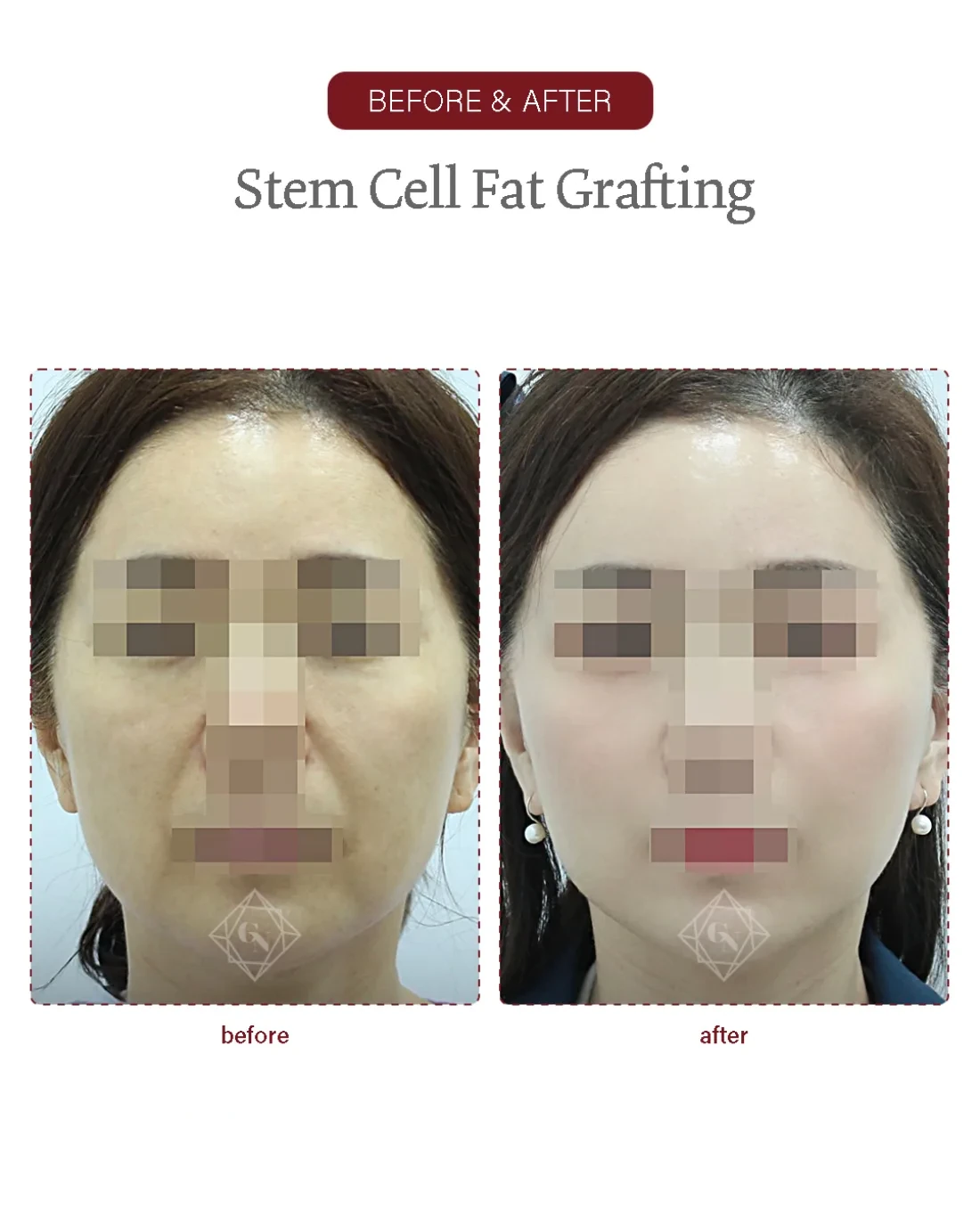
Before & After

Fat-grafting and contouring results of actual Garnet patients (published with consent, with date, procedure and clinic labelled). Results, the amount of fat retained, recovery and suitability vary by individual and are not guaranteed.

Refilling lost volume with your own tissue

Stem cell fat grafting is a fat-transfer procedure in which fat harvested from one part of the body is processed and re-injected into the face to replace lost volume, with the cell-rich stromal vascular fraction separated from the same harvest added to the graft. It is sometimes described as cell-assisted or stromal-fraction-supplemented fat grafting, and the transferred tissue is entirely your own.

As the face ages, part of the change is loss of volume: the cheeks flatten, the temples and under-eye hollow, and the face can read as tired as well as lax. Fat grafting addresses this directly by replacing the lost fat with soft tissue of your own. That tissue integrates with its surroundings, where a synthetic material would sit on top.

The 'stem cell' or stromal-fraction approach adds the cell-rich portion separated from the same harvested fat back into the graft. Adipose tissue naturally contains a mixed population of cells, the stromal vascular fraction, and the rationale is that re-adding this fraction may support the grafted fat. Garnet describes the technique factually: it is the clinic's stromal-fraction-supplemented fat grafting. It is not a designated advanced-regenerative-medicine treatment, and no superior survival or efficacy is promised.

At Garnet this is a single-surgeon procedure. Dr. Baek plans the case from the consultation, harvests and places the fat himself, and reviews healing at set intervals; the clinic caps the day at two surgeries so each case has unhurried time. The stated aim is to address the volume concern you arrived with, without over-filling.

One surgeon, one plan for your stem cell fat grafting

From the fat harvest and processing to layered placement, every step is done by Dr. Baek.

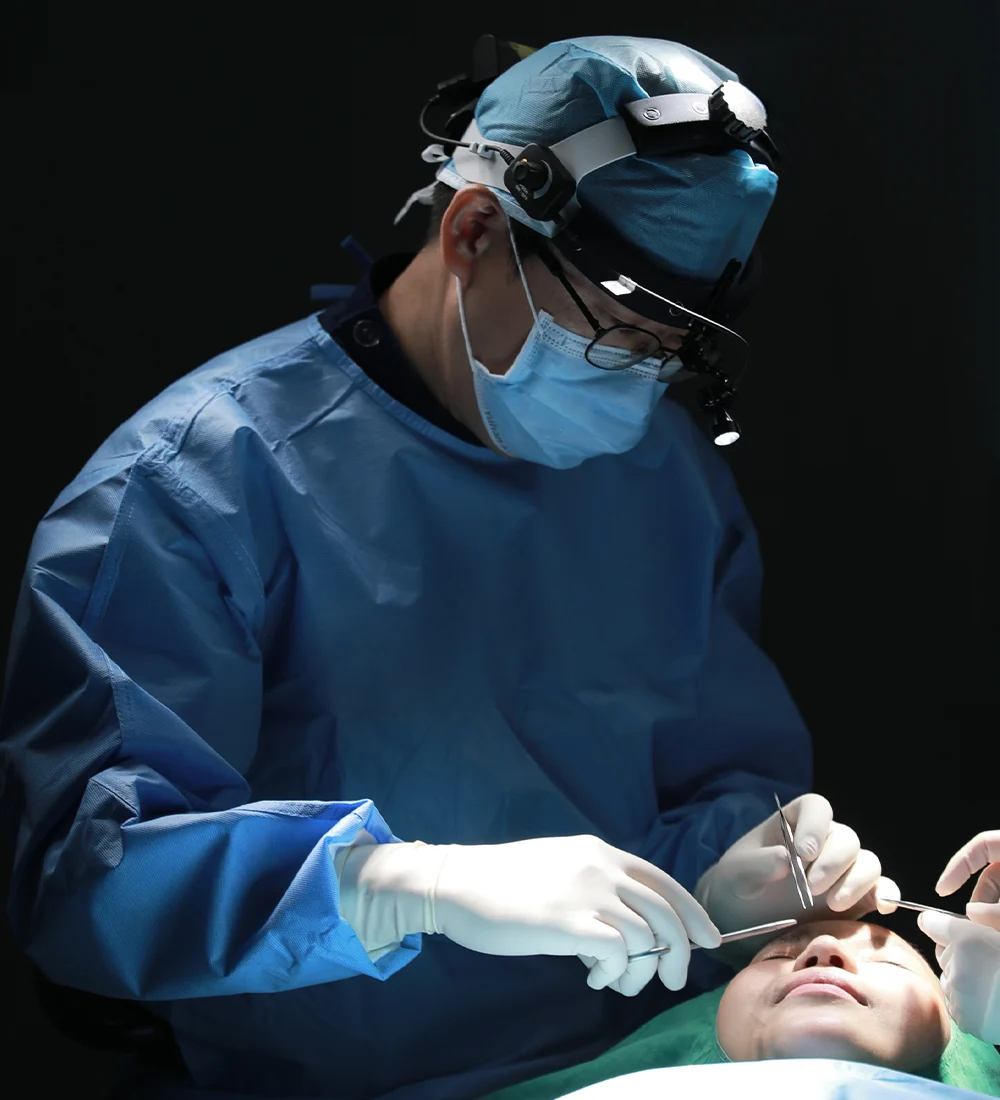
Dr. In-Soo Baek performing surgery at Garnet Plastic Surgery, Apgujeong

A single surgeon, start to finish. Dr. Baek decides where the enriched fat goes, harvests and places it himself and reviews every follow-up. With a limit of two surgeries a day, each graft gets unhurried time.

A stem cell fat graft typically takes about 1 to 2 hours. Local anaesthesia is used, with sedation as appropriate; your medical history guides the combination, as the clinic does not specify a single fixed anaesthetic. The steps below outline how the graft is harvested, prepared and placed at Garnet.

01

Areas to fill and where to harvest from

Dr. Baek assesses the areas of volume loss and the available donor sites (commonly the abdomen or thigh), and agrees the plan with you: how much to harvest and where to place it. Photographs are taken for the record.

02

Fat harvest

Fat is gently aspirated through fine cannula access points at the donor site, using a low-trauma technique intended to keep the fat cells viable for transfer.

03

Processing & enrichment

The harvested fat is processed, and the cell-rich stromal vascular fraction separated from the same harvest is prepared and added to the graft. This is done within the operation from your own tissue.

04

Small parcels at several depths

The prepared fat is placed in small parcels at multiple levels through fine cannula points, so each parcel sits close to a blood supply, the factor most associated with survival. One large pocket is avoided.

05

Pairing fill with neck contouring or threads

Where the consultation shows it, grafting is planned alongside neck and chin contouring or a thread lift so volume and contour are balanced together.

06

Dressing the access points and reviewing results

Light dressing over the access points. Because Garnet is single-surgeon, Dr. Baek reviews you himself and at each follow-up, when early settling and any need for a touch-up are assessed.

Why grafted fat is partly reabsorbed

Grafted fat has no blood supply of its own at the moment it is placed; in the first days it survives by diffusion from the surrounding tissue until new vessels grow in. Fat that is too far from a blood supply does not survive, which is why a portion of any graft is reabsorbed in the early months and why the surgeon places small parcels of fat at multiple levels instead of one large pocket. Reported resorption across the literature is wide, broadly in the range of 20–80% depending on technique and site (J Tissue Eng Regen Med 2018; DOI 10.1002/term.2524).

The stromal vascular fraction added to the graft is the non-fat-cell portion of the harvest, which includes cells thought to support new vessel formation. Reviews report that fraction- or stem-cell-supplemented grafting can be associated with higher retention than plain grafting in some settings (Aesthetic Plast Surg 2026; DOI 10.1007/s00266-025-05511-6), though results vary by study and by patient. Garnet plans the harvest and placement for each face individually; where fixed structural sag is the issue more than volume loss, a thread lift or surgical lifting may be more appropriate.

Stem cell grafting vs standard grafting vs filler

Standard fat graftingStem cell fat graftingSynthetic filler
MaterialYour own fatYour own fat + its stromal fractionManufactured gel (e.g. HA)
PermanenceSurviving fat persistsSurviving fat persistsTemporary, reabsorbed
Donor site neededYesYesNo
Early reabsorptionA portion reabsorbsA portion reabsorbsGradual over months
Best forVolume lossVolume lossSmaller, adjustable fill

A network meta-analysis of assisted fat-grafting methods is published in Aesthetic Plast Surg 2024 (DOI 10.1007/s00266-024-04060-8). Garnet is not designated for advanced regenerative medicine and makes no superior-survival claim; the right choice is individual and is discussed with Dr. Baek at consultation.

How your safety is handled in stem cell fat grafting

Anaesthesia

For the 1-to-2-hour stem cell graft, local anaesthesia is the usual base, with light sedation added as appropriate for comfort. Your medical history shapes the exact mix, and no single fixed anaesthetic is assumed in advance.

One surgeon from harvest through placement

Because Garnet caps the day at two surgeries, the procedure is unhurried and the same surgeon who planned the case harvests, enriches and places the fat and reviews recovery. There is no separate operating doctor.

Pre-graft checks coordinated in English

Pre-graft checks, scheduling and after-care for international visitors are coordinated in English under Garnet's registration with Korea's foreign-patient programme.

When another option fits better

If grafting is not appropriate, or a filler or lifting option suits you better, that is said at the consultation. Photos can be reviewed before you travel.

Cannula access points, not an incision

Stem cell fat grafting is carried out through fine cannula access points at both the donor site and the face. No surgical incision or suture line is involved. These entry points are small and are placed discreetly, and they typically fade over the weeks that follow.

Healing varies by individual and by skin type. Bruising at the donor and recipient sites is common early on and settles over one to two weeks. Dr. Baek reviews the access points and the donor area at the 1-, 3- and 6-month visits and advises on care.

Garnet Plastic Surgery, Apgujeong, Seoul

Stem cell fat grafting price

Stem cell fat grafting

From₩3,500,000 + VATExcluding VAT (10% VAT is added at payment)Book now

Same price as Korean patients. Prices shown exclude 10% VAT; your written quote, issued after the in-person consultation, shows the full amount payable.

Week by week

Days 1–3
Bruising and swelling build at both the donor and recipient sites. Rest, with cold compresses to the face as advised. Discomfort is usually mild and manageable with prescribed medication; the team reviews the access points before you settle in.
Days 4–7
Bruising starts to fade and swelling begins to settle. Gentle activity is fine. The grafted area may look fuller than the final result at this stage because of swelling.
Weeks 1–2
Most visible bruising resolves and you are presentable for everyday settings. The face continues to settle as early swelling reduces; the donor site eases.
Weeks 2–6
Early reabsorption of part of the graft occurs over these weeks, so the volume gradually finds its settled level. Strenuous exercise resumes as cleared at follow-up.
Months 1–6
The retained volume stabilises. Dr. Baek reviews settling at 1, 3 and 6 months (in person, or by messenger after you return home) and discusses whether a touch-up is wanted.

Do

Use cold compresses early, take medication as prescribed, keep the donor area clean, eat and hydrate well to support healing, and keep your follow-up visits.

Avoid

Strenuous exercise and heavy lifting early on, firm pressure or massage on the grafted area unless advised, alcohol and smoking, and very hot showers or saunas until cleared.

How long does stem cell fat grafting last?

Fat grafting is partly a long-term procedure and partly not: a proportion of any grafted fat is reabsorbed in the first months, while the fat that establishes a blood supply tends to persist. Reported survival varies widely between studies and patients, and adding the stromal fraction is associated with higher retention in some reviews (Laloze et al., J Tissue Eng Regen Med 2018; DOI 10.1002/term.2524), though no specific figure can be promised for an individual.

How much fat is retained depends on tissue quality, the area treated, technique and lifestyle factors such as weight change and smoking. Garnet's approach is to place the graft conservatively and review settling over months, with a touch-up discussed only if wanted. Because the tissue is your own, the fat that survives ages with you; it does not wear off the way a temporary filler does.

Often planned together with stem cell fat grafting

Matching restored volume with a defined neckline

Volume restoration is often planned with Pelican™ double-chin and neck contouring, so the lower face and neck are balanced in the same plan.

Thread lift

A thread lift can address early laxity that grafting alone does not, where mild repositioning as well as volume is part of the concern.

Standard fat grafting

Where the stromal-fraction step is not indicated, conventional fat grafting uses the same harvest-and-place principle and is discussed as an alternative.

Eyelid & under-eye work

Grafting to the under-eye is sometimes combined with eyelid procedures where hollowing and lid concerns occur together; this is assessed at consultation.

Garnet Plastic Surgery, Apgujeong, Seoul

Stem cell fat grafting: a word on risk

Every procedure carries risk. Smoking and uncontrolled medical conditions raise risk and are reviewed individually at consultation.

  • Graft reabsorption

    Early reabsorption of part of the graft.

  • Bruising, swelling and uneven correction

    Bruising and swelling are among the main considerations.

  • Asymmetry and correction

    Asymmetry, and over- or under-correction (sometimes needing a touch-up).

  • Uncommon issues

    Uncommonly, small firm areas, fat cysts or infection.

  • Donor site

    Donor-site effects such as bruising and temporary tenderness are usual and settle.

  • Vascular complications

    As with any procedure that places tissue into the face, rare vascular complications are recognised in the broader literature and are minimised by careful, layered technique (Aesthetic Plast Surg 2024; DOI 10.1007/s00266-024-04060-8).

  • No efficacy claim

    Because Garnet is not designated for advanced regenerative medicine, no superior survival or efficacy is claimed; the stromal-fraction step is described factually only.

What reduces risk in practice: careful patient selection, low-trauma harvesting, placing the fat in small parcels close to a blood supply, conservative volumes, and follow-up by the operating surgeon. With one surgeon and two surgeries a day, Garnet plans each fat graft without hurry and follows it personally.

Planning stem cell fat grafting from abroad

Most international patients plan roughly 7–10 days in Korea for stem cell fat grafting, so the early bruising has settled and the surgeon can review the result before travel. The coordinator confirms the timing for your specific plan.

Before you travel, send clear photos (front, three-quarter and side) and a note on the areas you would like addressed and your dates through WhatsApp, LINE or the form below. You'll get a pre-assessment that covers whether grafting is appropriate for your face, with no hard sell.

Consultations, scheduling and after-care are handled in English, and Garnet holds registration with Korea's foreign-patient programme. After you return home, Dr. Baek can continue to review your settling by messenger.

Sources

  1. Stromal Vascular Fraction-Assisted Fat Grafting: A Systematic Review and Meta-analysis of Clinical Outcomes. Aesthetic Plast Surg. 2026. DOI 10.1007/s00266-025-05511-6. link
  2. Laloze J, et al. Cell-assisted lipotransfer: friend or foe in fat grafting? Systematic review and meta-analysis. J Tissue Eng Regen Med. 2018. DOI 10.1002/term.2524. link
  3. Effectiveness and Safety of Different Methods of Assisted Fat Grafting: A Network Meta-Analysis. Aesthetic Plast Surg. 2024. DOI 10.1007/s00266-024-04060-8. link

Citations are provided for general education. This page is informational and does not replace an in-person consultation; suitability, technique and recovery are individual.

Questions about stem cell fat grafting

Is stem cell fat grafting the same as a stem cell treatment?
No. At Garnet it is fat grafting supplemented with the cell-rich stromal fraction separated from your own harvested fat. The clinic is not designated for advanced regenerative medicine, so it is described factually as stromal-fraction-supplemented grafting. It is not presented as a stem cell therapy.
How is stem cell fat grafting different from standard fat grafting or filler?
All three add volume, but differently. Standard fat grafting moves your own fat; stem cell grafting adds the stromal fraction from the same harvest to that fat; a synthetic filler is a manufactured gel that is gradually reabsorbed. Fat that survives persists, while filler is temporary. The right choice is individual.
Standard fat graftingStem cell fat graftingSynthetic filler
MaterialYour own fatYour own fat + its stromal fractionManufactured gel (e.g. HA)
PermanenceSurviving fat persistsSurviving fat persistsTemporary, reabsorbed
Donor site neededYesYesNo
Early reabsorptionA portion reabsorbsA portion reabsorbsGradual over months
Best forVolume lossVolume lossSmaller, adjustable fill
Does Dr. Baek perform the procedure himself?
Yes. Garnet is a single-surgeon practice, so Dr. Baek handles the consultation, the harvest, the enrichment and placement, and the follow-up personally. There is no separate operating doctor. The same is true of its standard fat grafting and other procedures.
How much of the grafted fat will last?
A proportion of any grafted fat is reabsorbed in the first months, and the fat that establishes a blood supply tends to persist. The amount retained varies widely by individual and technique, so no specific figure is promised; a touch-up can be discussed at follow-up if wanted.
How long should I stay in Korea?
Most international patients plan about 7–10 days, so early bruising settles and the surgeon can review the result before travel. The coordinator confirms timing for your plan, and Dr. Baek can review settling by messenger afterwards.
What anaesthesia is used for stem cell fat grafting, and how much pain is there?
Local anaesthesia, with sedation as appropriate, is typical for the 1-to-2-hour graft, and your history guides the choice. Most patients describe tenderness and bruising at the donor and recipient sites rather than sharp pain, managed with prescribed medication.
Where are the marks and will they show?
Access is through fine cannula points, not a surgical incision, so there is no suture line. The small entry points are placed discreetly and typically fade over the following weeks; bruising settles over one to two weeks.
When will I look presentable?
Most visible bruising resolves within one to two weeks for everyday settings. The grafted area may look fuller early because of swelling, and the volume finds its settled level as early reabsorption occurs over the following weeks.
When can I exercise again?
Gentle activity early; strenuous exercise and heavy lifting wait until cleared at follow-up, as this supports settling and reduces bruising. Your surgeon advises the timing for your plan.
Can I combine it with neck or chin contouring?
Yes. Volume restoration is commonly planned alongside Pelican™ neck and chin contouring or a thread lift where the consultation shows they balance the result in one plan.
What is the difference from a thread lift?
A thread lift repositions tissue to address early laxity, whereas fat grafting replaces lost volume. They treat different concerns and are sometimes combined; which one suits you is assessed at consultation.
What are the main risks?
Mainly early reabsorption of part of the graft, bruising, asymmetry, over- or under-correction that may need a touch-up, and, uncommonly, small firm areas or infection. These are discussed individually at consultation, and no superior survival is claimed.
Can I see fat-grafting before-and-after photos?
Yes. Contouring and fat-grafting examples of actual Garnet patients are shown on this page with consent and with the date, procedure and clinic labelled, and more contouring results appear with neck and jawline liposuction. Results vary by individual and are not guaranteed.
Where is the fat taken from?
Usually the abdomen or thigh, chosen at consultation based on where suitable fat is available. The donor site is accessed through fine cannula points and bruising there settles over one to two weeks. Where the concern is structural sag more than volume, a thread lift may be more appropriate.
How do I start without flying to Korea first?
Send photos of the areas you want filled, plus your dates, through WhatsApp, LINE or the form below. You'll get a pre-assessment, including whether grafting is appropriate, before you plan a trip.

Reviews on Google Maps

★★★★★

My mom recently had a brow lift and lower blepharoplasty with Dr. Baek, and our experience has been wonderful so far. The Garnet team was incredibly kind and welcoming, with Kelly assisting us as our English consultant—she made everything…

T S7 months ago

★★★★★

I’m so happy I chose this clinic for my lower blepharoplasty. I was traveling from abroad by myself, so I was a little nervous, but from the beginning I felt comfortable and truly cared for. Everyone was kind, patient, and professional…

S L2 months ago
★★★★★

Came in for an in-person consult and ended up choosing Garnet and Dr.Baek for my non-incisional DES and tiplasty/alarplasty. I communicated with Kelly (English consultant) from the start till now (3 weeks post-op). She really help me feel…

Stephanie Li6 months ago
★★★★★

My under-eyes have been sagging and folding for years... I tried to cover it up with makeup, but it actually got stuck in the wrinkles and made it stand out even more. While going for consultations, I noticed that the bigger the hospital…

조희원2 months ago · Translated by Google

Read all reviews on Google Maps

Ask Dr. Baek’s team

Send photos and your question before you travel. An English-speaking coordinator reviews every enquiry and replies with guidance on whether surgery is appropriate, the likely plan and timing.

  • ✓ Reviewed by the clinic coordinator, not a bot
  • ✓ Photo-based pre-assessment before you fly
  • ✓ Foreign-patient scheduling & after-care
  • ✓ One surgeon for consultation, surgery and follow-up

Prefer to chat now? Reach the coordinator directly:

Request a consultation

Find the clinic

51 Apgujeong-ro 30-gil, Gangnam-gu, Seoul — near Apgujeong Station

WhatsApp

