My mom recently had a brow lift and lower blepharoplasty with Dr. Baek, and our experience has been wonderful so far. The Garnet team was incredibly kind and welcoming, with Kelly assisting us as our English consultant—she made everything…
Septal and ear-cartilage rhinoplasty in brief
Septal and ear-cartilage rhinoplasty refines the nasal tip and supports the framework using the patient's own septal and ear (conchal) cartilage, without a permanent implant. Dr. In-Soo Baek, a board-certified plastic surgeon, harvests the cartilage, shapes the tip grafts himself and sees you at every follow-up.
- What it is
- A rhinoplasty that uses the patient's own septal and ear (conchal) cartilage to project, define and support the nasal tip. It is a structural, autologous approach without a permanent implant.
- Best for
- Refining and projecting an under-defined or under-supported tip where the case needs cartilage but not the volume of rib, including many natural-result and revision plans.
- Who performs it
- Garnet's sole operating doctor, board-certified plastic surgeon Dr. In-Soo Baek, takes both cartilages and builds the tip himself, and he also consults and follows up.
- Downtime
- Nose sutures come out around 7 days and the ear donor-site sutures around 10 days; most social downtime is over by roughly 2–3 weeks; the tip settles over several months.
- Material
- Septal cartilage for straight structural support and ear (conchal) cartilage for the gently curved tip — both your own tissue.
- How to start
- Send nose photos through WhatsApp or the form below and get a no-obligation view on whether septal and ear cartilage would be enough, before you travel.

Is septal and ear cartilage right for your tip?
A soft, under-projected tip needing support
- An under-defined or under-projected nasal tip that needs autologous cartilage support
- A wish to refine the tip without a permanent implant
- A revision nose where modest support is missing and rib is not required
- Good health overall, with room in your plans for ~2–3 weeks of social downtime while the tip settles
- Acceptance of a small, hidden ear donor-site incision
Noses that need major rebuilding
- A nose needing major structural rebuilding, where rib cartilage may be more appropriate
- Looking for a same-week, no-downtime change
- Uncontrolled medical conditions (assessed individually at consultation)
- Expecting a guaranteed identical match to a reference photo
- Active smoking, which raises wound-healing risk at the nose and ear and has to be planned around

Dr. In-Soo Baek
Operate on what you came for. Trained at Korea University Medical Center. Every case planned, performed and reviewed by the same hands.
- Board-certified plastic surgeon
- Educated at Korea University College of Medicine & graduate school (plastic surgery)
- Korean Society of Plastic and Reconstructive Surgeons member (facial-contour, eye & rhinoplasty groups)
- Every septal and ear-cartilage case planned, performed and followed up by the same surgeon
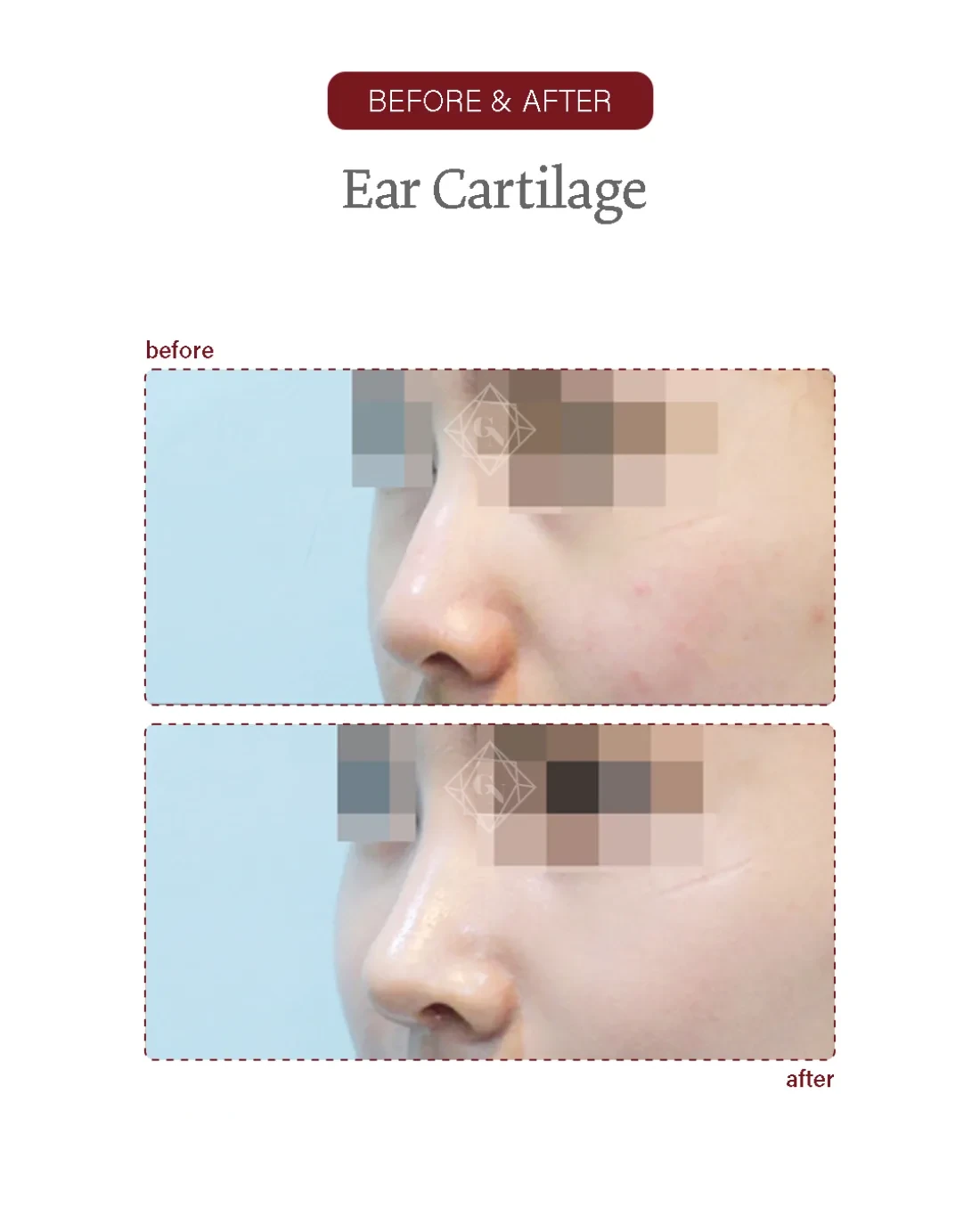
Before & After
Ear-cartilage rhinoplasty result of an actual Garnet patient, Apgujeong (published with consent; same lighting and angle before and after). Results, recovery and suitability vary by individual and are not guaranteed; further sets are reviewed privately at consultation.
Refining the tip with your own cartilage
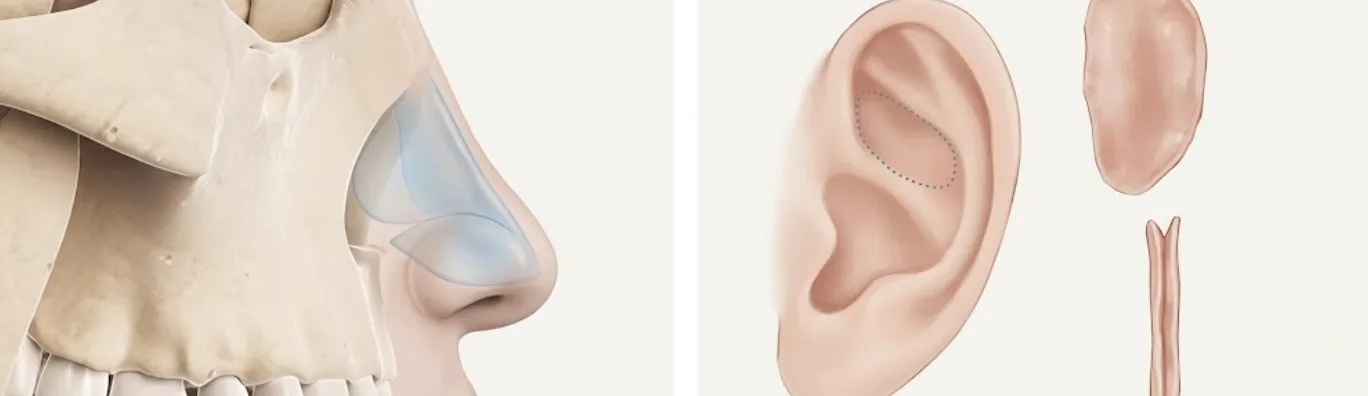
Septal and ear-cartilage rhinoplasty is a nose operation that projects and defines the nasal tip using the patient's own septal cartilage, for straight, structural grafts, and ear (conchal) cartilage, whose natural curve suits the soft contour of the tip. Because it rebuilds with the patient's own tissue and uses no synthetic implant, it is an autologous, structural approach used when a nose needs cartilage support without the larger volume of rib.
Tip refinement is often less about adding height to the bridge than about giving the tip structure: projection, rotation and definition that hold their shape. Septal cartilage, taken from the central wall of the nose, provides straight, firm grafts ideal for a septal-extension graft or tip strut; ear (conchal) cartilage, with its gentle natural curve, suits the rounded contour of the tip and the alar rim.
At Garnet this combination is used when a nose needs autologous support but not the volume of rib cartilage. It pairs naturally with an implant-free philosophy and is a common choice in revision work where modest support is missing. The two cartilages complement each other: the straight septum for the backbone, the curved ear for the surface.
This is a single-surgeon operation. Dr. Baek plans the case from the consultation, harvests and shapes the cartilage and performs the rebuild himself, and reviews healing at set intervals; the clinic caps the day at two surgeries so each case has unhurried time. The stated aim is to refine the tip for the concern you arrived with. The maximum possible change is not the target.
One surgeon from harvest to tip graft
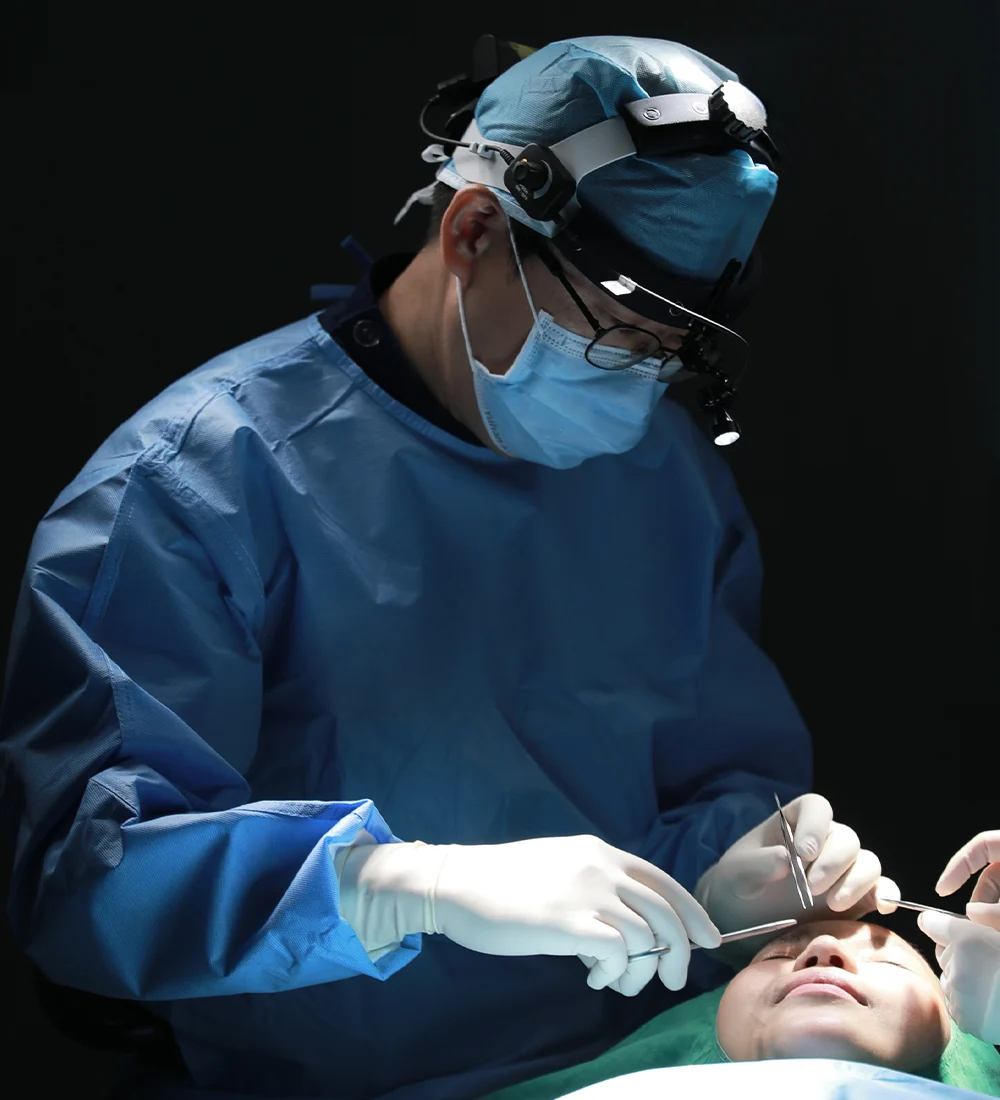
Cartilage harvest, tip grafting and donor-site closure are all done by Dr. Baek.
A single surgeon, start to finish. Dr. Baek decides which cartilage goes where, carries out the harvest and grafting himself and sees you at each follow-up. Only two operations are booked per day, so tip work is never rushed.
The operation can be closed or open depending on the case, and the time depends on how much tip work and grafting the nose needs; it is generally shorter and simpler to recover from than a rib case. Once your history has been reviewed, you and the anaesthesia team agree the anaesthesia together; nothing is fixed in advance. The six steps below run from the tip examination to the first dressing changes.

Checking septal supply and tip support
Dr. Baek examines the tip, its support and the skin in person, checks how much septal cartilage is available, and agrees the plan with you. Imaging is used where it helps map the grafting.
Septal harvest
Septal cartilage is taken from within the nose, preserving an L-strut for support, to supply straight structural grafts. This adds no external incision because the septum sits inside the nose.
Ear (conchal) harvest
Where curved cartilage is needed for the tip or alar rim, conchal cartilage is taken through a small, hidden incision behind the ear, without changing the ear's shape.
Tip grafting
The grafts are shaped and placed (a septal-extension graft or strut for projection and rotation, conchal grafts for the soft contour of the tip), so definition rests on a rebuilt structure.
Balancing the tip and closing the ear incision
The tip is checked for symmetry and the framework balanced; the nasal incisions and the small ear incision are closed; a splint and dressing are applied as needed.
Early checks on the tip and the ear
Garnet's protocol includes dressing changes early in recovery. As the only surgeon, Dr. Baek checks the tip and the ear site himself before you settle in and at each follow-up.
Why two cartilages, and where they come from
Septal and conchal cartilage have complementary properties. Septal cartilage is straight, flat and firm, which makes it the natural choice for a caudal septal-extension graft that lengthens and stabilises the tip; published work on conchal caudal septal-extension grafts shows good cosmetic and functional outcomes when the curved ear cartilage is engineered for this role (Facial Plast Surg 2023; DOI 10.1055/s-0042-1760296). Ear cartilage's gentle curve, by contrast, mirrors the soft contour of the dome and alar rim.
The ear donor site is the concha, the bowl of the outer ear, reached through a small, hidden incision usually placed behind the ear. Harvesting conchal cartilage does not change the ear's appearance or function when done carefully, and donor-site complications are low in published series (Arch Facial Plast Surg 2007; DOI 10.1001/archfaci.9.4.298). The septum is borrowed from within the nose itself, so it adds no external incision.
Septal/ear vs rib vs implant
| Septal & ear cartilage | Rib (costal) cartilage | Silicone implant | |
|---|---|---|---|
| Material source | Septum & ear (own) | Rib (own or donor) | Synthetic |
| Volume & strength | Moderate | Large & structural | Fixed, non-biological |
| Donor site | Behind the ear (small) | Chest (or none if donor rib) | None |
| Best for | Tip definition & support | Major rebuilding / revision | Dorsal augmentation only |
| Main caution | May be insufficient alone | Possible warping | Long-term implant risks |
Conchal cartilage harvesting shows low donor-site morbidity in published series (Arch Facial Plast Surg 2007, DOI 10.1001/archfaci.9.4.298), and is a reliable tip-graft source. Whether septal and ear cartilage are enough, or rib is needed, is individual, and Dr. Baek advises at consultation.
Safety in septal and ear-cartilage surgery
Anaesthesia
The anaesthesia is chosen with you and the anaesthesia team to suit the extent of the grafting and your medical history, which is reviewed beforehand.
Tip grafting without time pressure
With only two surgeries on any day, the tip grafting is unhurried, and Dr. Baek, who planned it, also carries it out and checks your recovery. No other doctor operates and care does not rotate.
Pre-operative planning for visitors from abroad
Garnet is registered with Korea's foreign-patient programme, and visitors from abroad have their pre-operative checks, surgery date and after-care arranged in English.
Cartilage assessment
If the nose needs more support than septal and ear cartilage can give, for instance rib, you are told so at the consultation. Photos can be reviewed before you travel.
Where the nose and ear incisions sit
Septal cartilage is harvested from inside the nose, so it leaves no external scar. The ear donor incision is small and usually placed behind the ear (or hidden in the conchal bowl), where it is concealed by the ear's own contour and is not obvious once mature. On the nose, a closed approach keeps the incisions inside the nostrils, while an open approach leaves a small columellar scar in a natural shadow.
The columellar and ear scars are permanent but placed where they hide, and Dr. Baek checks them at the 1-, 3- and 6-month visits and gives scar-care advice. Healing varies by individual and by skin type; if you are prone to thicker scarring, raise it early, because it matters most for the ear site.
Week by week
Do
Keep the head elevated, take medication as prescribed, sleep on your back, keep the ear dressing as advised, protect the splint, and keep your follow-up visits.
Avoid
Bumping or pressing the nose, glasses on the bridge early on, sleeping on the harvested ear early on, strenuous exercise and bending, alcohol and smoking, very hot showers/saunas, and direct sun on healing scars until cleared.
How long does a cartilage-built tip last?
Once healed, a tip built from septal and ear cartilage is intended to give durable, lasting definition because it rebuilds with the patient's own structural tissue and no synthetic implant. Conchal cartilage in particular tends to hold its shape reliably once integrated, and a conchal caudal septal-extension graft has shown good lasting cosmetic and functional outcomes in published follow-up (Facial Plast Surg 2023; DOI 10.1055/s-0042-1760296).
Individual longevity depends on tissue quality and how the nose is protected during healing. Garnet's approach is to graft conservatively and let the tip settle, since a result that was never over-projected tends to age more predictably. Where a nose later needs more support than these cartilages can give, rib is discussed as a separate step.
Often combined with septal and ear grafts
When septum and ear cannot supply enough
Where more structural volume is needed than the septum and ear hold, rib cartilage can rebuild the framework, with conchal grafts refining the tip surface.
Revisions missing modest tip support
Septal and ear cartilage are common choices in revision noses where modest tip support is missing and rib is not required.
Nasal valve or septum correction for breathing
Septal correction or work on the nasal valve is addressed in the same sitting where breathing has been affected, so shape and airway are treated together.
Standard rhinoplasty
A standard rhinoplasty can pair a dorsal implant with autologous septal or ear tip cartilage where the bridge also needs augmentation.
Septal and ear-cartilage risks
Every operation carries risk. With septal and ear cartilage the recognised issues are generally milder than with rib; these are explained individually at consultation.
Unevenness or partial cartilage resorption
Asymmetry and contour irregularity.
Partial resorption
Partial resorption of the cartilage.
Tip swelling
Prolonged tip swelling.
Insufficient cartilage
The possibility that the available cartilage is insufficient and another source is needed.
Low donor-site risk in the ear bowl
Conchal cartilage harvesting carries a low rate of donor-site problems such as keloid or haematoma in published series (Arch Facial Plast Surg 2007; DOI 10.1001/archfaci.9.4.298).
Sensation and breathing
Temporary changes in nasal or ear sensation, and breathing change.
Infection and scars
Infection (uncommon), and scar-related issues at the ear or columella.
Skin and smoking
Thin or previously operated skin can heal less predictably. Smoking raises wound-healing risk.
What reduces risk in practice: careful patient selection, preserving the septal L-strut during harvest, gentle conchal harvest that protects ear shape, meticulous grafting, and follow-up by the operating surgeon. A short daily list and a single surgeon give each septal and ear-cartilage case that kind of careful planning and personal after-care.
Planning septal and ear-cartilage surgery from abroad
Most international patients plan roughly 10–14 days in Korea for a septal and ear-cartilage rhinoplasty, so the splint and both the nose sutures (around day 7) and the ear sutures (around day 10) can be removed by the surgeon before travel. The coordinator confirms the schedule for your specific plan.
Ahead of the trip, share front, three-quarter, side and base photos of your nose, a short note on what bothers you about the tip, and your dates by WhatsApp, LINE or the form below. The pre-assessment you get back covers whether septal and ear cartilage are likely to be enough, with no hard sell.
As a registered clinic under Korea's foreign-patient programme, Garnet handles your consultation, surgery booking and after-care in English. When you are back home, Dr. Baek can follow the tip and ear healing by messenger.
Sources
- Foda HMT, El Abany A. A Novel Ear Cartilage Caudal Septal Extension Graft. Facial Plast Surg. 2023. DOI 10.1055/s-0042-1760296. link
- Wee JH, et al. Donor site morbidities resulting from conchal cartilage harvesting in rhinoplasty. Arch Facial Plast Surg. 2007. DOI 10.1001/archfaci.9.4.298. link
- Varadharajan K, Sethukumar P, Anwar M, Patel K. Complications Associated With the Use of Autologous Costal Cartilage in Rhinoplasty: A Systematic Review. Aesthet Surg J. 2015. DOI 10.1093/asj/sju117. link
Citations are provided for general education. This page is informational and does not replace an in-person consultation; suitability, technique and recovery are individual.
Questions about septal and ear-cartilage rhinoplasty
| Septal & ear cartilage | Rib (costal) cartilage | Silicone implant | |
|---|---|---|---|
| Material source | Septum & ear (own) | Rib (own or donor) | Synthetic |
| Volume & strength | Moderate | Large & structural | Fixed, non-biological |
| Donor site | Behind the ear (small) | Chest (or none if donor rib) | None |
| Best for | Tip definition & support | Major rebuilding / revision | Dorsal augmentation only |
| Main caution | May be insufficient alone | Possible warping | Long-term implant risks |
Reviews on Google Maps
I’m so happy I chose this clinic for my lower blepharoplasty. I was traveling from abroad by myself, so I was a little nervous, but from the beginning I felt comfortable and truly cared for. Everyone was kind, patient, and professional…
Came in for an in-person consult and ended up choosing Garnet and Dr.Baek for my non-incisional DES and tiplasty/alarplasty. I communicated with Kelly (English consultant) from the start till now (3 weeks post-op). She really help me feel…
My under-eyes have been sagging and folding for years... I tried to cover it up with makeup, but it actually got stuck in the wrinkles and made it stand out even more. While going for consultations, I noticed that the bigger the hospital…
Ask Dr. Baek’s team
Send photos and your question before you travel. An English-speaking coordinator reviews every enquiry and replies with plain guidance on whether septal and ear-cartilage rhinoplasty suits your tip, the likely plan and timing.
- ✓ Reviewed by the clinic coordinator, not a bot
- ✓ Photo-based pre-assessment before you fly
- ✓ Foreign-patient scheduling & after-care
- ✓ One surgeon for consultation, surgery and follow-up
Prefer to chat now? Reach the coordinator directly:
Request a consultation
Find the clinic
51 Apgujeong-ro 30-gil, Gangnam-gu, Seoul — near Apgujeong Station