My mom recently had a brow lift and lower blepharoplasty with Dr. Baek, and our experience has been wonderful so far. The Garnet team was incredibly kind and welcoming, with Kelly assisting us as our English consultant—she made everything…
Rib-cartilage rhinoplasty in brief
Rib-cartilage rhinoplasty rebuilds the nose with strong costal (rib) cartilage, for cases that need more structural support than the septum or ear can supply. At Garnet the rib harvest, the carving and the rebuild are all done by one board-certified plastic surgeon, Dr. In-Soo Baek, who also sees you through every follow-up.
- What it is
- A rhinoplasty that builds the nasal framework from costal (rib) cartilage, either autologous from your own chest or processed donor rib, for noses that need substantial, lasting structural support.
- Best for
- Low or under-projected bridges, significant rebuilding, and revision noses where septal and ear cartilage are not enough to provide the support required.
- Who performs it
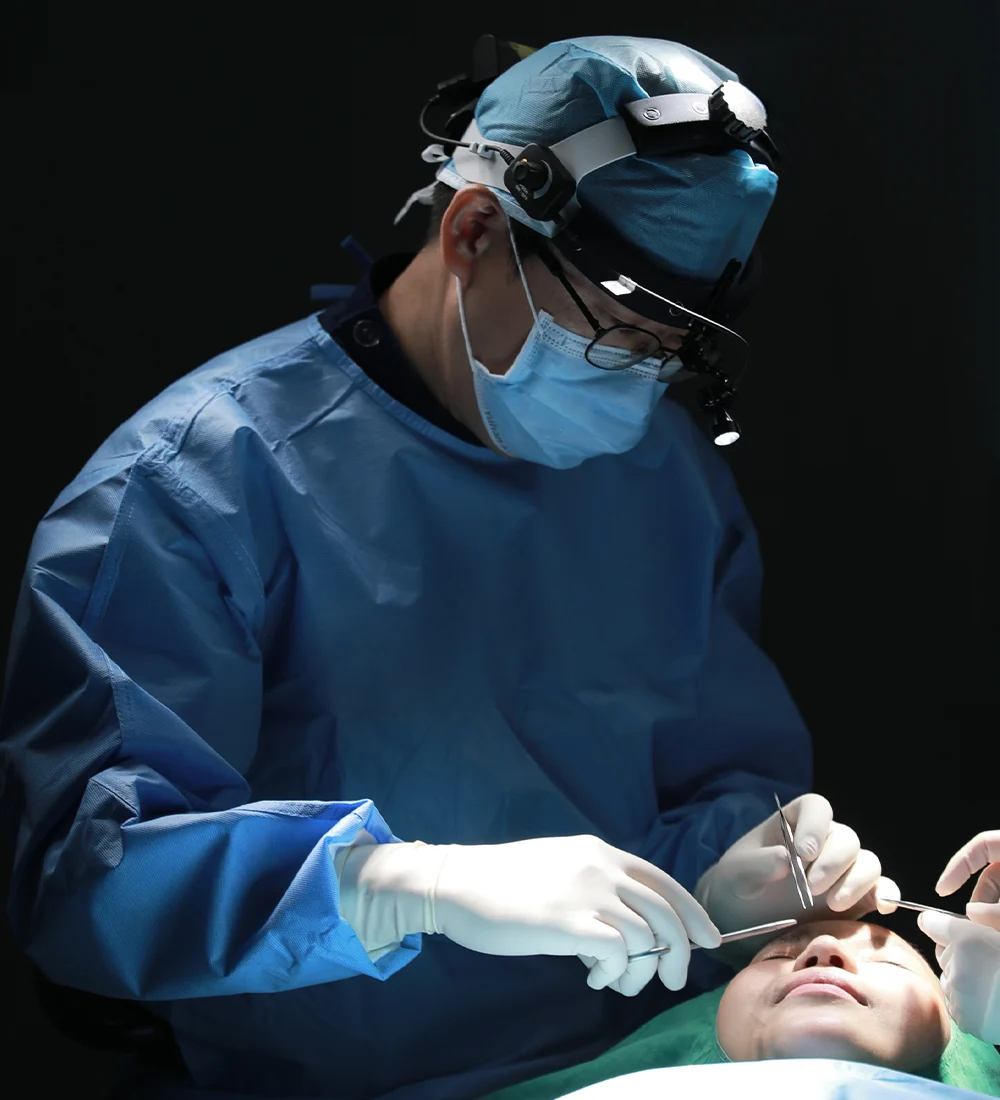
- Dr. In-Soo Baek, the board-certified plastic surgeon who is Garnet's one operating doctor. He consults, takes and carves the rib, rebuilds the nose and follows up.
- Downtime
- Nose sutures come out around 7 days and the rib donor-site sutures around 10 days; most social downtime is over by roughly 2–3 weeks; the tip settles over several months.
- Material
- Autologous rib (your own) or processed donor rib, chosen with you. Both avoid a permanent implant by rebuilding with cartilage.
- How to start
- Send front, side and base views of your nose by WhatsApp or the form below for a no-obligation pre-assessment before you fly.

Is rib-cartilage rhinoplasty right for you?
A low nose needing substantial rebuilding
- A low or under-projected nose that needs substantial structural rebuilding
- A revision nose where septal and ear cartilage are insufficient for the support required
- A wish to avoid a permanent implant by rebuilding with cartilage
- General good health and willingness to plan ~2–3 weeks of social downtime
- Acceptance of a chest donor site, or a preference for processed donor rib instead
When modest tip support is enough
- A nose needing only modest tip support, where septal/ear cartilage may be more proportionate
- Looking for a same-week, no-downtime change
- Uncontrolled medical conditions, or chest-wall issues that affect harvest, which are assessed individually
- Unwilling to accept the small possibility of cartilage warping over time
- Active smoking, a known wound-healing risk that has to be planned around

Dr. In-Soo Baek
Operate on what you came for. Trained at Korea University Medical Center. Every case planned, performed and reviewed by the same hands.
- Board-certified plastic surgeon
- Medical degree and plastic-surgery graduate training at Korea University
- Belongs to the rhinoplasty, eye and facial-contour groups of the Korean Society of Plastic and Reconstructive Surgeons
- Personally plans, operates on and follows up every nose
Before & After
Rib-cartilage rhinoplasty results are individual and identifiable, so before/after sets are shown privately at consultation with consent and are not published here. Results, recovery and suitability vary by individual and are not guaranteed.
Request before & after examples privatelyBuilding the nose from costal cartilage
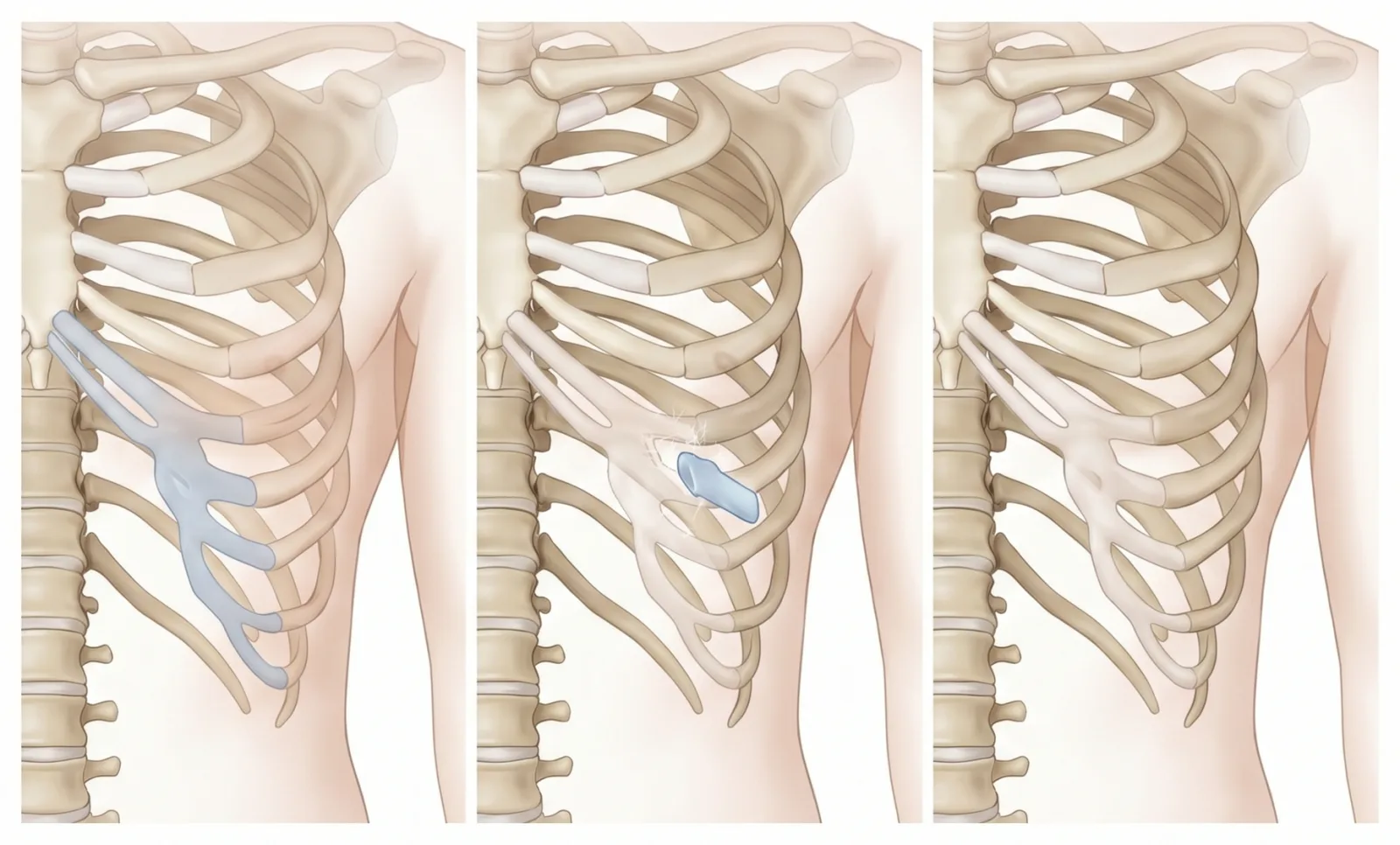
Rib-cartilage rhinoplasty is a nose operation that reconstructs the dorsum, septal support and tip using costal (rib) cartilage — taken either from the patient's own chest (autologous) or supplied as processed donor rib. The septum, ear and synthetic implants are not the source here. Because rib provides a large volume of strong, structural cartilage, it is the usual choice when a nose needs substantial rebuilding that softer grafts cannot deliver.
Some noses cannot be built from septal or ear cartilage alone. A very low bridge, a markedly under-projected tip, a structurally weak framework, or a revision where the septum has already been used all call for more cartilage than those sources hold. Rib cartilage answers that need: a single rib segment yields enough material to rebuild the dorsum, lengthen and support the septum, and reinforce the tip in one operation.
At Garnet, rib is used as a structural autologous solution when it is needed, never as a default. Where less support is missing, septal and ear cartilage are preferred for their simpler recovery; rib is chosen when the case genuinely needs its strength and volume, including many revision noses. Both autologous rib and processed donor rib are discussed, and the choice is made with you.
This is a single-surgeon operation. Dr. Baek plans the case from the consultation, harvests and shapes the rib and performs the rebuild himself, and reviews healing at set intervals; the clinic caps the day at two surgeries so a longer rib operation has unhurried time. The stated aim is to give the nose durable support for the concern you arrived with. Chasing the biggest possible change is not the aim.
How the rib framework is built, step by step
Dr. Baek carries out every step, from rib harvest and carving to the framework rebuild and donor-site closure.
A single surgeon, start to finish. The rib case you discuss with Dr. Baek is the one he harvests, carves and rebuilds, and he is also the doctor at each check-up afterwards. Only two surgeries are booked per day, which leaves room for the extra time rib carving takes.
Rib-cartilage rhinoplasty is longer than a septal or ear-cartilage case because the rib is harvested, carved and allowed to settle before final placement; the exact time depends on how much rebuilding the nose needs. Anaesthesia is agreed with you and the anaesthesia team once your history has been reviewed; it is not fixed in advance. These are the stages of a rib rebuild at Garnet.

Weighing own rib against donor rib
Dr. Baek examines the nose, bridge height, tip support and skin in person, discusses autologous versus donor rib, and agrees the plan with you. Imaging is used where it helps map the rebuild.
Rib harvest
A short, hidden incision in the chest crease allows a rib-cartilage segment to be taken with care for the surrounding tissue. With processed donor rib this step is omitted, avoiding a chest incision.
Carving & balancing
The cartilage is carved into the grafts the nose needs — dorsal graft, septal extension or strut, tip support — using balanced, concentric cuts and a settling period to limit the warping rib is known for.
Carved grafts lengthen and support the nose
Through an open or closed approach as the case requires, the carved grafts rebuild the dorsum, lengthen and support the septum, and reinforce the tip, so the result rests on a rebuilt structure.
Symmetry check, then nose and chest closure
The tip is shaped and the framework checked for symmetry; incisions on the nose and, where used, the chest are closed; a splint and dressing are applied.
Checking both the nose and chest site
Garnet's protocol includes dressing changes early in recovery. Dr. Baek checks both the nose and the chest site himself before you go back to rest, and again at every follow-up.
Why rib, and what warping means
Costal cartilage is the body's most abundant source of strong, autologous graft material, which is why it is the workhorse for major nasal reconstruction. A segment of rib provides enough cartilage to carve a dorsal graft, a septal-extension or strut for the tip, and reinforcing grafts, all from one donor site — something neither the septum nor the ear can match in volume or rigidity (Aesthet Surg J 2015; DOI 10.1093/asj/sju117).
The trade-off is a recognised tendency for rib cartilage to warp, meaning it bends slightly as it equilibrates after carving. Surgical strategies to limit this include balanced carving, concentric (symmetric) cuts, a settling period before final placement, and sometimes internal stabilisation; a systematic review of warping-prevention techniques summarises these (J Craniofac Surg 2020; DOI 10.1097/SCS.0000000000006429). Understanding warping is why rib work is planned and carved carefully, without rushing.
Rib vs septal/ear cartilage vs implant
| Septal / ear cartilage | Rib (costal) cartilage | Silicone implant | |
|---|---|---|---|
| Material source | Septum & ear (own) | Rib — own or donor | Synthetic |
| Volume & strength | Limited | Large & structural | Fixed, non-biological |
| Donor site | Minimal (behind ear) | Chest (or none if donor rib) | None |
| Best for | Tip & modest support | Major rebuilding / revision | Dorsal augmentation only |
| Main caution | May be insufficient | Possible warping | Long-term implant risks |
A systematic review of autologous costal cartilage reports recipient-site warping at about 5% and infection at about 2.5% (Aesthet Surg J 2015, DOI 10.1093/asj/sju117), with carving strategies used to limit warping. Which material suits your nose is individual, and Dr. Baek talks it through with you in person.
Safety for a longer rib-cartilage operation
Anaesthesia
The anaesthesia for a rib case is chosen with you and the anaesthesia team at consultation, suited to the longer operation and your medical history; nothing is set in advance. Your history is reviewed beforehand, including chest-wall considerations for the harvest.
A longer operation that is never rushed
A rib operation takes longer, and with no more than two surgeries a day it is never rushed. Dr. Baek plans it, performs it and checks your recovery, and no other doctor steps in at any stage.
Dates and checks organised before arrival
Through its registration in Korea's foreign-patient programme, Garnet organises pre-operative checks, dates and after-care for overseas patients in English.
When rib is not needed
If rib cartilage is more than your nose needs, or a lighter option suits you better, that is said at the consultation. Photos can be reviewed before you travel.
Where the incisions sit
Rib-cartilage rhinoplasty has two possible incision sites. On the nose, an open approach leaves a small columellar scar that falls in a natural shadow, with hidden incisions inside the nostrils; a closed approach keeps the nasal incisions inside. At the chest, autologous rib is taken through a short incision placed in a natural skin crease, where it is designed to be discreet once mature. Choosing processed donor rib avoids the chest incision entirely.
Scars are permanent but are placed where they hide, and Dr. Baek reviews them at the 1-, 3- and 6-month visits with scar-care advice. Healing varies by individual and by skin type; the chest scar in particular is talked through openly before surgery, including for patients prone to thicker scarring.
Week by week
Do
Keep the head elevated, take medication as prescribed, support the chest when coughing early on, sleep on your back, protect the splint, and keep your follow-up visits.
Avoid
Bumping or pressing the nose, glasses on the bridge early on, heavy lifting and strenuous exercise while the chest heals, alcohol and smoking, very hot showers/saunas, and direct sun on healing scars until cleared.
How long a rib-cartilage nose lasts
Once a rib-cartilage nose has fully healed, the framework is intended to give durable, lasting support because it rebuilds structure with strong autologous cartilage and does not rely on the skin or a synthetic implant. The main longer-term consideration is subtle warping, a slow bend in the carved cartilage, which careful, balanced carving is designed to limit (J Craniofac Surg 2020; DOI 10.1097/SCS.0000000000006429).
Individual longevity depends on tissue quality, the carving and the nose's protection during healing. Garnet's approach is to carve and stabilise the rib carefully and to rebuild conservatively, since a well-balanced framework tends to age more predictably. Minor refinements are occasionally discussed if healing leaves a small irregularity.
What a rib framework is combined with
Finer tip work layered on the framework
For tip refinement that does not need rib's strength, septal and ear cartilage can be combined with the rib framework to fine-tune definition.
Revision noses with a used-up septum
Rib is a common choice for revision noses where the septum has already been used and major rebuilding is required.
Valve and septum fixes alongside reshaping
Septal or nasal-valve correction is addressed in the same sitting where breathing has been affected, so shape and airway are treated together.
Fascia over a framework seen through thin skin
Temporalis fascia is used to smooth dorsal contour seen through thin skin over a rib framework where indicated.
Risks of rib-cartilage rhinoplasty
Every operation carries risk, and rib-cartilage rhinoplasty involves two areas: the nose and the chest donor site. These are explained individually at consultation.
Graft issues
With costal cartilage the recognised graft issues include warping, partial resorption, displacement and, less commonly, infection. Carving strategy is planned to reduce warping. A systematic review reported warping in about 5% and infection in about 2.5% of cases (Aesthet Surg J 2015; DOI 10.1093/asj/sju117).
Chest donor site
Donor-site risks at the chest include pain, scarring and, uncommonly, pneumothorax (air around the lung).
Processed donor rib
Processed donor rib avoids the chest incision but is not the patient's own tissue.
Contour irregularity and prolonged tip swelling
Nasal risks include asymmetry and contour irregularity.
Tip swelling
Prolonged tip swelling.
Breathing and scars
Breathing change and scar-related issues.
Smoking
Smoking raises wound-healing risk.
In practice, risk comes down with careful patient selection, balanced and concentric carving with a settling period, meticulous harvest technique, and follow-up by the surgeon who operated. A clinic with one surgeon and two cases a day can give rib work this kind of unhurried planning and personal after-care.
Planning rib-cartilage rhinoplasty from abroad
Most international patients plan roughly 10–14 days in Korea for a rib-cartilage rhinoplasty, so the splint and both the nose sutures (around day 7) and the chest sutures (around day 10) can be removed by the surgeon before travel. The coordinator confirms the schedule for your specific plan.
Before you travel, send clear photos (front, three-quarter, side and base) and a note on your concern and dates through WhatsApp, LINE or the form below. You'll get a pre-assessment that says whether rib is the right material at all, with no hard sell.
Consultations, surgery dates and after-care are coordinated in English under Garnet's registration in Korea's foreign-patient programme. When you are back home, Dr. Baek can go on checking the nose and chest by messenger.
Sources
- Varadharajan K, Sethukumar P, Anwar M, Patel K. Complications Associated With the Use of Autologous Costal Cartilage in Rhinoplasty: A Systematic Review. Aesthet Surg J. 2015. DOI 10.1093/asj/sju117. link
- Wee JH, et al. Prevention of Autologous Costal Cartilage Graft Warping in Secondary Rhinoplasty. J Craniofac Surg. 2020. DOI 10.1097/SCS.0000000000006429. link
- Kim JH, et al. Enhanced revision rhinoplasty with processed costal cartilage guided by preoperative computed tomography and 3D scanning. Maxillofac Plast Reconstr Surg. 2024. DOI 10.1186/s40902-024-00422-z. link
- Wee JH, et al. Donor site morbidities resulting from conchal cartilage harvesting in rhinoplasty. Arch Facial Plast Surg. 2007. DOI 10.1001/archfaci.9.4.298. link
Citations are provided for general education. This page is informational and does not replace an in-person consultation; suitability, technique and recovery are individual.
Questions about rib-cartilage rhinoplasty
| Septal / ear cartilage | Rib (costal) cartilage | Silicone implant | |
|---|---|---|---|
| Material source | Septum & ear (own) | Rib — own or donor | Synthetic |
| Volume & strength | Limited | Large & structural | Fixed, non-biological |
| Donor site | Minimal (behind ear) | Chest (or none if donor rib) | None |
| Best for | Tip & modest support | Major rebuilding / revision | Dorsal augmentation only |
| Main caution | May be insufficient | Possible warping | Long-term implant risks |
Reviews on Google Maps
I’m so happy I chose this clinic for my lower blepharoplasty. I was traveling from abroad by myself, so I was a little nervous, but from the beginning I felt comfortable and truly cared for. Everyone was kind, patient, and professional…
Came in for an in-person consult and ended up choosing Garnet and Dr.Baek for my non-incisional DES and tiplasty/alarplasty. I communicated with Kelly (English consultant) from the start till now (3 weeks post-op). She really help me feel…
My under-eyes have been sagging and folding for years... I tried to cover it up with makeup, but it actually got stuck in the wrinkles and made it stand out even more. While going for consultations, I noticed that the bigger the hospital…
Ask Dr. Baek’s team
Send photos and your question before you travel. An English-speaking coordinator reviews every enquiry and replies with guidance on whether surgery is appropriate, the likely plan and timing.
- ✓ Reviewed by the clinic coordinator, not a bot
- ✓ Photo-based pre-assessment before you fly
- ✓ Foreign-patient scheduling & after-care
- ✓ One surgeon for consultation, surgery and follow-up
Prefer to chat now? Reach the coordinator directly:
Request a consultation
Find the clinic
51 Apgujeong-ro 30-gil, Gangnam-gu, Seoul — near Apgujeong Station