After eyelid surgery the flight home usually comes sooner than after a facelift, and in every case your surgeon sets the date at a final review. “When can I fly?” is one of the first questions international patients ask, and no single number of days answers it. This guide explains why the timing is medical, how flying interacts with healing, and how to make the journey home as comfortable as possible.
The short answer
When you can fly is confirmed by your surgeon at a final review. It depends on your procedure and healing.
Flying does not heal you faster or slower, but long flights can add to swelling and stiffness, so the timing is worth respecting.
Different procedures clear at different times. Eyelid surgery tends to be earlier than facial lifting, and your surgeon confirms your specific date.
On a long flight, simple habits help: move and hydrate, follow your after-care instructions, and keep your surgeon's contact details to hand.
There is no universal number of days after which it is automatically fine to fly. When you can travel home is a medical decision made by your surgeon at a final review, based on how your wound is healing, how swelling is settling and what your specific procedure involved. A figure you read online is, at most, a rough planning estimate.
The reason this matters is that the final review and the decision to fly are linked. Once your surgeon has checked the area, removed stitches where needed and confirmed healing is on track, they clear you to travel and give you after-care instructions for the journey. Flying before that review means nobody has confirmed you are ready.
So the right way to plan is to build your trip around the final check. The cheapest flight comes second. You can get a planning estimate for your procedure during an online consultation, then confirm the real date once the surgeon has assessed you.
Swelling
How flying interacts with healing
Flying itself does not speed up or slow down healing, but a long-haul flight is not entirely neutral either. Hours of sitting still, cabin pressure and dry air can add to swelling and stiffness, and some people notice puffiness is a little more pronounced after a long flight. None of this is dangerous when you travel at the right time, but it is a reason not to rush.
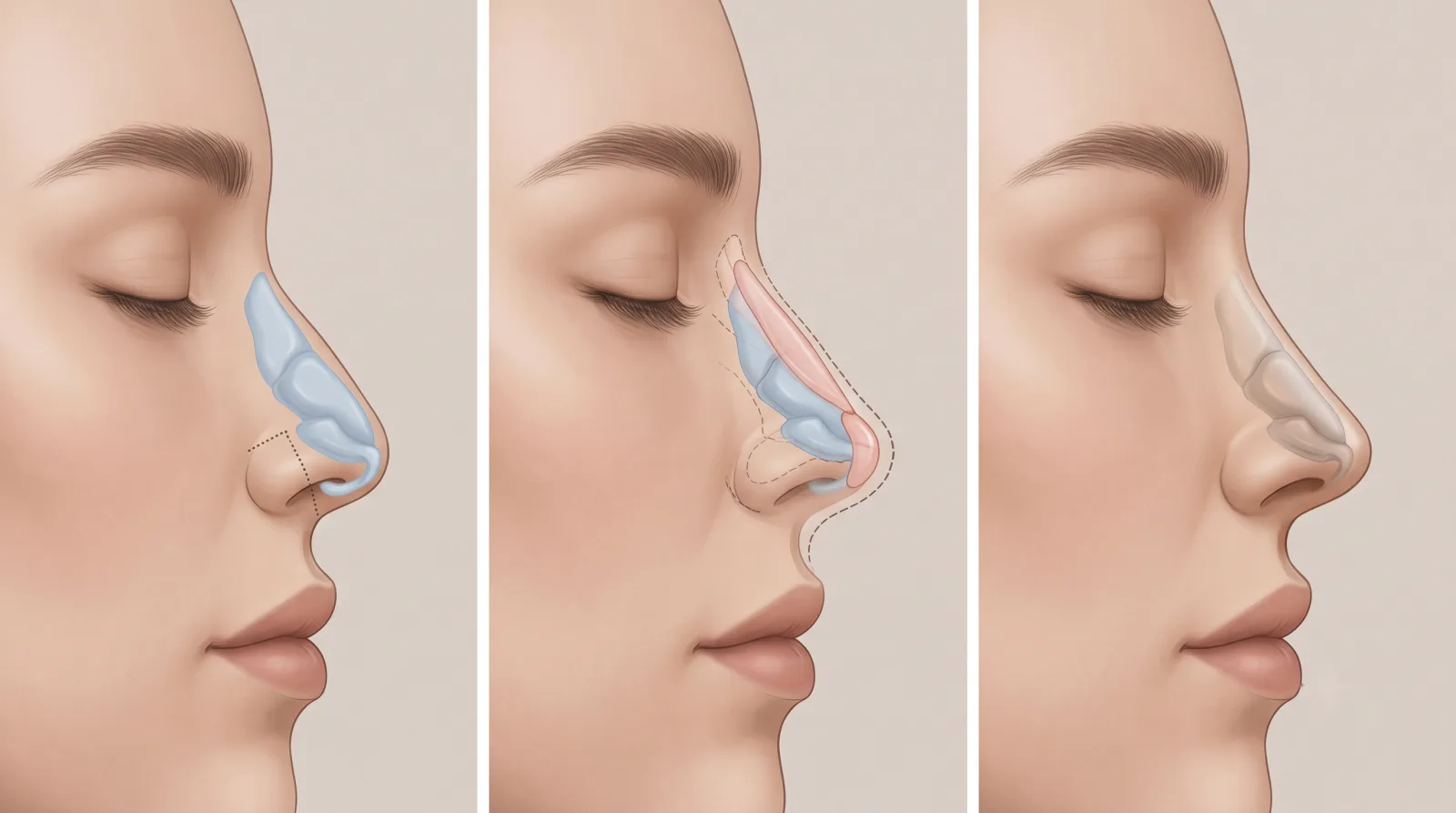
Illustration: the nasal framework (blue) is reshaped to raise the bridge and refine the tip. The dashed outline shows the original contour.
This is also why the early days, when swelling and bruising are at their peak, are not the moment for a long journey. Letting that settle to the point where your surgeon is comfortable means the flight adds far less to your recovery, and you arrive home in better shape.
Because the interaction depends on your procedure, the recovery sections on the procedure pages (for example rhinoplasty) describe the general pattern of swelling, while your surgeon confirms when that has settled enough for you to travel.
By procedure
Eyes, nose and facelift differ
Procedures clear for travel at different times. Eyelid surgery is generally on the earlier end. Recovery is relatively contained and stitches often come out around a week, so the window before flying tends to be shorter. Nose surgery involves dressings and stitch removal in the first week or so, with donor-site healing to consider when cartilage is taken from the ear or rib.
Illustration: the deeper facial layer (SMAS, shown in yellow) is released and repositioned as one unit with the skin, rather than pulling the skin alone.
Facial lifting takes the most patience. Swelling and bruising settle more slowly, stitches come out a little later, and the final review is correspondingly later. The time before you can comfortably fly after a facelift is longer than after eyelid surgery. Trying to compress that timeline to fit a flight is not advisable.
Because the differences are real, plan for your own procedure and leave single figures aside. If you are having more than one operation, ask how the combined timeline affects when you can travel. Your surgeon gives you the specific clearance at the final review.
Long flight
Making a long flight home more comfortable
When you are cleared to fly, a few simple habits make the journey easier. Move when you can with gentle walks and stretches during the flight, stay hydrated, and follow any after-care instructions your surgeon gave you for travel, such as how to position yourself or manage swelling. Keep essential medications and your after-care notes in your hand luggage. Do not pack them in checked baggage.
It also helps to keep your surgeon's contact details and clear guidance on what to watch for during the journey and the first days at home. Knowing who to message if you have a question turns a long flight from something to dread into something manageable.
If you would like to think through the practical side of the journey and the period afterwards, our guide to recovering in Seoul covers after-care and how follow-up continues once you are back home.
Flexible return
Plan a flexible return flight
Because the date you can fly is decided medically and healing varies between people, a flexible or changeable return flight is the single most useful thing you can arrange. If swelling is slow to settle or your surgeon wants one more look before clearing you, a flexible ticket means you are not forced to choose between your recovery and your booking.
Leaving before the final review, or before your surgeon is comfortable, is a common regret. It is far easier to spend a spare day or two in Seoul than to travel too early. Plan for the slightly longer case and treat an early clearance as a bonus.
For help sequencing the whole trip (consultation, surgery, recovery and the return flight), see our guide to how long to stay in Korea, which explains how the dates fit together.
At Garnet
How Garnet clears you to fly
Garnet is a single-surgeon clinic in Apgujeong, Seoul. Dr. In-Soo Baek is a board-certified plastic surgeon (Korean medical licence no. 77407) and the only operating doctor. He consults, operates and performs your final review himself. The person who decides you are ready to fly is therefore the person who operated on you and has followed your healing.
Before you travel, the surgeon gives you after-care instructions for the journey and the weeks afterwards, and Garnet plans structured follow-up that continues remotely once you are home, so support does not end at the airport. Garnet is registered with Korea's foreign-patient programme, and a dedicated coordinator helps line up your dates.
You can ask for a planning estimate of when you are likely to be able to fly during a no-obligation online assessment, then confirm the real date once the surgeon has assessed you in person.
Dr. In-Soo Baek
Director & sole operating surgeon
Korean medical licence no. 77407
Operate on what you came for. Trained at Korea University Medical Center. Every case planned, performed and reviewed by the same hands.
1Operating surgeon
~2Surgeries per day
7Registered techniques
Board-certified plastic surgeon
Plastic surgery training at Korea University College of Medicine & graduate school
Korean Society of Plastic and Reconstructive Surgeons member, in its facial-contour, eye & rhinoplasty groups
Consults, operates and follows up each case himself
Peer-reviewed papers behind the facts on this page. Each describes findings in its own study group — not results at Garnet — and none predicts your own outcome.
Kraft CT et al. Deep Venous Thrombosis Prophylaxis. Clinics in Plastic Surgery. 2020. doi:10.1016/j.cps.2020.03.002
Pannucci CJ. Venous Thromboembolism in Aesthetic Surgery: Risk Optimization in the Preoperative, Intraoperative, and Postoperative Settings. Aesthetic Surgery Journal. 2018. doi:10.1093/asj/sjy138
Vaccari S et al. Literature Review: Venous Thromboembolism Prophylaxis in Plastic Surgery. Aesthetic Plastic Surgery. 2023. doi:10.1007/s00266-023-03508-7
FAQ
Common questions
How long after surgery can I fly?
There is no fixed number of days that applies to everyone. When you can fly is confirmed by your surgeon at a final review, based on your procedure and how your healing is progressing. Eyelid surgery tends to clear earlier than facial lifting. Treat any figure online as a planning estimate and keep your return flight flexible.
Does flying affect swelling?
Flying does not speed up or slow healing, but a long flight, with hours of sitting, cabin pressure and dry air, can add to swelling and stiffness, and some people notice more puffiness afterwards. That is why the early days, when swelling peaks, are not the time to travel; waiting until your surgeon is comfortable means the flight adds far less.
When can I fly after rhinoplasty or a facelift?
It depends on the procedure and your healing, confirmed by your surgeon at the final review. Nose surgery involves dressings and stitch removal in the first week or so, while a facelift settles more slowly and clears later. Plan around your own procedure and confirm your date in person.
What should I do on a long flight after surgery?
Move gently when you can, stay hydrated, follow the travel after-care instructions your surgeon gave you, and keep medications and after-care notes in your hand luggage. Keep your surgeon's contact details to hand and know what to watch for, so you can ask a question during the journey or the first days at home if you need to.
Who decides when it's safe for me to fly?
Your surgeon, at a final review before you travel. They check the wound, remove stitches where needed, confirm healing is on track and give you after-care for the journey. At a single-surgeon clinic the surgeon who operated also performs that review, so the decision is made by the person who knows your case directly.
Is it risky to fly too soon after surgery?
Flying before your surgeon has reviewed you and confirmed you are ready means nobody has checked that you are fit to travel, and a long flight in the early days can add to swelling and discomfort. The safe approach is to plan your trip around the final review and keep a flexible return so you never have to fly before you are cleared.
Can swelling on the flight be a problem?
Extra puffiness after a long flight is common and usually settles, which is one reason to travel only once your surgeon is comfortable. The peak of swelling is not the time to fly. Your surgeon explains what is normal and what to watch for, and you should know who to contact if anything concerns you during or after the journey.
How should I plan my return flight?
Book a flexible or changeable return so that if healing is slow or your surgeon wants one more look, you are not forced to travel early. Leaving before the final review is a common regret. Plan for the slightly longer case and treat an early clearance as a bonus. See how long to stay in Korea for the full timeline.
Does Garnet confirm when international patients can fly home?
Yes. At Garnet the same board-certified surgeon who operated performs your final review and clears you to fly, then gives after-care for the journey, with follow-up continuing remotely once you are home. Garnet is registered with Korea's foreign-patient programme, and you can ask for a planning estimate during an online assessment beforehand.
My mom recently had a brow lift and lower blepharoplasty with Dr. Baek, and our experience has been wonderful so far. The Garnet team was incredibly kind and welcoming, with Kelly assisting us as our English consultant—she made everything…
I’m so happy I chose this clinic for my lower blepharoplasty. I was traveling from abroad by myself, so I was a little nervous, but from the beginning I felt comfortable and truly cared for. Everyone was kind, patient, and professional…
Came in for an in-person consult and ended up choosing Garnet and Dr.Baek for my non-incisional DES and tiplasty/alarplasty. I communicated with Kelly (English consultant) from the start till now (3 weeks post-op). She really help me feel…
My under-eyes have been sagging and folding for years... I tried to cover it up with makeup, but it actually got stuck in the wrinkles and made it stand out even more. While going for consultations, I noticed that the bigger the hospital…
Send photos and your question before you travel. An English-speaking coordinator reviews every enquiry and replies with guidance on whether surgery is appropriate, the likely plan and timing.
✓ Reviewed by the clinic coordinator, not a bot
✓ Photo-based pre-assessment before you fly
✓ Foreign-patient scheduling & after-care
✓ One surgeon for consultation, surgery and follow-up
Prefer to chat now? Reach the coordinator directly:









 T S7 months ago



