A deep mini facelift releases the deep sub-SMAS layer, and “Will it hurt?” is one of the first things people ask about it. The operation itself is not something you feel, and the recovery is dominated by tightness, swelling and numbness far more than by sharp pain. How that is managed still depends on the anaesthesia plan and the surgeon.
The short answer
You do not feel the operation itself. A deep mini facelift is done under anaesthesia, so there is no pain during surgery.
Most patients describe the days afterwards as tightness, pressure and swelling, with little of the sharp pain they expected.
The deep-plane release works beneath the SMAS layer, so well-managed discomfort comes mainly from swelling and the dressing.
Your anaesthesia plan (sedation or general) is decided with the surgeon based on your case.
A deep mini facelift is a true surgical lift. The incision runs from the temporal hairline down to the ear lobe, and the surgeon releases the deep sub-SMAS layer, which goes well beyond tightening skin. Because of that depth, it is performed under anaesthesia so that you feel nothing during the operation. The two usual approaches are deep sedation combined with local anaesthesia (often called twilight or IV sedation) and general anaesthesia. Both are designed to keep you comfortable and unaware throughout.
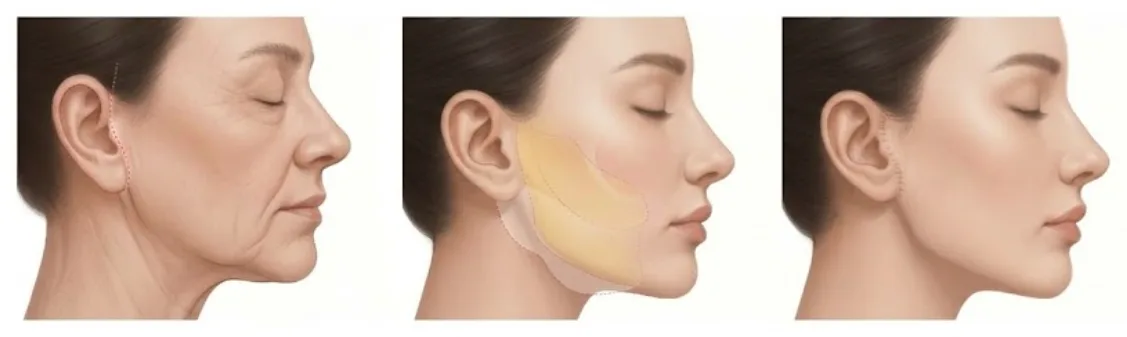
Illustration: through a shorter incision around the ear (dotted), the deeper layer (yellow) is lifted using the deep-plane principle (Deep mini™).
Which one suits you is a clinical decision. It depends on how extensive your lift is, your medical history, your airway and your own preference once the options are explained. A deep mini facelift done with a careful sedation protocol can be very comfortable, while some patients or some case plans are better served by general anaesthesia. The point worth holding on to is that you should leave your consultation knowing exactly which plan applies to you and why.
At a single-surgeon clinic, the same board-certified plastic surgeon who assesses you also decides the anaesthesia plan with you and is present throughout. That continuity matters for comfort: the person making decisions about your sedation knows your case and your face before the day of surgery.
During surgery
What the operation actually feels like
This is the part people fear most and feel least. Under sedation or general anaesthesia you are not aware of the surgery, so you do not experience the incision, the deep-plane dissection or the closure as pain. Time passes quickly from your perspective. You settle in, and the next thing you are aware of is waking in recovery with your face dressed and supported.
Before anything begins, local anaesthetic is also used in the surgical area, which keeps the immediate post-operative hours more comfortable as you wake. Many patients are surprised that the first thing they notice is a snug, wrapped, slightly heavy sensation around the cheeks and jaw. That comes from the dressing and the early swelling more than from the cut itself.
Because the deep mini facelift repositions tissue beneath the SMAS, the skin is redraped without tension. That technical detail has a comfort payoff: a lift that pulls skin tightly tends to feel and look tight, whereas a deep-plane release distributes the lift in the deeper layer, so the sensation afterwards feels supported, without a stretched quality.
Pain vs tightness
Pain versus tightness: what you really feel after a deep mini facelift
Most patients who have had a deep mini facelift describe the recovery in terms of tightness, pressure, fullness and numbness. Sharp or stabbing pain is uncommon. There is a tight, hugged feeling across the cheeks and along the jaw where the deeper layer has been lifted and fixed, and the skin can feel firm and a little wooden. This is expected and is not the same as the pain you might brace yourself for.
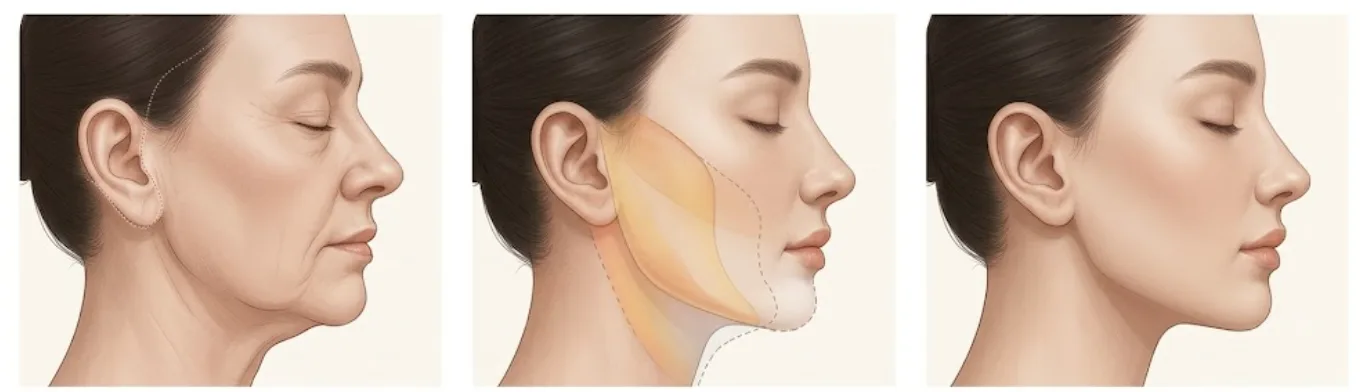
Illustration: the deeper facial layer (SMAS, shown in yellow) is released and repositioned as one unit with the skin, rather than pulling the skin alone.
Numbness is a normal companion to a facelift. Small sensory nerves in the skin are disturbed during the lift, so areas of the cheek, in front of the ear and around the incision can feel dull or buzzy for weeks and occasionally months as sensation returns gradually. Numbness can mask discomfort early on, then give way to tingling as nerves recover. Both are part of normal healing.
Genuine pain, when it occurs, is usually mild to moderate and concentrated in the first two to three days, and it responds well to the medication your surgeon prescribes. If you want the deeper recovery picture beyond comfort alone, the deep mini facelift overview and the broader deep plane facelift page set out how the lift heals over the following weeks.
Day by day
How discomfort eases day by day
The first 24 to 48 hours are when you feel the most: snugness from the dressing, swelling building to its peak, and the tightest sensation across the lifted areas. This is the window where regular pain relief, head elevation and rest do the most work. Most people are not in severe pain at this stage. They are managing pressure and the strangeness of a wrapped, swollen face.
From around day three the swelling and the tight feeling begin to settle, and any true soreness usually fades faster than the swelling does. The sutures stay in until about day ten, and removing them is a brief, low-discomfort appointment. By the time the sutures come out, most patients have moved from needing scheduled pain relief to only the occasional dose, if any.
Over the following two to six weeks the tightness loosens, numbness slowly improves, and the face begins to feel like your own again. Mild tightness on smiling or wide jaw movement can linger longest and is normal as the deep layer settles. Structured follow-ups at one, three and six months let the same surgeon track how your sensation and comfort are recovering, so you are not left to wonder alone.
At home
Managing comfort during recovery
Comfort after a deep mini facelift is mostly about reducing swelling and supporting the lifted tissue. Keeping your head elevated, including sleeping propped up for the first week or two, limits swelling and the heavy, throbbing feeling that comes with it. Cool compresses in the early days, gentle activity in place of bed-bound stillness, and avoiding bending or heavy lifting all help the tight sensation ease sooner.
Take the prescribed pain relief on schedule in the first couple of days, before discomfort builds, then taper as you need less. Avoid alcohol and anything your surgeon asks you to stop, keep the incision and any dressing as instructed, and resist the urge to test the lift by making big facial movements early on. The deep layer needs time to hold.
Because the same surgeon follows you through recovery, you have a clear route for questions when something feels unfamiliar. A lot of early worry is simply not knowing whether a sensation is normal. If you are weighing this up from overseas, the international patient guide explains how follow-up and comfort are handled once you travel home.
Warning signs
When pain is a sign to call your surgeon
Most discomfort after a deep mini facelift is predictable and eases on the expected timeline. What is not normal is pain that suddenly worsens instead of improving, especially if it is one-sided and accompanied by rapid, tense swelling on that side. That combination can signal a collection of blood under the skin that needs prompt review, and it is the main reason to contact your clinic quickly.
Other reasons to reach out include fever, spreading redness or warmth around the incision, discharge, or pain that your prescribed medication is not controlling at all. None of these are common, but knowing them in advance turns a frightening moment into a clear action: call your surgeon. Clear pre-operative information about what is and is not normal is part of safe care.
This is also where having the operating surgeon manage your recovery matters. A surgeon who knows your exact case can tell quickly whether a symptom is ordinary healing or something to act on. If you are still choosing where to have surgery, the guide on whether plastic surgery in Korea is safe covers how to confirm who operates and who handles complications.
Dr. In-Soo Baek
Director & sole operating surgeon
Korean medical licence no. 77407
Operate on what you came for. Trained at Korea University Medical Center. Every case planned, performed and reviewed by the same hands.
1Operating surgeon
~2Surgeries per day
7Registered techniques
Board-certified plastic surgeon
Plastic surgery training at Korea University College of Medicine & graduate school
Korean Society of Plastic and Reconstructive Surgeons member, in its facial-contour, eye & rhinoplasty groups
Consults, operates and follows up each case himself
Peer-reviewed papers behind the facts on this page. Each describes findings in its own study group — not results at Garnet — and none predicts your own outcome.
Coleman J. Short Incision, Short Flap Face-Lift Surgery versus Deep Plane Face-Lift Surgery. Facial Plastic Surgery. 2007. doi:10.1055/s-2007-970132
Pandkhahi A et al. Comparison of Deep SMAS Lift and MACS in Facelift: A Meta-Analysis. Medicina. 2026. doi:10.3390/medicina62010112
Hijkoop LF et al. The minimal access cranial suspension (MACS) lift: A systematic review of literature 18 years after its introduction. Journal of Plastic, Reconstructive & Aesthetic Surgery. 2022. doi:10.1016/j.bjps.2021.11.051
FAQ
Common questions
Is a deep mini facelift painful during the operation?
No. The operation is performed under anaesthesia, either deep sedation with local anaesthetic or general anaesthesia, so you do not feel the incision or the lift. From your perspective you are unaware of the surgery and wake afterwards in recovery with your face dressed and supported.
What anaesthesia is used for a deep mini facelift?
Usually either deep IV sedation combined with local anaesthesia, or general anaesthesia. The choice depends on how extensive your lift is, your medical history and your preference once the options are explained. At a single-surgeon clinic the same surgeon who assesses you decides the plan with you and is present throughout.
How much does it hurt after a deep mini facelift?
Most patients describe tightness, pressure, fullness and numbness more than sharp pain. Genuine soreness is usually mild to moderate, concentrated in the first two to three days, and responds well to prescribed medication. The tight, hugged sensation across the cheeks and jaw lasts longer than any actual pain.
Why does my face feel tight rather than sore?
A deep mini facelift lifts and fixes the deep sub-SMAS layer and redrapes the skin without tension, so the dominant sensation is support and tightness. The skin itself is not pulled painfully. The tightness is the deeper layer settling and eases over the following weeks.
Is numbness after a deep mini facelift normal?
Yes. Small sensory nerves are disturbed during the lift, so areas of the cheek, in front of the ear and around the incision can feel dull or buzzy for weeks and sometimes months. Sensation returns gradually, often passing through a tingling phase, and this is part of normal healing.
How long does the discomfort last?
The most you feel is in the first 24 to 48 hours, easing noticeably from around day three. Sutures come out at about day ten, and by then most people need little or no pain relief. Tightness and numbness improve over two to six weeks, with mild tightness on big facial movements lingering longest.
How can I stay comfortable during recovery?
Keep your head elevated, including sleeping propped up for the first week or two, use cool compresses early, take prescribed pain relief on schedule in the first days, and avoid bending or heavy lifting. Reducing swelling is the main way to ease the tight, heavy feeling sooner.
When should pain make me call the clinic?
If pain suddenly worsens, particularly one-sided pain with rapid, tense swelling on that side, contact your clinic promptly, as it can signal a collection of blood that needs review. Also call for fever, spreading redness, discharge, or pain your medication is not controlling.
Does a single-surgeon clinic make recovery more comfortable?
It helps in two ways: the surgeon who knows your exact case decides your anaesthesia and manages your recovery, and structured follow-ups at one, three and six months mean someone is tracking your comfort and sensation, so you do not have to guess what is normal.
Can I ask about pain and anaesthesia before I travel?
Yes. You can raise anaesthesia options, expected discomfort and recovery in an online consultation before committing to travel, and send photos for a pre-assessment so the plan, including how comfort is managed, is clear in advance.
My mom recently had a brow lift and lower blepharoplasty with Dr. Baek, and our experience has been wonderful so far. The Garnet team was incredibly kind and welcoming, with Kelly assisting us as our English consultant—she made everything…
I’m so happy I chose this clinic for my lower blepharoplasty. I was traveling from abroad by myself, so I was a little nervous, but from the beginning I felt comfortable and truly cared for. Everyone was kind, patient, and professional…
Came in for an in-person consult and ended up choosing Garnet and Dr.Baek for my non-incisional DES and tiplasty/alarplasty. I communicated with Kelly (English consultant) from the start till now (3 weeks post-op). She really help me feel…
My under-eyes have been sagging and folding for years... I tried to cover it up with makeup, but it actually got stuck in the wrinkles and made it stand out even more. While going for consultations, I noticed that the bigger the hospital…
If you are worried about pain or which anaesthesia is right for you, send photos for a no-obligation pre-assessment and we will explain exactly how comfort would be managed in your case.
Send photos and your question before you travel. An English-speaking coordinator reviews every enquiry and replies with guidance on whether surgery is appropriate, the likely plan and timing.
✓ Reviewed by the clinic coordinator, not a bot
✓ Photo-based pre-assessment before you fly
✓ Foreign-patient scheduling & after-care
✓ One surgeon for consultation, surgery and follow-up
Prefer to chat now? Reach the coordinator directly:








 T S7 months ago



