The deep mini and full facelift both release and reposition the sub-SMAS layer beneath the skin, so neither relies on pulling the skin tight. They differ in how far they reach toward the jawline and neck, how long the scar runs, and how much downtime they ask of you. Choosing well means matching the operation to your face; the biggest one is not automatically the right one.
The short answer
Both lift in the deep plane, but the Deep mini facelift™ uses a shorter incision (temporal hairline to earlobe) and addresses the mid-to-lower face, while a full facelift extends to the jawline and neck through a longer incision.
The deep mini suits earlier, mid-face and nasolabial-fold ageing; a full facelift suits more advanced laxity along the jawline and neck that a shorter lift can't reach.
A shorter incision and more limited dissection generally mean a shorter, easier recovery for the deep mini. It also does less, so it isn't right for everyone.
The right answer depends on your anatomy and goals, which is exactly what an in-person or online assessment is for. The bigger operation isn't automatically the better one.
It helps to start with what's the same, because it's the part that matters most for a natural result. Both the deep mini facelift and the full facelift work in the deep plane. They release and reposition the sub-SMAS layer beneath the skin; neither simply pulls the skin tight. Skin-only lifts are what create the pulled, wind-blown look; deep-plane work moves the supporting layer, so the skin is redraped without tension and the result reads as natural and ages well.
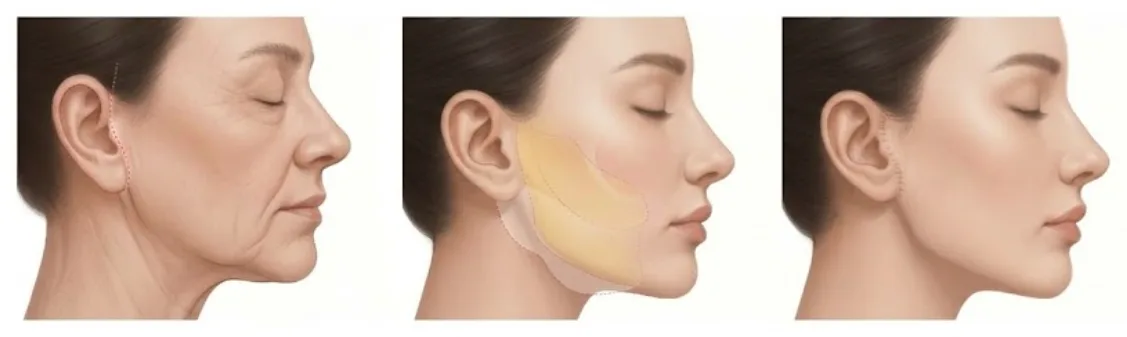
Illustration: through a shorter incision around the ear (dotted), the deeper layer (yellow) is lifted using the deep-plane principle (Deep mini™).
So the choice between them is not 'natural versus tight' or 'good versus better'. Both can give a natural, lasting result when done well. The choice is about reach: how much of the face and neck needs to be addressed, and therefore how long the incision and how extensive the release need to be. A bigger operation is only better if your face actually needs the extra reach.
That framing keeps the decision grounded. The useful question is which one matches what your face needs. For some faces that's the deep mini, for others it's the full facelift.
Incision & extent
How the incision and the lift differ
The deep mini facelift uses a contained incision running from the temporal hairline, around the front of the ear, to the earlobe, and releases the deep plane to lift the mid-to-lower face. This softens the nasolabial folds and refreshes the cheek and upper jaw area. It is designed to do meaningful deep-plane work through a shorter approach.
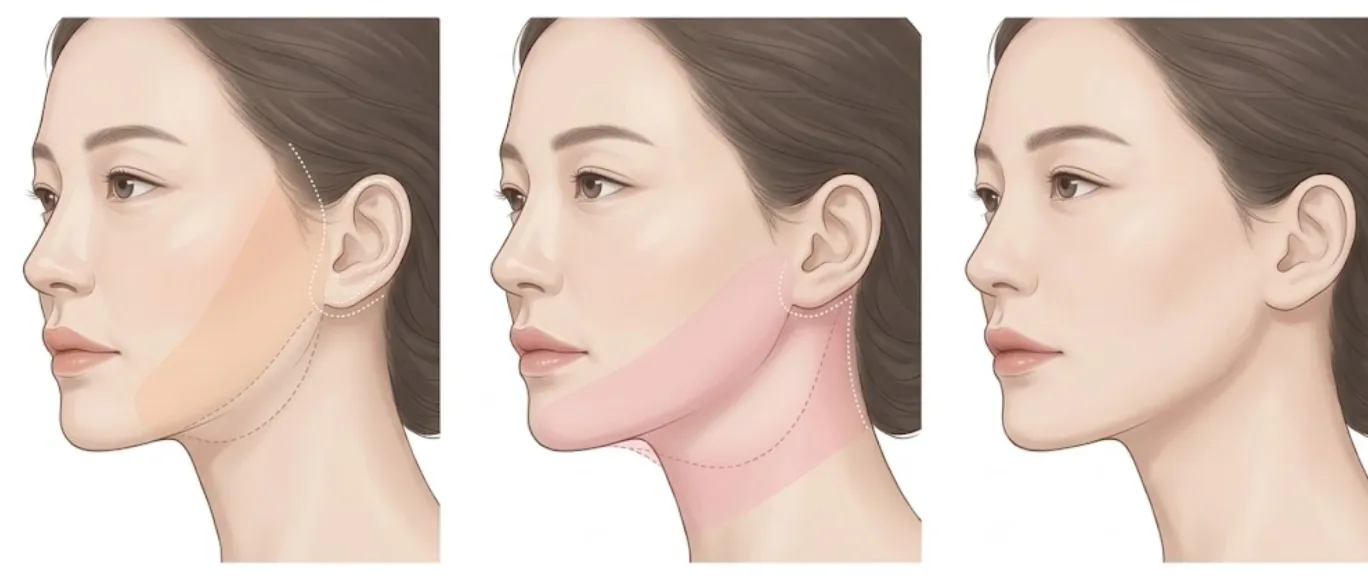
Illustration: through a fine line around the ear (dotted), the sagging lower face and neck are lifted up and back toward the ear (shaded); the dashed outline shows the old contour.
A full facelift extends further. Its incision typically runs from the temporal hairline, in front of the ear and continues behind the ear, and the deep-plane (and dual-plane) release reaches all the way to the jawline. When a neck lift is combined, it continues into the neck to address banding and a heavy jaw-to-neck transition. The longer incision and more extensive dissection are what let it correct laxity the shorter lift simply cannot reach.
In short: the deep mini reaches the mid-face and the area around the cheek and upper jaw; the full facelift reaches the jawline and neck. If your concern is an early-to-moderate softening of the mid-face, the deep mini's reach is enough. If your concern is jowling along the jaw and loose tissue down the neck, only the longer operation gets there.
Scar & downtime
Scar length and recovery, deep mini against full facelift
Because the deep mini incision is shorter and the dissection more limited, the recovery is generally shorter and easier, and the resulting scar is shorter. At Garnet the deep mini sutures typically come out around day 10, with the most visible recovery in the first two weeks and the contour settling over 1 to 3 months. This is covered in detail in our deep mini recovery timeline.
A full facelift asks more of you. The incision is longer (and runs behind the ear), the dissection is more extensive, and the swelling and recovery are correspondingly greater. Sutures are typically removed in two stages, around day 10 and day 14, and the settling period runs longer. Neither scar should be obvious once mature: both are tucked into the hairline and the natural creases around the ear, and a behind-the-ear extension hides in the crease there. But the full facelift's incision is undeniably longer, simply because it has to travel further to do more.
This is the genuine trade-off. The full facelift's longer scar and longer downtime buy you reach the deep mini doesn't have. If you don't need that reach, you'd be accepting a bigger recovery and a longer scar for correction you don't require. That is exactly why the operation should be matched to the face.
Who suits which
Who each operation actually suits
The deep mini facelift tends to suit patients with earlier or moderate ageing concentrated in the mid-face (softening cheeks, deepening nasolabial folds, an early loss of definition around the upper jaw) who want a genuine lift with a manageable recovery and a shorter scar. It's often the right operation for someone whose jawline and neck are still reasonably tight and who doesn't need correction down there.
A full facelift tends to suit more advanced laxity: clear jowling along the jawline, loose tissue and banding in the neck, and a heavier overall descent that a mid-face lift wouldn't fully address. For these faces, a deep mini would underdeliver. It can't reach the jawline and neck, so the result would look incomplete. The longer operation exists precisely for this pattern.
There's also a middle ground: some faces sit between the two, and the choice is a judgement call made in person, looking at how the tissue moves and where the heaviness actually is. That's why a careful surgeon won't commit to one operation from a single photo. The assessment is part of the decision.
Choosing by anatomy
Why the bigger operation isn't automatically better
It's tempting to assume the full facelift is the 'more thorough' choice and therefore the safer bet. It isn't, if your face doesn't need the extra reach. Choosing a full facelift for mid-face ageing means a longer scar, a longer recovery and more extensive surgery for correction a deep mini would have delivered with less. Equally, choosing a deep mini for advanced jowling and neck laxity means paying for an operation and recovery that can't actually solve the problem you came in with.
A sound decision matches the operation to the anatomy. A surgeon who tells you a deep mini is enough, when it is, is doing you a favour. And a surgeon who explains that you genuinely need the longer operation to reach the jawline and neck is being straight with you. The goal is the operation your face needs.
Because so much of this rests on assessing how your tissue actually moves, an in-person consultation matters. You can still get a first read before you travel by sending photos for an online consultation, where the surgeon can give you a candid sense of which direction fits your face.
At Garnet
How Garnet helps you choose between them
At Garnet, both the deep mini and the full facelift are performed by Dr. In-Soo Baek, a board-certified plastic surgeon (Korean medical licence no. 77407) and the clinic's only operating doctor. Because the same surgeon consults, operates and follows up, the person assessing which operation fits your face is the same person who will perform it. There's no incentive to hand you to a bigger procedure than you need, and no gap between who advises and who operates.
Garnet's approach is to address only the area you came for and to avoid over-recommending. If your face needs the deep mini, that's what you'll be advised, and if it needs the full facelift, you'll hear that too, with the reasons. As a single-surgeon clinic in Apgujeong, the day is capped at two surgeries, so the consultation and the operation both have unhurried time. Garnet is registered with Korea's foreign-patient programme.
Follow-up is structured at 1, 3 and 6 months whichever operation you have, with the same surgeon reviewing you. For international patients who've flown home, he continues to review your recovery by messenger. The first step is simply a read on which operation suits you, which you can get through an online assessment before planning any travel.
Dr. In-Soo Baek
Director & sole operating surgeon
Korean medical licence no. 77407
Operate on what you came for. Trained at Korea University Medical Center. Every case planned, performed and reviewed by the same hands.
1Operating surgeon
~2Surgeries per day
7Registered techniques
Board-certified plastic surgeon
Plastic surgery training at Korea University College of Medicine & graduate school
Korean Society of Plastic and Reconstructive Surgeons member, in its facial-contour, eye & rhinoplasty groups
Consults, operates and follows up each case himself
Peer-reviewed papers behind the facts on this page. Each describes findings in its own study group — not results at Garnet — and none predicts your own outcome.
Hijkoop LF et al. The minimal access cranial suspension (MACS) lift: A systematic review of literature 18 years after its introduction. Journal of Plastic, Reconstructive & Aesthetic Surgery. 2022. doi:10.1016/j.bjps.2021.11.051
Gencer M et al. Scar-Minimizing Full-Face Rejuvenation: A Novel Multiplanar and Multivector Approach Using Combined Forehead, Transoral Midface, and Limited-Incision Lower Face and Neck Lift Techniques. Aesthetic Plastic Surgery. 2026. doi:10.1007/s00266-026-06036-2
DeJoseph LM et al. Local Anesthetic Facelift. Facial Plastic Surgery Clinics of North America. 2020. doi:10.1016/j.fsc.2020.03.012
Somenek MT. Short Scar Male Neck Lift: A Minimally Invasive Option for Neck Contouring. Facial Plastic Surgery. 2025. doi:10.1055/a-2695-3785
FAQ
Common questions
What is the difference between a deep mini facelift and a full facelift?
Both lift in the deep plane beneath the skin, but they differ in reach. The deep mini uses a shorter incision (temporal hairline to earlobe) and addresses the mid-to-lower face. A full facelift uses a longer incision that continues behind the ear and reaches the jawline and neck, correcting more advanced laxity a shorter lift can't reach. The cost is a longer scar and recovery.
Is a deep mini facelift or a full facelift better for me?
Neither is universally better. It depends on your face. A deep mini suits earlier or moderate mid-face ageing with a still-tight jawline and neck. A full facelift suits clear jowling and neck laxity that a shorter lift can't address. The bigger operation is only the better choice if your face actually needs the extra reach; otherwise it means more scar and downtime than necessary.
How do I choose between a deep mini facelift and a full facelift?
The choice is matched to your anatomy: where the heaviness sits, how the tissue moves, and what you want corrected. Mid-face concerns point toward the deep mini; jawline and neck laxity point toward the full facelift. Because it depends on how your tissue actually behaves, an assessment in person, or first by photos online, is the proper way to decide.
Does a deep mini facelift leave a smaller scar than a full facelift?
Yes. The deep mini's incision is shorter, running from the temporal hairline to the earlobe, while a full facelift's incision is longer and also runs behind the ear. Both are placed in the hairline and the natural creases around the ear and are designed to be discreet once mature, but the full facelift's scar is longer because it travels further to do more.
Is recovery faster after a deep mini facelift than a full facelift?
Generally yes. The deep mini's shorter incision and more limited dissection mean a shorter, easier recovery: sutures out around day 10, with the contour settling over 1 to 3 months. A full facelift is more extensive, with sutures typically removed in two stages (around day 10 and day 14) and a longer settling period.
Can a deep mini facelift fix a sagging jawline and neck?
Not fully. The deep mini reaches the mid-to-lower face (cheeks, nasolabial folds and the upper jaw area), but it doesn't extend to the jawline and neck. Clear jowling along the jaw or loose tissue and banding in the neck need a full facelift, often combined with a neck lift, to be properly corrected.
Will a surgeon recommend the bigger operation to do more?
A careful surgeon recommends the operation that matches your face, which is not always the largest one. At a single-surgeon clinic where the same doctor consults, operates and follows up, there's no hand-off between who advises and who operates. The advice is to address only what you need, whether that's the deep mini or the full facelift.
Can I decide between the two before travelling to Korea?
You can get a first read before you travel by sending photos for an online consultation, where the surgeon can give you a candid sense of which operation fits your face. A final decision usually needs an in-person assessment of how your tissue moves, but the online consultation lets you plan with realistic expectations.
Who performs facelift surgery at Garnet?
Both the deep mini and the full facelift at Garnet are performed by Dr. In-Soo Baek, a board-certified plastic surgeon (Korean medical licence no. 77407) and the clinic's only operating doctor. He consults, operates and reviews every follow-up, so the surgeon who assesses which operation suits you is the one who performs it.
My mom recently had a brow lift and lower blepharoplasty with Dr. Baek, and our experience has been wonderful so far. The Garnet team was incredibly kind and welcoming, with Kelly assisting us as our English consultant—she made everything…
I’m so happy I chose this clinic for my lower blepharoplasty. I was traveling from abroad by myself, so I was a little nervous, but from the beginning I felt comfortable and truly cared for. Everyone was kind, patient, and professional…
Came in for an in-person consult and ended up choosing Garnet and Dr.Baek for my non-incisional DES and tiplasty/alarplasty. I communicated with Kelly (English consultant) from the start till now (3 weeks post-op). She really help me feel…
My under-eyes have been sagging and folding for years... I tried to cover it up with makeup, but it actually got stuck in the wrinkles and made it stand out even more. While going for consultations, I noticed that the bigger the hospital…
Not sure whether a deep mini or a full facelift fits your face? Send photos for a no-obligation pre-assessment, including which operation you actually need, before you plan a trip.
Send photos and your question before you travel. An English-speaking coordinator reviews every enquiry and replies with plain guidance on whether a facelift is appropriate for you, the likely plan and timing.
✓ Reviewed by the clinic coordinator, not a bot
✓ Photo-based pre-assessment before you fly
✓ Foreign-patient scheduling & after-care
✓ One surgeon for consultation, surgery and follow-up
Prefer to chat now? Reach the coordinator directly:








 T S7 months ago



