Double-eyelid surgery gives you a crease; epicanthoplasty opens the inner corner of the eye. They are frequently combined in Korea, but adding inner-corner release is a genuine decision about your eye shape and the small scar it leaves at the inner corner. This page explains when it helps, when it doesn't, and how the two work as one operation.
The short answer
Double-eyelid surgery forms a crease; epicanthoplasty releases the inner-corner fold to lengthen the eye horizontally. They change different things.
Epicanthoplasty helps mainly when a pronounced inner fold (the Mongolian fold) makes the eyes look short or covers the inner corner; if you don't have that, it adds little.
Both are reached through nearby incisions and are commonly done in one session, so the crease and corner can be planned together as one design.
Inner-corner release leaves a small scar in a visible area and is not easily reversed, so it should be chosen deliberately.
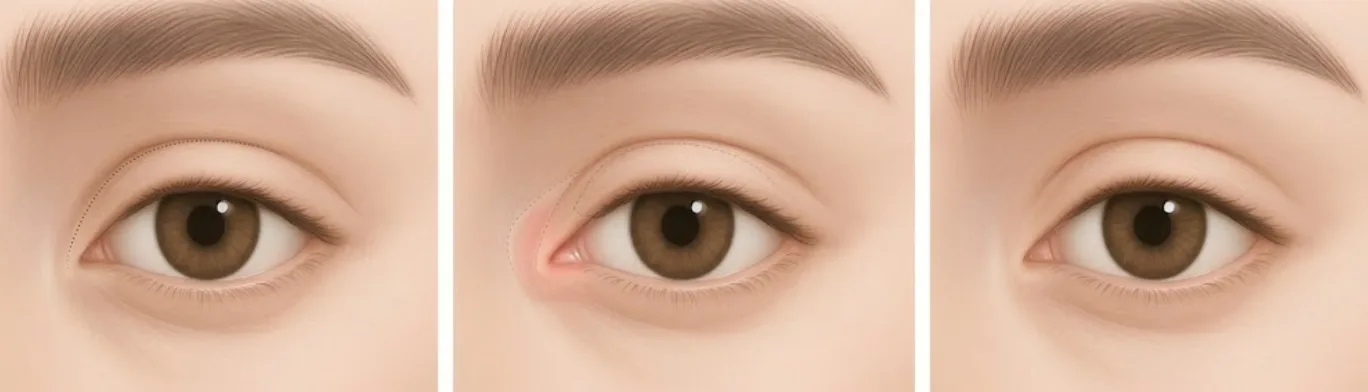
Many people have a small fold of skin at the inner corner of the eye (the epicanthal or "Mongolian" fold) that partly covers the pink inner corner and can make the eyes look shorter or more closed-set. Epicanthoplasty releases that band so the inner corner is revealed and the eye reads slightly longer horizontally. At Garnet this is done as a two-way (medial and upper) release of the fold.
Illustration: the skin fold covering the inner corner is released along the dotted line so the inner corner opens slightly while the eye keeps its own shape.
This is a different change from a crease. Double-eyelid surgery adds a fold to the upper lid, changing the eye vertically and giving it a defined line; epicanthoplasty works at the corner, changing the eye horizontally. Because the two act on different dimensions of the same eye, they influence the overall shape together. That makes the decision to combine them a design question.
Not everyone has a pronounced inner fold, and not everyone who does is bothered by it. If your inner corners are already open, releasing them further changes little and can look unnatural, so the first question is whether the fold is actually limiting your eye shape.
Should you add it?
Should you add epicanthoplasty to your double eyelid?
The starting point is your own anatomy. Epicanthoplasty tends to help when a prominent inner fold makes the eyes look short, when the fold interrupts the line of a new crease so the crease can't taper naturally toward the inner corner, or when you specifically want a longer, more open eye shape. If none of these describe you, adding it gives little benefit for a lasting change and a scar.
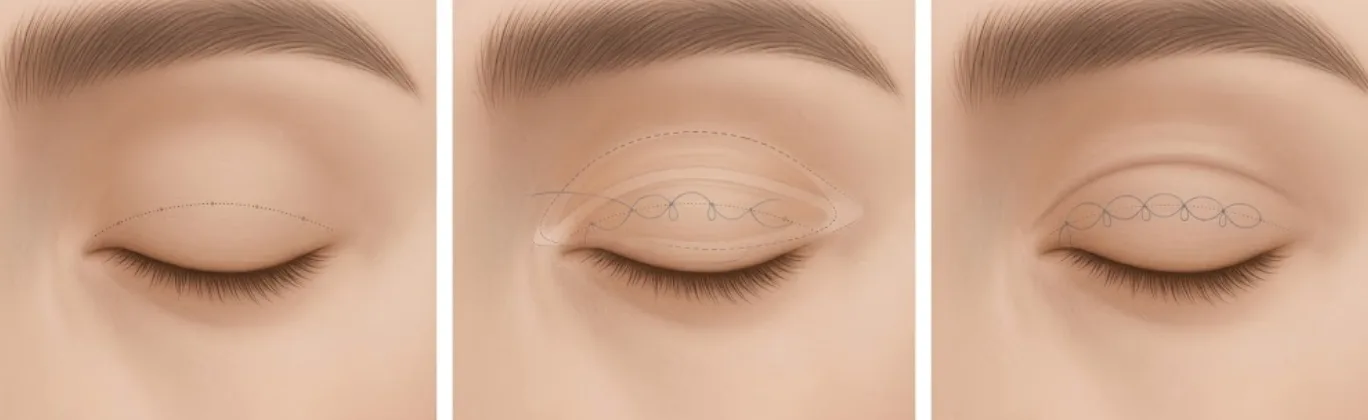
Illustration: a thin buried suture is looped along the planned crease through tiny points, with no skin incision, so the lid folds at the new line.
There is also a proportion question. Releasing the inner corners increases the amount of visible eye and reduces the distance between the eyes. It is a subtle change that suits some faces and over-opens others. A good surgeon considers how far apart your eyes already sit and how much release is appropriate; the corners are not opened by the same amount for everyone. Small differences here noticeably change the outcome.
Crease plus corner is not automatically better. The decision turns on whether your inner fold genuinely limits your eye shape, and on how comfortable you are with a small lasting scar to change it. For some patients the answer is a clear yes; for others, a crease alone (sometimes even a non-incision crease) is the right, smaller operation.
Why combined
Why the two are commonly combined
When both are indicated, doing them together makes sense for a design reason; price is not the reason. The crease and the inner corner meet at the same part of the eye: where the fold tapers toward the nose depends on whether the inner corner is opened. Planning both in one operation lets the surgeon shape the crease to flow into the released corner, which is harder to reconcile if the two are done months apart.
It is also practical. The incisions for the crease and for the inner-corner release are close together and heal over a similar window, so combining them means one operation and one recovery, which is useful for an international patient making a single trip. That convenience should only follow from the decision that you need both.
If you only need a crease, combining adds an unnecessary lasting change. If you have a strong inner fold but a naturally good lid, some surgeons will discuss whether the corner release alone meets your goal. The point is to match the operation to your eye, and combining is the answer only when both parts genuinely improve the shape.
One operation
How the combined operation works
In a combined case the surgeon forms the double-eyelid crease and performs the inner-corner release in the same session. Because epicanthoplasty is a two-way release of the fold at the medial corner, the surgeon designs it in relation to the new crease so the two transitions look continuous, with the fold tapering into the opened corner instead of stopping abruptly.
The precision is at the inner corner. How much to release, and how to lay the small incision so it settles discreetly, is a matter of fine judgement, and the natural-looking outcome depends heavily on that design. This is one reason an experienced surgeon and unhurried operating time matter for corner work specifically, and why the crease is set with the corner in mind.
Ask who performs the corner release. It is a delicate, visible part of the eye that is not easily revised, so confirming that the same board-certified surgeon does both the crease and the epicanthoplasty, from consultation through surgery, is a reasonable thing to establish in writing before you commit.
Scars & healing
Scars, healing and why this is hard to reverse
The trade-off with epicanthoplasty is the scar at the inner corner. Releasing the inner corner leaves a small incision in a visible part of the eye. In most patients it fades and becomes inconspicuous over months, but it is in an area people notice, and how it heals varies between individuals. Sutures for the combined operation typically come out around day 7, with swelling and some redness at the corners in the first week or two that is expected and temporary.
The corners settle gradually. Early on the released inner corner can look pinker or more open than it will finally read, and the scar is at its most noticeable in the first weeks before it matures. Judging the result before a few months have passed is misleading. Corner healing is one of the clearer arguments for structured follow-up over several months instead of one early check.
Reversibility is the key caution. Once the inner-corner fold is released, restoring it is difficult, so this is not a change to make on impulse or because it was offered alongside the crease. That is precisely why the decision should rest on whether your inner fold genuinely limits your eye shape, so that the change is one you chose deliberately.
At Garnet
How Garnet approaches combined eye surgery
Garnet is a single-surgeon clinic in Apgujeong, Seoul. Dr. In-Soo Baek is a board-certified plastic surgeon (Korean medical licence no. 77407) and the only operating doctor. He consults, performs both the crease and the inner-corner release himself, and reviews every follow-up, with the day capped at two surgeries so delicate corner work is not rushed. Garnet is registered with Korea's foreign-patient programme.
The clinic's stated approach is to address only what you came for and not to over-recommend, so epicanthoplasty is proposed only when your inner-corner anatomy calls for it, and never as a default add-on to a crease. Follow-up is structured at 1, 3 and 6 months, which suits corner healing that matures over time. You can start with a no-obligation online assessment and send close photos of your inner corners for an opinion on whether a crease alone, or a crease with epicanthoplasty, suits your eyes.
Dr. In-Soo Baek
Director & sole operating surgeon
Korean medical licence no. 77407
Operate on what you came for. Trained at Korea University Medical Center. Every case planned, performed and reviewed by the same hands.
1Operating surgeon
~2Surgeries per day
7Registered techniques
Board-certified plastic surgeon
Plastic surgery training at Korea University College of Medicine & graduate school
Korean Society of Plastic and Reconstructive Surgeons member, in its facial-contour, eye & rhinoplasty groups
Consults, operates and follows up each case himself
Peer-reviewed papers behind the facts on this page. Each describes findings in its own study group — not results at Garnet — and none predicts your own outcome.
Pan S et al. The Impact of Full-Incision Double-Eyelid Blepharoplasty on Dry Eye: Association with Short-Term Meibomian Gland Dysfunction and Increased Incomplete Blinking. Aesthetic Plastic Surgery. 2026. doi:10.1007/s00266-026-06052-2
Fineide FA et al. Minimizing Postoperative Scars in Epicanthoplasty: A Concise Review. Journal of Cosmetic Dermatology. 2025. doi:10.1111/jocd.70603
Fu HX et al. A Surgical Strategy Combining Modified Park Double Eyelid Surgery and Flying-Tail Incision: Technique and Outcomes in Upper Eyelid Skin Laxity. Journal of Craniofacial Surgery. 2025. doi:10.1097/scs.0000000000011533
He Z et al. Comparison of Modified Asymmetric Inverse Z-plasty and Z-plasty in the Correction of Epicanthal Folds. Aesthetic Plastic Surgery. 2025. doi:10.1007/s00266-025-05282-0
FAQ
Common questions
Should I add epicanthoplasty to my double-eyelid surgery?
Only if a prominent inner fold makes your eyes look short or interrupts the crease line. If your inner corners are already open, adding epicanthoplasty gives little benefit for a lasting change and a scar. A surgeon assesses your inner-corner anatomy before advising either way.
What does epicanthoplasty actually do?
It releases the fold of skin at the inner corner of the eye so the pink inner corner is revealed and the eye reads slightly longer horizontally. At Garnet it is a two-way release. This is a different change from a crease, which alters the eye vertically.
When is inner-corner release helpful?
It helps mainly when a pronounced inner fold makes the eyes look short or closed-set, when the fold stops a new crease tapering naturally toward the nose, or when you want a longer, more open eye shape. If none of these apply, it changes little.
Are they done in one session?
Yes, when both are needed. The incisions for the crease and the corner release are close together and heal over a similar window, so they are commonly done in one operation with one recovery, with sutures typically out around day 7. Combining should follow the decision that you need both.
Does epicanthoplasty leave a scar?
Yes, a small incision at the inner corner, in a visible part of the eye. In most patients it fades and becomes inconspicuous over months, but healing varies and it is in an area people notice. That visible, lasting scar is why the decision should be deliberate.
Can epicanthoplasty be reversed?
Not easily. Once the inner-corner fold is released, restoring it is difficult, so it is not a change to make on impulse or simply because it was offered alongside a crease. This is the main reason to be sure your inner fold genuinely limits your eye shape first.
Do I always need epicanthoplasty with a double eyelid?
No. If your inner corners are already open, a crease alone (sometimes even a non-incision crease) is the right, smaller operation. Adding corner release where it isn't needed does not improve the eye. It only adds a lasting change and a scar.
Will my eyes look natural after the combined surgery?
A natural-looking result depends on how much the corner is released and how the crease is designed to flow into it. Small differences matter, which is why an experienced surgeon and unhurried operating time are worth prioritising. Over-opening the corners can look unnatural, so restraint is part of good corner work.
How long does the corner take to heal?
Sutures typically come out around day 7, with swelling and redness at the corners in the first week or two. The scar is most noticeable early and matures over months, and the released corner settles gradually, so wait a few months before you judge the result.
Can I get assessed before travelling to Korea?
Yes. Send close photos of your inner corners for a pre-assessment in an online consultation, and get a candid view on whether a crease alone or a crease with epicanthoplasty suits your eyes before you commit to travel.
My mom recently had a brow lift and lower blepharoplasty with Dr. Baek, and our experience has been wonderful so far. The Garnet team was incredibly kind and welcoming, with Kelly assisting us as our English consultant—she made everything…
I’m so happy I chose this clinic for my lower blepharoplasty. I was traveling from abroad by myself, so I was a little nervous, but from the beginning I felt comfortable and truly cared for. Everyone was kind, patient, and professional…
Came in for an in-person consult and ended up choosing Garnet and Dr.Baek for my non-incisional DES and tiplasty/alarplasty. I communicated with Kelly (English consultant) from the start till now (3 weeks post-op). She really help me feel…
My under-eyes have been sagging and folding for years... I tried to cover it up with makeup, but it actually got stuck in the wrinkles and made it stand out even more. While going for consultations, I noticed that the bigger the hospital…
Unsure whether your eyes need inner-corner release or just a crease? Send close photos of your inner corners for a no-obligation assessment before you plan a trip.
Send photos and your question before you travel. An English-speaking coordinator reviews every enquiry and replies with guidance on whether surgery is appropriate, the likely plan and timing.
✓ Reviewed by the clinic coordinator, not a bot
✓ Photo-based pre-assessment before you fly
✓ Foreign-patient scheduling & after-care
✓ One surgeon for consultation, surgery and follow-up
Prefer to chat now? Reach the coordinator directly:








 T S7 months ago



