The lower face and the neck age as one continuous unit, so a facelift and a neck lift are often planned together; treat one and the untreated area can look out of step. Your anatomy, and no package, decides whether you need both and how much neck work. This page explains how the combined operation really works and how to decide.
The short answer
A deep-plane facelift lifts the lower face and jawline; a neck lift addresses laxity and banding below it. The two meet at the jawline.
Because the jawline and neck are continuous, treating the face without the neck (or vice versa) can leave a visible mismatch, which is why they are usually planned together.
Whether your neck needs muscle work such as corset platysmaplasty depends on your anatomy; not every facelift patient needs the same neck procedure.
Combining is common because they share the same recovery. Doing more is not automatically better, and you should only have the neck work you actually need.
The lower face and the neck are not separate zones. They are a single continuous surface that ages together. As the deeper support layer (the SMAS and, in the neck, the platysma muscle) loosens, the jawline blurs and the neck loosens at the same time. That is why a deep-plane facelift and a neck lift are so often discussed together: they address two ends of one problem.
Illustration: the deeper facial layer (SMAS, shown in yellow) is released and repositioned as one unit with the skin, rather than pulling the skin alone.
A facelift releases and repositions the SMAS to restore the lower face and define the jawline; a neck lift works below that, tightening the platysma and removing laxity through submental or behind-the-ear incisions. The jawline is where the two meet, the transition point where the face becomes the neck, so how one is done affects how the other looks.
This continuity is the real reason these procedures are grouped. It is not that more surgery is inherently better; it is that the jawline and neck read together, so planning them as one unit is what produces a balanced result when both areas have loosened.
Do you need both?
How to tell whether you need both
Not every facelift patient needs the same neck work, and some need very little. The relevant questions are specific: is there loose skin or a soft, undefined jawline; are there vertical neck bands that show when you tense; is there fullness under the chin; how much has the platysma muscle loosened? The answers determine whether your neck needs a full neck lift, targeted muscle work such as corset platysmaplasty, or comparatively little.
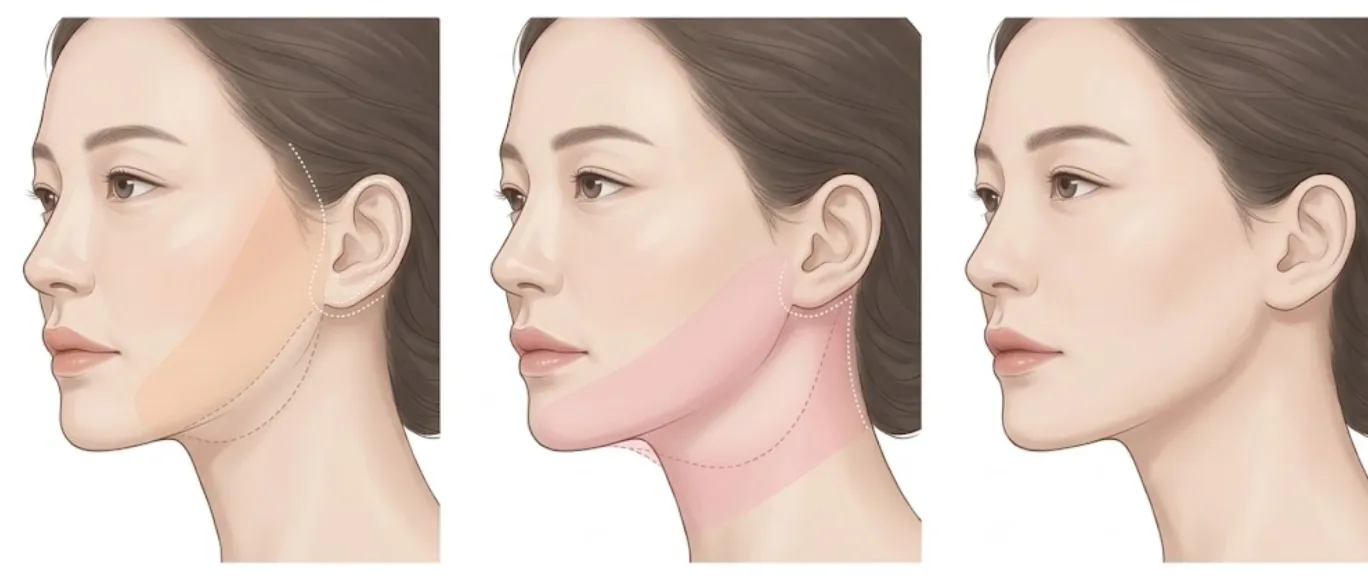
Illustration: through a fine line around the ear (dotted), the sagging lower face and neck are lifted up and back toward the ear (shaded); the dashed outline shows the old contour.
It is genuinely possible to need a facelift and only modest neck work, or to have neck laxity that is really the main concern. A careful surgeon examines the neck separately and does not assume it always needs the same procedure. That is why an assessment sometimes concludes that a smaller operation meets your goal. Adding neck surgery you don't need does not make the result better.
Equally, treating the face and ignoring an obviously loose neck can leave the two areas mismatched: a tightened lower face above a slack neck. The judgement is in matching the amount of neck work to your anatomy, which is precisely what an in-person or photo consultation is for.
Why combined
Why the two are usually planned together
When both areas have loosened, planning them in one operation is sensible for a structural reason, and price has nothing to do with it. The SMAS of the face and the platysma of the neck are connected tissues, and the pull that redefines the jawline in a facelift interacts with how the neck is tightened. Doing them together lets the surgeon set the tension across the whole lower face and neck as one design. Treating half and trying to match the other half later is harder.
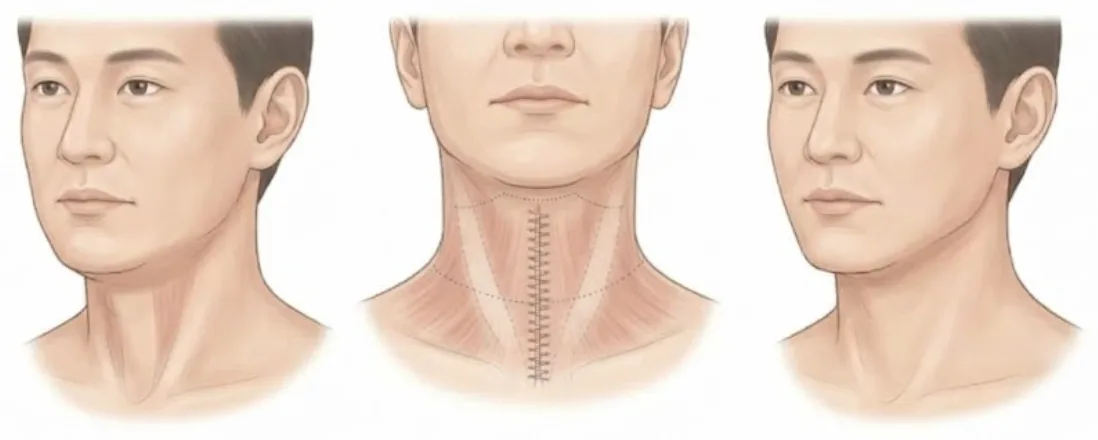
Illustration: the neck muscle (platysma) is drawn back together along the midline, like lacing a corset, to firm the neck.
There is also the recovery argument. A facelift and a neck lift share overlapping incisions and the same healing window, so combining them means one operation and one recovery instead of two, which is meaningful for an international patient making a single trip, and gentler than undergoing a second lift months afterward. But this convenience should follow the finding that both areas need work.
The banding and fullness under the chin are addressed by the neck component, sometimes a corset platysmaplasty that plicates the platysma in the midline. It is planned alongside the facelift's jawline work so the two transitions are continuous. Combining is the right answer when both the jawline and the neck genuinely need attention, and only then.
One operation
How the combined operation actually works
In a combined case the surgeon performs the deep-plane facelift (releasing and repositioning the SMAS from the temporal hairline and in front of the ear down to the jawline) and the neck lift through submental and behind-the-ear incisions in the same session. Where midline muscle laxity or banding is present, corset platysmaplasty tightens the platysma through a small incision under the chin. It is one continuous operation because the areas are contiguous.
The skill is in the transition at the jawline. The tension set in the face has to hand off smoothly to the tension set in the neck, so the jaw-to-neck line looks like one clean contour from jaw to neck. This is deeper, more structural work than a skin-only lift, and it is where an experienced facelift surgeon and unhurried operating time matter most.
Because a combined face-and-neck lift is a longer, more involved case, ask who performs it and confirm it in writing. At a single-surgeon clinic the same board-certified surgeon plans and performs both the facelift and the neck work from start to finish, with the day's surgical load capped so a long combined case is not rushed.
Recovery
Recovery when the face and neck are done together
Because the face and neck share the same healing window, recovery is one process with no second recovery stacked on top. Sutures typically come out in stages around day 10 and day 14. The first week or two involves swelling, bruising and tightness across the lower face and neck, and you will need to plan your stay in Korea around at least the early suture removals. A combined lift is not a quick-turnaround trip.
Swelling and firmness in the neck and along the jawline settle gradually, and the final contour becomes clear over months as deep swelling resolves and the tissues relax into their new position. The jawline definition and neck line you see in the first weeks are not the settled result. This is a slower, more staged recovery than eyelid or nose surgery, and it should be planned for realistically.
Structured follow-up matters here because the result matures over time and because a combined lift involves more tissue than either procedure alone. Being reviewed at set points, and having the operating surgeon reachable after you return home, is more important for a face-and-neck lift than for a smaller operation.
At Garnet
How Garnet approaches combined face and neck lifting
Garnet is a single-surgeon clinic in Apgujeong, Seoul. Dr. In-Soo Baek is a board-certified plastic surgeon (Korean medical licence no. 77407) and the only operating doctor — he consults, performs both the facelift and the neck work himself, and reviews every follow-up, with the day capped at two surgeries so a long combined case is unhurried. Garnet is registered with Korea's foreign-patient programme.
The clinic's stated approach is to address only what you came for and not to over-recommend, so the amount of neck work is matched to your anatomy and never added by default. Follow-up is structured at 1, 3 and 6 months, which suits a lifting result that settles over time. You can start with a no-obligation online assessment and send photos of your jawline and neck for an opinion on whether you need a facelift, a neck lift, or both.
Dr. In-Soo Baek
Director & sole operating surgeon
Korean medical licence no. 77407
Operate on what you came for. Trained at Korea University Medical Center. Every case planned, performed and reviewed by the same hands.
1Operating surgeon
~2Surgeries per day
7Registered techniques
Board-certified plastic surgeon
Plastic surgery training at Korea University College of Medicine & graduate school
Korean Society of Plastic and Reconstructive Surgeons member, in its facial-contour, eye & rhinoplasty groups
Consults, operates and follows up each case himself
Peer-reviewed papers behind the facts on this page. Each describes findings in its own study group — not results at Garnet — and none predicts your own outcome.
Gu JT et al. Direct Neck Lift for Men. Facial Plastic Surgery Clinics of North America. 2024. doi:10.1016/j.fsc.2024.02.004
Charafeddine AH et al. Neck Rejuvenation. Clinics in Plastic Surgery. 2019. doi:10.1016/j.cps.2019.06.004
Marten T et al. Neck Lift. Clinics in Plastic Surgery. 2018. doi:10.1016/j.cps.2018.06.002
FAQ
Common questions
Are a facelift and neck lift done together in Korea?
Often, yes. The lower face and neck age as one continuous unit, so a deep-plane facelift and a neck lift are commonly planned together. Whether you need both, and how much neck work, depends on your anatomy, and a package does not decide it.
Do I need both a facelift and a neck lift?
Not always. Some patients need a facelift with only modest neck work; others have neck laxity as the main concern. A surgeon examines the neck separately for loose skin, bands and fullness under the chin, and matches the operation to what you actually need.
Does combining give a more balanced result?
It can, when both areas have loosened, because the jawline and neck read together, so treating one and ignoring the other can look mismatched. But that depends on your anatomy, with no fixed rule: if your neck is fine, a facelift alone is the right, smaller operation.
Why are the face and neck treated as one unit?
Because the SMAS of the face and the platysma of the neck are connected tissues that loosen together, and the jawline is where they meet. Planning both in one operation lets the surgeon set the tension across the whole lower face and neck as one design, without matching two halves later.
What is corset platysmaplasty and do I need it?
It tightens the platysma muscle in the midline of the neck through a small incision under the chin, addressing banding and fullness. Corset platysmaplasty is added when your neck has that muscle laxity. It is not for every patient, and is added only when indicated.
Is combining just a cheaper package?
No. The reason to combine is structural: the face and neck are contiguous, so treating both together produces one continuous jaw-to-neck contour. Focus on what each area needs. A discount for doing more is not a medical reason to add neck surgery you don't need.
How long is recovery for a combined face and neck lift?
It is one recovery, with sutures typically out in stages around day 10 and day 14. The first week or two involves swelling, bruising and tightness, and the final contour settles over months. Plan to stay in Korea through at least the early suture removals; it is not a quick trip.
Will the jawline and neck match after surgery?
That is the point of combining: the tension set in the face hands off to the tension in the neck so the jaw-to-neck line is one clean contour. Achieving that smooth transition is the skilled part, which is why experience and unhurried operating time matter for a combined lift.
Who should perform a combined face and neck lift?
A combined lift is a longer, structural operation, so ask who performs it and confirm in writing. At a single-surgeon clinic the same board-certified surgeon plans and performs both the facelift and the neck work from start to finish, with the day's load capped so a long case isn't rushed.
Can I be assessed before flying to Korea?
Yes. Send photos of your jawline and neck for a pre-assessment in an online consultation, and get a candid view on whether you need a facelift, a neck lift, or both before you commit to travel.
My mom recently had a brow lift and lower blepharoplasty with Dr. Baek, and our experience has been wonderful so far. The Garnet team was incredibly kind and welcoming, with Kelly assisting us as our English consultant—she made everything…
I’m so happy I chose this clinic for my lower blepharoplasty. I was traveling from abroad by myself, so I was a little nervous, but from the beginning I felt comfortable and truly cared for. Everyone was kind, patient, and professional…
Came in for an in-person consult and ended up choosing Garnet and Dr.Baek for my non-incisional DES and tiplasty/alarplasty. I communicated with Kelly (English consultant) from the start till now (3 weeks post-op). She really help me feel…
My under-eyes have been sagging and folding for years... I tried to cover it up with makeup, but it actually got stuck in the wrinkles and made it stand out even more. While going for consultations, I noticed that the bigger the hospital…
Not sure whether you need a facelift, a neck lift, or both? Send photos of your jawline and neck for a no-obligation assessment before you plan a trip.
Send photos and your question before you travel. An English-speaking coordinator reviews every enquiry and replies with guidance on whether surgery is appropriate, the likely plan and timing.
✓ Reviewed by the clinic coordinator, not a bot
✓ Photo-based pre-assessment before you fly
✓ Foreign-patient scheduling & after-care
✓ One surgeon for consultation, surgery and follow-up
Prefer to chat now? Reach the coordinator directly:








 T S7 months ago



