A facelift for a man has a specific brief: to reset a heavy jawline and sagging neck so the face looks rested and defined, while still reading as a man's face that has aged well. It should never look tight, wind-blown or feminised. Male anatomy changes how the operation is planned, from where the incisions hide in a beard to how a stronger neck is handled. Done well, the result is quiet: people notice you look better without knowing why.
The short answer
The masculine goal is a natural, refreshed jaw and neck. A pulled, over-tight look is both feminising and a giveaway, so a conservative, deep-plane approach matters.
Beard-bearing skin changes where incisions are placed, because hair-growth patterns and the beard line must be respected around the ear and sideburn.
Men often have a stronger, heavier platysma muscle and more submental fat, so the neck is frequently the deciding part of the operation.
A younger or lighter face may only need a deep-mini lift, while heavier sagging is addressed with a full deep-plane facelift.
Men's facial skin is generally thicker, more vascular and carries a richer blood supply beneath a beard, which changes both how the tissue is lifted and how bleeding is controlled. The supporting SMAS layer and the platysma muscle of the neck tend to be stronger, and men usually carry heavier soft tissue along the jaw and under the chin. All of this means a male facelift is planned around a different anatomy; it is not a female facelift scaled down.
The aesthetic brief is also distinct. Men age into heaviness (jowls, a blunted jawline, a sagging neck), and the goal is to restore a clean jaw and neck angle while keeping the face masculine and natural. A tight, lifted, over-smoothed result is a tell-tale sign of surgery, and on a man it also reads as feminised and wrong. Restraint and a deep, structural lift of the SMAS keep the outcome believable; a skin-tightening pull does not.
Because Garnet is a single-surgeon clinic, Dr. In-Soo Baek, a board-certified plastic surgeon, assesses your face, discusses what a natural masculine result means for you, and performs the operation himself. A facelift is a technique-heavy operation where the surgeon's judgement about how much to lift decides whether it looks natural or done.
Beard & incisions
Incisions, beard-bearing skin and the hairline
Incision planning is one of the biggest differences in a male facelift. A full deep-plane facelift uses incisions from the temporal hairline and in front of the ear down to the jawline. In a man, these have to respect the beard line, the sideburn and the direction of hair growth, so that beard-bearing skin is not pulled onto the ear or into places it does not belong, and so the sideburn is not lifted out of position.
Illustration: the deeper facial layer (SMAS, shown in yellow) is released and repositioned as one unit with the skin, rather than pulling the skin alone.
The trade-off men should understand is that facial hair can shift with the skin. Careful planning keeps the beard line and shaving pattern natural, but the surgeon has to account for where hair grows and where it does not, for example around the ear, where non-hair-bearing skin should stay non-hair-bearing. This is a routine part of male facelift planning and one of the clearest reasons an experienced, individualised assessment matters.
How the incisions are designed depends on your hairline, beard density and how much lift you need. In an online consultation you can send photos and discuss how the incisions would sit for your beard and hairline. You will also get a straight view of whether a facelift, or a smaller procedure, is the right step.
The neck
Why the neck often decides a male result
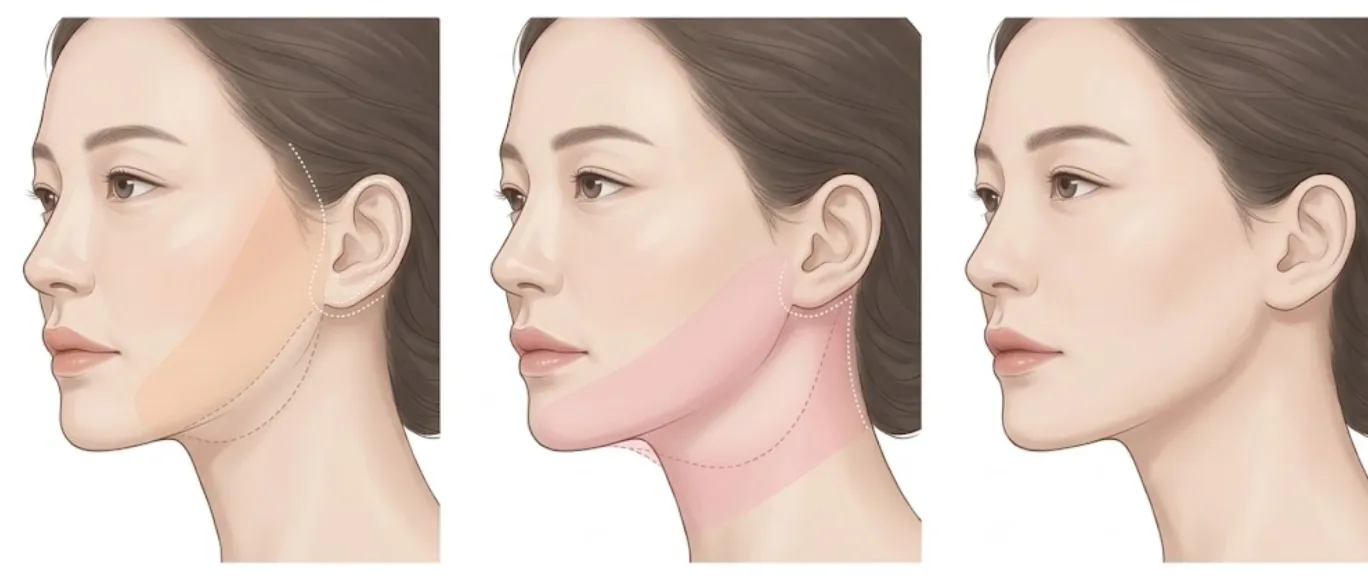
For many men it is the neck, more than the cheek, that makes them look older and heavier: a blunted jaw-to-neck angle, banding from the platysma muscle, and fullness under the chin. Male platysma muscles are often stronger and the submental fat heavier, so treating the neck properly is frequently the deciding part of the operation. A neck lift addresses this through submental and post-auricular access, tightening the SMAS-platysma layer and, where indicated, refining the muscle and contour so a clean jaw-neck angle returns.
Illustration: through a fine line around the ear (dotted), the sagging lower face and neck are lifted up and back toward the ear (shaded); the dashed outline shows the old contour.
A facelift that lifts the face but ignores a heavy neck leaves the most visible sign of ageing untouched, which is why the neck is assessed as part of the same plan. Depending on the case, neck work is combined with the facelift so the jawline and neck are corrected together in one plan.
Whether your neck needs full treatment, and how much, depends on examining the muscle, fat and skin, which is exactly what a same-surgeon assessment is for. Dr. Baek evaluates the neck alongside the face and recommends whether a combined lift or a more limited approach fits your anatomy.
Which lift
Deep-mini or a full deep-plane facelift
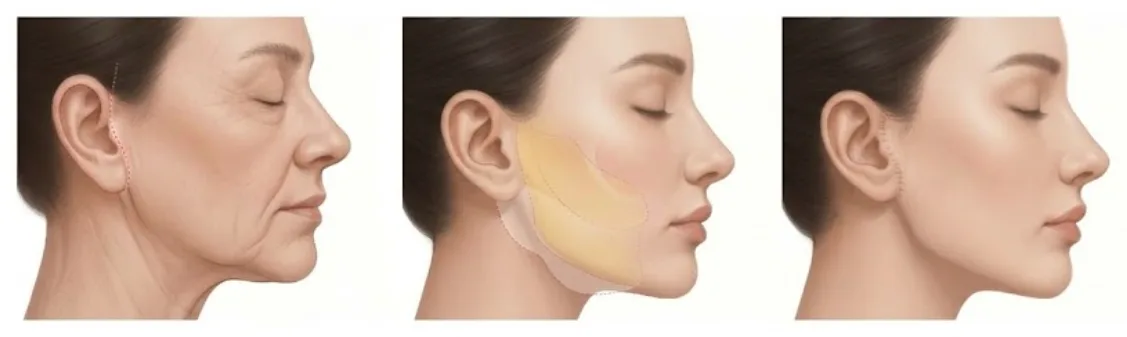
Not every man needs the same extent of surgery. A younger man, or one with lighter sagging focused on the mid-face and nasolabial folds, may be suited to a deep-mini facelift: a shorter incision from the temporal hairline to the ear lobe, with a deep-plane release under the SMAS, and sutures out at around ten days. It targets early jowling and folds with less extent than a full lift.
Illustration: through a shorter incision around the ear (dotted), the deeper layer (yellow) is lifted using the deep-plane principle (Deep mini™).
A man with more advanced sagging along the jaw and neck is generally better served by a full deep-plane facelift, which releases the SMAS all the way to the jawline for a more complete, longer-lasting correction; sutures come out in stages at around ten and fourteen days. The deep-plane technique repositions the deeper structural layer and does not pull on the skin. That is what keeps a male jawline looking natural instead of tight.
Which you need depends on your anatomy and the degree of sagging along your jaw and neck. Picking the bigger or smaller option for its own sake is the wrong starting point. The surgeon's job is to recommend the least surgery that will actually achieve the result, and to tell you if a lift is premature.
Recovery
Recovery, downtime and a natural result
For a deep-mini lift, sutures come out around day ten; for a full deep-plane facelift and neck lift, in stages at around ten and fourteen days. Swelling and bruising are heaviest in the first week to ten days, and there is usually tightness and some numbness around the ears and neck that eases over the following weeks. Most men are ready to be seen socially at around two to three weeks, once the visible bruising has resolved, though the final settled result develops over the following months.
A beard can be an advantage in recovery, helping to camouflage incisions near the ear and jaw as they heal. It is generally advisable to avoid shaving directly over healing incisions until cleared, and to be gentle around the sideburn and ear while the skin settles. Keeping the head elevated and avoiding strenuous activity early on helps the swelling go down faster.
If you are travelling from abroad, plan to stay in Seoul until your sutures are out (for a full lift, through the 14-day stage), and then use Garnet's structured follow-ups at 1, 3 and 6 months by messenger after you return home. Because the same surgeon who performed the lift reviews your recovery, any early question about tightness or symmetry is assessed by the person who planned it.
Dr. In-Soo Baek
Director & sole operating surgeon
Korean medical licence no. 77407
Operate on what you came for. Trained at Korea University Medical Center. Every case planned, performed and reviewed by the same hands.
1Operating surgeon
~2Surgeries per day
7Registered techniques
Board-certified plastic surgeon
Plastic surgery training at Korea University College of Medicine & graduate school
Korean Society of Plastic and Reconstructive Surgeons member, in its facial-contour, eye & rhinoplasty groups
Consults, operates and follows up each case himself
Peer-reviewed papers behind the facts on this page. Each describes findings in its own study group — not results at Garnet — and none predicts your own outcome.
Surek CC et al. Deep Plane Anatomy for the Facelift Surgeon. Facial Plastic Surgery Clinics of North America. 2022. doi:10.1016/j.fsc.2022.01.015
Huq NS et al. Cosmetic Face, Neck, and Brow Lifts with Local Anesthesia. Clinics in Plastic Surgery. 2013. doi:10.1016/j.cps.2013.08.007
Fitzgerald R et al. Update on Facial Aging. Aesthetic Surgery Journal. 2010. doi:10.1177/1090820x10378696
Gordon NA et al. From the Deep-Plane Rhytidectomy to the Vertical Platysma Advancement. Facial Plastic Surgery Clinics of North America. 2020. doi:10.1016/j.fsc.2020.03.002
FAQ
Common questions
How is a male facelift different from a female one?
Male skin is thicker and more vascular, the SMAS and neck muscles are stronger, and men carry heavier tissue along the jaw and under the chin. Incisions also have to respect the beard line and sideburn. So a male facelift is planned around a different anatomy, with a deep, structural lift aimed at a natural result without tightness.
Do beard-bearing areas affect where the incisions go?
Yes. Incisions are planned around the beard line, sideburn and hair-growth direction so that beard-bearing skin is not pulled onto the ear or out of position, and non-hair-bearing skin stays that way. This is a routine but important part of male facelift planning, and it depends on your individual hairline and beard density.
Will a facelift make me look pulled or feminised?
It should not if it is done with a deep-plane technique and restraint. A tight, over-smoothed, pulled look is both a giveaway of surgery and reads as feminised on a man. Repositioning the deeper SMAS layer, without pulling the skin, is what keeps a male face looking naturally refreshed.
Is the neck part of a male facelift?
Often it is the deciding part. Men frequently have a stronger platysma muscle and heavier fat under the chin, so a neck lift tightening the SMAS-platysma layer is combined with the facelift to restore a clean jaw-neck angle. A lift that ignores a heavy neck leaves the most visible sign of ageing untouched.
Do I need a full facelift or a smaller procedure?
It depends on how much sagging you have. Lighter, mid-face sagging can suit a deep-mini facelift with a shorter incision, while more advanced jaw and neck sagging is better served by a full deep-plane facelift. The aim is the least surgery that achieves the result, decided at consultation.
How long is the recovery and downtime?
Sutures come out around day ten for a deep-mini lift, and in stages at about ten and fourteen days for a full deep-plane and neck lift. Swelling and bruising are heaviest in the first week to ten days, and most men are ready to be seen socially at two to three weeks, with the final result settling over the following months.
Does having a beard affect the surgery or recovery?
A beard is factored into incision planning so hair-growth patterns and the beard line stay natural, and it can help camouflage healing incisions near the ear and jaw. It is generally advisable to avoid shaving over healing incisions until cleared. Your beard density and hairline are assessed as part of the plan.
Can I have a male facelift as an international patient?
Yes. Garnet is registered with Korea's foreign-patient programme. You can start with an online consultation and photo assessment, plan to stay in Seoul until your sutures are out (through the 14-day stage for a full lift), and continue follow-ups at 1, 3 and 6 months by messenger after you return home.
Who will perform my facelift at Garnet?
Dr. In-Soo Baek, a board-certified plastic surgeon (Korean medical licence no. 77407), consults, operates and reviews your follow-ups himself. Garnet is a single-surgeon clinic, so the surgeon who plans your lift performs it and sees you through recovery. That matters in a facelift, where judgement about how much to lift decides whether it looks natural.
My mom recently had a brow lift and lower blepharoplasty with Dr. Baek, and our experience has been wonderful so far. The Garnet team was incredibly kind and welcoming, with Kelly assisting us as our English consultant—she made everything…
I’m so happy I chose this clinic for my lower blepharoplasty. I was traveling from abroad by myself, so I was a little nervous, but from the beginning I felt comfortable and truly cared for. Everyone was kind, patient, and professional…
Came in for an in-person consult and ended up choosing Garnet and Dr.Baek for my non-incisional DES and tiplasty/alarplasty. I communicated with Kelly (English consultant) from the start till now (3 weeks post-op). She really help me feel…
My under-eyes have been sagging and folding for years... I tried to cover it up with makeup, but it actually got stuck in the wrinkles and made it stand out even more. While going for consultations, I noticed that the bigger the hospital…
Wondering whether it is your jaw, your neck, or too soon to consider a lift at all? Send photos for a no-obligation assessment of what would suit a man's face before you plan a trip.
Send photos and your question before you travel. An English-speaking coordinator reviews every enquiry and replies with guidance on whether surgery is appropriate, the likely plan and timing.
✓ Reviewed by the clinic coordinator, not a bot
✓ Photo-based pre-assessment before you fly
✓ Foreign-patient scheduling & after-care
✓ One surgeon for consultation, surgery and follow-up
Prefer to chat now? Reach the coordinator directly:







 T S7 months ago



