Nasolabial folds run from the nose to the corners of the mouth; marionette lines run from the mouth corners downward. Both are among the first changes people notice with age. Each line is a symptom with more than one possible cause, and softening them well depends on understanding why they formed in your face.
The short answer
Nasolabial folds and marionette lines are usually driven by descent of the cheek and jowl plus loss of deep facial volume — often both at once.
There is no single operation that suits every fold: a facelift repositions sagging tissue, while fat grafting restores lost volume, and the two are sometimes combined.
Surface fillers and threads can blur a fold temporarily, but when the cause is descent or volume loss, a surgical approach addresses the underlying change instead of masking it.
The most useful first step is an assessment of what is actually causing your folds, so you are not offered surgery that will not help.
A nasolabial fold is the crease between the cheek and the upper lip; a marionette line runs down from the corner of the mouth toward the jaw. In a young face both are shallow. They deepen for a few overlapping reasons: the cheek fat pad and deeper tissues descend with gravity and time, the jowl forms as the jawline softens, and the face loses volume in the mid-cheek and around the mouth so the skin folds where it once stayed full. Skin quality and repeated expression add to the picture.
This matters because the same visible line can have different underlying causes in different people. In one face the fold is mostly a heavy cheek and jowl sagging over a still-supported mid-face; in another it is mainly deflation: the cheek has hollowed and lost its projection, so the fold appears by contrast. Many faces show a mix of both. That is why a fold is best thought of as a symptom to be assessed before any single operation is chosen.
It also explains why a treatment that helps one person can disappoint another. Lifting descended tissue does little for a fold caused mainly by volume loss, and adding volume does little for a fold caused mainly by heavy, sagging jowls. Matching the approach to the cause is the whole point of a proper assessment.
The procedures
Which Garnet procedures address folds and lines
When descent of the cheek and jowl is the main driver, a surgical lift repositions the deeper tissue layer so the fold and marionette line soften from underneath. Garnet's deep-plane facelift releases and repositions the SMAS layer through to the jawline, which addresses a heavier lower face and marionette lines. For patients with earlier, more localised sagging, the deep mini facelift uses a shorter incision from the temporal hairline to the earlobe with a deep-plane release of the sub-SMAS layer. It is a smaller operation aimed at the jawline and mid-face, without treating the whole face.
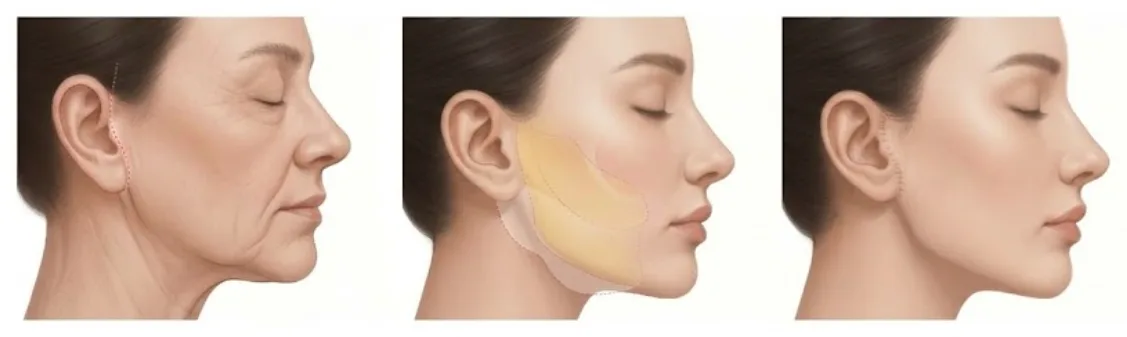
Illustration: the deeper facial layer (SMAS, shown in yellow) is released and repositioned as one unit with the skin, rather than pulling the skin alone.
When the fold is driven mainly by lost volume, restoring that volume is the more logical route. Garnet's fat grafting harvests your own fat (from the abdomen or thigh) and places it as micro-fat through cannula access, with no scar line, to rebuild projection in the mid-cheek and support the fold from within. Fat grafting and a lift are not competitors: in a face that has both descended and deflated, the same surgeon may lift the sagging tissue and graft fat to restore lost fullness, planned together.
The right combination is a clinical judgement about your specific face. Because Garnet is a single-surgeon clinic, the surgeon who assesses which of these actually applies to you is the same one who would carry it out, so the plan and the operation stay joined up.
How they differ
How the options differ in practice
The procedures differ in what they change, how invasive they are and how they recover. A deep-plane facelift is the most substantial: it repositions sagging tissue across the lower face, uses incisions along the temporal hairline and in front of the ear, and Garnet removes sutures in two stages at around 10 and 14 days. A deep mini facelift is a smaller version for earlier sagging, with a shorter incision and sutures out at about 10 days.
Illustration: through a shorter incision around the ear (dotted), the deeper layer (yellow) is lifted using the deep-plane principle (Deep mini™).
Fat grafting is different in kind: it adds volume without lifting tissue, is done through cannula access without a visible scar line, and involves swelling that settles over weeks while a proportion of the transferred fat establishes its own blood supply and the rest is reabsorbed. Because outcomes and downtime differ, the choice comes down to which one matches the cause of your folds.
Non-surgical options such as fillers or threads sit alongside these: they can soften the look of a fold temporarily and involve little downtime, but they work at or near the surface and do not reposition descended tissue or replace the structural volume a graft can. They can be a reasonable first step for milder change or for someone not ready for surgery, and this is worth raising openly with the surgeon.
Deciding
How to decide which route fits you
The decision starts with the cause of the fold. If your folds are driven mainly by a heavy, sagging lower face and defined jowls, a lift addresses the underlying descent; if they are driven mainly by a hollowed, deflated mid-cheek, restoring volume is more logical; if both are present, a combined plan often makes more sense than either alone. Age, skin quality, how the fold behaves when you smile, and how much downtime you can take all feed into it.
It also depends on how much change you want and how much recovery you can accommodate. A facelift asks for more downtime but works on the structure of the lower face; fat grafting is less invasive but its result depends partly on how much grafted fat survives. Someone travelling from abroad for a single trip will weigh these differently from someone local. There is no universally correct answer, and any clinic that offers you one before examining your face is worth questioning.
A good sign is a surgeon who is willing to say a given operation would not help you, or that a smaller step is more appropriate than a larger one. At Garnet the same board-certified plastic surgeon who assesses you is the one who would operate and follow you up, so the recommendation is not handed off to someone else.
Expectations
Realistic expectations for nasolabial folds and marionette lines
It helps to be realistic about what surgery can and cannot do for folds and lines. A lift can meaningfully soften a fold and marionette line that stem from descent, and fat grafting can restore fullness that softens a deflated fold, but neither erases a crease completely, and deep, long-standing folds set into the skin may remain visible even after the underlying cause is addressed. The aim is a softer, more rested lower face; a line-free face is not a realistic goal.
Results also evolve over time and do not appear instantly. After a facelift, swelling settles over weeks and the final contour becomes clear over the following months. After fat grafting, some of the transferred fat is reabsorbed in the early weeks, so the settled result is fuller than the raw post-operative look but less than the immediate swelling. That is why a surgeon plans for this and does not promise a fixed amount. Ageing continues afterwards, so folds can gradually redevelop over years.
No responsible surgeon can guarantee a specific outcome, and results vary from person to person. What a careful plan can offer is a considered estimate of what is achievable for your folds and a clear account of the trade-offs. For the safety side of facial surgery here, see plastic surgery safety in Korea.
Consultation
Getting your nasolabial folds assessed
Because folds have several possible causes, the single most useful thing you can do is get yours assessed before committing to any procedure. That means someone examining how your cheek and jawline sit, how the fold behaves when you smile and rest, and whether descent, volume loss or both are the main driver, and then explaining which route, if any, actually addresses it.
At Garnet, a clinic in Apgujeong, Seoul registered with Korea's foreign-patient programme, the only operating doctor is Dr. In-Soo Baek, a board-certified plastic surgeon (Korean medical licence no. 77407). He examines your folds, performs any lift or fat grafting himself and reviews every follow-up at 1, 3 and 6 months, so the assessment and the plan stay with one person from start to finish.
If you are abroad, you can start with a no-obligation online consultation. Send photos and a description of what bothers you, and get a pre-assessment of whether a lift, fat grafting, a combination or a non-surgical option best fits your case before you plan any travel.
Dr. In-Soo Baek
Director & sole operating surgeon
Korean medical licence no. 77407
Operate on what you came for. Trained at Korea University Medical Center. Every case planned, performed and reviewed by the same hands.
1Operating surgeon
~2Surgeries per day
7Registered techniques
Board-certified plastic surgeon
Plastic surgery training at Korea University College of Medicine & graduate school
Korean Society of Plastic and Reconstructive Surgeons member, in its facial-contour, eye & rhinoplasty groups
Consults, operates and follows up each case himself
Peer-reviewed papers behind the facts on this page. Each describes findings in its own study group — not results at Garnet — and none predicts your own outcome.
Strong AL et al. Technical Precision with Autologous Fat Grafting for Facial Rejuvenation: A Review of the Evolving Science. Plastic & Reconstructive Surgery. 2023. doi:10.1097/prs.0000000000010643
Marten T et al. Periorbital Fat Grafting. Facial Plastic Surgery Clinics of North America. 2021. doi:10.1016/j.fsc.2021.02.003
Fiedler LS et al. Autologous fat grafting in the face and neck: Multinational trends and knowledge of the safety, applications, and indications considering oncologic risk potential. Laryngoscope Investigative Otolaryngology. 2021. doi:10.1002/lio2.649
FAQ
Common questions
What surgery softens nasolabial folds?
There is no single operation for every fold. When the cause is a sagging cheek and jowl, a deep-plane or deep mini facelift repositions the descended tissue so the fold softens; when the cause is lost volume, fat grafting restores fullness that supports the fold. Many faces need a combination, which is why an assessment of the underlying cause comes before choosing a procedure.
Are folds treated with a lift or fat grafting?
It depends on why the fold formed. A lift addresses folds driven by descent of the cheek and jowl; fat grafting addresses folds driven by volume loss and hollowing. In a face that has both descended and deflated, a surgeon may plan the two together. The right route is a clinical judgement about your specific face; no fixed rule applies.
Why do deep nasolabial folds return over time?
Ageing does not stop after surgery. Tissue continues to descend gradually and the face continues to lose volume over the years, so a fold that was softened can slowly redevelop. Surgery addresses the change present at the time; it does not freeze the face. How quickly folds redevelop varies from person to person.
What are marionette lines and how are they treated?
Marionette lines run downward from the corners of the mouth and are often driven by jowling and descent of the lower face. Where descent is the main cause, a facelift that repositions the lower-face tissue can soften them; where volume loss around the mouth contributes, restoring volume may help. The approach follows the cause, assessed case by case.
Will fillers or threads work instead of surgery?
Fillers and threads can soften the look of a fold temporarily with little downtime, but they work at or near the surface and do not reposition descended tissue or rebuild lost structural volume. They can be a reasonable step for milder change or before considering surgery. Which is appropriate depends on the cause and degree of your folds, best discussed at consultation.
Can a facelift and fat grafting be done together?
Yes. In a face that has both sagged and lost volume, a lift and fat grafting can be planned together, with the lift repositioning descended tissue and the graft restoring lost fullness. Whether that combination suits you is a judgement made after examining your face. At a single-surgeon clinic the same surgeon plans and carries out both.
How long does the improvement from a facelift last?
A facelift repositions the tissue as it is at the time of surgery, and many patients enjoy a softer lower face for years. Because ageing continues, folds and jowling can gradually redevelop over time. A realistic, individual estimate of how long your result may last is something to discuss with the surgeon who assesses you.
Does fat grafting last permanently?
Not all transferred fat survives. In the early weeks a proportion is reabsorbed, and the fat that establishes a blood supply tends to remain, though the face continues to age around it. No responsible surgeon can promise a fixed, permanent amount; the settled result is planned for but cannot be guaranteed. A realistic estimate is given after assessing your case.
Can I get an assessment before travelling to Korea?
Yes. You can send photos and a description of what bothers you for a no-obligation online consultation and receive a pre-assessment of whether a lift, fat grafting, a combination or a non-surgical option fits your case, before committing to any travel. Garnet, registered with Korea's foreign-patient programme, arranges the visit for overseas patients with fold and jowl concerns.
Who will perform my surgery at Garnet?
Dr. In-Soo Baek (board-certified plastic surgeon, licence no. 77407) is Garnet's only surgeon: he consults on your folds, operates himself and reviews your follow-ups at 1, 3 and 6 months. Confirming who operates from start to finish is one of the most useful questions any patient can ask before booking.
My mom recently had a brow lift and lower blepharoplasty with Dr. Baek, and our experience has been wonderful so far. The Garnet team was incredibly kind and welcoming, with Kelly assisting us as our English consultant—she made everything…
I’m so happy I chose this clinic for my lower blepharoplasty. I was traveling from abroad by myself, so I was a little nervous, but from the beginning I felt comfortable and truly cared for. Everyone was kind, patient, and professional…
Came in for an in-person consult and ended up choosing Garnet and Dr.Baek for my non-incisional DES and tiplasty/alarplasty. I communicated with Kelly (English consultant) from the start till now (3 weeks post-op). She really help me feel…
My under-eyes have been sagging and folding for years... I tried to cover it up with makeup, but it actually got stuck in the wrinkles and made it stand out even more. While going for consultations, I noticed that the bigger the hospital…
Send photos and your question before you travel. An English-speaking coordinator reviews every enquiry and replies with guidance on whether surgery is appropriate, the likely plan and timing.
✓ Reviewed by the clinic coordinator, not a bot
✓ Photo-based pre-assessment before you fly
✓ Foreign-patient scheduling & after-care
✓ One surgeon for consultation, surgery and follow-up
Prefer to chat now? Reach the coordinator directly:









 T S7 months ago



