A natural double eyelid is a soft, in-line crease on the upper eyelid that people cannot tell you had done. It suits your eye and does not create a high, staring fold that changes your look. This page explains what "natural" means for eyelid surgery, how crease height and method affect it, and how a conservative single-surgeon approach keeps the result subtle.
The short answer
A natural crease is usually a lower, in-line fold that matches your eye shape. It is rarely the highest crease that can be made.
The non-incision (buried-suture) method leaves no scar line and suits many eyes wanting a soft, natural crease.
The incision method suits thicker or fattier lids and can be shaped conservatively for a natural look too.
At a single-surgeon clinic the same board-certified surgeon designs the crease height and performs it, so the plan and the result match.
For eyelid surgery, "natural" almost always means restraint. A natural double eyelid is a crease that follows your own eye shape, sits at a modest height and looks as though it was always there. It is the kind of result where friends say you look rested and do not ask what you had done. It is the opposite of a high, fixed fold that makes the eyes look permanently wide or surprised.
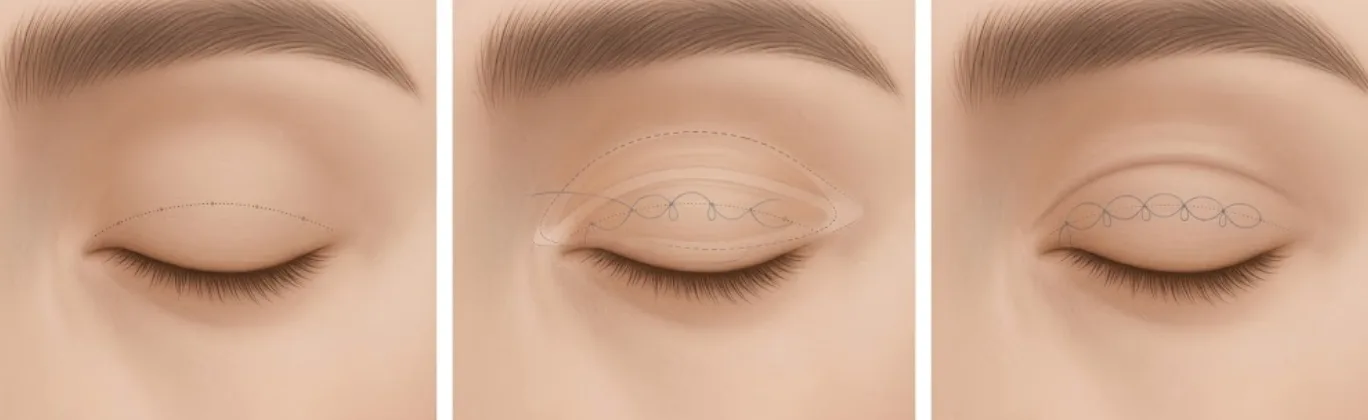
Illustration: a thin buried suture is looped along the planned crease through tiny points, with no skin incision, so the lid folds at the new line.
Getting there is mostly about design, and only partly about technique. The two main routes are a non-incision double eyelid, which forms the crease with buried sutures and no external cut, and an incision double eyelid, which creates the fold through a full upper-lid incision. Either can look natural when the crease is planned conservatively.
Because "natural" varies from face to face, the crease is better designed on your own eyes, with simulation and open discussion. A reference photo shows someone with a different lid.
Crease height
How high the crease should be
Crease height is the single biggest driver of whether a double eyelid looks natural. A lower, in-line crease tends to read as soft and unremarkable; a high crease can look dramatic and, on many eyes, obviously operated. The natural range depends on your eye shape, lid thickness, brow position and how much skin you have. There is no universal "correct" height.
A conservative design errs toward the lower end of what suits your eye, because a crease that is slightly too low still looks natural, while one that is too high is hard to soften afterwards. This is a decision worth making carefully at consultation, with the crease drawn and previewed before anything is fixed.
The aim is a fold in proportion with the eye and the rest of the face: a crease you stop noticing within weeks, which leaves your expression as it was.
Method
Non-incision or incision for a natural look
Both methods can produce a natural crease; the right one depends on your lids. The non-incision double eyelid uses buried sutures to form the fold, with no scar line and a shorter recovery; sutures typically come out around five days. It suits thinner lids without excess skin or fat, and is often chosen precisely for its soft, natural crease.
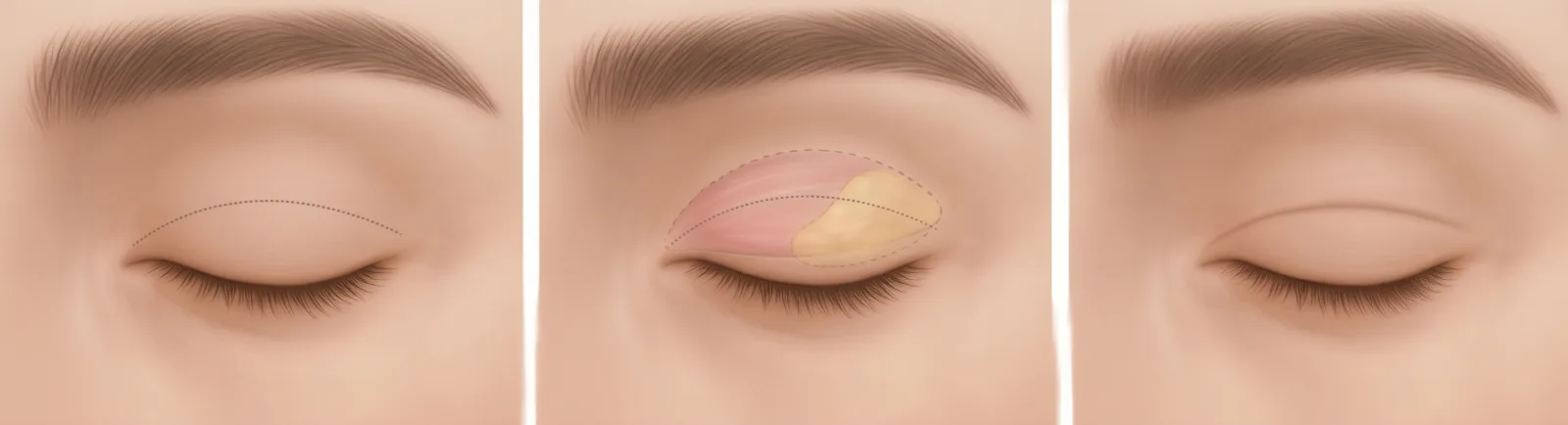
Illustration: the crease is set through an incision along the planned fold; the tissue beneath (muscle in pink, fat in yellow) is adjusted so the crease holds.
The incision double eyelid creates the crease through a full upper-lid incision, which allows excess skin and fat to be addressed and a firmer, longer-lasting fold to be built; sutures usually come out around seven days. It suits thicker or fattier lids, and can also be shaped conservatively. The incision does not have to mean a high or dramatic crease.
Choosing between them is a clinical judgement about your lid that you should not have to make alone. A surgeon can tell you which method your eyes actually suit, and why, at consultation.
Why eyelids look done
Why some eyelids look "done" after double eyelid surgery, and how it is avoided
The eyelids people describe as obvious usually share one or two causes: a crease set too high, or a fold made too deep and fixed for the eye. A high crease exposes more of the lid and can create a staring look; an over-deep fold can look carved instead of soft. Removing too much skin can add to the effect, giving a tight, surprised expression.
Avoiding this comes back to conservative design: choosing a modest height, matching the fold to the eye, and removing only the skin that needs to go. A surgeon who suggests a lower crease than a patient asks for, because it will look more natural on that eye, is protecting the result. That is not under-delivering.
At a single-surgeon clinic, the surgeon who designs that conservative crease is the one who forms it, so the height agreed at consultation is the height you get.
Realistic expectations
Realistic expectations for a subtle double eyelid crease
A double eyelid does not look natural immediately. In the first days the crease sits higher and looks more pronounced than it will settle to, with swelling that softens over one to several weeks. The non-incision method settles faster; the incision method takes longer for the fold to relax into its final, softer shape. The eyelid you see at one week is not the one you keep.
It also helps to expect small asymmetry early on, since the two lids can swell and settle at slightly different rates. Most of this evens out as the crease matures. Expecting a natural, in-line crease, and not a perfectly matched pair of high folds, makes for a happier result.
No surgical result is guaranteed, and a crease can occasionally need a minor adjustment. Understanding that, and knowing who would handle it, is part of a sensible plan. You can discuss all of this in an online consultation before you travel.
At Garnet
How Garnet approaches a natural double eyelid
Garnet approaches eyelid surgery as a design decision first: the crease height and method are chosen to suit your eye and to look natural, with both the non-incision and incision routes available so the method follows the lid and not a house preference. Dr. In-Soo Baek is a board-certified plastic surgeon (Korean medical licence no. 77407) and the clinic's only operating doctor.
Because the same surgeon designs the crease, performs the surgery and reviews you at set follow-ups, the conservative height you agree on is the one carried out, and your recovery is watched by the person who did the work. Garnet is registered with Korea's foreign-patient programme and coordinates consultation and after-care for international visitors. You can start with a no-obligation online assessment: send photos and describe the natural crease you have in mind.
Dr. In-Soo Baek
Director & sole operating surgeon
Korean medical licence no. 77407
Operate on what you came for. Trained at Korea University Medical Center. Every case planned, performed and reviewed by the same hands.
1Operating surgeon
~2Surgeries per day
7Registered techniques
Board-certified plastic surgeon
Plastic surgery training at Korea University College of Medicine & graduate school
Korean Society of Plastic and Reconstructive Surgeons member, in its facial-contour, eye & rhinoplasty groups
Consults, operates and follows up each case himself
Peer-reviewed papers behind the facts on this page. Each describes findings in its own study group — not results at Garnet — and none predicts your own outcome.
Chee E et al. Asian Blepharoplasty – An Overview. Orbit. 2011. doi:10.3109/01676830.2010.535644
Bae KH et al. Nonincisional Blepharoplasty for Asians. Facial Plastic Surgery Clinics of North America. 2021. doi:10.1016/j.fsc.2021.06.005
Kim DW et al. Upper Blepharoplasty in the Asian Eyelid. Facial Plastic Surgery Clinics of North America. 2005. doi:10.1016/j.fsc.2005.06.009
Khoo LS et al. Simultaneous Orthognathic Surgery With Asian Double Eyelid Suture Blepharoplasty. Journal of Craniofacial Surgery. 2021. doi:10.1097/scs.0000000000007704
FAQ
Common questions
What is a natural double eyelid?
A natural double eyelid is a soft, in-line crease that follows your own eye shape and sits at a modest height, so it looks as though it was always there. It is the opposite of a high, fixed fold that makes the eyes look permanently wide. The result should read as rested, with no obvious sign of surgery.
Which method looks more natural — non-incision or incision?
Both can look natural; the right one depends on your lids. The non-incision method uses buried sutures with no scar line and suits thinner lids, often for its soft crease. The incision method suits thicker or fattier lids and can also be shaped conservatively. A surgeon decides which your eyes suit at consultation.
How high should the crease be for a natural look?
Usually toward the lower end of what suits your eye. A lower, in-line crease reads as soft and unremarkable, while a high crease can look dramatic and obviously done. The natural height depends on your eye shape, lid thickness and brow position, so it is better designed on your own eyes than copied from a photo.
Will people know I had double eyelid surgery?
A conservatively designed crease is meant to look unremarkable. People may notice your eyes look rested without identifying why. Obvious results usually come from a crease set too high or made too deep. A modest height matched to your eye is what keeps the result subtle.
Does non-incision double eyelid last?
A buried-suture crease can be long-lasting, but it holds most reliably on thinner lids without excess skin or fat; on thicker lids an incision method usually gives a firmer, longer-lasting fold. Which is more durable for you depends on your lid, so it is worth asking a surgeon to assess it at consultation.
How long until my double eyelid looks natural?
The crease looks higher and more pronounced at first and softens as swelling settles, over roughly one to several weeks, faster for the non-incision method and longer for the incision method. Early asymmetry is common and usually evens out. The eyelid you see at one week is not the final result.
Why do some double eyelid results look overdone?
Usually because the crease was set too high or made too deep, sometimes with too much skin removed, giving a staring or surprised look. Avoiding this is a matter of conservative design: a modest height, a fold matched to the eye, and minimal skin removal. A surgeon suggesting a lower crease is protecting the result.
Does the same surgeon design and perform my eyelid surgery at Garnet?
Yes. Garnet is a single-surgeon clinic where Dr. In-Soo Baek, a board-certified plastic surgeon, personally handles the consultation, the surgery and every follow-up. This means the conservative crease height agreed at consultation is the one that is formed, and your recovery is reviewed by the surgeon who operated.
Can I plan a natural double eyelid from abroad?
Yes. You can send photos and describe the crease you want in an online consultation, and receive a pre-assessment of what would look natural on your eyes, including which method suits your lids, before you commit to travel. Garnet is registered with Korea's foreign-patient programme.
My mom recently had a brow lift and lower blepharoplasty with Dr. Baek, and our experience has been wonderful so far. The Garnet team was incredibly kind and welcoming, with Kelly assisting us as our English consultant—she made everything…
I’m so happy I chose this clinic for my lower blepharoplasty. I was traveling from abroad by myself, so I was a little nervous, but from the beginning I felt comfortable and truly cared for. Everyone was kind, patient, and professional…
Came in for an in-person consult and ended up choosing Garnet and Dr.Baek for my non-incisional DES and tiplasty/alarplasty. I communicated with Kelly (English consultant) from the start till now (3 weeks post-op). She really help me feel…
My under-eyes have been sagging and folding for years... I tried to cover it up with makeup, but it actually got stuck in the wrinkles and made it stand out even more. While going for consultations, I noticed that the bigger the hospital…
Send photos and your question before you travel. An English-speaking coordinator reviews every enquiry and replies with guidance on whether surgery is appropriate, the likely plan and timing.
✓ Reviewed by the clinic coordinator, not a bot
✓ Photo-based pre-assessment before you fly
✓ Foreign-patient scheduling & after-care
✓ One surgeon for consultation, surgery and follow-up
Prefer to chat now? Reach the coordinator directly:








 T S7 months ago



