A natural facelift lifts the jawline and lower face by repositioning the deeper SMAS layer, so the skin is not pulled tight. That answers the fear behind almost every facelift search, of looking pulled, tight or wind-swept and younger but no longer yourself. The result reads as a well-rested version of your own face. This page explains how that is achieved, and how an overdone look is avoided.
The short answer
A natural facelift lifts deeper tissue (the SMAS layer) and leaves the skin without tension, which is what avoids the pulled look.
The "wind-swept" appearance usually comes from tightening skin alone or over-pulling in the wrong direction.
Not everyone needs a full lift; a mini or deep-mini lift may suit a jawline or lower-face concern.
At a single-surgeon clinic the same board-certified surgeon chooses the right amount of lift and performs it, so the plan and the result match.
A natural facelift is one that makes you look rested and younger without changing who you are. The jawline is cleaner and the lower face softer, while your expression and your features stay unmistakably your own. It is the opposite of the tight, over-lifted look that people can spot across a room. The goal is not a different face; it is your face, years earlier.
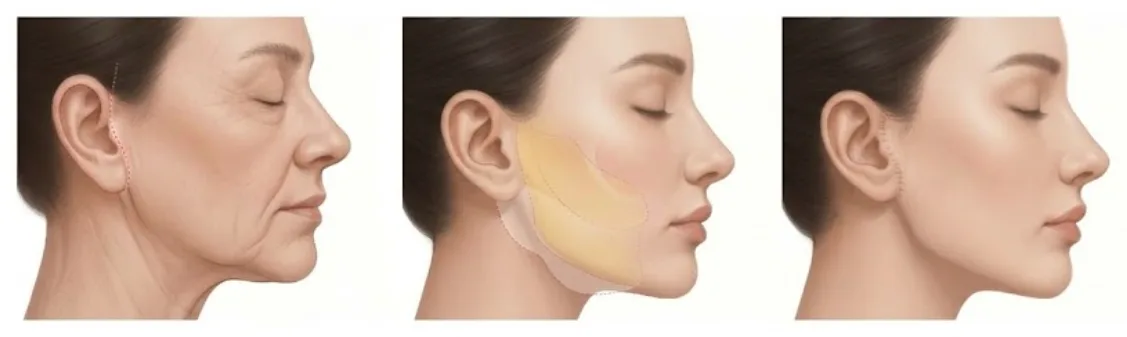
Illustration: the deeper facial layer (SMAS, shown in yellow) is released and repositioned as one unit with the skin, rather than pulling the skin alone.
The key is what actually gets lifted. Modern facelifts reposition the deeper support layer of the face, the SMAS, and do not rely on pulling the skin. A deep-plane facelift releases and repositions this layer to the jawline, so the skin is redraped without tension. That absence of tension is what keeps the result natural.
For lower-face or jawline concerns that do not need a full lift, a deep-mini facelift or a shorter-scar mini facelift can achieve a natural improvement with less surgery. Matching the size of the operation to the concern is part of a natural result.
Why lifts look pulled
Why some facelifts look pulled or wind-swept
The pulled, wind-swept look has a specific cause: tension on skin. When a lift relies on tightening skin alone and leaves the deeper SMAS layer where it is, the skin carries all the load, and it shows as a tight, stretched appearance, a distorted mouth corner, or an unnatural direction of pull. Over time, skin under tension can also relax unevenly and settle poorly.
The other common cause is over-correction: lifting more than the face needs, or pulling in a direction that flattens natural contours. A natural result comes from lifting the right layer in the right vector, and stopping at the point where the face looks refreshed, before it turns taut.
This is why a conservative, well-planned lift tends to age more gracefully than an aggressive one. A surgeon who lifts the deeper layer and lets the skin sit without tension is building a result meant to look natural both now and years later.
Deep-plane vs skin-only
Deep-plane repositioning versus skin-only tightening
The difference between a natural and an obvious facelift often comes down to the plane of surgery. A skin-only lift pulls and trims skin, which can look tight and tends not to last. A deep-plane facelift works beneath the SMAS, releasing and repositioning the deeper tissue so that the descended structures are moved back up as a unit and the skin follows naturally, without being stretched.
Illustration: through a shorter incision around the ear (dotted), the deeper layer (yellow) is lifted using the deep-plane principle (Deep mini™).
Because the lift is carried by the deeper layer, the overlying skin can be laid back in place under little tension. That avoids the pulled look and helps the result hold. For a focused lower-face or jawline concern, a deep-mini facelift applies the same deep-plane principle through a shorter incision.
Deeper work is more demanding and depends heavily on the surgeon's technique and judgement. That is one reason confirming who will actually perform your operation matters, as covered in the guide on ghost surgery and single-surgeon care.
The right lift
Choosing the right amount of lift
A natural result also depends on not over-treating. Not everyone needs a full facelift; the right operation is the smallest one that addresses your actual concern. A mini facelift targets the nasolabial fold and early jawline laxity through a short scar, while a deep-plane facelift suits more advanced lower-face and neck descent.
Illustration: through a shorter incision in front of the ear (dotted line), the lower face and jawline (shaded) are lifted.
Choosing between them is a clinical judgement about how much and where your face has changed. Being offered the least surgery that will achieve your goal is a good sign; being steered to the largest lift is a warning.
At a single-surgeon clinic, the surgeon who makes that judgement is the one who performs the lift, so the conservative plan you agree on is the one carried out, and the same surgeon reviews how it settles.
Realistic expectations
Realistic expectations for a natural facelift
A facelift does not look natural in the first weeks, and that is normal. Expect swelling, bruising and some tightness that eases over time; with a deep-plane lift, sutures typically come out in stages around ten and fourteen days, and the face keeps softening for weeks to months afterward. The tightness some patients worry about early on is usually swelling that settles.
It also helps to set the right goal. A natural facelift turns the clock back on your own face; it does not erase every line or make you look like someone else, and it should not try to. Fine surface lines may still need separate, non-surgical care. A good surgeon will tell you what a lift can and cannot do for your jawline and lower face before you book.
No result is guaranteed, faces continue to age after surgery, and follow-up matters. Knowing who manages your recovery, and that the same surgeon reviews it, is part of a sensible decision. You can discuss all of this in an online consultation before you travel.
At Garnet
How Garnet approaches a natural facelift
Garnet approaches facelifting by lifting the deeper layer and matching the size of the operation to the concern, without defaulting to the largest lift. Deep-plane, deep-mini and mini options are all available, so the plan follows your face. Dr. In-Soo Baek is a board-certified plastic surgeon (Korean medical licence no. 77407) and the clinic's only operating doctor, with the day capped at two surgeries so each case has unhurried time.
Because the same surgeon assesses your face, chooses the right amount of lift, performs it and reviews you at set follow-ups, the conservative plan you agree on is the one carried out, and your recovery is watched by the person who did the work. Garnet is registered with Korea's foreign-patient programme and coordinates consultation and after-care for international visitors. You can start with a no-obligation online assessment: send photos and describe the natural, not-done result you have in mind.
Dr. In-Soo Baek
Director & sole operating surgeon
Korean medical licence no. 77407
Operate on what you came for. Trained at Korea University Medical Center. Every case planned, performed and reviewed by the same hands.
1Operating surgeon
~2Surgeries per day
7Registered techniques
Board-certified plastic surgeon
Plastic surgery training at Korea University College of Medicine & graduate school
Korean Society of Plastic and Reconstructive Surgeons member, in its facial-contour, eye & rhinoplasty groups
Consults, operates and follows up each case himself
Peer-reviewed papers behind the facts on this page. Each describes findings in its own study group — not results at Garnet — and none predicts your own outcome.
Jacono A et al. Extended Deep Plane Facelift. Clinics in Plastic Surgery. 2018. doi:10.1016/j.cps.2018.06.007
Prado A et al. A Clinical Retrospective Study Comparing Two Short-Scar Face Lifts: Minimal Access Cranial Suspension versus Lateral SMASectomy. Plastic and Reconstructive Surgery. 2006. doi:10.1097/01.prs.0000207402.53411.1e
Fedok F. The Aging Face. Facial Plastic Surgery. 1996. doi:10.1055/s-0028-1082402
Gordon NA et al. Deep Plane Face Lifting for Midface Rejuvenation. Clinics in Plastic Surgery. 2015. doi:10.1016/j.cps.2014.08.009
FAQ
Common questions
How is a facelift kept natural?
By lifting the deeper support layer of the face, the SMAS, instead of pulling on skin, and by lifting only as much as the face needs. When the deeper layer carries the lift, the skin is redraped without tension, which is what avoids the pulled look and lets a result read as a rested version of your own face.
Why do some facelifts look pulled or wind-swept?
Usually because the lift tightened skin alone, or pulled too far or in the wrong direction. Skin under tension looks stretched and can distort the mouth or cheeks. A natural result comes from repositioning the deeper SMAS layer in the right vector and stopping where the face looks refreshed.
Is a deep-plane facelift more natural than a skin-only lift?
It is designed to be. A deep-plane facelift repositions tissue beneath the SMAS so the skin follows without being stretched, which tends to look more natural and hold better than a skin-only lift that relies on tension. It is more technically demanding, so the surgeon's experience matters.
Will a facelift make me look like a different person?
A natural facelift is meant to turn back the clock on your own face, not change your identity. The jawline and lower face improve while your features and expression stay your own. If your goal implies a dramatic change, a good surgeon will explain what a lift can and cannot realistically do first.
Do I need a full facelift or a mini facelift?
It depends on how much and where your face has changed. A mini or deep-mini facelift can suit an early jawline or lower-face concern through a shorter scar, while a deep-plane facelift suits more advanced descent. The right choice is a clinical judgement, and being offered the least surgery that meets your goal is a good sign.
How long until a facelift looks natural?
Not in the first weeks. Expect swelling, bruising and early tightness that ease over time; with a deep-plane lift, sutures typically come out around ten and fourteen days, and the face keeps softening for weeks to months. The tightness some patients notice early is usually swelling that eases with time.
Will a facelift remove all my wrinkles?
A facelift repositions sagging tissue and cleans up the jawline and lower face, but it does not erase every fine surface line, which may need separate non-surgical care. Expecting a natural, rested result, with some lines remaining, leads to a happier outcome, and a good surgeon will set that expectation upfront.
Does the same surgeon plan and perform my facelift at Garnet?
Yes. Garnet is a single-surgeon clinic where Dr. In-Soo Baek, a board-certified plastic surgeon, personally handles the consultation, the surgery and every follow-up, with the day capped at two operations. This means the conservative plan discussed is the one carried out, and your recovery is reviewed by the surgeon who operated.
Can I plan a natural facelift from abroad before travelling?
Yes. You can send photos and describe the not-done result you want in an online consultation, and receive a pre-assessment covering which lift suits your face and what is realistic before you commit to travel. Garnet is registered with Korea's foreign-patient programme.
My mom recently had a brow lift and lower blepharoplasty with Dr. Baek, and our experience has been wonderful so far. The Garnet team was incredibly kind and welcoming, with Kelly assisting us as our English consultant—she made everything…
I’m so happy I chose this clinic for my lower blepharoplasty. I was traveling from abroad by myself, so I was a little nervous, but from the beginning I felt comfortable and truly cared for. Everyone was kind, patient, and professional…
Came in for an in-person consult and ended up choosing Garnet and Dr.Baek for my non-incisional DES and tiplasty/alarplasty. I communicated with Kelly (English consultant) from the start till now (3 weeks post-op). She really help me feel…
My under-eyes have been sagging and folding for years... I tried to cover it up with makeup, but it actually got stuck in the wrinkles and made it stand out even more. While going for consultations, I noticed that the bigger the hospital…
Wondering what a natural, not-done result would look like on your face? Send photos of your jawline and lower face for a no-obligation pre-assessment before you plan a trip.
Send photos and your question before you travel. An English-speaking coordinator reviews every enquiry and replies with guidance on whether surgery is appropriate, the likely plan and timing.
✓ Reviewed by the clinic coordinator, not a bot
✓ Photo-based pre-assessment before you fly
✓ Foreign-patient scheduling & after-care
✓ One surgeon for consultation, surgery and follow-up
Prefer to chat now? Reach the coordinator directly:









 T S7 months ago



