Many international patients arrive with the same worry: they want a refined nose that does not look operated on. A natural rhinoplasty is less about a dramatic change and more about proportion, restraint and a result that reads as "you, on a good day". This page explains how that is approached, and how an overdone look is avoided.
The short answer
A natural nose is judged by proportion and how it sits with your other features. How much was changed matters less.
The most "done" looks usually come from over-augmentation: too high a bridge or an over-projected, pinched tip.
Using your own cartilage in place of a large implant tends to give a softer, more forgiving long-term result. The trade-offs depend on your skin thickness and how much cartilage you have.
At a single-surgeon clinic the same board-certified surgeon plans the conservative amount and performs it, so the assessment and the execution match.
"Natural" is one of the most searched words in Korean rhinoplasty, and it rarely means "barely changed." It means a nose that is in proportion with your forehead, eyes and chin, so that people notice you look refreshed or more balanced without being able to say why. A natural result is judged in profile and from the front together: a bridge and tip that agree with each other, and with the rest of your face.
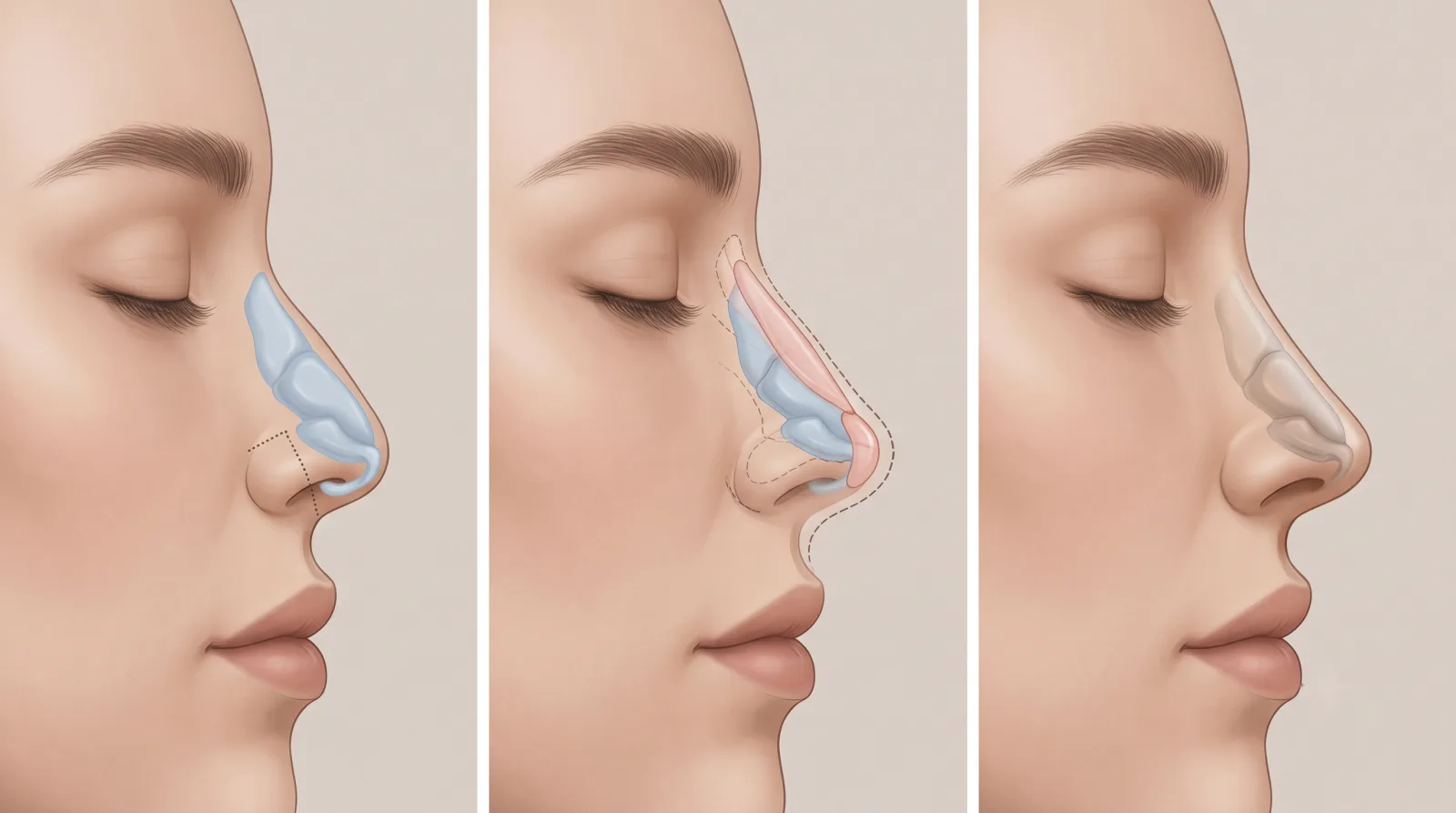
Illustration: the nasal framework (blue) is reshaped to raise the bridge and refine the tip. The dashed outline shows the original contour.
For most patients seeking a subtle nose, the goal is a small, well-chosen adjustment: a slightly straighter bridge, a tip that is a touch more defined, a nose that no longer draws the eye first. This is the territory of a standard rhinoplasty, where a modest silicone dorsal augmentation is paired with your own tip cartilage, or an implant-free rhinoplasty that uses cartilage alone.
Because "natural" is subjective, it is worth defining it in your own words at consultation, with photos and frank feedback about what will and will not read as natural on your particular face.
Why noses look done
Why some noses look "done", and how it is avoided
The looks people describe as obvious usually share a cause: over-augmentation. A bridge built too high for the face, a tip pushed too far forward, or a tip narrowed until it looks pinched — each of these fights the surrounding features instead of complementing them. Skin thickness matters too; thin skin shows every underlying edge, so an implant that would disappear under thicker skin can look sharp and artificial.
Avoiding this is mostly a matter of restraint and planning: choosing an increase in height and projection that the skin and existing framework can carry, keeping the tip supported by cartilage without over-shaping it, and stopping short of the maximum change that is technically possible. A conservative plan is easier to live with and easier to revise later than an aggressive one.
This is where a candid assessment counts. A surgeon who declines to build the bridge as high as a patient requests, because it would not look natural on that face, is protecting the result.
Implant vs cartilage
Implant or your own cartilage for a natural look
The most common question is whether a silicone implant or your own cartilage gives a more natural nose. Both can look natural in the right hands; the difference is in the trade-offs. A modest silicone implant on the bridge, combined with your own septal or ear cartilage at the tip, is a common approach in a rhinoplasty and can give a clean, predictable dorsal line.
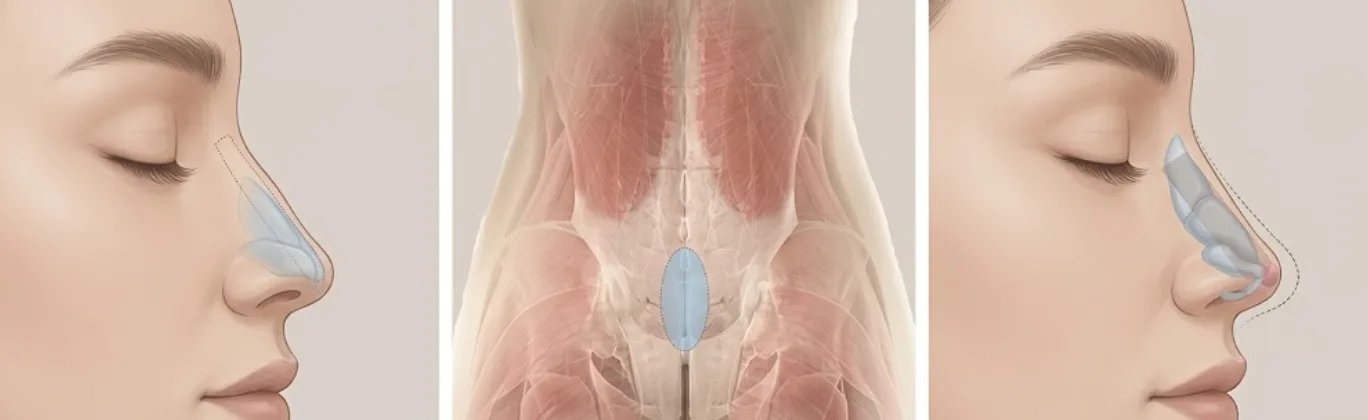
Illustration: instead of an implant, the bridge and tip are built from the patient's own tissue, shaped into the nasal framework (blue). The dashed line shows the original contour.
An implant-free rhinoplasty uses ear cartilage for the bridge and septal cartilage for the tip, with no artificial material at all. For patients with thin skin, a strong preference to avoid implants, or a wish for the softest possible long-term feel, this can be the more forgiving route. It involves a small ear donor site, where sutures typically come out around ten days versus about seven for the nose.
No single material is inherently more natural for everyone. The right choice depends on your skin, your existing cartilage, how much change you want and your feelings about implants, so it cannot be fixed in advance.
The approach
A conservative, single-surgeon approach
A natural result depends heavily on judgement: how much to change, and where to stop. That judgement is hard to transfer between a consultation and an operating room if different people handle each. At a single-surgeon clinic, the same board-certified surgeon who assesses your face and agrees the plan is the one who carries it out, so the conservative amount discussed is the amount performed.
Garnet is a single-surgeon clinic in Apgujeong, Seoul, where Dr. In-Soo Baek personally handles the consultation, the surgery and every follow-up, and the day is capped at two operations so each case has unhurried time. Confirming who will actually operate is one of the most useful questions you can ask anywhere. You can read more about why in the guide on ghost surgery and single-surgeon care.
Continuity also helps a natural result settle. The bridge and tip take weeks to soften into their final shape, and having the operating surgeon review that process at set intervals means small concerns are caught early, before they set.
Realistic expectations
Realistic expectations for a subtle nose
A natural rhinoplasty is not invisible on day one. Expect swelling and a dressing, with nose sutures usually removed around seven days; the tip in particular can stay swollen for weeks and continues to refine over several months. The nose you see at one week is not the nose you keep, so patience is part of a subtle result.
It also helps to hold realistic goals. A conservative plan will not turn one nose into a completely different one, and it should not try to; the aim is a nose that suits your face and looks unremarkable in the good sense. If your reference photos imply a large change, a careful surgeon will say so before you book.
No result is guaranteed, and revision is sometimes part of nasal surgery even in careful hands. Understanding that upfront, and knowing who would manage a revision, is part of a sensible decision. You can raise all of this in an online consultation before you travel.
At Garnet
How Garnet approaches a natural nose
Garnet approaches rhinoplasty as a proportion problem before a technique problem: the plan starts from what will balance your face, then chooses the least intervention that achieves it. Dr. In-Soo Baek is a board-certified plastic surgeon (Korean medical licence no. 77407), and both the implant-supported and the implant-free routes are available so the material can follow the face instead of a house style.
Because the same surgeon consults, operates and reviews you at set follow-ups, the conservative plan you agree on is the plan carried out, and your recovery is watched by the person who performed it. For patients flying in, Garnet is registered with Korea's foreign-patient programme and arranges the rhinoplasty consultation and after-care. You can start with a no-obligation online assessment: send photos and describe, in your own words, the natural result you have in mind.
Real Results
Before & After
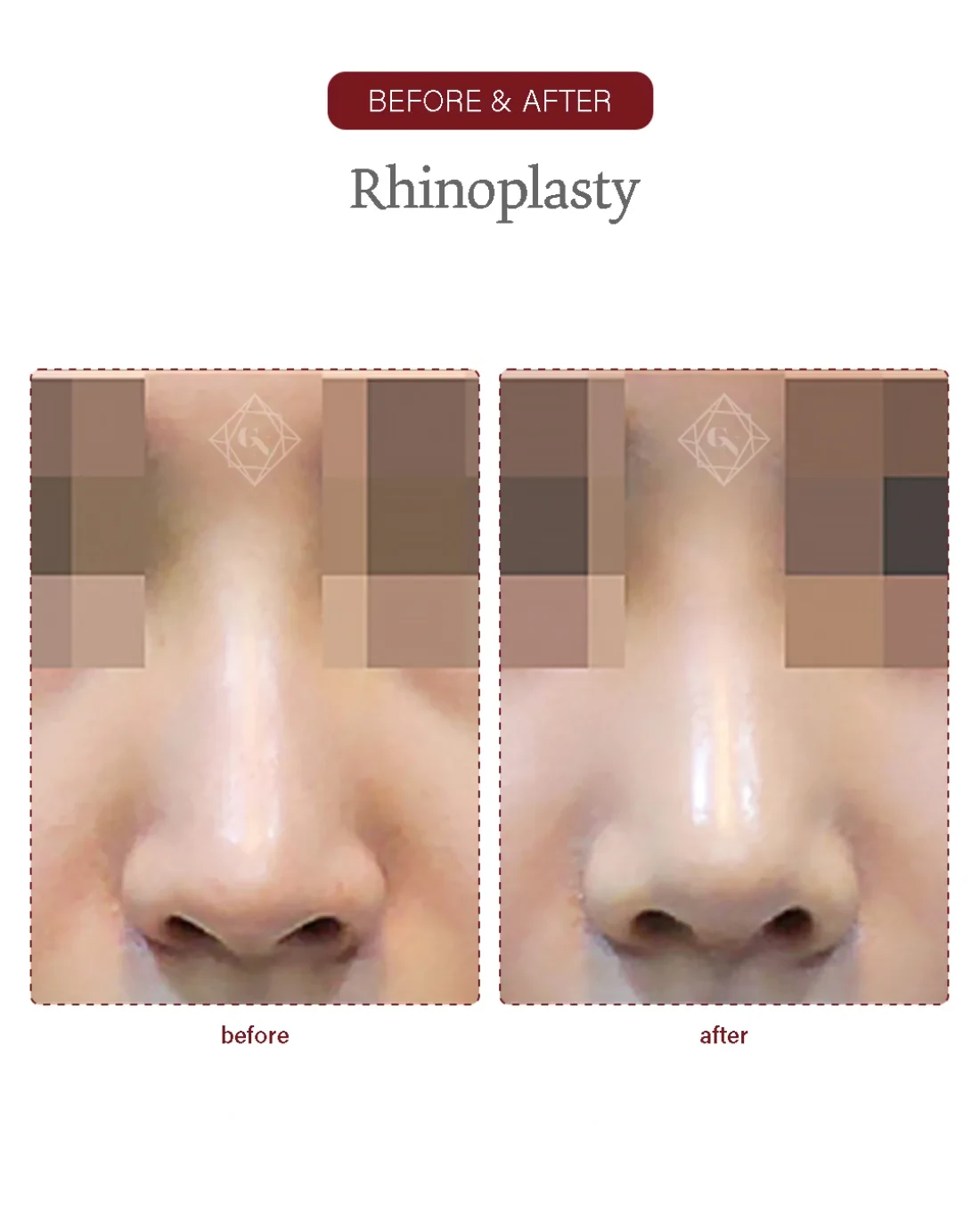
Rhinoplasty result of an actual Garnet patient (published with consent). Date, procedure and clinic (Garnet Plastic Surgery, Apgujeong) are labelled on the image, with the usual same-condition disclaimer. Results, recovery and suitability vary by individual and are not guaranteed.
Dr. In-Soo Baek
Director & sole operating surgeon
Korean medical licence no. 77407
Operate on what you came for. Trained at Korea University Medical Center. Every case planned, performed and reviewed by the same hands.
1Operating surgeon
~2Surgeries per day
7Registered techniques
Board-certified plastic surgeon
Plastic surgery training at Korea University College of Medicine & graduate school
Korean Society of Plastic and Reconstructive Surgeons member, in its facial-contour, eye & rhinoplasty groups
Consults, operates and follows up each case himself
Peer-reviewed papers behind the facts on this page. Each describes findings in its own study group — not results at Garnet — and none predicts your own outcome.
Nassif PS et al. Asian Rhinoplasty. Facial Plastic Surgery Clinics of North America. 2010. doi:10.1016/j.fsc.2009.11.018
Toriumi DM et al. Asian Rhinoplasty. Facial Plastic Surgery Clinics of North America. 2007. doi:10.1016/j.fsc.2007.04.003
Frederick JW et al. Asian Augmentation Rhinoplasty. Facial Plastic Surgery. 2025. doi:10.1055/a-2595-5275
FAQ
Common questions
What makes a rhinoplasty look natural?
Proportion matters more than the amount of change. A natural nose sits in balance with your forehead, eyes and chin, with a bridge and tip that agree with each other. Natural-looking results usually come from a conservative plan, a modest adjustment matched to your skin and features. The maximum change that is technically possible rarely looks natural.
Should I choose an implant or my own cartilage for a natural nose?
Both can look natural; the difference is in the trade-offs. A modest silicone bridge with your own tip cartilage gives a clean, predictable line, while an implant-free approach using ear and septal cartilage avoids artificial material and can be more forgiving for thin skin. The right choice depends on your skin thickness, how much septal and ear cartilage you have, and your preferences.
Will people be able to tell I had a nose job?
A well-judged, conservative rhinoplasty is meant to look unremarkable. People may notice you look more balanced without identifying why. Obvious results usually come from over-augmentation: too high a bridge or an over-projected, pinched tip. Restraint and a plan matched to your face are what keep a result subtle.
Is implant-free rhinoplasty better for thin skin?
Thin skin shows underlying edges more easily, so some patients with thin skin prefer an implant-free approach that uses their own cartilage. It is not automatically better for everyone. It involves a small ear donor site and depends on how much cartilage you have. A surgeon can advise which route suits your skin at consultation.
How long until my nose looks natural after surgery?
The nose you see at one week is not the final result. Nose sutures usually come out around seven days, but swelling, especially at the tip, settles over weeks and refines across several months. A subtle result reveals itself gradually, so patience is part of the process.
Can a natural rhinoplasty fix a nose I really dislike?
A conservative plan aims to balance your nose with your face. It does not replace it with a completely different one. It can meaningfully refine a bridge or tip while still looking like you. If your goal implies a large change, a careful surgeon will tell you what is realistic before you decide.
Why do some Korean rhinoplasty results look overdone?
Usually because the change went beyond what the face and skin could carry: an over-high bridge or an over-shaped tip. Avoiding this is a matter of restraint: choosing an increase the framework can support and stopping short of the technical maximum. A surgeon who declines an over-aggressive request is protecting the result.
Does the same surgeon plan and perform my rhinoplasty at Garnet?
Yes. At Garnet, board-certified plastic surgeon Dr. In-Soo Baek sees your nose at consultation, performs the rhinoplasty and handles every follow-up himself. This continuity means the conservative plan discussed is the one carried out, and your recovery is reviewed by the surgeon who operated.
Can I plan a natural rhinoplasty from abroad before travelling?
Yes. You can send photos and describe the result you want in an online consultation, and receive a pre-assessment of what would look natural on your face, including whether your goals are realistic, before you commit to travel. Garnet is registered with Korea's foreign-patient programme.
My mom recently had a brow lift and lower blepharoplasty with Dr. Baek, and our experience has been wonderful so far. The Garnet team was incredibly kind and welcoming, with Kelly assisting us as our English consultant—she made everything…
I’m so happy I chose this clinic for my lower blepharoplasty. I was traveling from abroad by myself, so I was a little nervous, but from the beginning I felt comfortable and truly cared for. Everyone was kind, patient, and professional…
Came in for an in-person consult and ended up choosing Garnet and Dr.Baek for my non-incisional DES and tiplasty/alarplasty. I communicated with Kelly (English consultant) from the start till now (3 weeks post-op). She really help me feel…
My under-eyes have been sagging and folding for years... I tried to cover it up with makeup, but it actually got stuck in the wrinkles and made it stand out even more. While going for consultations, I noticed that the bigger the hospital…
Send photos and your question before you travel. An English-speaking coordinator reviews every enquiry and replies with plain guidance on whether a natural rhinoplasty is appropriate for your nose, the likely plan and timing.
✓ Reviewed by the clinic coordinator, not a bot
✓ Photo-based pre-assessment before you fly
✓ Foreign-patient scheduling & after-care
✓ One surgeon for consultation, surgery and follow-up
Prefer to chat now? Reach the coordinator directly:








 T S7 months ago



