A wide or flat nose is one of the most common reasons people consider rhinoplasty in Korea, but 'wide' and 'flat' can mean several different things. Refining the nose well starts with understanding which features actually create the impression: the bridge, the tip, the nostrils, or a combination.
The short answer
A nose can look wide or flat because of a low bridge, a broad or rounded tip, wide nostrils, or several of these together.
Raising a low bridge and refining the tip are different steps, and a natural result usually depends on balancing them; heightening the bridge alone is rarely enough.
Rhinoplasty can use a small dorsal implant, or an implant-free approach using your own cartilage. Each has trade-offs worth understanding.
The aim is a nose that suits your face, so an assessment of your bridge, tip and nostrils comes before choosing a technique.
A nose that reads as wide or flat is rarely one single feature. A low bridge (a dorsum that sits low relative to the rest of the face) makes the nose look flatter and, because light falls differently, can make it look broader too. A tip that is rounded, bulbous or under-projected can make the front of the nose look wide, while wide nostrils or a broad base widen the nose at the bottom. Skin thickness matters as well: thicker skin tends to soften definition, so the same underlying structure can look less refined.
Because several features contribute, two people who both describe a 'wide flat nose' may need quite different plans. In one, the main issue is a low bridge that needs raising; in another, the bridge is acceptable but the tip is broad and needs refining; in a third, it is mainly the nostrils. Often it is a combination, and a low bridge with a rounded tip is a very common pattern. Identifying which features are actually driving the impression is the whole basis of a natural result.
This is why simply 'making the bridge higher' is not automatically the answer. Over-raising a bridge without addressing the tip can look unbalanced or unnatural, and refining a tip without supporting the bridge can leave the nose still looking flat. A considered plan looks at the nose as a whole and at how it sits within your particular face. It does not treat one dimension in isolation.
The approach
How Garnet refines a wide or flat nose
Refining a wide or flat nose usually combines raising or defining the bridge with refining the tip, and sometimes narrowing the base. Garnet's rhinoplasty typically augments the dorsum with a silicone implant sized to the face and refines the tip using your own cartilage, commonly from the nasal septum or ear. The incision may be closed or open depending on the case, and Garnet removes the nose sutures at around seven days.
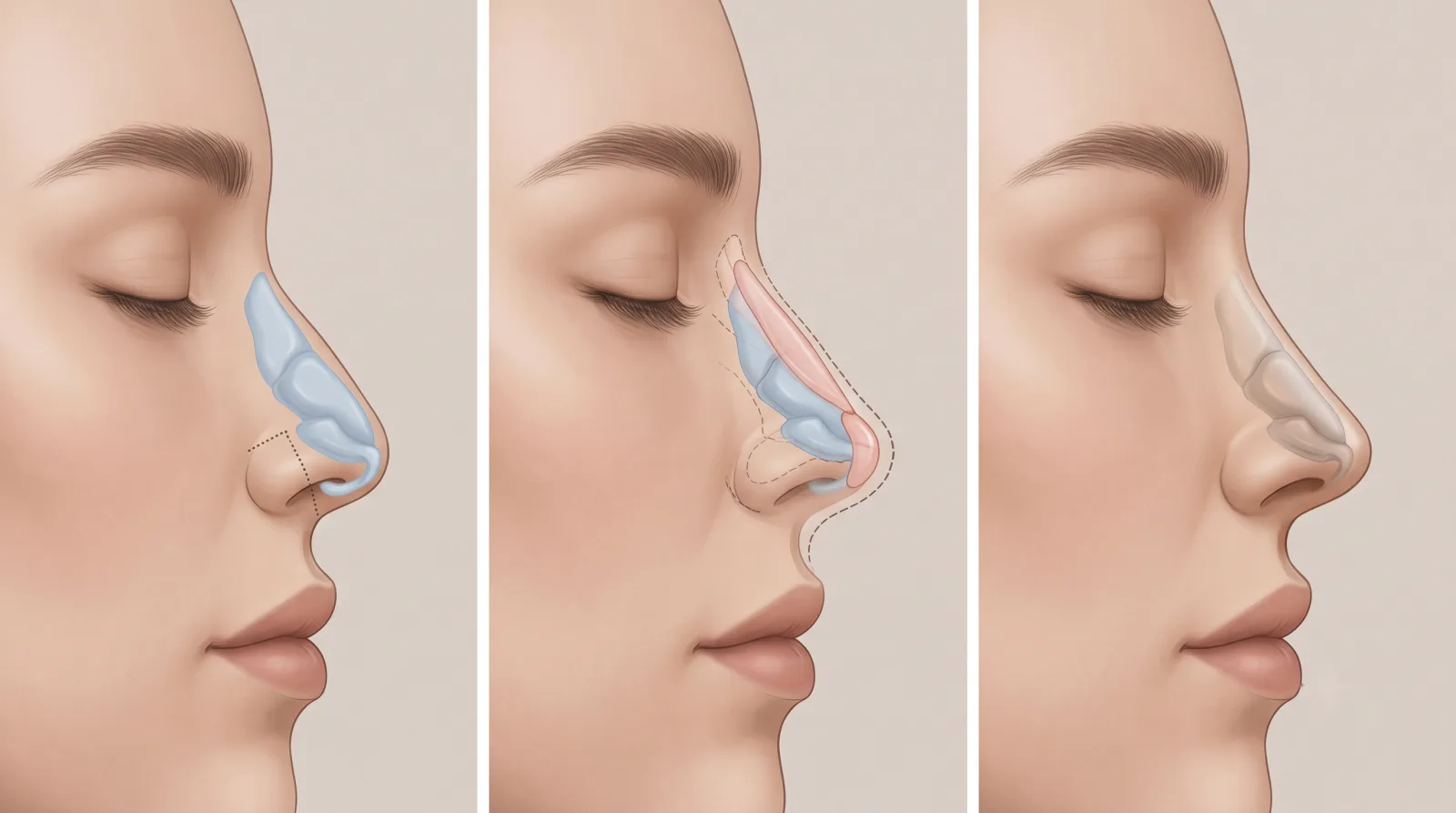
Illustration: the nasal framework (blue) is reshaped to raise the bridge and refine the tip. The dashed outline shows the original contour.
For patients who prefer not to have an implant, Garnet also offers implant-free rhinoplasty, which builds the bridge from your own ear cartilage and refines the tip with septal cartilage, using no synthetic implant at all. It follows the same goal of a balanced, natural-looking refinement but relies entirely on autologous tissue, with sutures out at about seven days for the nose and around ten days for the ear donor site.
Which combination of steps a nose needs (bridge, tip, base, or all three) is a clinical judgement made after examining your nose and your skin. Because Garnet is a single-surgeon clinic, the surgeon who assesses which approach suits you is the same one who would carry it out, so the plan you discuss is the plan performed.
Implant vs implant-free
Implant and implant-free approaches compared
The main structural choice for the bridge is between a small dorsal implant and using your own cartilage. In Garnet's rhinoplasty, a silicone implant heightens the bridge and your own cartilage refines the tip; a well-sized implant gives predictable dorsal height, which is often useful when a low bridge needs meaningful augmentation. As with any implant, there are considerations to weigh over the long term, and the surgeon will go through them with you.
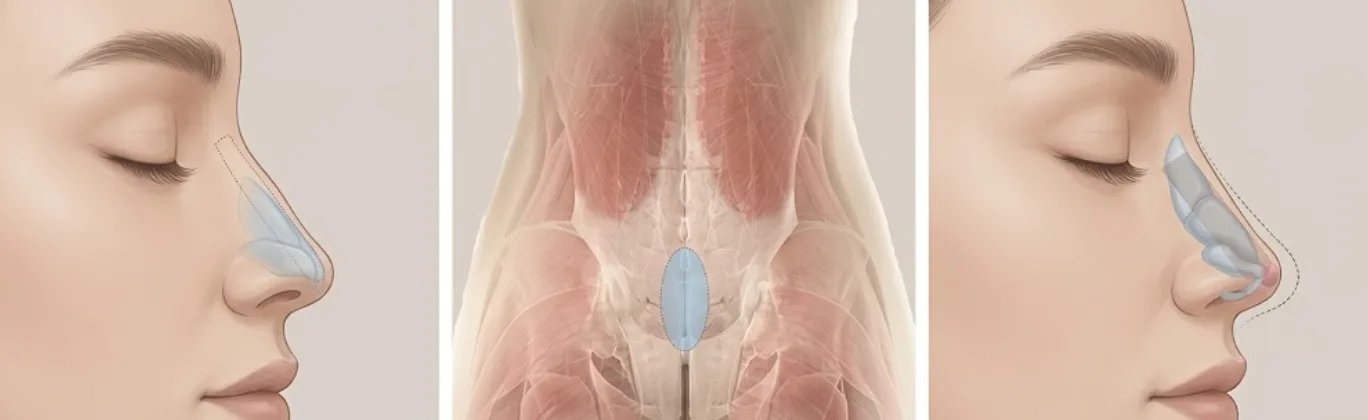
Illustration: instead of an implant, the bridge and tip are built from the patient's own tissue, shaped into the nasal framework (blue). The dashed line shows the original contour.
In implant-free rhinoplasty, the bridge is built from your own ear cartilage and the tip from septal cartilage, so no synthetic material is placed. This appeals to patients who prefer to avoid an implant, and it uses only your own tissue. The trade-off is that it draws on a limited amount of cartilage and adds a small ear donor site that heals over about ten days. How much augmentation your bridge needs partly determines whether this is a good fit.
Neither approach is universally better; they suit different noses and different preferences. The recovery is broadly similar for the nose itself, with sutures out around seven days, and both aim at a balanced, natural refinement of the bridge and tip. The way to choose is a conversation about your nose, your skin and your priorities with the surgeon who would perform the operation.
Deciding
How to decide which approach fits you
The decision starts with which features actually need work. If your bridge is low and needs clear augmentation, an implant may give predictable height; if you would rather avoid a synthetic implant and the amount of augmentation is modest, an implant-free approach using your own cartilage may suit; and in most cases the tip needs refining alongside the bridge regardless of which is chosen. Your skin thickness, the strength and amount of your own cartilage, and how much change you want all feed in.
Your priorities matter as much as the anatomy. Some patients feel strongly about avoiding an implant; others prioritise predictable bridge height; some want the least possible change to still look like themselves. There is no single correct answer, and any clinic that recommends one technique before examining your nose is worth questioning. A good plan reconciles what your nose needs with what you actually want.
A reassuring sign is a surgeon who explains the trade-offs of each route plainly and is willing to say when a smaller change, or a different emphasis, would suit your nose better. At Garnet the same board-certified plastic surgeon who assesses your nose is the one who would operate and follow you up, so the recommendation is not passed to someone else.
Expectations
Realistic expectations for a wide or flat nose
It helps to be realistic about what rhinoplasty can do for a wide or flat nose. Raising and defining the bridge, refining the tip and narrowing the base can make the nose look more refined and better balanced with your face. What it cannot do is give you someone else's nose or ignore the limits set by your own skin and cartilage. Thicker skin, in particular, softens definition, and the surgeon works with what your anatomy allows.
The result also takes time to settle. Early swelling makes the nose look bigger and less defined than it will finally be, and the tip in particular refines gradually over months as swelling resolves, so the settled shape emerges well after the first weeks. Ask for a realistic recovery timeline for your own nose, including when it looks presentable and when it is fully settled.
No responsible surgeon can guarantee a specific shape, and results vary from person to person. What a careful plan offers is a realistic estimate of what suits your face and is achievable with your anatomy, along with a clear account of the trade-offs of each technique. It does not promise a particular look. You can read more in the guide on plastic surgery safety in Korea.
Consultation
Getting your nose assessed
Because a wide or flat nose can come from the bridge, the tip, the nostrils or a combination, the most useful first step is an assessment of which features are actually creating the impression in your case. That means someone examining your bridge height, tip shape, nostril width and skin thickness, and then explaining which steps and which technique would give a balanced, natural result, without steering you to one method up front.
At Garnet, in Apgujeong, Seoul, every nose is operated on by Dr. In-Soo Baek, a board-certified plastic surgeon (Korean medical licence no. 77407) and the clinic's only operating doctor; Garnet is registered with Korea's foreign-patient programme. He consults, performs the rhinoplasty himself and reviews every follow-up at 1, 3 and 6 months, which matters with rhinoplasty because the tip settles over months and benefits from continuity of care.
If you are abroad, you can start with a no-obligation online consultation. Send photos from a few angles and a description of what you would like to change, and get a pre-assessment of whether an implant or implant-free approach, and which combination of steps, best fits your nose before you plan any travel.
Dr. In-Soo Baek
Director & sole operating surgeon
Korean medical licence no. 77407
Operate on what you came for. Trained at Korea University Medical Center. Every case planned, performed and reviewed by the same hands.
1Operating surgeon
~2Surgeries per day
7Registered techniques
Board-certified plastic surgeon
Plastic surgery training at Korea University College of Medicine & graduate school
Korean Society of Plastic and Reconstructive Surgeons member, in its facial-contour, eye & rhinoplasty groups
Consults, operates and follows up each case himself
Peer-reviewed papers behind the facts on this page. Each describes findings in its own study group — not results at Garnet — and none predicts your own outcome.
Park MJ et al. Rhinoplasty Considerations in the Ethnic Patient. Facial Plastic Surgery Clinics of North America. 2022. doi:10.1016/j.fsc.2022.07.007
Suh MK. Cosmetic Augmentation Rhinoplasty for East Asians. Facial Plastic Surgery Clinics of North America. 2021. doi:10.1016/j.fsc.2021.06.010
Hwang NH et al. Septal Extension Graft in Asian Rhinoplasty. Facial Plastic Surgery Clinics of North America. 2018. doi:10.1016/j.fsc.2018.03.007
FAQ
Common questions
What surgery refines a wide or flat nose?
Rhinoplasty refines a wide or flat nose by some combination of raising or defining the bridge, refining the tip and sometimes narrowing the base. Garnet's rhinoplasty typically augments the bridge with a small implant and refines the tip with your own cartilage, while an implant-free approach uses your own cartilage throughout. Which steps you need depends on which features create the impression.
Implant or implant-free for a low bridge?
Both can raise a low bridge. A small dorsal implant gives predictable height and is often useful when meaningful augmentation is needed; an implant-free approach builds the bridge from your own ear cartilage and avoids synthetic material, which suits patients who prefer that and need more modest augmentation. The right choice depends on your nose, your skin and your preference, assessed individually.
Will my nose look natural after surgery?
The aim is a nose that suits your face, which usually means balancing the bridge and tip instead of only heightening the bridge. A natural result depends on working within the limits of your own skin and cartilage. No surgeon can guarantee an exact shape, but a considered plan aims at balance and refinement suited to your features.
Why does a low bridge make the nose look wide?
A low bridge lets light fall across the nose differently, so the nose can look flatter and broader even when the width itself has not changed. Raising or defining the bridge often makes the nose look narrower as a result. That said, a rounded tip or wide nostrils can also make a nose look wide, so the cause is assessed feature by feature.
Can the tip be refined at the same time as the bridge?
Yes, and it usually is. Refining a wide or flat nose typically involves both raising or defining the bridge and refining the tip with your own cartilage, because addressing only one can leave the nose looking unbalanced. Whether the base or nostrils are narrowed as well depends on your anatomy, decided after examining your nose.
How long is recovery after rhinoplasty?
Garnet removes the nose sutures at around seven days, and for an implant-free approach the ear donor site heals over about ten days. Early swelling makes the nose look bigger than it will finally be, and the tip in particular refines gradually over months. A realistic timeline for when the nose looks presentable versus fully settled is discussed for your case.
Does thick skin affect the result?
It can. Thicker skin tends to soften definition, so the same underlying work may look less sharply refined than it would under thinner skin. A surgeon takes your skin thickness into account when planning and when setting realistic expectations, which is one reason an assessment of your specific nose matters more than a generic promise.
Is an implant-free nose job better than one with an implant?
Neither is universally better; they suit different noses and preferences. An implant gives predictable bridge height, while an implant-free approach avoids synthetic material by using your own cartilage, with a small ear donor site. The best way to choose is to talk through your bridge, tip, skin and priorities with Dr. Baek, who would perform the operation.
Can I get an assessment before travelling to Korea?
Yes. You can send photos from a few angles and a description of what you would like to change for a no-obligation online consultation, and receive a pre-assessment of whether an implant or implant-free approach and which steps fit your nose, before committing to travel. Garnet coordinates care for international visitors through Korea's foreign-patient programme.
Who will perform my surgery at Garnet?
Dr. In-Soo Baek, a board-certified plastic surgeon (licence no. 77407) and Garnet's only surgeon, consults, performs your rhinoplasty himself and reviews your follow-ups at 1, 3 and 6 months. Confirming who operates from start to finish is one of the most useful questions any patient can ask before booking rhinoplasty.
My mom recently had a brow lift and lower blepharoplasty with Dr. Baek, and our experience has been wonderful so far. The Garnet team was incredibly kind and welcoming, with Kelly assisting us as our English consultant—she made everything…
I’m so happy I chose this clinic for my lower blepharoplasty. I was traveling from abroad by myself, so I was a little nervous, but from the beginning I felt comfortable and truly cared for. Everyone was kind, patient, and professional…
Came in for an in-person consult and ended up choosing Garnet and Dr.Baek for my non-incisional DES and tiplasty/alarplasty. I communicated with Kelly (English consultant) from the start till now (3 weeks post-op). She really help me feel…
My under-eyes have been sagging and folding for years... I tried to cover it up with makeup, but it actually got stuck in the wrinkles and made it stand out even more. While going for consultations, I noticed that the bigger the hospital…
Send photos and your question before you travel. An English-speaking coordinator reviews every enquiry and replies with guidance on whether rhinoplasty is appropriate for you, the likely plan and timing.
✓ Reviewed by the clinic coordinator, not a bot
✓ Photo-based pre-assessment before you fly
✓ Foreign-patient scheduling & after-care
✓ One surgeon for consultation, surgery and follow-up
Prefer to chat now? Reach the coordinator directly:








 T S7 months ago



