Most facelift patients are in their late 40s to 60s, yet there is no single “right age”, and any clinic that quotes one is oversimplifying. What actually matters is how far your jawline and neck have aged, how your skin and the deeper SMAS layer have changed, and whether a lift addresses what is bothering you. Age is a useful guide to all of that, but the assessment decides.
The short answer
There is no fixed age for a facelift. Most people who benefit from a surgical lift are in their late 40s to 60s, but the degree of ageing matters more than the birthday.
A facelift repositions deeper tissue (the SMAS layer) that has descended; it treats sagging. Fine lines and volume loss need other treatment, so a lift suits structural ageing more than early skin changes.
Ageing is on a spectrum: earlier or milder laxity may suit a mini or deep mini lift, while established jowls and neck laxity call for a full deep-plane facelift.
Healing tends to be a little slower with age, but health, skin quality and lifestyle matter more than the number, and a consultation weighs all of them.
There is no single best age for a facelift. A facelift is a structural operation: it lifts and repositions the deeper tissue layer of the face, the SMAS, that has gradually descended with time, and it re-drapes the skin over that restored foundation. Whether it will help you depends on how far that descent has gone; your date of birth matters far less. Two people the same age can be at very different stages, and the assessment has to be of the face in front of the surgeon and the number on the form comes second.
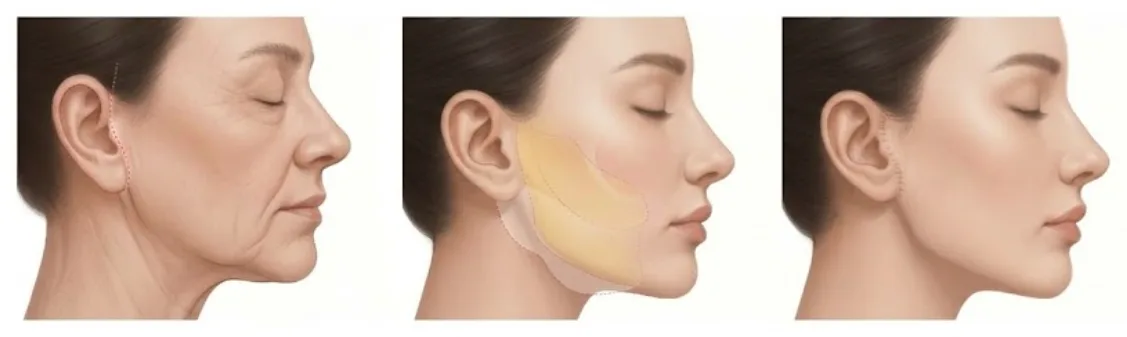
Illustration: the deeper facial layer (SMAS, shown in yellow) is released and repositioned as one unit with the skin, rather than pulling the skin alone.
In practice, most people who benefit from a deep-plane facelift are somewhere between their late 40s and their 60s, because that is when jowling, a softening jawline and neck laxity typically become established enough that only a surgical lift will genuinely address them. Those are the years it tends to become the right operation, though this is a pattern and no fixed rule. Some faces reach that point earlier; others hold their structure well into their 60s and 70s and are excellent candidates then.
Think of age as a guide to a bigger question: has your face aged in a way a lift can correct? A facelift treats sagging and descended tissue. It does not fill hollows, erase fine lines or change skin texture. When the main concern is loose, sliding tissue along the jaw and neck, a lift is the appropriate answer, and the right time is when that concern is real, whatever the year of your birth.
Can you be too young?
Can you be too young for a facelift?
You can be, in the sense that a lift solves a problem you may not yet have. In your 30s and early 40s, the changes people dislike are usually early: some volume loss, fine lines, a first hint of softening. Those respond better to non-surgical options or to volume. Lifting tissue that has barely descended helps little. Operating early does not “bank” a result; the face keeps ageing on its own timeline afterwards, so a lift done before there is meaningful laxity simply gives you less to gain and an operation you did not yet need.
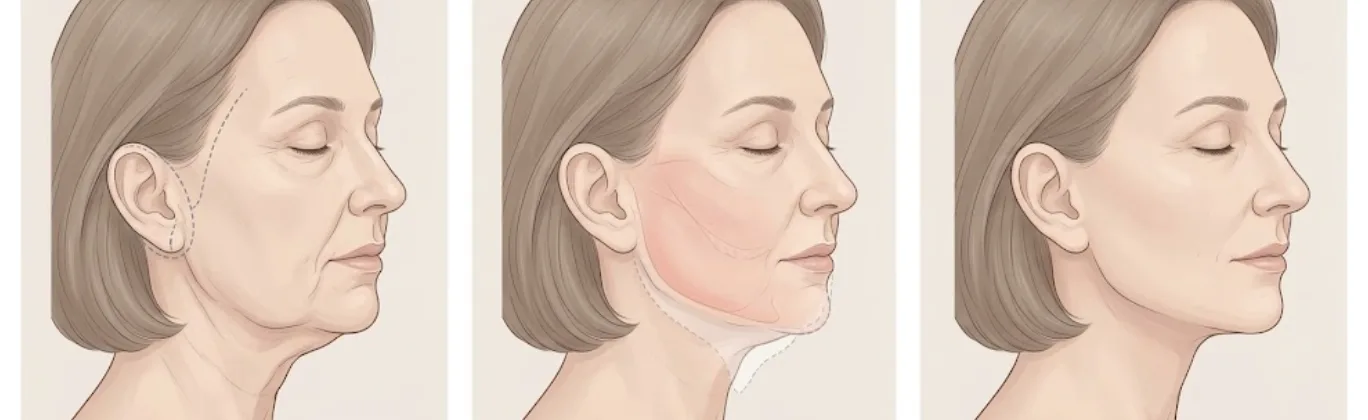
Illustration: through a shorter incision in front of the ear (dotted line), the lower face and jawline (shaded) are lifted.
That said, ageing is genuinely individual. Some people develop early jowling or a heavy neckline in their early-to-mid 40s (through genetics, weight change or sun exposure), and for them a lift can be entirely appropriate at that age. Where the tissue has descended enough to lift, the operation is right; where it has not, a smaller intervention is the better recommendation. Being “too young” is really about the state of your jawline and neck.
When the laxity is early or limited, a smaller lift often fits better than a full one. A mini facelift targets the nasolabial fold and early jawline softening through a shorter incision, and a deep mini facelift works in the deep plane for early-to-moderate ageing without the full extent of a complete lift. A good consultation should tell you plainly if you would be better served waiting, or by a lighter procedure, and should never push you toward the largest operation.
Is it ever too late?
Is it ever too late for a facelift?
Far less often than people fear. Plenty of patients in their 60s and 70s are strong facelift candidates, and in some ways well-established ageing makes the case for a lift clearer: the descended tissue is exactly what the operation is designed to reposition. What matters at older ages is your overall health: how well controlled any medical conditions are, whether you can stop smoking around surgery, and how your skin and tissues have held up. These are assessed individually for each patient.
Skin quality does shift the picture. With time, skin loses some elasticity, so it re-drapes a little differently and the deeper fixation carries more of the work. That is one reason a full deep-plane facelift, working beneath the SMAS without pulling on skin, tends to age well and to suit more advanced laxity. A skin-only tightening pulls on the wrong layer and shows its limits fast; a deep-plane lift restores the foundation, which is why it remains appropriate at older ages.
So “too late” is rarely about a number. It becomes a real consideration only when health or healing capacity would make surgery unwise, and that is a medical judgement made for the individual patient. There is no cut-off applied by age, and for many older patients a well-chosen lift is very much still on the table.
Which lift for your stage
Which lift suits your stage of ageing
Because ageing sits on a spectrum, so do the operations. The right choice follows the degree of descent. Early softening around the nasolabial fold and a first hint of jawline change often suit a mini facelift, which uses a short pre- and post-auricular incision and superficial dissection, with sutures out at around 10 days. It is a smaller operation for a smaller problem, and pushing it beyond what it can do would under-treat established laxity.
Illustration: through a shorter incision around the ear (dotted), the deeper layer (yellow) is lifted using the deep-plane principle (Deep mini™).
Moderate ageing (a defined jowl beginning to form, a jawline losing its edge) is often where a deep mini facelift fits. It releases the deep, sub-SMAS layer through an incision from the temporal hairline to the ear lobe, so it lifts the structure beneath the skin, with a recovery in the middle of the spectrum (sutures out at about 10 days). It suits early-to-moderate ageing that a mini lift would not fully correct.
Established jowls, a soft jawline and neck laxity together call for a full deep-plane facelift, which releases the SMAS in the deep and dual planes down to the jawline, with sutures removed at roughly ten and fourteen days. It is the most complete of the three and the right answer when the ageing is advanced. Matching the operation to your actual stage of ageing is the whole point of the assessment.
Age, healing and assessment
How age affects healing, and why the assessment decides
Age does have a modest, real effect on recovery. Skin and tissues heal a little more slowly with time, swelling can take longer to settle, and pre-existing health conditions become more common. A surgeon factors all of this into planning and follow-up. But the number itself is a weaker predictor than people assume. A healthy, non-smoking person in their early 60s often heals more smoothly than a stressed, heavy-smoking person in their 40s. Your general health, skin quality and how you look after yourself around surgery matter more than your age.
This is exactly why a consultation should decide, and an age chart should not. At Garnet, the same board-certified plastic surgeon, Dr. In-Soo Baek (Korean medical licence no. 77407), consults, operates and follows up, so the person assessing whether a lift suits your stage is the person who will perform it and see you through recovery at one, three and six months. The clinic caps the day at two operations, which keeps each assessment unhurried, and does not over-recommend: only the concern you came with is addressed.
If you are weighing whether it is your time for a lift, the useful step is a real assessment of your face. You can send photos for a no-obligation pre-assessment before you plan any travel, and be told plainly whether a lift is right for you now, whether a lighter procedure fits better, or whether waiting is the better advice. Age points the way; the consultation makes the call.
Dr. In-Soo Baek
Director & sole operating surgeon
Korean medical licence no. 77407
Operate on what you came for. Trained at Korea University Medical Center. Every case planned, performed and reviewed by the same hands.
1Operating surgeon
~2Surgeries per day
7Registered techniques
Board-certified plastic surgeon
Plastic surgery training at Korea University College of Medicine & graduate school
Korean Society of Plastic and Reconstructive Surgeons member, in its facial-contour, eye & rhinoplasty groups
Consults, operates and follows up each case himself
Peer-reviewed papers behind the facts on this page. Each describes findings in its own study group — not results at Garnet — and none predicts your own outcome.
Koroma P et al. Deep Plane Facelifts: A Systematic Review and Meta-Analysis of Outcomes. Aesthetic Plastic Surgery. 2026. doi:10.1007/s00266-026-06138-x
Morrissette M et al. In-Office Surgical Procedures for Prejuvenation. Facial Plastic Surgery. 2026. doi:10.1055/a-2898-5952
Freytag L et al. Understanding Facial Aging Through Facial Biomechanics. Facial Plastic Surgery Clinics of North America. 2022. doi:10.1016/j.fsc.2022.01.001
Khoury S et al. The Deep Plane versus SMAS Facelift: A Systematic Review and Meta-Analysis. Aesthetic Plastic Surgery. 2025. doi:10.1007/s00266-025-05118-x
FAQ
Common questions
What is the best age for a facelift?
There is no single best age. Most people who benefit from a surgical facelift are in their late 40s to 60s, because that is when jowling, a softening jawline and neck laxity typically become established. But the degree of ageing decides, more than your birthday. Some faces reach that stage earlier and some hold their structure into their 70s, so an assessment of your tissue matters more than any age chart.
Can you be too young for a facelift?
You can, in the sense that a lift addresses descended tissue you may not yet have. In your 30s and early 40s the changes are usually early (volume loss and fine lines), which respond better to non-surgical options than to lifting. Operating early does not preserve a result, since the face keeps ageing afterwards. Where genuine early laxity exists, though, a smaller lift can be appropriate even then.
Is it ever too late for a facelift?
Rarely because of age alone. Many people in their 60s and 70s are strong candidates, and well-established ageing can make the case for a lift clearer. What matters at older ages is overall health and skin quality. A deep-plane lift works beneath the skin without pulling on it, which is one reason it suits more advanced laxity and ages well.
Does a younger person need a smaller facelift?
Often, yes, but it follows the degree of ageing. Earlier or limited laxity tends to suit a mini or deep mini facelift, which target the nasolabial fold or the early jawline through shorter incisions. Established jowls and neck laxity call for a full deep-plane facelift. The right operation is matched to your stage of ageing.
How does age affect healing after a facelift?
There is a modest, real effect: skin and tissues heal a little more slowly with time and swelling can take longer to settle. But your general health, skin quality and lifestyle (especially not smoking around surgery) matter more than the number. A healthy person in their 60s can heal more smoothly than a heavy smoker in their 40s, which is why healing is assessed individually.
Will a facelift last longer if I have it younger?
Not in a way that banks the result. A facelift repositions descended tissue at the time it is done, but the face continues to age naturally afterwards on its own timeline. Having one before there is meaningful laxity simply means less to correct and an operation you did not yet need. It does not make the outcome last longer.
Should I get a facelift or wait?
That depends entirely on your degree of ageing, and it is exactly what a consultation is for. If loose, descended tissue along the jaw and neck is the real concern, a lift is the appropriate answer. If the changes are still early, a lighter procedure or waiting may be the better advice. A good surgeon should tell you plainly which applies to you and never push the largest operation.
What if a facelift is not right for my age or stage?
Then a good clinic should say so. A facelift treats sagging and descended tissue. It does not treat fine lines, volume loss or texture, so if those are your concerns a lift is not the right tool. At Garnet, only the concern you came with is addressed and there is no over-recommendation. You will be told plainly if a lift does not suit your stage before you plan any travel.
Who decides whether I am the right age for a facelift?
The assessment of your face does. At Garnet the same board-certified plastic surgeon, Dr. In-Soo Baek, consults, operates and follows up, so the person judging whether a lift suits your stage is the one who will perform it. You can send photos for a no-obligation pre-assessment and get a clear answer about whether now is your time, before committing to travel.
My mom recently had a brow lift and lower blepharoplasty with Dr. Baek, and our experience has been wonderful so far. The Garnet team was incredibly kind and welcoming, with Kelly assisting us as our English consultant—she made everything…
I’m so happy I chose this clinic for my lower blepharoplasty. I was traveling from abroad by myself, so I was a little nervous, but from the beginning I felt comfortable and truly cared for. Everyone was kind, patient, and professional…
Came in for an in-person consult and ended up choosing Garnet and Dr.Baek for my non-incisional DES and tiplasty/alarplasty. I communicated with Kelly (English consultant) from the start till now (3 weeks post-op). She really help me feel…
My under-eyes have been sagging and folding for years... I tried to cover it up with makeup, but it actually got stuck in the wrinkles and made it stand out even more. While going for consultations, I noticed that the bigger the hospital…
Wondering whether it is your time for a lift? Send photos for a no-obligation pre-assessment, and you will be told plainly whether a facelift, a lighter procedure or waiting is right for you.
Send photos and your question before you travel. An English-speaking coordinator reviews every enquiry and replies with guidance on whether surgery is appropriate, the likely plan and timing.
✓ Reviewed by the clinic coordinator, not a bot
✓ Photo-based pre-assessment before you fly
✓ Foreign-patient scheduling & after-care
✓ One surgeon for consultation, surgery and follow-up
Prefer to chat now? Reach the coordinator directly:







 T S7 months ago



