A deep-plane facelift and a deep-mini facelift both release the deep SMAS layer instead of just pulling skin, but they work at different scales. The deep-mini is a lighter, shorter-incision version aimed mainly at the early jawline and mid-face; the full deep-plane releases the SMAS all the way to the jawline for a more complete lift. The useful question is how much laxity you have, since a mini cannot do a full lift's job and a full lift is more than early ageing needs.
The short answer
The deep-mini facelift (Deep mini™ at Garnet) is a lighter deep-plane release through a shorter incision from the temporal hairline to the ear lobe, with sutures out at around 10 days.
The full deep-plane facelift releases the SMAS with a dual-plane approach all the way to the jawline through longer incisions along the hairline and in front of the ear, with sutures removed at around 10 to 14 days.
The deciding factor is not which is better but how advanced the sagging is: a deep-mini suits early-to-moderate laxity, while moderate-to-advanced sagging needs the reach of a full deep-plane.
The same board-certified surgeon assesses your degree of ageing and will tell you plainly which scale of lift your face actually calls for, including neither yet.
Both of these procedures work in the deep plane, the layer beneath the SMAS. That is what separates them from older skin-only lifts, which simply tighten skin. The difference between them is reach. The deep-mini facelift, Garnet's Deep mini™ method, performs a deep-plane release through a shorter incision running from the temporal hairline to the ear lobe. It concentrates on the early jawline and mid-face and is designed as a lighter version of the same principle, with sutures out at around 10 days.
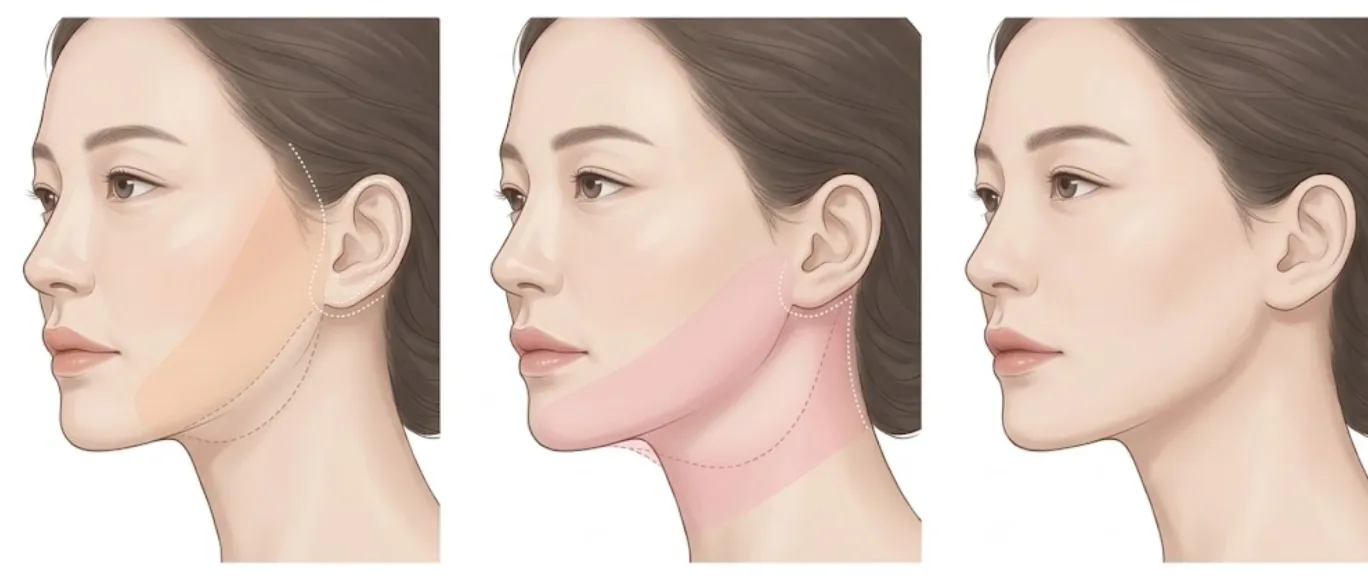
Illustration: through a shorter incision around the ear (dotted), the deeper layer (yellow) is lifted using the deep-plane principle (Deep mini™).
The full deep-plane facelift takes that same release much further. Through longer incisions along the hairline and in front of the ear, it releases the SMAS with a dual-plane approach all the way to the jawline, resetting the deeper structure of the whole lower face and neck, with sutures removed at around 10 to 14 days. Both apply one deep-plane idea at two scales: a focused, lighter release and a complete one. The right choice tracks how much of the face has descended.
How much lift
How much a deep-plane and a deep-mini facelift each lift
This is the difference that matters most. The deep-mini gives a genuine deep-plane lift but within a limited range: it refreshes an early jawline, softens beginning jowls and tidies the mid-face, working over a shorter dissection. Pushed beyond early-to-moderate laxity it will not reach far enough to hold a heavier, more descended face. Correct candidacy therefore matters more than the appeal of a smaller operation. Its scope is set out in who a deep-mini facelift is for.
The full deep-plane lifts substantially more because it releases the SMAS to the jawline and re-drapes the whole lower face and neck. For someone with moderate-to-advanced sagging, clear jowls and a blunted jawline, it achieves a completeness the mini physically cannot. The trade-off is that it is a bigger undertaking with a longer recovery. In the abstract the full lift lifts more. The right question is which one matches the amount of descent you actually have, since a full lift on early laxity is more than the face needs.
Who each suits
Who a deep-plane or deep-mini facelift suits
A deep-mini facelift suits early-to-moderate ageing: a jawline that is just beginning to soften, early jowling and a mid-face that has started to descend, in someone who wants a real structural lift but not the reach or recovery of a full one. It is well matched to patients addressing the first clear signs of jowling, and to those who want a shorter incision. Long-established heaviness is outside its range. It is not built to correct advanced sagging or a markedly loose neck.
Illustration: through a fine line around the ear (dotted), the sagging lower face and neck are lifted up and back toward the ear (shaded); the dashed outline shows the old contour.
A full deep-plane facelift suits moderate-to-advanced ageing: established jowls, clear skin laxity, a blunted jawline and often neck involvement, where only a complete release will reset the structure. It suits people who want a thorough, durable change and can accept real recovery. Many faces sit on the border between the two, and if the neck is a major part of the picture the plan may extend toward a neck lift as well. Those border cases are where an in-person read earns its place; see also who a deep-plane facelift is for.
Incisions & recovery
Incisions and recovery
Incisions are the most visible difference. The deep-mini uses a shorter incision from the temporal hairline to the ear lobe, so there is less to heal and sutures come out at around 10 days. The full deep-plane uses longer incisions along the hairline and in front of the ear to reach the jawline, and its sutures are removed across a slightly longer window of around 10 to 14 days, with a longer settling period before the result fully matures. Both are placed to sit discreetly, but the full lift naturally involves more.
Recovery scales with the operation. Expect the deep-mini to be the lighter of the two, with less swelling and bruising and an earlier return to normal social life, while the full deep-plane asks for a more patient recovery in exchange for its greater reach. Neither timeline is a reason on its own to choose the smaller procedure if your face needs the larger: recovery is the price of the correction and should not decide it. The full day-by-day pictures are on the deep-mini recovery timeline and the deep-plane recovery timeline.
Which fits you
Which facelift fits your face: deep plane or deep mini
As a general guide: if your ageing is early-to-moderate (a softening jawline, early jowls, a mid-face just starting to descend) and you want a real deep-plane lift with a shorter incision and lighter recovery, a deep-mini is a sensible fit. If your ageing is moderate-to-advanced (established jowls, loose skin, a blunted jawline, often with the neck involved), the full deep-plane is the procedure that will actually reset it. Many people are somewhere between, and there an in-person assessment matters most.
The wrong reasons to choose are worth naming. Picking the deep-mini only because it is smaller, when your laxity genuinely needs a full release, leads to an under-corrected result; choosing the full lift for very early ageing is more than the face needs. A good surgeon will sometimes recommend neither yet. Where your jawline and jowls sit on that scale can be discussed in an online consultation before you commit to either lift.
At Garnet
A deep-plane vs deep-mini facelift assessment at Garnet
Garnet is a single-surgeon clinic in Apgujeong, Seoul. Dr. In-Soo Baek is a board-certified plastic surgeon (Korean medical licence no. 77407) who performs both the deep-mini and the full deep-plane facelift himself. The recommendation you receive is therefore free of any pull toward the one scale a particular doctor happens to offer. Because one surgeon assesses your degree of descent, he can tell you candidly whether your face calls for the lighter release, the full one, or neither yet.
Whichever lift you choose, Dr. Baek also runs the 1, 3 and 6-month checks, and continues them remotely once you are home. Garnet is registered with Korea's foreign-patient programme. The most useful next step is a no-obligation online assessment: send photos and get a clear read on whether a deep-mini facelift, a full deep-plane facelift, or neither is right for your face before you plan a trip.
Dr. In-Soo Baek
Director & sole operating surgeon
Korean medical licence no. 77407
Operate on what you came for. Trained at Korea University Medical Center. Every case planned, performed and reviewed by the same hands.
1Operating surgeon
~2Surgeries per day
7Registered techniques
Board-certified plastic surgeon
Plastic surgery training at Korea University College of Medicine & graduate school
Korean Society of Plastic and Reconstructive Surgeons member, in its facial-contour, eye & rhinoplasty groups
Consults, operates and follows up each case himself
Peer-reviewed papers behind the facts on this page. Each describes findings in its own study group — not results at Garnet — and none predicts your own outcome.
Bray D et al. Male Deep-Plane Face and Neck Lifting. Facial Plastic Surgery Clinics of North America. 2024. doi:10.1016/j.fsc.2024.02.003
Van Pham T et al. Short or Minimum Incision Deep Plane/Extended Deep Plane Facelift/Rhytidectomy. Facial Plastic Surgery. 2020. doi:10.1055/s-0040-1714118
Surek CC et al. Deep Plane Anatomy for the Facelift Surgeon. Facial Plastic Surgery Clinics of North America. 2022. doi:10.1016/j.fsc.2022.01.015
Jacono AA et al. The Modern Minimally Invasive Face Lift. Facial Plastic Surgery Clinics of North America. 2013. doi:10.1016/j.fsc.2013.02.002
FAQ
Common questions
What is the difference between a deep-plane and a deep-mini facelift?
Both release the deep SMAS layer instead of just pulling skin, but at different scales. The deep-mini works through a shorter incision and concentrates on the early jawline and mid-face. The full deep-plane releases the SMAS all the way to the jawline through longer incisions, resetting the whole lower face and neck for a more complete lift.
Is a deep-plane or a deep-mini facelift better for me?
Neither is universally better; it depends on how advanced your ageing is. Early-to-moderate laxity suits the lighter deep-mini; moderate-to-advanced sagging with established jowls and a loose neck needs the reach of a full deep-plane. Seeing your jawline and jowls in person is the reliable way to tell which scale fits.
Does a deep-mini lift as much as a full deep-plane facelift?
No. The deep-mini gives a genuine deep-plane lift but within a limited range, aimed at early jowls and the mid-face. The full deep-plane lifts substantially more because it releases the SMAS to the jawline and re-drapes the whole lower face and neck. Pushing a mini beyond early laxity will not reach far enough to hold.
Is the recovery very different between the two?
Yes, recovery scales with the operation. The deep-mini uses a shorter incision with sutures out at around 10 days and lighter swelling and bruising. The full deep-plane uses longer incisions to the jawline, with sutures removed at around 10 to 14 days and a longer settling period before the result fully matures.
Can a deep-mini be upgraded to a full deep-plane later?
Ageing continues, so some people who have a deep-mini for early laxity may consider a fuller lift years later as descent progresses. Whether that is the right path for you depends on your starting anatomy and how your face ages, which a surgeon assesses as you go. No fixed sequence is promised.
Does either one address the neck?
The full deep-plane, working to the jawline, is better placed to influence the upper neck, and when the neck is a major part of the picture the plan may extend to a dedicated neck lift. A deep-mini is more focused on the jawline and mid-face. Which your neck needs is part of the in-person assessment.
Is a deep-mini just a smaller version of the same operation?
In essence yes. It applies the same deep-plane release through a shorter incision and over a smaller area, scaled to early-to-moderate ageing. The distinction that matters is reach, and whether that reach matches your degree of laxity.
How long does each result last?
Both are structural, deep-plane lifts and set the clock back meaningfully and for more than a short while, though neither stops the natural ageing that continues afterward. The full deep-plane, by resetting more, addresses more advanced change; the deep-mini suits earlier laxity. How durable your result feels depends on your starting point and how you age.
Who decides which procedure I should have?
You do, with a clear assessment. At Garnet Dr. Baek performs both the deep-mini and the full deep-plane facelift himself. He assesses your degree of descent and tells you candidly which scale of lift suits your face, sometimes advising the lighter option, or that neither is needed yet.
Can I get this assessment before travelling to Korea?
Yes. Send photos and discuss whether a deep-mini, a full deep-plane facelift or neither fits your face in an online consultation before you commit to travel. After either lift, Garnet, which is registered with Korea's foreign-patient programme, keeps following your recovery remotely once you are home.
My mom recently had a brow lift and lower blepharoplasty with Dr. Baek, and our experience has been wonderful so far. The Garnet team was incredibly kind and welcoming, with Kelly assisting us as our English consultant—she made everything…
I’m so happy I chose this clinic for my lower blepharoplasty. I was traveling from abroad by myself, so I was a little nervous, but from the beginning I felt comfortable and truly cared for. Everyone was kind, patient, and professional…
Came in for an in-person consult and ended up choosing Garnet and Dr.Baek for my non-incisional DES and tiplasty/alarplasty. I communicated with Kelly (English consultant) from the start till now (3 weeks post-op). She really help me feel…
My under-eyes have been sagging and folding for years... I tried to cover it up with makeup, but it actually got stuck in the wrinkles and made it stand out even more. While going for consultations, I noticed that the bigger the hospital…
Send photos and your question before you travel. An English-speaking coordinator reviews every enquiry and replies with guidance on whether surgery is appropriate, the likely plan and timing.
✓ Reviewed by the clinic coordinator, not a bot
✓ Photo-based pre-assessment before you fly
✓ Foreign-patient scheduling & after-care
✓ One surgeon for consultation, surgery and follow-up
Prefer to chat now? Reach the coordinator directly:









 T S7 months ago



