Lateral canthoplasty opens the outer corner of the eye to make it look a little longer and more open. It suits some eye shapes and goals well and is unnecessary or unsuitable for others, so the useful question is whether it is right for you. This page walks through who tends to benefit, who does not, and why a careful surgeon will sometimes advise against it, grounded in how the procedure is actually performed at Garnet.
The short answer
Good candidates often have a relatively short eye or a slightly rounded, tight outer corner and want a subtly longer, more open eye shape.
It is frequently combined with double-eyelid surgery or an inner-corner epicanthoplasty, because balancing both corners usually looks more harmonious than changing one alone.
It is not a fix for every concern: sagging lids, dark circles or under-eye bags are different problems with different procedures.
A careful assessment matters more than eligibility on paper; a careful surgeon will advise against surgery that will not genuinely help you.
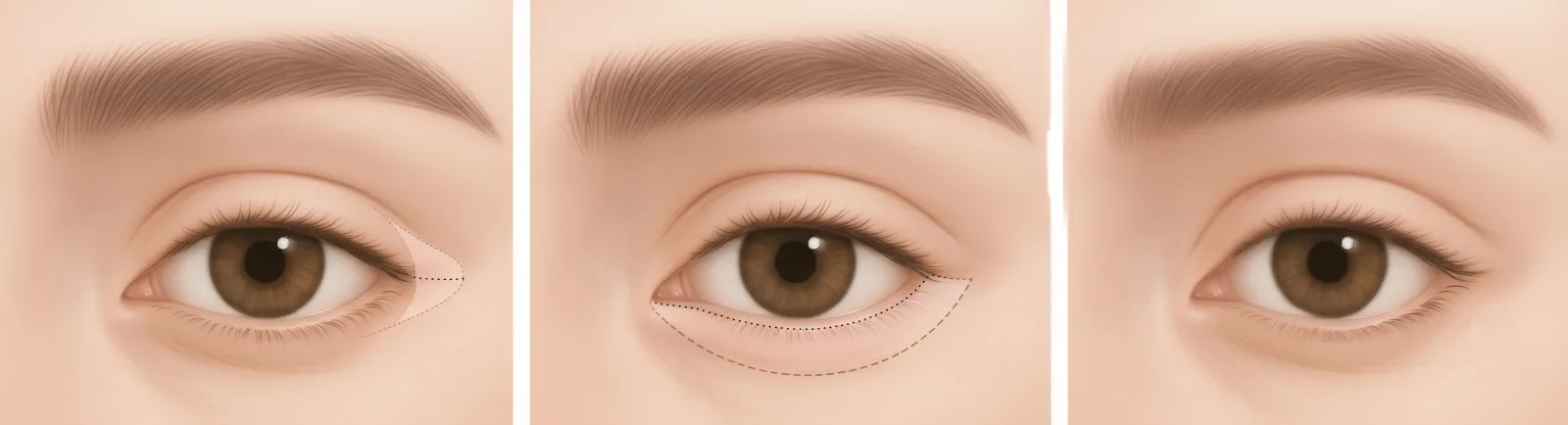
Lateral canthoplasty works on the outer corner of the eye (the lateral canthus) to make the eye read as a little longer and the outer corner sit slightly more open. At Garnet it is performed as a Wide angle™ procedure through a conjunctival incision on the inner surface of the lid, with an accompanying lower-canthal opening at the bottom of the corner. The aim is a subtle change to the horizontal length and openness of the eye, without dramatic reshaping. You can read the full overview on the lateral canthoplasty page.
Illustration: the outer corner is extended and the lower-lid line gently lowered along the dotted lines, softening the angle of the eye.
Understanding what it does and does not do is the foundation of judging candidacy. It changes the outer corner; it does not lift a sagging brow, remove under-eye fat, or correct heavy upper-lid skin. A good candidate is therefore someone whose concern genuinely lives at the outer corner. A single corner procedure will not solve a different problem.
Because the change is to a small, expressive area, the right candidate usually wants refinement over transformation. The outer corner is where eye shape reads as longer or rounder, more open or more closed, so opening it suits people who feel their eyes look slightly short or tight at the outer edge and want a softer, more open look that still reads as their own face.
Good candidate
Who tends to be a good candidate
The most common good candidate has a relatively short eye or a slightly rounded, tight outer corner, and wants the eye to look a little longer and more open. People who feel their eyes appear small or that the outer corner sits high or closed often find that gently opening it gives the subtle lengthening they are after, while keeping a natural appearance. The procedure tends to satisfy those seeking refinement more than those wanting a wholesale change in eye character.
Realistic expectations are themselves a sign of a good candidate. Someone who understands that the result is a subtle few-millimetre change, that healing takes time, and that the outer corner keeps settling for months is far better placed than someone expecting a transformed eye overnight. The recovery timeline page is worth reading on this. General health that supports safe surgery and healing, and being a non-smoker or willing to pause smoking, also help.
Candidacy is ultimately about anatomy plus goals. Two people with similar-looking eyes can have different starting structures, and what suits one may not suit the other. That is why a good candidate is best identified by a surgeon looking at your actual eyes and listening to what you want. A checklist alone cannot do this.
Combined
When it is best combined with other eye surgery
Lateral canthoplasty is often not done in isolation, and for many candidates the better plan combines it with other eye surgery. Because changing only the outer corner can look unbalanced against an unchanged inner corner or lid, surgeons frequently pair it with double-eyelid surgery or an inner-corner epicanthoplasty to balance the whole eye. For a candidate whose goal is overall harmony across both corners, a combined plan often gives the most natural result.
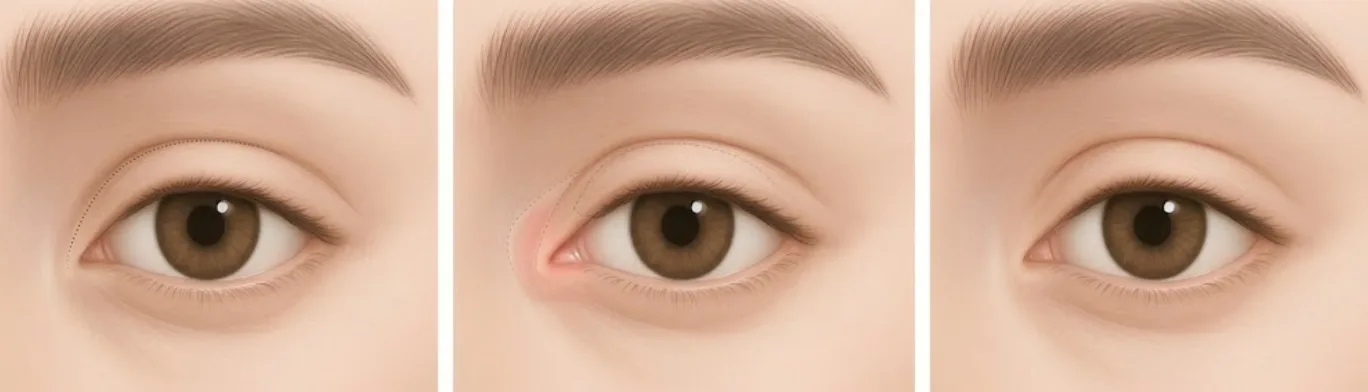
Illustration: the skin fold covering the inner corner is released along the dotted line so the inner corner opens slightly while the eye keeps its own shape.
Combining is a clinical judgement based on your specific eyes. Someone with a short outer corner but well-balanced inner corner may need the lateral procedure alone; someone wanting a longer, more open eye overall may benefit from addressing both corners together. The right answer depends on starting anatomy, which is why it is judged at assessment and not assumed in advance.
Combining also tends to be more efficient (one recovery, one set of follow-ups), but it should always be driven by what improves the result, never by adding procedures for their own sake. A careful surgeon recommends combined work only where it genuinely helps and is just as willing to keep the plan to a single corner.
Not suited
Who lateral canthoplasty is not for
Lateral canthoplasty is not the answer to every eye concern, and recognising this is part of choosing well. If your real issue is heavy, hooded upper-lid skin, a drooping brow, under-eye bags or dark circles, those are different problems addressed by different procedures. Opening the outer corner will not fix them and may disappoint if chosen for the wrong reason. A candid surgeon will point you toward the procedure that actually matches your concern.
Some anatomy makes the procedure less suitable or calls for extra caution: very lax lower-lid support, certain previous eye surgeries, or a tendency to noticeable scarring may change whether it is advisable or how it is approached. Active eye conditions such as dry-eye disease, infection or inflammation usually need to be settled first, and uncontrolled medical conditions that affect healing are a reason to pause and reassess.
Expectations can also make someone the wrong candidate even with suitable anatomy. If the hope is for a dramatic transformation, a guaranteed outcome, or a change that would not actually suit the rest of the face, surgery may not be the right step, or at least not this one. A careful clinic will say so plainly.
Assessment
Why a lateral canthoplasty assessment matters more than eligibility
Being technically eligible for lateral canthoplasty is not the same as it being the right choice for you, and the gap between the two is exactly what a proper assessment is for. A surgeon examining your eyes in person can see how the outer corner sits, how the lower lid is supported, how your two corners relate, and how a small change would read against the rest of your face. A self-assessment or a photo filter cannot tell you any of this reliably.
A good assessment also means being told when not to operate. A surgeon who is willing to say "this would not help you" or "you do not need this" is protecting your result and your money, and that candour is one of the most useful things you can look for. A hard sell toward more surgery than you came for points the other way. You can read more about what to look for in the choosing a board-certified surgeon guide.
For international patients, this conversation can begin before any travel. Sending photographs through an online consultation lets a surgeon give a preliminary, candid view of your candidacy, what combining might or might not add, and if a trip is worth planning at all. A full in-person assessment confirms the plan once you arrive.
At Garnet
How Garnet assesses candidacy
Garnet is a single-surgeon clinic in Apgujeong, Seoul, where Dr. In-Soo Baek, a board-certified plastic surgeon (Korean medical licence no. 77407), personally consults, assesses and operates. That means the surgeon who decides on your candidacy is the same one who would perform the surgery and follow up afterward, so the assessment is grounded in exactly how he would approach your eyes. It is not handed off to someone else.
The clinic's approach is to address only the area you came for and to avoid over-recommending. If lateral canthoplasty genuinely suits your eyes and goals, the surgeon will explain what it would and would not change and whether combining with another eye procedure would help; if it would not help, he will say so plainly. There is no consultation or CT fee and no pressure to book the same day, which makes a straight answer easier to give and to hear.
If you would like to know if you are a good candidate, you can start from abroad with a no-obligation online consultation: send photographs and describe your goals, and the surgeon will give a candid preliminary view before you commit to any travel, with the plan confirmed at an in-person assessment in Seoul.
Dr. In-Soo Baek
Director & sole operating surgeon
Korean medical licence no. 77407
Operate on what you came for. Trained at Korea University Medical Center. Every case planned, performed and reviewed by the same hands.
1Operating surgeon
~2Surgeries per day
7Registered techniques
Board-certified plastic surgeon
Plastic surgery training at Korea University College of Medicine & graduate school
Korean Society of Plastic and Reconstructive Surgeons member, in its facial-contour, eye & rhinoplasty groups
Consults, operates and follows up each case himself
Peer-reviewed papers behind the facts on this page. Each describes findings in its own study group — not results at Garnet — and none predicts your own outcome.
Peterson E et al. Lateral Canthal Management in Esthetic Blepharoplasty, an Update. Facial Plastic Surgery Clinics of North America. 2026. doi:10.1016/j.fsc.2025.08.011
Juniat V et al. Canthoplasty repair for canthal rounding. Eye. 2021. doi:10.1038/s41433-021-01497-y
Cho YK et al. The Effective Fixation Level for Cosmetic Lateral Canthoplasty. Journal of Craniofacial Surgery. 2019. doi:10.1097/scs.0000000000005378
FAQ
Common questions
Who is a good candidate for lateral canthoplasty?
A good candidate typically has a relatively short eye or a slightly rounded, tight outer corner and wants the eye to look a little longer and more open, with realistic expectations of a subtle few-millimetre change. General health that supports safe healing helps. The most reliable way to confirm candidacy is a careful assessment of your actual eyes, as covered on the lateral canthoplasty page.
Am I suitable for lateral canthoplasty?
It depends on your starting anatomy and your goals, which is why a surgeon looking at your eyes matters more than a checklist. If your outer corner feels short, high or closed and you want a subtly longer, more open eye, you may be suitable. You can get a candid preliminary view through an online consultation before any travel.
When is lateral canthoplasty not recommended?
It is not recommended when your real concern is something else: hooded upper-lid skin, a drooping brow, under-eye bags or dark circles are different problems with different procedures. It may also be unsuitable with very lax lower-lid support, certain previous surgeries, active eye conditions, or expectations of a dramatic or guaranteed transformation.
Is lateral canthoplasty usually combined with other eye surgery?
Often, yes. Because changing only the outer corner can look unbalanced, it is frequently paired with double-eyelid surgery or an inner-corner epicanthoplasty for a more harmonious eye shape. Whether to combine depends on your anatomy and goals and is decided at assessment, never added for its own sake.
Will lateral canthoplasty make my eyes much bigger?
No. It produces a subtle change, a slightly longer and more open outer corner, without dramatic enlargement. The right candidate is usually looking for refinement that still reads as their own face. Realistic expectations are an important part of being a good candidate.
Can lateral canthoplasty fix under-eye bags or dark circles?
No. Under-eye bags and dark circles are separate concerns addressed by different procedures, such as lower-eyelid surgery or fat repositioning. Lateral canthoplasty only changes the outer corner. A careful surgeon will point you toward the procedure that actually matches your concern, even if it differs from the one you asked for.
Does a rounded or short eye suit lateral canthoplasty?
Frequently, yes. A relatively short eye or a slightly rounded, tight outer corner is one of the more common reasons people benefit, since gently opening the outer corner gives a subtle lengthening. The exact suitability still depends on your individual anatomy, which a surgeon confirms at assessment.
What if the surgeon says I do not need it?
That is a good sign. A surgeon willing to advise against surgery that would not genuinely help you is protecting your result and your money. Garnet's approach is to address only the area you came for and avoid over-recommending, so a plain "you do not need this" is part of the assessment.
How does recovery look if I do go ahead?
The first milestone is suture removal at around seven days, with most early swelling settling in the first week and the corner refining over the following months. Many people feel presentable within one to two weeks. The recovery timeline page walks through it day by day.
Can I check if I am a candidate from abroad?
Yes. You can send photographs and describe your goals through a no-obligation online consultation, and the surgeon will give a candid preliminary view of your candidacy and what, if anything, is worth combining. This comes before you commit to travel, with the plan confirmed in person in Seoul.
My mom recently had a brow lift and lower blepharoplasty with Dr. Baek, and our experience has been wonderful so far. The Garnet team was incredibly kind and welcoming, with Kelly assisting us as our English consultant—she made everything…
I’m so happy I chose this clinic for my lower blepharoplasty. I was traveling from abroad by myself, so I was a little nervous, but from the beginning I felt comfortable and truly cared for. Everyone was kind, patient, and professional…
Came in for an in-person consult and ended up choosing Garnet and Dr.Baek for my non-incisional DES and tiplasty/alarplasty. I communicated with Kelly (English consultant) from the start till now (3 weeks post-op). She really help me feel…
My under-eyes have been sagging and folding for years... I tried to cover it up with makeup, but it actually got stuck in the wrinkles and made it stand out even more. While going for consultations, I noticed that the bigger the hospital…
To find out if lateral canthoplasty suits your eyes, send photos for a no-obligation pre-assessment. The surgeon will tell you candidly if it would help, before you book any travel.
Send photos and your question before you travel. An English-speaking coordinator reviews every enquiry and replies with guidance on whether surgery is appropriate, the likely plan and timing.
✓ Reviewed by the clinic coordinator, not a bot
✓ Photo-based pre-assessment before you fly
✓ Foreign-patient scheduling & after-care
✓ One surgeon for consultation, surgery and follow-up
Prefer to chat now? Reach the coordinator directly:








 T S7 months ago



