Lateral canthoplasty opens the outer corner of the eye to make it look a little longer and wider. Because the corner is such a visible, expressive part of the face, patients want more than a vague "a week or two". They want to know what happens on day 1, day 3, day 7, and in the weeks after. This page walks through the timeline stage by stage, grounded in how the procedure is actually performed and followed up at Garnet.
The short answer
The first milestone is suture removal at around 7 days; most of the early swelling settles within this first week.
Mild pinkness, tightness and a little watering at the outer corner are normal for the first few weeks and fade gradually.
Many people feel presentable enough for desk work and social settings within one to two weeks, though the corner keeps refining for a few months.
The same surgeon who operates reviews recovery at structured follow-ups, and international patients can continue this remotely after flying home.
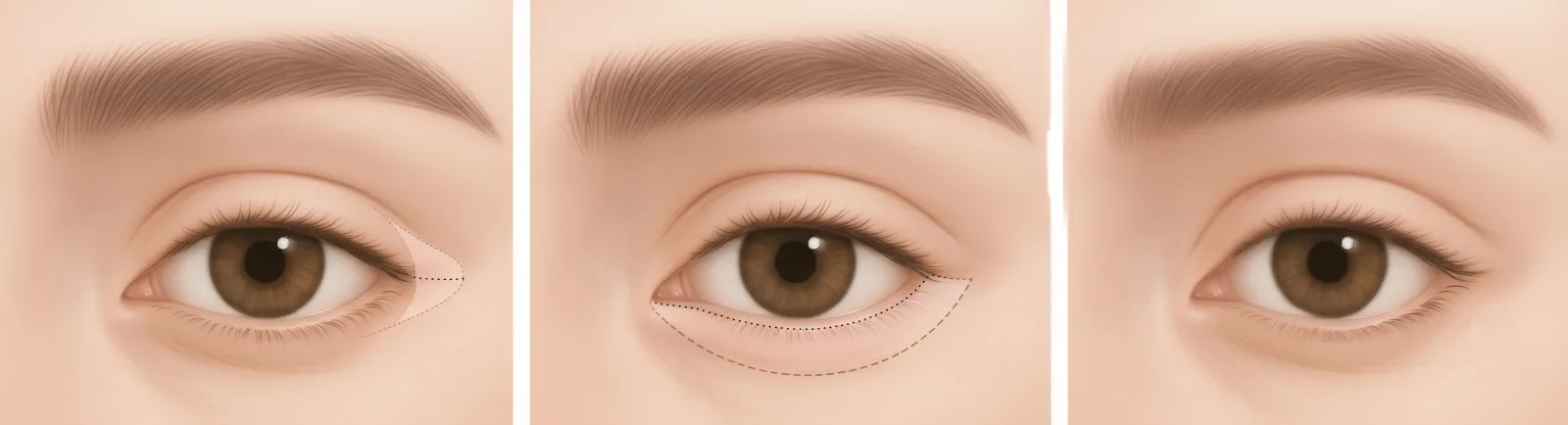
Lateral canthoplasty opens the outer corner of the eye (the lateral canthus) so the eye reads as a little longer and the outer corner sits slightly more open. At Garnet it is performed as a Wide angle™ procedure through a conjunctival incision, made on the inner, moist surface of the lid instead of the outer skin, with an accompanying lower-canthal opening at the bottom of the corner. Because the main incision sits inside the lid, recovery is driven less by a visible skin wound and more by how the delicate corner tissue settles. You can read the procedure overview on the lateral canthoplasty page.
Illustration: the outer corner is extended and the lower-lid line gently lowered along the dotted lines, softening the angle of the eye.
Knowing what you are healing from sets realistic expectations. There is no large dressing over the eye and no bedbound downtime. The early limits are about swelling, redness, mild watering and protecting fine sutures, and you can still function normally. The visible journey is gradual: the corner looks its most worked-on in the first days, then steadily calms down as the swelling resolves and the new outer corner finds its shape.
Lateral canthoplasty is often combined with other eye procedures, such as double-eyelid surgery or an inner-corner epicanthoplasty, because balancing both corners frequently gives a more harmonious eye shape than changing one alone. If your plan combines procedures, recovery follows the same overall arc but you should expect a little more swelling across the lid, and the surgeon will set expectations for your specific combination at consultation.
Days 1 to 7
Days 1 to 7: the first week, up to suture removal
Day 1 to 2 is the peak of swelling. The outer corners feel tight and look pink, the eyes may water more than usual, and there can be light bruising and a little crusting near the corner, which is normal. Cool compresses as directed, keeping your head elevated when resting and sleeping, and avoiding bending or straining all help bring the swelling down faster. You are mobile and can manage gentle activity at home, but this is a rest-and-protect phase for the outer corners, and sightseeing can wait.
By day 3 to 5 the worst of the swelling usually starts to ease and any bruising begins to change colour as it resolves. The outer corner is still visibly pink and the fine sutures are in place, so the area still looks clearly operated-on, and the eyes may feel dry or tire quickly. Keep the area clean exactly as instructed, avoid rubbing the eyes, and keep screen time and reading short. Most people are not yet ready to be photographed up close but are otherwise comfortable.
Around day 7 the sutures are removed. This is the key first-week milestone at Garnet, where the lateral canthoplasty stitches come out at about 7 days. Suture removal is quick, and once they are out the corner often looks tidier almost immediately, though it will still be pink. Many international patients plan to be in Seoul through this suture-removal visit so the surgeon can check the corner in person before they consider travelling home.
Weeks 2 to 4
Weeks 2 to 4: looking presentable and returning to normal
Through the second week, residual swelling continues to fade and the pinkness softens. By around the end of week one into the middle of week two, many people feel presentable enough to return to desk work and ordinary social settings. The corners are no longer obviously swollen, though a close look still shows a healing line and a touch of redness. Light eye makeup can usually be worn once the surgeon confirms the area has fully closed, which helps cover residual redness.
Into weeks three and four, the eye shape looks much more natural and the new outer corner reads as part of your face and less like a recent operation. You can gradually return to light exercise as the surgeon advises, while still avoiding heavy straining, swimming and anything that risks a knock to the eye. Vigorous activity is reintroduced slowly because the corner tissue is still remodelling beneath the surface.
What is normal at this stage is a subtle pinkness, occasional tightness and a little watering at the very outer corner that you notice more than anyone else does. What is not expected is increasing pain, spreading redness or discharge; those warrant a message to the clinic. Because the same surgeon follows your recovery, you have one direct point of contact and are not passed between staff.
Months 1 to 6
Months 1 to 6: the corner settles into its final shape
The result of lateral canthoplasty arrives in two stages: the broad shape settles within the first weeks, but the fine details of the outer corner keep refining for months. From the first month onward the corner continues to soften, any residual pinkness fades toward your natural skin tone, and the slightly longer, more open look reads more naturally as the surrounding tissue relaxes around it.
By around three months the corner usually looks settled, and by six months it has typically matured to a natural outer corner that does not announce itself. Garnet builds structured follow-ups into recovery at 1, 3 and 6 months, which line up well with these milestones. Each visit (or remote check) lets the surgeon confirm the corner is healing as planned and the openness is holding as intended.
Healing speed varies with skin type and aftercare, and the outer corner is a high-movement, expressive area, so patience matters. Avoiding sun on the fresh area, not rubbing the eyes and following the surgeon's guidance all help the final result. If you are weighing whether the procedure suits your eye shape in the first place, the who is it for page covers candidacy in more detail.
Aftercare
Aftercare essentials and red flags to watch
Good aftercare is mostly about protecting a small, delicate area. Keep the corner clean as instructed, do not rub or pull at the outer corners, and avoid eye makeup until your surgeon confirms the area is fully closed. Keep your head elevated for the first nights, use cool compresses as directed in the first couple of days, and rest your eyes from long screen sessions while they feel tired or dry. Lubricating drops can help if your surgeon recommends them, especially as the eyes may water more in the early days.
Avoid smoking, which slows wound healing, and avoid alcohol in the early days as it can worsen swelling. Hold off on swimming, saunas, contact lenses and vigorous exercise until cleared, and protect the healing corner from strong sun. These simple habits do most of the work of getting a clean, settled outer corner.
Most discomfort is mild and improves day by day. Contact the clinic promptly if you notice pain that increases, spreading redness or warmth, pus-like discharge, a suture coming loose early, or any sudden change in vision. Knowing the difference between normal healing (pinkness, tightness, mild swelling and watering) and a warning sign means you can recover with confidence.
At Garnet
Follow-up at Garnet and planning your flight home
Garnet is a single-surgeon clinic in Apgujeong, Seoul, where Dr. In-Soo Baek, a board-certified plastic surgeon (Korean medical licence no. 77407), performs the surgery himself and reviews every follow-up. For an international patient that continuity is the practical value: the person who opened your outer corner is the same person who checks it at suture removal and reviews it at 1, 3 and 6 months, with no hand-off between consultation, surgery and after-care.
For planning a flight home, the usual anchor is the suture-removal visit at around 7 days. Many patients arrange to remain in Seoul until the surgeon has removed the sutures and confirmed the corner looks good, then travel once cleared. Short-haul flights are generally easier sooner than long-haul; your surgeon will give guidance based on your healing and your itinerary, and the broader question of timing is covered in the when can I fly after surgery guide.
If you are still deciding, you can start with a no-obligation pre-assessment from abroad: send photographs through an online consultation and the surgeon will give a candid view of whether lateral canthoplasty suits your eye shape, how it might combine with other eye procedures, and what recovery would realistically look like for you before you book any travel.
Dr. In-Soo Baek
Director & sole operating surgeon
Korean medical licence no. 77407
Operate on what you came for. Trained at Korea University Medical Center. Every case planned, performed and reviewed by the same hands.
1Operating surgeon
~2Surgeries per day
7Registered techniques
Board-certified plastic surgeon
Plastic surgery training at Korea University College of Medicine & graduate school
Korean Society of Plastic and Reconstructive Surgeons member, in its facial-contour, eye & rhinoplasty groups
Consults, operates and follows up each case himself
Peer-reviewed papers behind the facts on this page. Each describes findings in its own study group — not results at Garnet — and none predicts your own outcome.
Glat PM et al. Evolution of the Lateral Canthoplasty: Techniques and Indications. Plastic & Reconstructive Surgery. 1997. doi:10.1097/00006534-199711000-00003
Peterson E et al. Lateral Canthal Management in Esthetic Blepharoplasty, an Update. Facial Plastic Surgery Clinics of North America. 2026. doi:10.1016/j.fsc.2025.08.011
FAQ
Common questions
How long does lateral canthoplasty recovery take?
The first key milestone is suture removal at around 7 days, by which point most early swelling has eased. Many people feel presentable enough for desk work and social settings within one to two weeks. The outer corner then keeps refining over the following months, usually looking settled by around three to six months. See the full overview on the lateral canthoplasty page.
What is lateral canthoplasty recovery like day by day?
Days 1 to 2 are peak swelling and tightness with possible light bruising and watering. Days 3 to 5 see swelling start to ease while the corner stays pink. Around day 7 the sutures come out and the corner looks tidier. Through weeks 2 to 4 redness fades and the shape looks natural, while the outer corner continues to refine over the following months.
When can I return to work after lateral canthoplasty?
Many people return to desk work within one to two weeks, often around the time the sutures are removed at day 7. The outer corner will still be pink up close, and light makeup (once the surgeon confirms the area is closed) can help cover residual redness. Physically demanding work should wait until the surgeon clears it.
When are the stitches removed after lateral canthoplasty?
At Garnet the outer-corner sutures are removed at around 7 days. Suture removal is quick, and the outer corner often looks noticeably tidier immediately afterward, although it remains pink while it continues to settle over the following weeks and months.
How long does swelling and redness last after lateral canthoplasty?
The bulk of the swelling eases within the first week, and bruising, if any, resolves over one to two weeks. A subtle pinkness, occasional tightness and a little watering at the outer corner can linger for several weeks and fade gradually, with the corner looking fully settled over the following months.
Is lateral canthoplasty usually combined with other eye surgery?
Often, yes. Balancing the outer corner with double-eyelid surgery or an inner-corner epicanthoplasty frequently gives a more harmonious eye shape than changing one area alone. Recovery follows the same overall arc, but expect a little more swelling across the lid. The surgeon sets expectations for your specific combination at consultation.
When can I fly home after lateral canthoplasty?
Many international patients plan to stay in Seoul through the suture-removal visit at around day 7, then travel once the surgeon confirms the corner looks good. Short-haul flights are generally easier sooner than long-haul. Your surgeon gives guidance based on your healing and itinerary, as covered in the when can I fly guide.
What aftercare follows lateral canthoplasty?
Keep the corner clean, do not rub the outer corners, avoid eye makeup until the area is fully closed, keep your head elevated for the first nights, use cool compresses as directed, and rest your eyes from long screen time. Avoid smoking, alcohol, swimming, saunas, contact lenses and vigorous exercise until cleared, and protect the corner from sun.
What recovery signs mean I should contact the clinic?
Contact the clinic if pain increases, redness or warmth spreads, there is pus-like discharge, a suture comes loose early, or you notice any sudden change in vision. Mild pinkness, tightness, watering and swelling that improve day by day are normal. Because the same surgeon follows your recovery, you have a direct point of contact.
How is lateral canthoplasty followed up after I fly home?
Yes. The operating surgeon reviews your recovery, and after you travel home you can continue remotely by sending photographs at intervals, alongside structured follow-ups at 1, 3 and 6 months, so the surgeon can confirm the corner is settling normally or step in early if needed.
My mom recently had a brow lift and lower blepharoplasty with Dr. Baek, and our experience has been wonderful so far. The Garnet team was incredibly kind and welcoming, with Kelly assisting us as our English consultant—she made everything…
I’m so happy I chose this clinic for my lower blepharoplasty. I was traveling from abroad by myself, so I was a little nervous, but from the beginning I felt comfortable and truly cared for. Everyone was kind, patient, and professional…
Came in for an in-person consult and ended up choosing Garnet and Dr.Baek for my non-incisional DES and tiplasty/alarplasty. I communicated with Kelly (English consultant) from the start till now (3 weeks post-op). She really help me feel…
My under-eyes have been sagging and folding for years... I tried to cover it up with makeup, but it actually got stuck in the wrinkles and made it stand out even more. While going for consultations, I noticed that the bigger the hospital…
If you are planning lateral canthoplasty from abroad, send photos for a no-obligation pre-assessment. The surgeon will explain whether it suits your eye shape and what recovery would look like for you, before you book any travel.
Send photos and your question before you travel. An English-speaking coordinator reviews every enquiry and replies with guidance on whether surgery is appropriate, the likely plan and timing.
✓ Reviewed by the clinic coordinator, not a bot
✓ Photo-based pre-assessment before you fly
✓ Foreign-patient scheduling & after-care
✓ One surgeon for consultation, surgery and follow-up
Prefer to chat now? Reach the coordinator directly:









 T S7 months ago



