Rhinoplasty is one of the most requested procedures by men, and the brief is different from the delicate, upturned shape often associated with a female nose. For most men the goal is a straight bridge, a defined but not over-refined tip, and enough height to balance the face, without the tell-tale signs that anything was done. Getting the masculine proportions right is where the whole result is decided.
The short answer
A masculine nose usually wants a straight bridge and a slightly stronger, less upturned tip. Over-refining or over-rotating the tip is the main way a male nose ends up looking feminine.
Male skin is typically thicker and more sebaceous, which hides fine definition and calls for a stronger cartilage framework to hold the shape.
Standard rhinoplasty uses a silicone dorsal implant with your own tip cartilage; an implant-free approach uses only your own cartilage if you prefer no implant.
A previously operated nose is a different problem, handled with revision rhinoplasty and a stronger graft plan.
A man's nose is not simply a larger version of a woman's. It is generally longer, with a higher and straighter bridge, a tip that sits closer to a right angle with the lip instead of turning up, and a base that is proportionally wider. On top of that, male nasal skin is usually thicker and more oily, which softens and hides fine surface detail. Designing a male nose as if it were a female one is the most common reason a result looks feminised or unnatural.
The brief is usually about correction and balance: straightening a bridge, refining a bulbous or drooping tip, or adding height so the nose sits in proportion with a strong jaw and brow. The aim is a nose that looks like it always belonged on your face and does not announce surgery.
Because Garnet is a single-surgeon clinic, Dr. In-Soo Baek, a board-certified plastic surgeon, assesses your nose, discusses realistic masculine proportions for your face, and performs the surgery himself. Rhinoplasty is one of the operations where a single, experienced hand and a careful assessment matter most, because the framework decides the result for years.
Masculine shape
What makes a male nose look masculine without looking over-done
Three things generally define a masculine nose: a straight bridge (a scooped, concave line reads as feminine), a tip that is defined but not over-rotated or upturned, and height that balances the face without looking artificially high. Over-rotating the tip so the nostrils show, over-narrowing a strong nose, or building the bridge too high are the classic ways a male nose ends up looking feminine or obviously operated on. Restraint is the masculine principle.
Because male skin is thicker, a nose also needs a stronger underlying cartilage framework to show any definition at all. A delicate structure simply disappears under heavy skin and the tip stays rounded. Paradoxically, that means a natural masculine result often requires more structural support, so the shape holds up over time.
How far to take any of this is a judgement about your existing features, skin thickness and facial balance. In an online consultation you can send photos and get a realistic read on your nose, including where a smaller, subtler change would serve you better than an aggressive reshape.
Technique
Implant or your own cartilage: the two routes
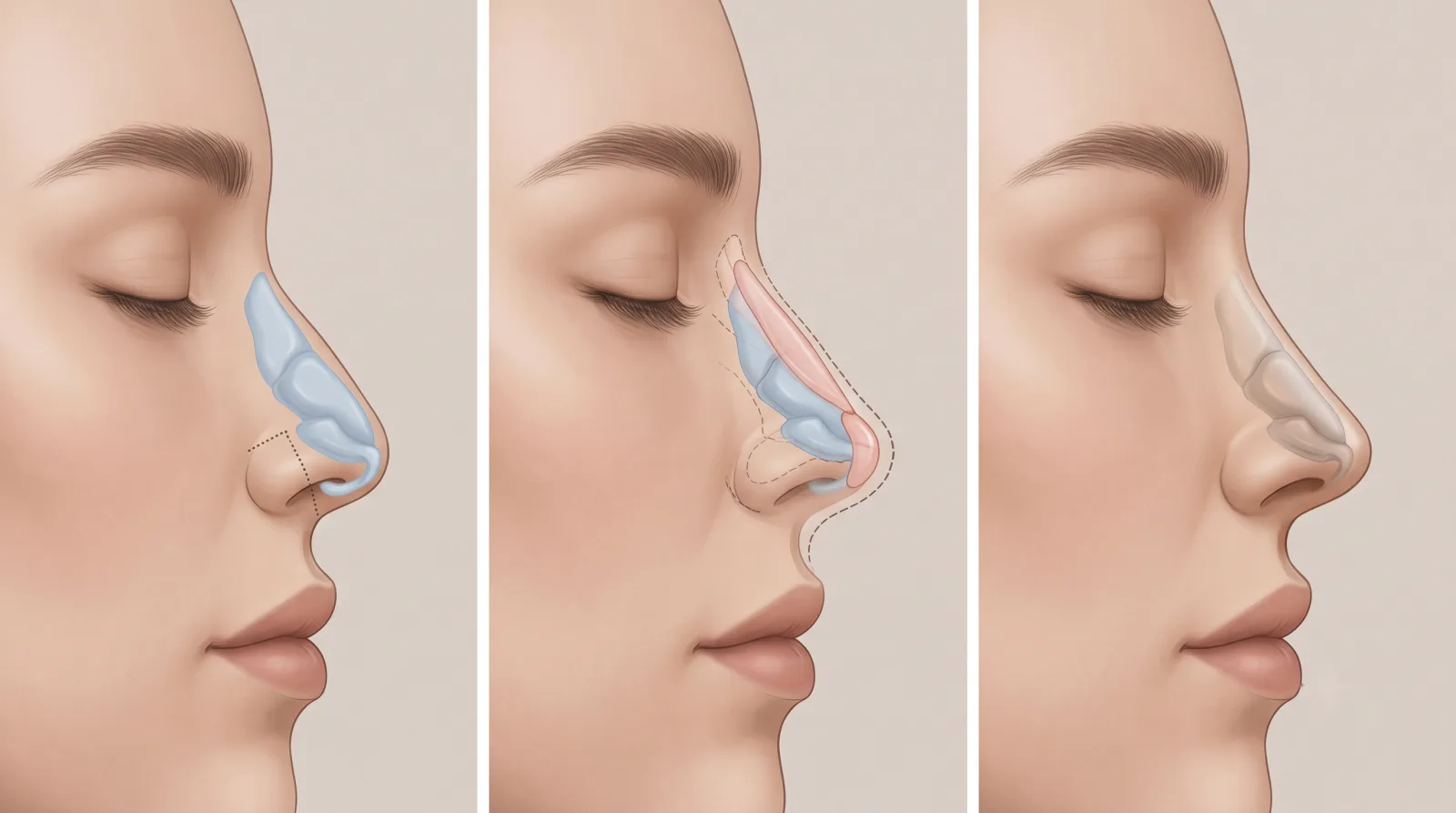
The standard approach raises the bridge with a silicone dorsal implant and refines the tip with your own cartilage, taken from the septum or ear. It gives a smooth, predictable bridge line and is a well-established way to add masculine height, with the tip built from your own tissue so it moves and feels natural. Sutures come out at about seven days.
Illustration: the nasal framework (blue) is reshaped to raise the bridge and refine the tip. The dashed outline shows the original contour.
If you would rather have no implant at all, the implant-free method builds the bridge from your own ear cartilage and the tip from septal cartilage, using no artificial material. It appeals to men who prefer an entirely autologous nose or who are cautious about implants. Because a donor site is involved, the ear stitches come out a little later, at around ten days.
Neither route is universally better. The right one depends on how much height you need, your skin and cartilage, and your own preference about implants. The surgeon's role is to explain which approach suits your nose and to tell you plainly if the height you are picturing would look too high for your face.
Revision
Revision and thick-skinned noses
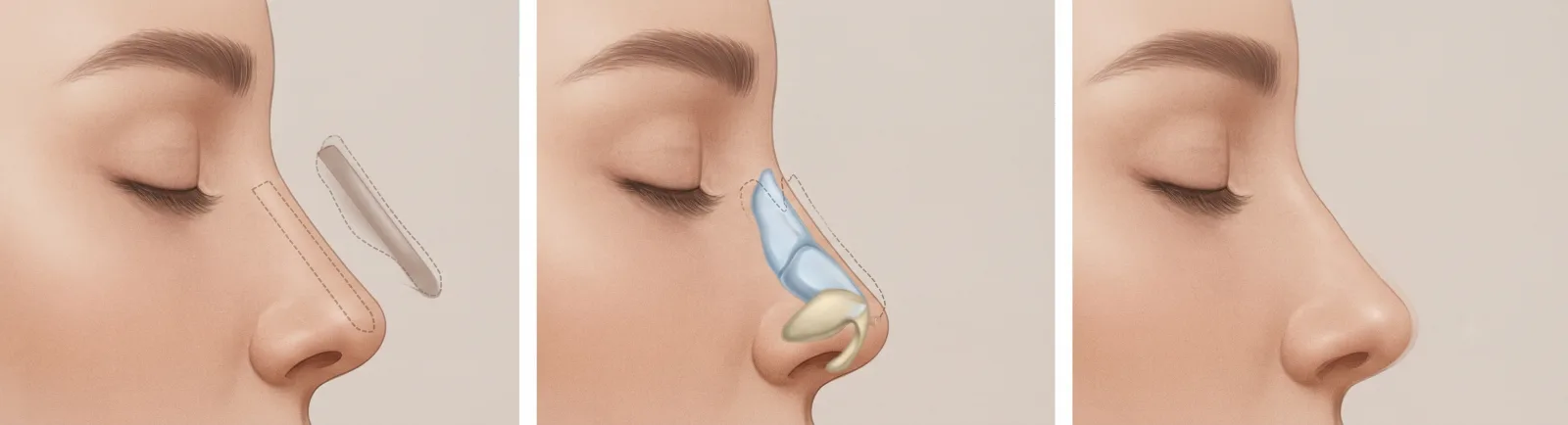
A nose that has already been operated on is a different and more demanding problem. Scar tissue, previous grafts and a weakened or distorted framework mean a revision rhinoplasty usually needs an open approach and a stronger source of cartilage. Depending on the case that can mean your own rib, donor rib, septal and ear cartilage, or fascia, chosen first to rebuild support; adding height comes second. Sutures come out anywhere from seven to fourteen days depending on the donor site.
Illustration: the previous implant (outlined) is removed and the framework is rebuilt with the patient's own cartilage for support.
Thick male skin adds its own challenge, in both primary and revision cases. Heavy skin resists showing tip definition and can hold swelling longer, so a robust cartilage structure is what ultimately shapes the nose from underneath. This is one reason a male nose that was under-supported the first time often looks rounded or droops later, and needs stronger framework at revision.
Because these decisions turn on examining your existing structure and skin, they are exactly what a same-surgeon assessment is for. Dr. Baek evaluates what remains of your framework and skin thickness before recommending the graft plan, and performs the revision himself.
Recovery
Recovery, downtime and a natural result
For a standard rhinoplasty, expect a dressing change on about day one and day three, with the nose sutures out around day seven; implant-free and revision cases add a donor site that heals a little longer, up to around ten to fourteen days. Swelling and some bruising around the eyes are heaviest in the first week and then settle. Most men look socially presentable within one to two weeks once the external splint and any bruising are gone.
Thick male skin tends to hold tip swelling longer than thinner skin, so the tip is the last area to show its final shape. This can take several months, and refinement continues gradually over the first year. Judging the tip in the early weeks is misleading; patience is part of a good rhinoplasty result. Keeping your head elevated and avoiding knocks and strenuous activity early on helps the swelling settle.
If you are travelling from abroad, plan to stay in Seoul until the splint and sutures are removed, then use Garnet's structured follow-ups at 1, 3 and 6 months (by messenger after you return home) to track how the bridge and tip settle. Because the same surgeon who built the framework reviews your recovery, any question about height or symmetry is assessed by the person who planned it.
Prices
Price at Garnet
Revision rhinoplasty
From₩4,000,000 + VATExcluding VAT (10% VAT is added at payment)Book now
Same price as Korean patients. Prices shown exclude 10% VAT; your written quote, issued after the in-person consultation, shows the full amount payable.
Dr. In-Soo Baek
Director & sole operating surgeon
Korean medical licence no. 77407
Operate on what you came for. Trained at Korea University Medical Center. Every case planned, performed and reviewed by the same hands.
1Operating surgeon
~2Surgeries per day
7Registered techniques
Board-certified plastic surgeon
Plastic surgery training at Korea University College of Medicine & graduate school
Korean Society of Plastic and Reconstructive Surgeons member, in its facial-contour, eye & rhinoplasty groups
Consults, operates and follows up each case himself
Peer-reviewed papers behind the facts on this page. Each describes findings in its own study group — not results at Garnet — and none predicts your own outcome.
Jin HR et al. Rhinoplasty in the Asian Patient. Clinics in Plastic Surgery. 2016. doi:10.1016/j.cps.2015.09.015
Li D et al. An Overview of Asian Rhinoplasty. Annals of Plastic Surgery. 2016. doi:10.1097/sap.0000000000000841
Jang YJ et al. Rhinoplasty in the Asian Nose. Facial Plastic Surgery Clinics of North America. 2014. doi:10.1016/j.fsc.2014.04.001
FAQ
Common questions
How is male rhinoplasty different from female rhinoplasty?
A male nose generally wants a straight bridge, a stronger and less upturned tip, and height that balances a stronger face, whereas a scooped bridge and rotated tip read as feminine. Male skin is also thicker, so the nose needs a stronger cartilage framework to show any definition. The design goals differ as much as the technique does.
What makes a nose look masculine?
Mainly a straight bridge with no concave scoop, a defined tip that is not over-rotated, and height in proportion with the face that does not look artificially high. Over-narrowing, over-rotating the tip so the nostrils show, or building the bridge too high are the usual ways a male nose ends up looking feminine or over-done.
Will my nose look natural after surgery?
That is the goal: a nose that looks like it always belonged on your face. It depends on realistic proportions for your features and a framework strong enough to hold the shape under thicker skin. A careful assessment of what suits your face keeps the result looking natural; a fixed template does not.
Should I have an implant or use my own cartilage?
The standard approach uses a silicone dorsal implant with your own tip cartilage; the implant-free approach builds the whole nose from your own cartilage if you prefer no implant. The right choice depends on how much height you need, your cartilage and your own preference, which the surgeon goes through with you.
Does thick male skin affect the result?
Yes. Thicker, more sebaceous skin hides fine definition and holds swelling longer, so the tip is the last area to show its final shape. It also means the nose needs a stronger cartilage framework underneath to shape it. This is a normal part of planning a male nose.
I have had rhinoplasty before — can it be corrected?
Often, yes, with a revision rhinoplasty. A previously operated nose usually needs an open approach and a stronger cartilage source, such as rib, septal or ear cartilage, or fascia, to rebuild support. The plan depends on what remains of your framework, which is assessed at consultation.
How long is the recovery and downtime?
A standard case has dressing changes around day one and three, with nose sutures out about day seven; implant-free and revision cases add a donor site healing up to ten to fourteen days. Most men look presentable within one to two weeks, though the tip keeps refining over several months, especially with thicker skin.
Can I have male rhinoplasty as an international patient?
Yes. Garnet is registered with Korea's foreign-patient programme. You can start with an online consultation and photo assessment, plan to stay in Seoul until your splint and sutures are removed, and continue follow-ups at one, three and six months by messenger after you return home.
Who will perform my rhinoplasty at Garnet?
Dr. In-Soo Baek, a board-certified plastic surgeon (Korean medical licence no. 77407), consults, operates and reviews your follow-ups himself. Garnet is a single-surgeon clinic, so the surgeon who plans your nose builds the framework and sees you through recovery. That matters in rhinoplasty, where the structure decides the result for years.
My mom recently had a brow lift and lower blepharoplasty with Dr. Baek, and our experience has been wonderful so far. The Garnet team was incredibly kind and welcoming, with Kelly assisting us as our English consultant—she made everything…
I’m so happy I chose this clinic for my lower blepharoplasty. I was traveling from abroad by myself, so I was a little nervous, but from the beginning I felt comfortable and truly cared for. Everyone was kind, patient, and professional…
Came in for an in-person consult and ended up choosing Garnet and Dr.Baek for my non-incisional DES and tiplasty/alarplasty. I communicated with Kelly (English consultant) from the start till now (3 weeks post-op). She really help me feel…
My under-eyes have been sagging and folding for years... I tried to cover it up with makeup, but it actually got stuck in the wrinkles and made it stand out even more. While going for consultations, I noticed that the bigger the hospital…
To see how much height or refinement would suit your face, send photos for a no-obligation assessment of what is realistic for your nose before you plan a trip.
Send photos and your question before you travel. An English-speaking coordinator reviews every enquiry and replies with guidance on whether surgery is appropriate, the likely plan and timing.
✓ Reviewed by the clinic coordinator, not a bot
✓ Photo-based pre-assessment before you fly
✓ Foreign-patient scheduling & after-care
✓ One surgeon for consultation, surgery and follow-up
Prefer to chat now? Reach the coordinator directly:







 T S7 months ago



