A primary rhinoplasty in Korea takes about 1.5 to 2 hours and changes two zones at once: the nasal bridge, often raised with a soft silicone graft, and the nasal tip, rebuilt with your own septal or ear cartilage. Choosing a clinic means checking who will shape both, how the plan is written down, and who sees you at 1, 3 and 6 months.
The short answer
Confirm the operating surgeon by name, and check that the same person reviews your nose after surgery.
Ask how many rhinoplasties the surgeon performs and look at labelled nose results, not the clinic's total case count.
A good plan names the bridge material, the tip cartilage source, a closed or open approach and the suture-out day (about 7 days for the nose).
Compare the written quote line by line, excluding VAT, and ask what a revision or rib graft adds before you travel.
Rhinoplasty is carved by hand: the surgeon decides how much height the bridge can take, how much cartilage the tip needs and how thick your skin is over it. Start by confirming that this person is a board-certified plastic surgeon, and ask for the name in writing.
Next ask whether the doctor you meet at consultation is the doctor in the operating room for the whole case. In some clinics a different surgeon operates, a practice usually called ghost surgery. A clear written answer that also covers who removes the splint and sutures tells you how the clinic actually runs.
Finally, ask who you contact if the tip looks uneven or a graft feels firm months later. For international patients that answer matters as much as the operation day, because most of the nose settles after you have flown home.
Experience
Ask how much nose surgery the surgeon does
A clinic's overall case count mixes eyes, lifts and injections. For a nose, the useful figure is how many rhinoplasties the operating surgeon performs and whether revision cases are part of that work. Revision noses need scar-tissue handling and extra cartilage, so ask about those cases separately.
Look at rhinoplasty results that carry a date, a procedure label and the clinic name, published with the patient's consent. Several angles of the same nose, including the profile, tell you more than one front view. Edited or unlabelled pictures are hard to judge.
Then ask what the surgeon would not do for your nose. A surgeon who explains the limits of your skin, your septum or your breathing is giving you planning information you can compare between clinics.
The plan
Searching for the best rhinoplasty in Seoul: what the written plan should show
When you collect quotes from Seoul clinics, compare the plans line by line. Each should state the bridge material (silicone, cartilage or none), where the tip cartilage comes from (septum, ear or rib), whether the approach is closed inside the nostrils or open with a small cut under the tip, and the type of anaesthesia.
The plan should also give the recovery dates that shape your trip: dressing changes in the first days, nose sutures out at about 7 days, longer for ear, fascia or rib donor sites, and roughly 1 to 2 weeks before most people feel comfortable in public. Review points at 1, 3 and 6 months show how the clinic follows the tip as swelling settles.
If two plans differ, ask each surgeon why. Differences in graft choice often come from skin thickness, tip strength or a previous operation. A reasoned explanation is more useful to you than a promise about the final shape.
Clinic types
Large hospitals, single-surgeon clinics and agency bookings
Large multi-surgeon hospitals offer many operating rooms and fixed coordinator teams. Ask how a surgeon is assigned to your case and whether that can change on the day. Their scale can suit patients who want a big support desk, provided the named surgeon is confirmed in writing.
A single-surgeon clinic has one operating doctor, so the person at consultation, surgery and review is the same. The trade-off is fewer surgery slots each day, which means booking earlier and fitting your travel dates around the surgeon's schedule.
Agency or package bookings bundle travel and surgery. Check whether the price includes an agency fee, which clinic and surgeon you will actually see, and whether you can speak to that clinic directly before paying. You can compare all three types with the same checklist in our guide to choosing a clinic in Korea.
Grafts and implants
Silicone, septal cartilage, ear cartilage and rib
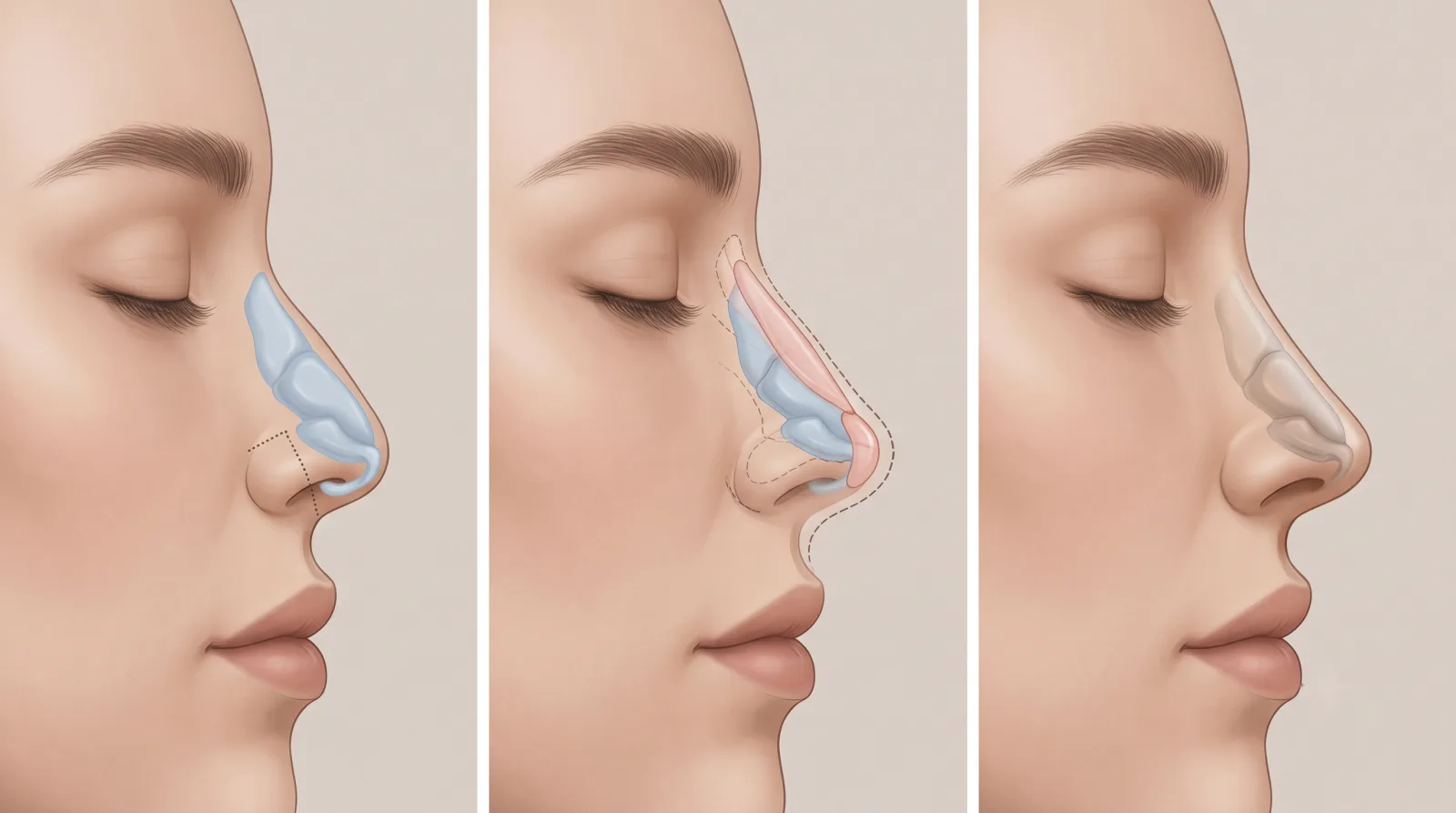
A common primary rhinoplasty in Korea raises the bridge with a soft silicone graft and shapes the tip with the patient's own septal or ear cartilage, so no implant sits in the thin skin of the tip. Garnet's rhinoplasty follows this pairing.
Illustration: the nasal framework (blue) is reshaped to raise the bridge and refine the tip. The dashed outline shows the original contour.
If you would prefer no implant at all, ask about an implant-free plan, where ear cartilage builds the bridge and septal cartilage supports the tip. Our page on implant-free vs implant rhinoplasty sets out how the two compare.
Noses already operated on elsewhere may need more tissue. For revision rhinoplasty Garnet works with your own rib, donor rib, dermis from the buttock, temporal fascia, or septal and ear cartilage, chosen after examining the nose. Each donor site has its own suture timing, from about 10 days for ear, fascia or rib to about 14 days for dermis.
At Garnet
How Garnet's nose surgery fits these checks
Garnet is a single-surgeon clinic in Apgujeong, Seoul. Dr. In-Soo Baek, a board-certified plastic surgeon (Korean medical licence no. 77407), consults, performs every rhinoplasty himself and reviews each nose at 1, 3 and 6 months. The clinic keeps to two operations a day and records 10,000+ rhinoplasty cases since 2011.
The published revision price is shown on this page in Korean won, excluding VAT, and international patients pay the same as Korean patients. There is no consultation or CT fee, and a written, itemised quote follows the in-person examination.
Some noses are better left alone or need a smaller change than expected, and Dr. Baek will say so. You can send front and profile photos for a no-obligation online assessment before planning any travel.
Real Results
Before & After
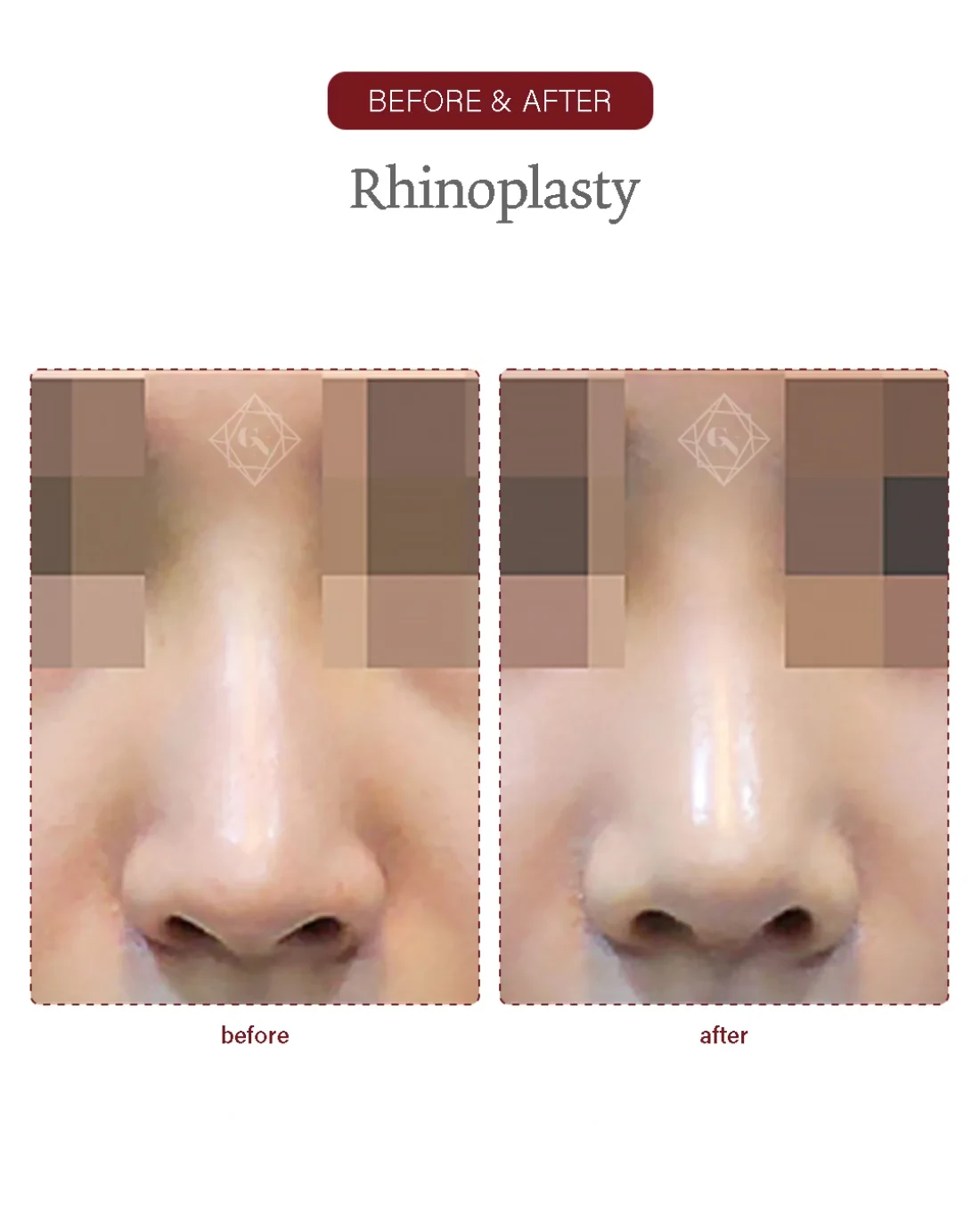
Rhinoplasty result of an actual Garnet patient (published with consent). Date, procedure and clinic (Garnet Plastic Surgery, Apgujeong) are labelled on the image, with the usual same-condition disclaimer. Results, recovery and suitability vary by individual and are not guaranteed.
Prices
Price at Garnet
Revision rhinoplasty
From₩4,000,000 + VATExcluding VAT (10% VAT is added at payment)Book now
Same price as Korean patients. Prices shown exclude 10% VAT; your written quote, issued after the in-person consultation, shows the full amount payable.
Dr. In-Soo Baek
Director & sole operating surgeon
Korean medical licence no. 77407
Operate on what you came for. Trained at Korea University Medical Center. Every case planned, performed and reviewed by the same hands.
1Operating surgeon
~2Surgeries per day
7Registered techniques
Board-certified plastic surgeon
Plastic surgery training at Korea University College of Medicine & graduate school
Korean Society of Plastic and Reconstructive Surgeons member, in its facial-contour, eye & rhinoplasty groups
Consults, operates and follows up each case himself
Peer-reviewed papers behind the facts on this page. Each describes findings in its own study group — not results at Garnet — and none predicts your own outcome.
Jang YJ et al. Rhinoplasty in the Asian Nose. Facial Plastic Surgery Clinics of North America. 2014. doi:10.1016/j.fsc.2014.04.001
Frederick JW et al. Asian Augmentation Rhinoplasty. Facial Plastic Surgery. 2025. doi:10.1055/a-2595-5275
Frederick JW et al. Asian Male Blepharoplasty and Rhinoplasty. Facial Plastic Surgery Clinics of North America. 2024. doi:10.1016/j.fsc.2024.03.005
Kaoutzanis C et al. Incidence and Risk Factors for Major Hematomas in Aesthetic Surgery: Analysis of 129,007 Patients. Aesthetic Surgery Journal. 2017. doi:10.1093/asj/sjx062
FAQ
Common questions
Where should I get rhinoplasty in Korea?
Choose on the surgeon and the plan: a board-certified plastic surgeon named in writing as the operating doctor, labelled rhinoplasty results, a written plan that lists the bridge and tip materials, and follow-up after you fly home. Location matters less than these checks.
How do I check a rhinoplasty surgeon in Korea?
Ask for the surgeon's specialty and licence, confirm in writing that the same surgeon operates from start to finish, ask how many rhinoplasties and revision noses they perform, and look at dated, labelled results of the nose from several angles.
Is a large hospital or a single-surgeon clinic better for rhinoplasty?
Neither is right for everyone. A large hospital has more operating rooms and staff; a single-surgeon clinic keeps one doctor through consultation, surgery and review but has fewer daily slots. Ask either type who operates and who follows your recovery.
How much does rhinoplasty cost at Garnet?
Revision rhinoplasty at Garnet starts from ₩4,000,000 + VAT, excluding VAT (10% VAT is added at payment). A first-time rhinoplasty is priced in the written quote after Dr. Baek examines your nose, and rib, dermis or fascia grafts are priced within your plan.
What materials does Garnet use in a nose job?
A typical primary case uses a soft silicone graft on the bridge and your own septal or ear cartilage at the tip. Implant-free plans use ear cartilage on the bridge, and revision cases may use your own rib, donor rib, buttock dermis, temporal fascia or septal and ear cartilage.
How long should I stay in Seoul after rhinoplasty?
Plan to stay at least until the nose sutures come out at about 7 days, with dressing changes on day 1 and day 3. Ear, fascia or rib donor sites take about 10 days and dermis about 14 days. Most people feel comfortable in public after roughly 1 to 2 weeks.
Can a nose operated on at another clinic be corrected?
Often, yes, after an examination. Revision rhinoplasty usually needs extra cartilage or tissue, so the plan depends on the existing implant, scar tissue and tip support. Dr. Baek decides the graft source with you after seeing the nose.
Is there a fee for the rhinoplasty consultation?
No. Garnet does not charge a consultation or CT fee, and a written, itemised quote is issued after the in-person consultation.
Can I get an opinion on my nose before travelling to Korea?
Yes. Send front and profile photos by WhatsApp or the form on this page for a no-obligation pre-assessment. Suitability is decided only in person, but the photos let the coordinator outline likely options and dates.
Are before-and-after photos a fair way to compare clinics?
They help when each photo is dated, labelled with the procedure and clinic, and published with consent. Results vary with skin, anatomy and healing, so use photos to judge the surgeon's style, not to predict your own result.
My mom recently had a brow lift and lower blepharoplasty with Dr. Baek, and our experience has been wonderful so far. The Garnet team was incredibly kind and welcoming, with Kelly assisting us as our English consultant—she made everything…
I’m so happy I chose this clinic for my lower blepharoplasty. I was traveling from abroad by myself, so I was a little nervous, but from the beginning I felt comfortable and truly cared for. Everyone was kind, patient, and professional…
Came in for an in-person consult and ended up choosing Garnet and Dr.Baek for my non-incisional DES and tiplasty/alarplasty. I communicated with Kelly (English consultant) from the start till now (3 weeks post-op). She really help me feel…
My under-eyes have been sagging and folding for years... I tried to cover it up with makeup, but it actually got stuck in the wrinkles and made it stand out even more. While going for consultations, I noticed that the bigger the hospital…
Send photos and your question before you travel. An English-speaking coordinator reviews every enquiry and replies with honest guidance on whether surgery is appropriate, the likely plan and timing.
✓ Reviewed by the clinic coordinator, not a bot
✓ Photo-based pre-assessment before you fly
✓ Foreign-patient scheduling & after-care
✓ One surgeon for consultation, surgery and follow-up
Prefer to chat now? Reach the coordinator directly:









 T S7 months ago



