The cost of rhinoplasty in Korea depends on your nose, the technique that suits it, the materials used (a silicone implant or your own cartilage) and what the clinic includes in the quote. A responsible clinic will not quote a figure sight unseen. Understanding those factors lets you compare quotes properly instead of chasing the lowest number.
The short answer
Rhinoplasty has no fixed price. The cost depends on the technique your nose needs, the materials used, the complexity of the case and what the clinic includes.
An implant-free, all-cartilage nose is usually more involved than a silicone-implant case because cartilage must be harvested and shaped, so the two are not priced the same.
A meaningful quote should state exactly what is included (surgery, anaesthesia, materials, follow-ups and after-care) so you can compare like with like beyond the headline numbers.
The lowest price is rarely good value; who operates, how the day is scheduled and how revisions are handled matter more to your result than a small price difference.
Under Korean medical advertising rules, a responsible clinic does not advertise a fixed surgical price or promise a figure before seeing your nose, and such a figure would not be useful anyway. Two patients asking for “rhinoplasty” can need very different operations: one a straightforward bridge augmentation, another a tip refinement with cartilage grafts, another an all-autologous rebuild. Each takes different time, materials and skill, so each costs differently.
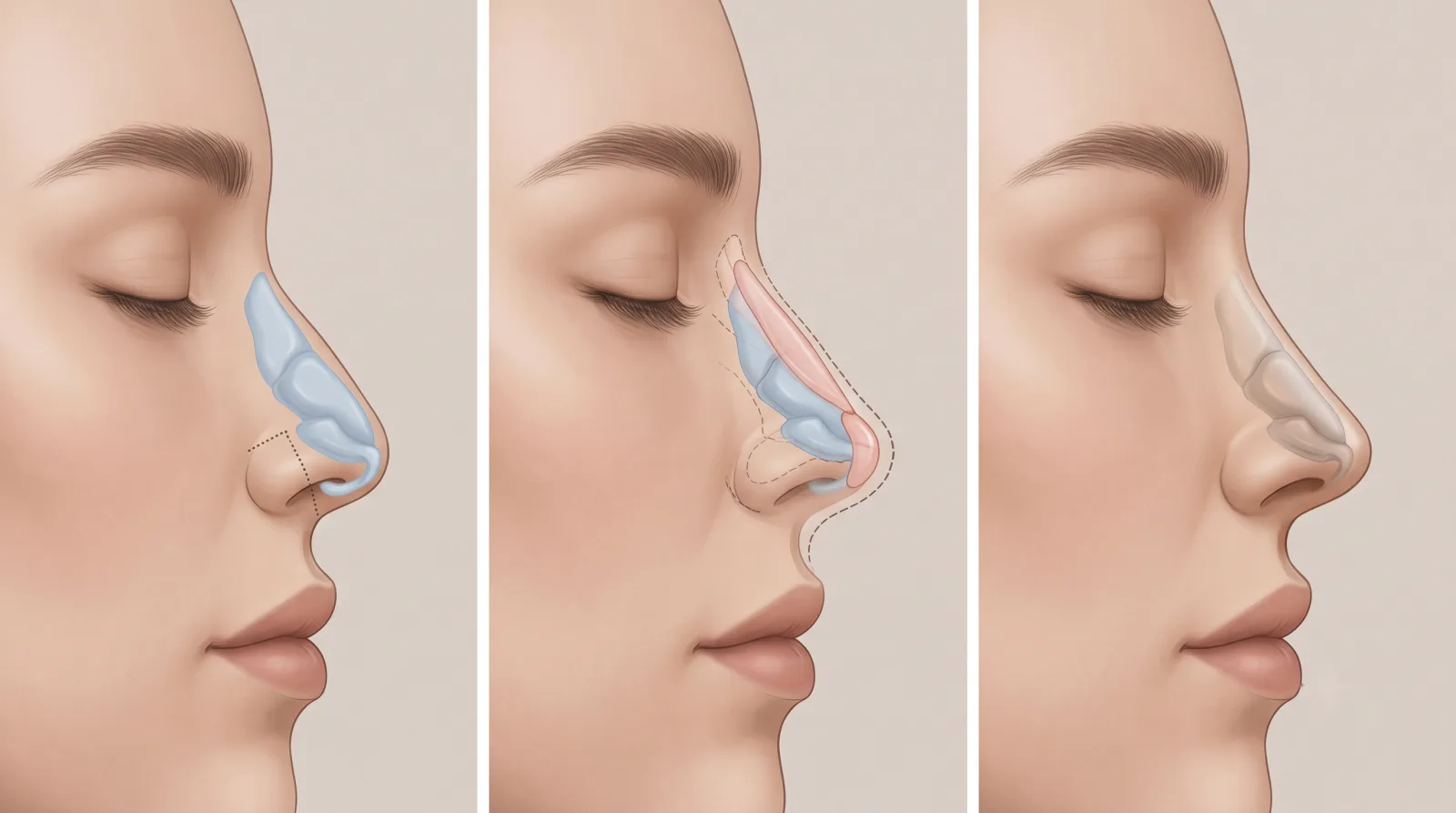
Illustration: the nasal framework (blue) is reshaped to raise the bridge and refine the tip. The dashed outline shows the original contour.
That is why a price you find online is, at best, a rough range and, at worst, a teaser that changes once you are assessed. A reliable quote is given after a surgeon has looked at your nose, in person or from photos, and decided what the operation actually involves. This guide explains the factors behind that quote so you can read it with confidence.
If you want the broader picture of pricing across procedures and why Korea is often competitive, our guide on plastic surgery cost in Korea and the one on what affects plastic surgery cost set the context. Here we focus specifically on the nose.
Cost factors
What moves the cost of rhinoplasty
The biggest driver is what your nose needs. A simple bridge augmentation is less involved than a combined bridge-and-tip case, which in turn is less involved than reshaping a deviated nose or correcting a previous surgery. Tip work, in particular, is delicate and time-consuming because the surgeon shapes and supports cartilage in a small, mobile area, so a nose that needs significant tip refinement generally costs more than one that needs only height.
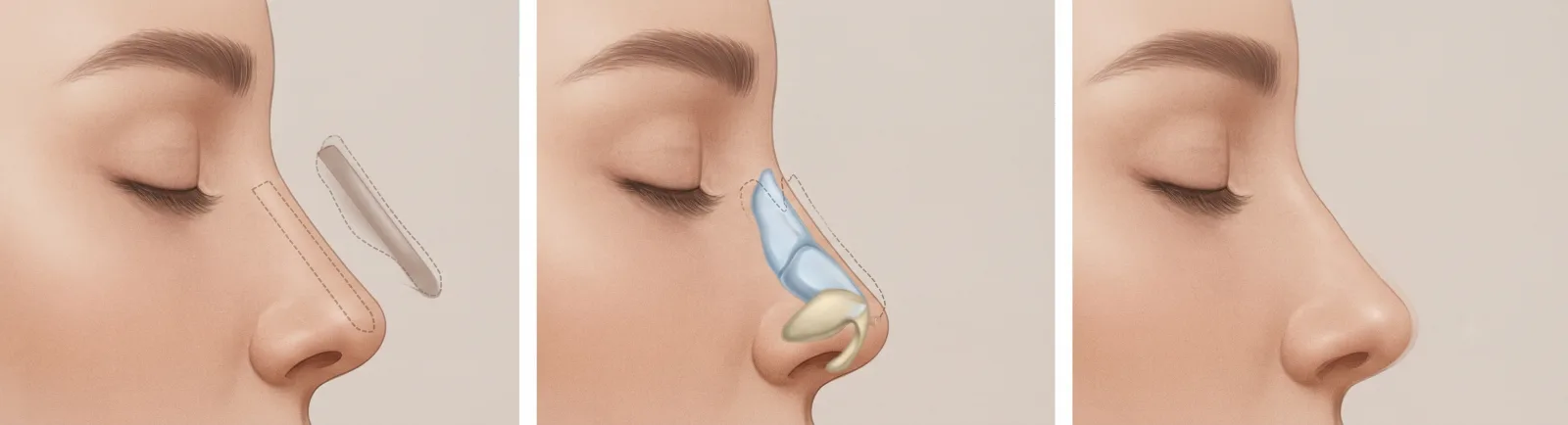
Illustration: the previous implant (outlined) is removed and the framework is rebuilt with the patient's own cartilage for support.
Materials matter too. A silicone-implant case uses a shaped implant plus your own septal or ear cartilage for the tip; an implant-free case uses no implant but harvests and carves more of your own cartilage, which adds operating time and a donor site. The type of anaesthesia (light sedation versus general), the length of the operation and whether structural grafts are needed all feed into the figure.
Finally, the case's difficulty and history move the price. Revision rhinoplasty, operating on a nose that has already been done, is usually more complex because scar tissue and altered anatomy make it slower and harder, and may need cartilage brought from further afield. These differences reflect genuinely different amounts of surgical work.
What's included
What a fair quote should include
A quote is only comparable if you know what sits inside it. Ask whether it covers the surgeon's fee, anaesthesia and the anaesthesia team, the operating facility, the implant or cartilage graft materials, and the standard dressings and medications. At Garnet there is no separate consultation or CT fee and no pressure to book on the day, which is the kind of detail worth confirming with any clinic so you are not surprised later.
After-care is part of the price, even when it is not itemised. Find out how many follow-up visits are included, who removes the sutures (for a nose, typically around 7 days), and whether a structured review schedule is part of the package. At Garnet the same surgeon reviews you at 1, 3 and 6 months, and continues to check in by messenger once international patients return home.
Be wary of a low headline price that excludes obvious costs, then adds them once you have committed. A transparent clinic spells out what is and is not included before you decide. If anything is unclear, ask for the quote in writing; the same principle that protects you on paying as a foreign patient applies here.
Implant vs free
Why implant-free can cost differently
The choice of technique has a direct effect on price. A silicone-implant rhinoplasty tends to be the more contained operation: the implant gives controllable bridge height, only the tip needs cartilage, and there is no large second site. That generally makes it the shorter, simpler case of the two.
An implant-free, all-cartilage nose is usually more involved. The bridge as well as the tip is built from your own cartilage, most of it harvested from behind the ear, which adds operating time, a donor site that needs its own care (the ear sutures come out around 10 days at Garnet, against 7 for the nose), and more intricate carving and stacking of cartilage. More work and more skill mean the two approaches are not priced identically.
This does not make one “better value” by default. If your skin or your wish to avoid a foreign material points to an implant-free nose, that is the appropriate operation for you, and its price reflects what it takes to do it well. The point is to understand why the figures differ, which is also covered in our comparison of rhinoplasty versus implant-free rhinoplasty, before assuming the cheaper option is the smarter one.
Value
Cheapest versus best value
The lowest quote can be the most expensive decision if the result needs correcting. A nose is unforgiving: a poorly judged implant size, an under-supported tip or a rushed operation can lead to a revision that costs far more in money, time and stress than the original saving. With rhinoplasty especially, who operates and how carefully matters more than a modest price difference.
When you compare quotes, weigh the things that protect your result: whether the operating surgeon is a board-certified plastic surgeon, whether that same surgeon performs the whole operation, how the day is scheduled, and how complications and revisions are handled. A clinic that runs many operating rooms at once and rotates staff is a different proposition from one where the same surgeon plans, operates and follows up, even at a similar headline price.
Value also includes the parts you only notice later: unhurried assessment, candid advice about whether surgery will even help, and structured follow-up after you fly home. These are hard to put on a price list but are exactly what stand between a good outcome and a regretted one. Judge a quote on the whole package.
At Garnet
How Garnet approaches a rhinoplasty quote
Garnet is a single-surgeon clinic in Apgujeong, Seoul. Dr. In-Soo Baek is a board-certified plastic surgeon (Korean medical licence no. 77407) and the only operating doctor, so the person who quotes your nose is the person who operates on it, with no handover to an unknown surgeon after you have paid. The clinic caps the day at 2 surgeries, and there is no consultation or CT fee and no pressure to book the same day.
You receive a quote based on what your nose actually needs, with what is included made clear: surgery, anaesthesia, materials, and structured follow-up at 1, 3 and 6 months with the same surgeon. The clinic's policy is to address only what you came for, without upselling a larger operation. You can start with a no-obligation online assessment: send front and side photos of your nose and you will get a clear sense of the operation involved before you commit to travel.
Prices
Price at Garnet
Revision rhinoplasty
From₩4,000,000 + VATExcluding VAT (10% VAT is added at payment)Book now
Same price as Korean patients. Prices shown exclude 10% VAT; your written quote, issued after the in-person consultation, shows the full amount payable.
Dr. In-Soo Baek
Director & sole operating surgeon
Korean medical licence no. 77407
Operate on what you came for. Trained at Korea University Medical Center. Every case planned, performed and reviewed by the same hands.
1Operating surgeon
~2Surgeries per day
7Registered techniques
Board-certified plastic surgeon
Plastic surgery training at Korea University College of Medicine & graduate school
Korean Society of Plastic and Reconstructive Surgeons member, in its facial-contour, eye & rhinoplasty groups
Consults, operates and follows up each case himself
Peer-reviewed papers behind the facts on this page. Each describes findings in its own study group — not results at Garnet — and none predicts your own outcome.
Yap EC. Rhinoplasty for South East Asian Nose. Facial Plastic Surgery Clinics of North America. 2018. doi:10.1016/j.fsc.2018.03.012
Duggan RP et al. Unanticipated Economic Burden of Cosmetic Surgery Tourism: A Single Academic Center’s Experience. Aesthetic Plastic Surgery. 2024. doi:10.1007/s00266-024-04516-x
Jin HR et al. Rhinoplasty in the Asian Patient. Clinics in Plastic Surgery. 2016. doi:10.1016/j.cps.2015.09.015
Hery D et al. Plastic Surgery Tourism: Complications, Costs, and Unnecessary Spending?. Aesthetic Surgery Journal Open Forum. 2023. doi:10.1093/asjof/ojad113
FAQ
Common questions
How much does rhinoplasty cost in Korea?
There is no single price, and a responsible clinic does not quote a figure before seeing your nose. The cost depends on the technique your nose needs, the materials used, how complex the case is and what the clinic includes. A meaningful figure comes from an assessment, in person or from photos.
What affects the cost of rhinoplasty?
The main drivers are what your nose needs (bridge height, tip refinement, correcting a deviation) plus the materials (implant versus your own cartilage), the type and length of anaesthesia, whether structural grafts are required, and whether it is a first operation or a revision. More surgical work and skill mean a higher figure.
Is rhinoplasty in Korea cheaper than in other countries?
Korea is often competitive because of its high volume and experience, but the value is in the result as much as the headline price. Comparing across countries only makes sense once you know what each quote includes and who actually performs the operation. Our broader guide on plastic surgery cost in Korea gives the wider context.
What is included in a rhinoplasty quote?
A fair quote should cover the surgeon's fee, anaesthesia, the facility, implant or cartilage graft materials, dressings and medications, and a defined number of follow-up visits. Ask what is and is not included before deciding. At Garnet there is no separate consultation or CT fee and follow-ups are scheduled at 1, 3 and 6 months.
Why is implant-free rhinoplasty often more expensive?
An implant-free nose builds the bridge as well as the tip from your own cartilage, most of it harvested from behind the ear. That adds operating time, a donor site and more intricate carving, so it is usually a more involved operation than a silicone-implant case and is not priced the same.
Does revision rhinoplasty cost more?
Usually, yes. Operating on a nose that has already been done is more complex because scar tissue and altered anatomy make it slower and harder, and it may need cartilage brought from further afield. Revision cases vary widely, so they are quoted individually after assessment.
Is the cheapest rhinoplasty the ideal deal?
Rarely. A nose is unforgiving, and a poorly judged operation can lead to a revision that costs far more than the original saving. Who operates, how carefully the day is scheduled, and how revisions are handled matter more than a small price difference. Judge the whole package.
Are consultations and CT scans charged separately at Garnet?
No. Garnet does not charge a separate consultation or CT fee, and there is no pressure to book on the day. It is worth confirming this kind of detail with any clinic so that the quote you compare reflects the full cost.
Can I get a rhinoplasty quote before flying to Korea?
Yes. You can send front and side photos of your nose for an online pre-assessment, and discuss what the operation would involve and what is included, before you commit to travel. The figure follows the assessment.
Does the price include after-care once I return home?
It should be clear either way. At Garnet the same surgeon reviews you at 1, 3 and 6 months and continues to check in by messenger after international patients return home. Always ask any clinic how follow-up is handled and whether it is part of the quoted price.
My mom recently had a brow lift and lower blepharoplasty with Dr. Baek, and our experience has been wonderful so far. The Garnet team was incredibly kind and welcoming, with Kelly assisting us as our English consultant—she made everything…
I’m so happy I chose this clinic for my lower blepharoplasty. I was traveling from abroad by myself, so I was a little nervous, but from the beginning I felt comfortable and truly cared for. Everyone was kind, patient, and professional…
Came in for an in-person consult and ended up choosing Garnet and Dr.Baek for my non-incisional DES and tiplasty/alarplasty. I communicated with Kelly (English consultant) from the start till now (3 weeks post-op). She really help me feel…
My under-eyes have been sagging and folding for years... I tried to cover it up with makeup, but it actually got stuck in the wrinkles and made it stand out even more. While going for consultations, I noticed that the bigger the hospital…
For a clear sense of what your rhinoplasty would involve and what it includes, send front and side photos for a no-obligation pre-assessment before you plan a trip.
Send photos and your question before you travel. An English-speaking coordinator reviews every nose surgery enquiry and replies with guidance on whether surgery is appropriate, the likely plan and timing.
✓ Reviewed by the clinic coordinator, not a bot
✓ Photo-based pre-assessment before you fly
✓ Foreign-patient scheduling & after-care
✓ One surgeon for consultation, surgery and follow-up
Prefer to chat now? Reach the coordinator directly:








 T S7 months ago



