In Korean nose surgery, almost every decision comes back to whether the bridge is built from a silicone implant or from your own ear and septal cartilage. Both are legitimate, well-established approaches. Neither is universally better: they suit different noses, different goals and different tolerances for risk. This page compares them in depth so you can have a precise conversation at your consultation.
The short answer
Implant rhinoplasty uses a silicone implant to raise the bridge; implant-free rhinoplasty builds the bridge from your own ear cartilage and shapes the tip with septal cartilage, with no foreign material.
An implant gives a higher, sharper bridge more predictably; an all-cartilage bridge tends to feel and look more natural but raises the bridge more modestly.
Implants carry small but real long-term risks foreign tissue does not: shifting, visibility over thin skin, and a low rate of late infection or extrusion.
The right choice depends on your skin thickness, how much height you want, your attitude to foreign material, and whether you have suitable cartilage, all of which the surgeon examines.
The label can be confusing, because both operations are "rhinoplasty" and both can change the bridge and the tip. The real difference is the material used to add height to the dorsum, the bridge of the nose. In a conventional implant rhinoplasty, a pre-shaped silicone implant is placed along the bridge to raise and straighten it, while the tip is usually refined with a small piece of your own cartilage. In implant-free rhinoplasty, no implant is used at all: the bridge is built up with your own ear (conchal) cartilage and the tip is shaped with septal cartilage taken from inside the nose.
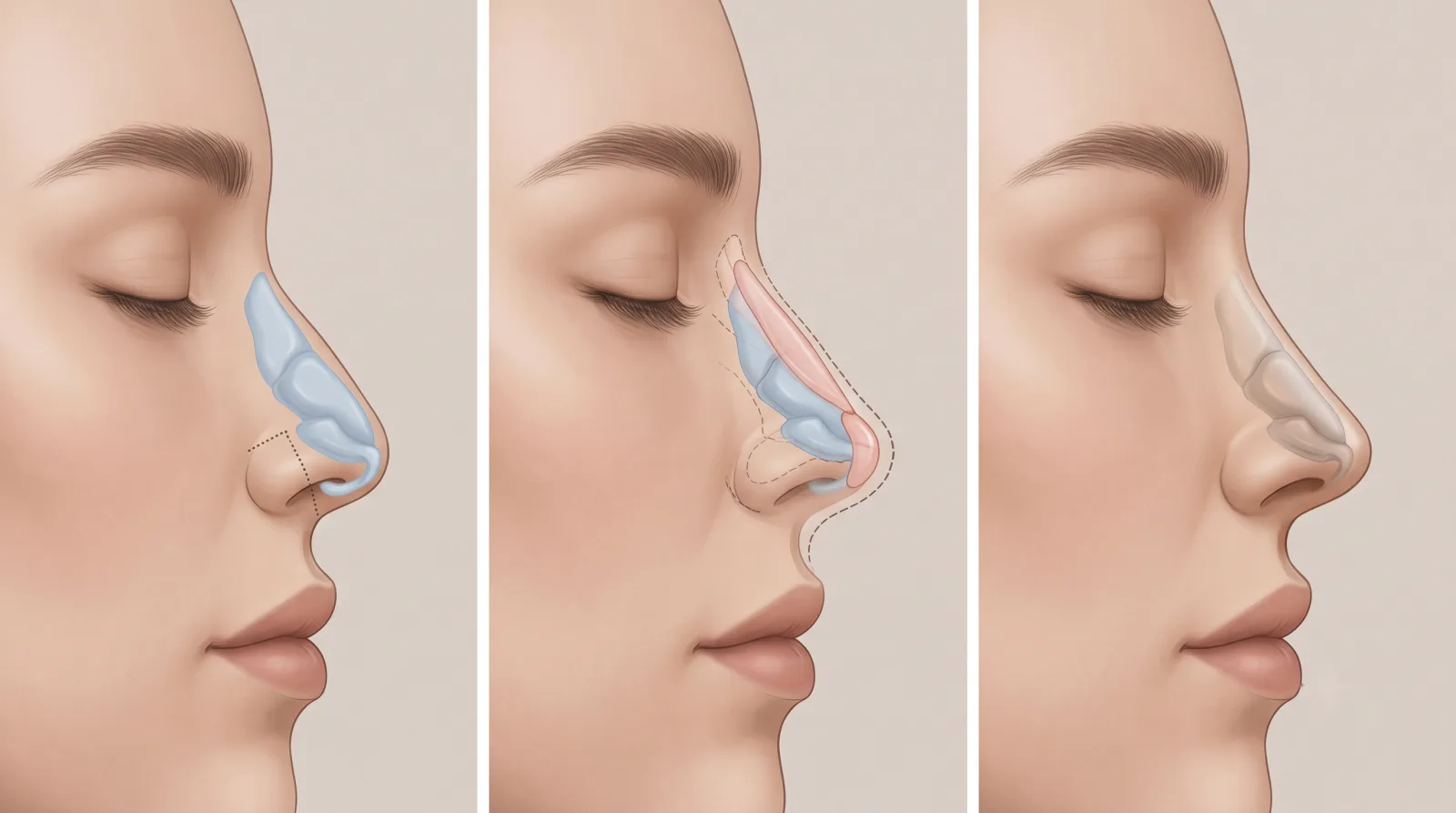
Illustration: the nasal framework (blue) is reshaped to raise the bridge and refine the tip. The dashed outline shows the original contour.
So the tip is often handled similarly in both, with your own tissue. The decision really lives in the bridge: height added with a manufactured silicone implant, which is efficient and predictable, or with your own cartilage, which integrates as living tissue but is more limited in how high it can safely go. Everything else (natural feel, longevity, risk profile, recovery) flows from that single choice.
At Garnet, both routes are performed by the same board-certified plastic surgeon, Dr. In-Soo Baek, who assesses your nose at consultation and recommends the approach that genuinely fits it, with no default. He will say so plainly if a silicone implant would actually serve your goals better than an all-cartilage bridge, or the reverse.
The bridge
How each approach builds the bridge
A silicone implant is a solid, pre-carved piece placed over the bridge bone and cartilage. Because it is manufactured, the surgeon can choose a height and contour with a good degree of predictability, and it can lift a flat or low bridge quite dramatically in a single step. For patients who want a clearly higher, more sculpted bridge, this is the most direct way to get there.
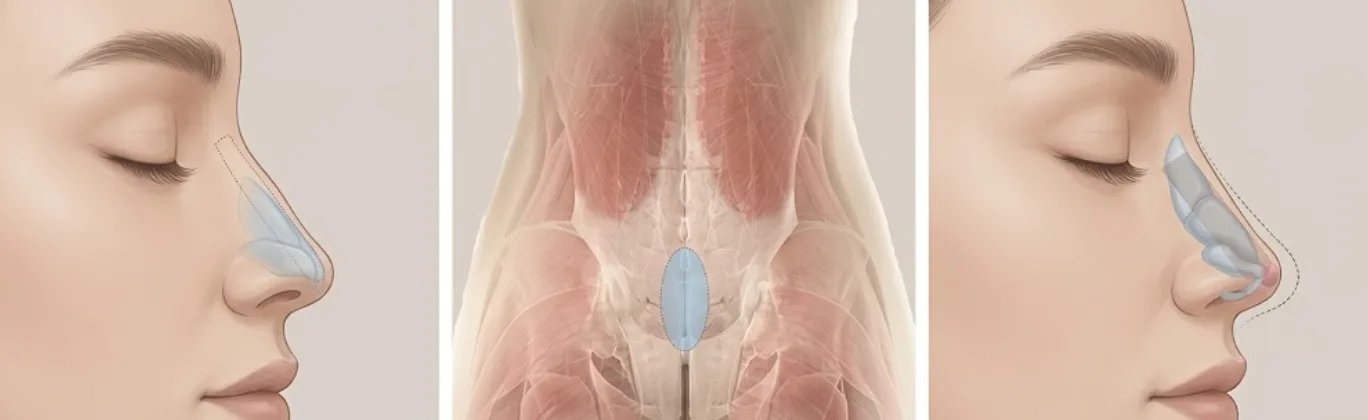
Illustration: instead of an implant, the bridge and tip are built from the patient's own tissue, shaped into the nasal framework (blue). The dashed line shows the original contour.
An all-cartilage bridge is built differently. The surgeon harvests cartilage from the bowl of your ear, which leaves no visible change to the ear's shape and only a small hidden incision behind or inside it. That cartilage is then layered and secured along the bridge to add height. Because it is your own tissue, it integrates and softens over time, but ear cartilage is naturally curved and limited in volume, so the realistic gain in bridge height is more modest than a silicone implant can deliver. For tip definition, both approaches typically borrow from the septum; you can read how that part works in our implant-free rhinoplasty overview.
This is the crux of the trade-off. If your goal is a tall, dramatic bridge, an implant reaches it more easily. If your goal is a refined, natural-looking lift with no foreign material, an all-cartilage bridge does that well, within the height your own cartilage can support.
Feel & look
Natural feel, appearance and how each ages
Over thicker skin, a well-placed silicone implant can look entirely natural for years, and most patients are very happy with it. The concerns tend to appear over thin skin or the very long term: an implant is firmer than your own tissue, can occasionally become subtly visible at the edges as skin thins with age, and in a small number of people the body's response or movement of the implant changes the contour over time.
An all-cartilage bridge tends to feel like part of your own nose because it is: it warms, moves and ages with you, and it does not have hard edges to show through thin skin. The counterpoint is that living cartilage can change shape slightly as it heals and settles, so the final result is a little less perfectly controllable than a carved implant, and a touch-up is occasionally wanted. Neither material is truly "permanent" in the sense of never changing; both age with your face.
If you have particularly thin skin, are planning for the long term, or simply dislike the idea of a manufactured object in your nose, the natural feel of an all-cartilage bridge often matters more than the extra height an implant could give. We go further into suitability on our who is it for page.
Trade-offs
Implant and cartilage trade-offs, stated plainly
Every rhinoplasty carries shared risks: swelling, asymmetry, the small chance of an unsatisfying shape, and the possibility of wanting a revision later. On top of those, a silicone implant adds a specific set of low-probability but real risks that foreign material brings: the implant can shift, the body can form a tight capsule around it, the edge can become visible over thin skin, and rarely there can be late infection or extrusion years afterward. These are uncommon, but they are the reason some patients prefer to avoid an implant entirely.
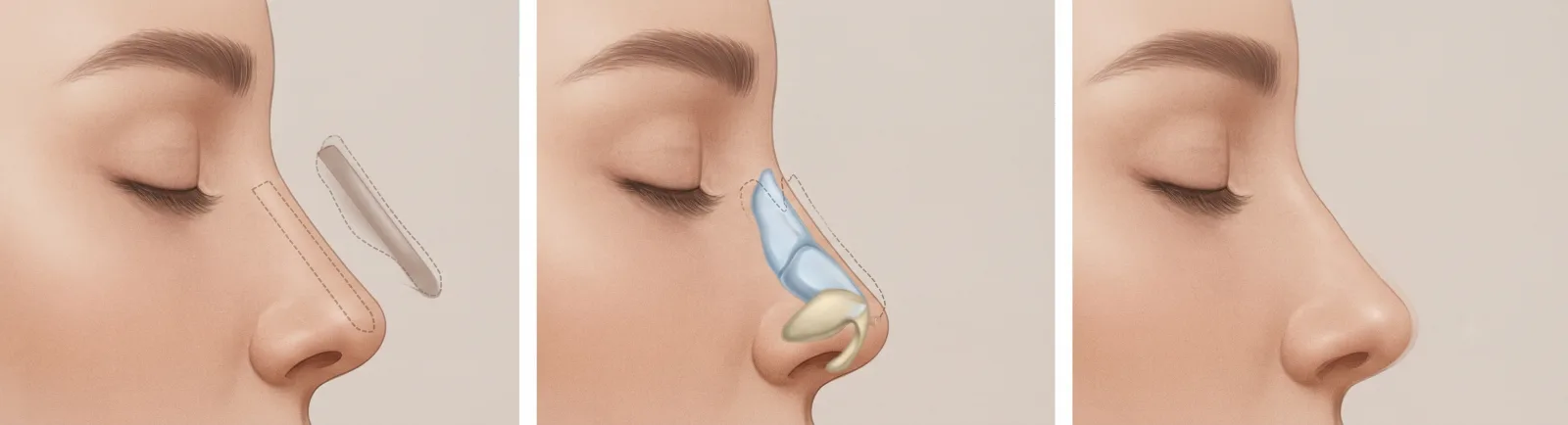
Illustration: the previous implant (outlined) is removed and the framework is rebuilt with the patient's own cartilage for support.
Implant-free rhinoplasty removes those implant-specific risks because there is no foreign material. In exchange, it adds a second, minor surgical site: the ear, where cartilage is harvested. At Garnet this donor site is hidden and heals with ear sutures removed at about 10 days, while the nose sutures come out at around 7 days. Some patients also weigh that an all-cartilage result is slightly less precisely controllable than a carved implant, and that a future revision draws on a finite supply of your own cartilage.
There is no low-risk option, and a careful surgeon will not pretend otherwise. The useful question is which set of trade-offs you prefer to live with: the convenience and height of an implant with its small long-term foreign-material risks, or the natural feel of your own tissue with a modest second donor site and a more limited height gain.
Who suits each
Which approach suits which patient
Implant rhinoplasty tends to suit patients who want a clearly higher, more defined bridge, have reasonably thick skin to camouflage the implant, and are comfortable with a manufactured material in exchange for a predictable, dramatic lift. For many people this is a perfectly good, time-tested choice.
Implant-free rhinoplasty tends to suit patients who specifically want no foreign material, who have thin skin where an implant might show over time, who are happy with a natural and more moderate increase in bridge height, and who have enough healthy ear and septal cartilage to build with. It is also a common preference among people who are anxious about the idea of an implant, or who are revising an earlier implant nose and want to move to all-tissue. Our candidacy guide covers exactly who fits.
Crucially, suitability is something a surgeon confirms in person. It depends on your skin thickness, your existing nasal structure and how much cartilage is available. The same surgeon who assesses you at Garnet is the one who will operate and follow you up, so the plan you agree on is the plan that is carried out.
Deciding
How to make the decision well
Start by being clear with yourself about the result you actually want. If a tall, sharply defined bridge is the goal and you have thick skin, an implant deserves serious consideration. If your priority is a natural, your-own-tissue nose, even at the cost of a more modest lift and a small ear donor site, implant-free is worth exploring. Many international patients arrive certain they want one and leave choosing the other once the trade-offs are laid out plainly.
Bring this comparison to your consultation and ask direct questions: how much bridge height your own cartilage can realistically achieve given your skin and structure, what an implant would add that cartilage cannot, and which the surgeon would choose for a nose like yours, and why. A surgeon willing to talk you out of the more profitable option is a good sign; a hard sell toward one route is not.
You can begin this conversation before you ever fly to Korea. Send photos through an online consultation and Dr. Baek will give a pre-assessment of whether an implant-free or implant approach makes more sense for your nose, and what each would involve. For the safety questions worth asking any clinic, see our guide on whether plastic surgery in Korea is safe.
Prices
Price at Garnet
Revision rhinoplasty
From₩4,000,000 + VATExcluding VAT (10% VAT is added at payment)Book now
Same price as Korean patients. Prices shown exclude 10% VAT; your written quote, issued after the in-person consultation, shows the full amount payable.
Dr. In-Soo Baek
Director & sole operating surgeon
Korean medical licence no. 77407
Operate on what you came for. Trained at Korea University Medical Center. Every case planned, performed and reviewed by the same hands.
1Operating surgeon
~2Surgeries per day
7Registered techniques
Board-certified plastic surgeon
Plastic surgery training at Korea University College of Medicine & graduate school
Korean Society of Plastic and Reconstructive Surgeons member, in its facial-contour, eye & rhinoplasty groups
Consults, operates and follows up each case himself
Peer-reviewed papers behind the facts on this page. Each describes findings in its own study group — not results at Garnet — and none predicts your own outcome.
Bohler F et al. Fresh Frozen vs Autologous Costal Cartilage in Rhinoplasty: A Meta-Analysis of Complication Rates. Aesthetic Surgery Journal Open Forum. 2026. doi:10.1093/asjof/ojag072
Xiang X et al. The Treatment of Alar Base Depression in Rhinoplasty with Diced Autologous Cartilage or Mass Cartilage: A Systematic Review. Aesthetic Plastic Surgery. 2024. doi:10.1007/s00266-024-04008-y
Liyanage D et al. A Systematic Review and Meta-Analysis of Autologous vs Irradiated Homologous Costal Cartilage Grafts for Dorsal Augmentation Rhinoplasty. Aesthetic Surgery Journal Open Forum. 2024. doi:10.1093/asjof/ojae122
FAQ
Common questions
What is the difference between implant-free and implant rhinoplasty?
The difference is the material used to raise the bridge. Implant rhinoplasty uses a pre-shaped silicone implant on the dorsum, while implant-free rhinoplasty builds the bridge from your own ear cartilage and shapes the tip with septal cartilage, using no foreign material. The tip is often refined with your own cartilage in both.
Is implant-free rhinoplasty better than implant rhinoplasty?
Neither is universally better. An implant gives a higher, more predictable bridge and suits thicker skin; an all-cartilage bridge feels more natural and avoids foreign-material risks but raises the bridge more modestly. The better choice depends on your skin, goals and structure, which a surgeon examines in person.
Does implant-free rhinoplasty look more natural?
It often does, especially over thin skin, because the bridge is built from your own living tissue with no firm edges to show through. That said, a well-placed implant can also look entirely natural over thicker skin. The natural advantage of implant-free is most meaningful for thin-skinned patients and the long term.
Which option lasts longer?
Neither material is truly permanent; both age with your face. An implant can occasionally shift or become visible over many years, while your own cartilage integrates as living tissue but can settle slightly as it heals. A small number of patients in either group eventually want a refinement or revision.
Is implant-free rhinoplasty safer?
It removes the specific risks that come with a silicone implant (shifting, visibility over thin skin, and rare late infection or extrusion), because there is no foreign material. In exchange it adds a small ear donor site. Both approaches share the general risks of any rhinoplasty, such as swelling and asymmetry.
Can I get the same height with cartilage as with an implant?
Usually a more modest height. Ear cartilage is naturally curved and limited in volume, so an all-cartilage bridge gives a refined, moderate lift, short of the dramatic height a silicone implant can reach. If a tall bridge is essential, the surgeon will tell you plainly what your own cartilage can and cannot do.
Does implant-free rhinoplasty leave a scar on my ear?
Cartilage is taken from the bowl of the ear through a small hidden incision behind or inside it, leaving no visible change to the ear's shape. At Garnet the ear sutures are removed at around 10 days, and the nose sutures at about 7 days.
I have an old silicone implant. Can I switch to all-cartilage?
Often yes. Many patients revising an earlier implant nose choose to move to an all-tissue result. This becomes a revision rhinoplasty, where material is selected per case; an in-person assessment confirms what is possible. See our revision rhinoplasty page for how that is approached.
How do I decide between the two?
Decide what result you truly want, then test it against the trade-offs: an implant for predictable height and thick skin, or all-cartilage for a natural feel and no foreign material. Ask the surgeon which they would choose for a nose like yours and why. You can start with an online consultation before travelling.
Can I get an opinion before travelling to Korea?
Yes. Send photos through an online consultation and Dr. Baek will give a pre-assessment of whether an implant-free or implant approach suits your nose, and what each would involve, before you commit to a trip.
My mom recently had a brow lift and lower blepharoplasty with Dr. Baek, and our experience has been wonderful so far. The Garnet team was incredibly kind and welcoming, with Kelly assisting us as our English consultant—she made everything…
I’m so happy I chose this clinic for my lower blepharoplasty. I was traveling from abroad by myself, so I was a little nervous, but from the beginning I felt comfortable and truly cared for. Everyone was kind, patient, and professional…
Came in for an in-person consult and ended up choosing Garnet and Dr.Baek for my non-incisional DES and tiplasty/alarplasty. I communicated with Kelly (English consultant) from the start till now (3 weeks post-op). She really help me feel…
My under-eyes have been sagging and folding for years... I tried to cover it up with makeup, but it actually got stuck in the wrinkles and made it stand out even more. While going for consultations, I noticed that the bigger the hospital…
If you are not sure whether an implant or an all-cartilage bridge suits your nose, send photos for a no-obligation pre-assessment before you plan a trip.
Send photos and your question before you travel. An English-speaking coordinator reviews every rhinoplasty enquiry and replies with guidance on whether surgery is appropriate, the likely plan and timing.
✓ Reviewed by the clinic coordinator, not a bot
✓ Photo-based pre-assessment before you fly
✓ Foreign-patient scheduling & after-care
✓ One surgeon for consultation, surgery and follow-up
Prefer to chat now? Reach the coordinator directly:







 T S7 months ago



