Implant-free rhinoplasty builds the bridge from your own ear cartilage and shapes the tip with septal cartilage, so its cost in Korea depends on how much of that work your nose needs. A single figure tells you very little, because the price also depends on the complexity of the work and what the clinic includes. This page quotes no numbers. It explains what actually drives the cost, how to read a quote properly, and why the cheapest option is rarely good value. Your exact figure is confirmed only after an assessment of your nose.
The short answer
Implant-free rhinoplasty cost depends on your nose: how much cartilage work is needed, your skin and structure, and whether it is a first surgery or a revision.
A proper quote should cover the surgery, anaesthesia, the surgeon's fee, follow-up visits and after-care. Ask exactly what is and is not included.
The cheapest quote is not good value: who actually operates, how unhurried the surgery is, and the quality of follow-up matter more than a small price difference.
Your real figure is confirmed only after a proper assessment of your nose, with a precise online or in-person quote.
Implant-free rhinoplasty is not a one-size operation, so it does not have a one-size price. Building a bridge from your own ear cartilage and shaping the tip with septal cartilage takes different amounts of work depending on your starting anatomy. A nose that needs a modest refinement is a different undertaking from one that needs significant reshaping. Because no implant is used, the surgery also involves a second, donor site at the ear, which is part of what you are paying for in skilled hands. You can see how the procedure is built on our implant-free rhinoplasty overview.
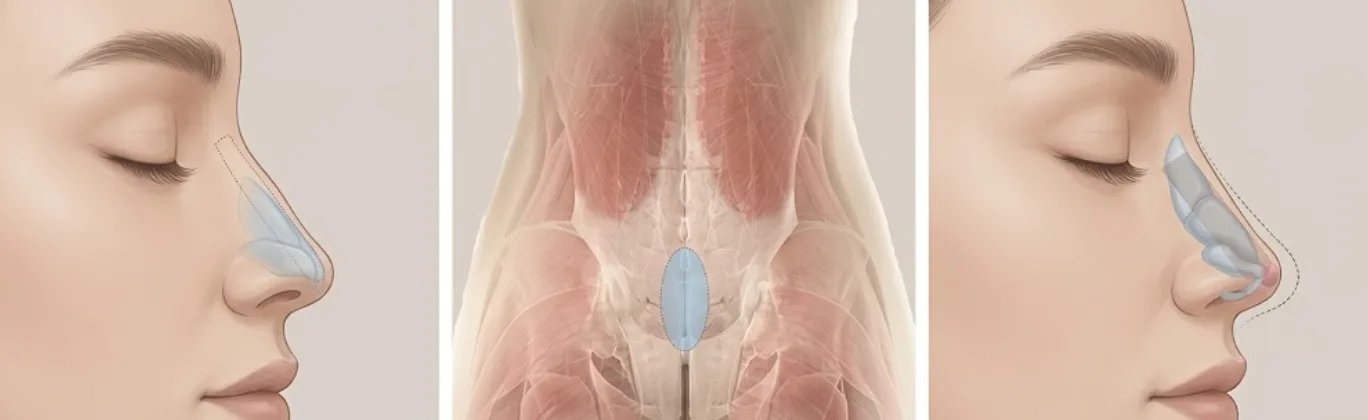
Illustration: instead of an implant, the bridge and tip are built from the patient's own tissue, shaped into the nasal framework (blue). The dashed line shows the original contour.
This is why a clinic that gives you a firm price before seeing your nose should be treated with caution. A responsible figure follows an assessment of your skin thickness, your existing structure and how much healthy cartilage is available. Two patients asking for "implant-free rhinoplasty" can need quite different operations, and a fair quote reflects that.
For that reason this page gives you no numbers. Korea's medical advertising rules and plain good practice both point the same way: the meaningful figure is the personalised one you receive after a proper consultation. A headline price designed to attract clicks says little about your nose.
Cost factors
What actually drives the cost
Several things move the price of implant-free rhinoplasty. The biggest is the complexity of the work your nose needs: how much bridge height your own cartilage must build, how much tip reshaping is involved, and whether the septum and ear both need to be harvested. A straightforward refinement sits at one end; a more extensive reshaping sits at the other.
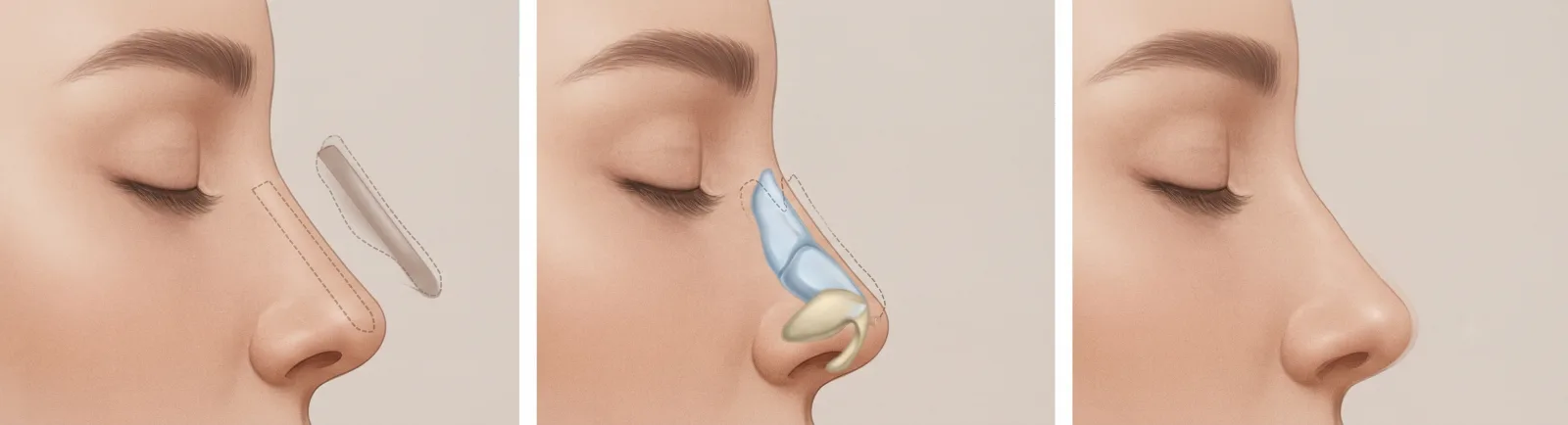
Illustration: the previous implant (outlined) is removed and the framework is rebuilt with the patient's own cartilage for support.
Whether it is a first operation or a revision matters too. A revision rhinoplasty (for example switching an old silicone implant to all-cartilage) is more demanding, often needs more or different cartilage, and therefore costs more than a primary case. The surgeon's training and experience, the time the operation is given, the anaesthesia involved, and the depth of after-care all feed into the figure as well. A clinic that runs many rooms at once and rushes each case can quote less than one that gives every patient unhurried time — and you are paying for that difference as well as the scalpel work.
What does not change the cost in a well-run clinic is upselling. At Garnet only the area you came for is addressed, with no over-recommendation, so your quote reflects the surgery you actually need, with no extras added to inflate it.
What's included
What a proper quote should cover
The single most useful thing you can do with any quote is ask exactly what it includes. A complete implant-free rhinoplasty figure should account for the surgeon's fee, the operation itself, anaesthesia, the harvesting of ear and septal cartilage, and the after-care: the dressing changes and the removal of nose sutures at around 7 days and ear sutures at around 10 days. It should also be clear about follow-up visits.
Watch for what a low headline price might leave out: anaesthesia billed separately, consultation or imaging fees, medication, or follow-up treated as an extra. A quote that looks cheap can become average once these are added, while a slightly higher all-inclusive quote can be the better deal. At Garnet there is no consultation or CT fee and no pressure to book the same day, and structured follow-up at 1, 3 and 6 months is included in the care.
When you compare clinics, compare like with like. Ask each one to itemise what their figure covers, and you will often find that two quotes which looked far apart are much closer once you align what is actually included.
Value
Why the cheapest quote is rarely good value
It is natural to look for the lowest price, especially when travelling for surgery, but rhinoplasty is one of the areas where the cheapest option carries the most hidden cost. A low price often reflects a high-volume model where the operation is rushed, follow-up is thin, or, most importantly, the surgeon you consulted may not be the one who operates. The result you live with for decades is decided in those hours of surgery, so that is the wrong place to economise.
Better value comes from asking who actually performs the operation from start to finish, how much time your case is given, and what happens if something needs attention later. A single-surgeon clinic answers all three cleanly: at Garnet, board-certified plastic surgeon Dr. In-Soo Baek personally consults, operates and follows up every patient, the day is capped at two surgeries so no case is rushed, and the same surgeon sees you through recovery. That continuity is part of what you are buying.
A modestly higher figure that buys you the right surgeon, unhurried surgery and real follow-up is usually better value than a bargain that risks a revision. If you do end up needing one, our revision rhinoplasty page explains why second operations are harder and more costly. That is the strongest argument for getting the first one right. For the broader safety questions, see whether plastic surgery in Korea is safe.
Foreign patients
What international patients should factor in
If you are travelling from abroad, the surgery fee is only part of the picture. Sensible budgeting also allows for your flights and accommodation, time in Korea for the procedure and at least one follow-up, and the days needed for the nose sutures to come out at about 7 days and the ear donor site at about 10 days. Planning your trip around those windows avoids paying to extend a stay or, worse, flying home before sutures are removed.
Garnet is registered with Korea's foreign-patient programme, and a dedicated coordinator stays with you from consultation through recovery, which helps you plan the trip realistically. The clinic can also continue to review your recovery remotely after you return home, so you are not paying to fly back for routine check-ins.
Many international patients find that Korea offers strong value for this kind of cartilage work relative to comparable surgery elsewhere. The comparison that matters is surgeon versus surgeon and what is included. A precise, personalised quote, with the trip costs factored in, is far more useful than a generic country price.
Confirming
How your exact figure is confirmed
Your real cost is settled only after your nose has been assessed. That assessment looks at your skin thickness, your existing structure, how much cartilage is available and exactly what the operation needs to achieve your goals. From that comes a figure that actually applies to you.
You do not have to be in Korea to start. Send photos through an online consultation and Dr. Baek can give a pre-assessment and an indicative idea of what your case involves before you travel, with the precise figure confirmed once he has examined your nose in person. There is no consultation or CT fee, and no pressure to commit on the day.
Whatever clinic you choose, treat the quote as one input among several. The questions of who operates, how unhurried the surgery is, and how follow-up works will shape your result and your true total cost far more than a small difference in the headline price. If you are still weighing the approach itself, our implant-free vs implant comparison may help.
Prices
Price at Garnet
Revision rhinoplasty
From₩4,000,000 + VATExcluding VAT (10% VAT is added at payment)Book now
Same price as Korean patients. Prices shown exclude 10% VAT; your written quote, issued after the in-person consultation, shows the full amount payable.
Dr. In-Soo Baek
Director & sole operating surgeon
Korean medical licence no. 77407
Operate on what you came for. Trained at Korea University Medical Center. Every case planned, performed and reviewed by the same hands.
1Operating surgeon
~2Surgeries per day
7Registered techniques
Board-certified plastic surgeon
Plastic surgery training at Korea University College of Medicine & graduate school
Korean Society of Plastic and Reconstructive Surgeons member, in its facial-contour, eye & rhinoplasty groups
Consults, operates and follows up each case himself
Peer-reviewed papers behind the facts on this page. Each describes findings in its own study group — not results at Garnet — and none predicts your own outcome.
Drake VE et al. Outcomes of Autologous Versus Irradiated Homologous Costal Cartilage Graft in Rhinoplasty. Facial Plastic Surgery & Aesthetic Medicine. 2024. doi:10.1089/fpsam.2023.0334
Farid M et al. Complications of Cosmetic Surgery Abroad – Cost Analysis and Patient Perception. Plastic and Reconstructive Surgery - Global Open. 2019. doi:10.1097/gox.0000000000002281
Chen H et al. Complications Associated with Autologous Costal Cartilage Used in Rhinoplasty: An Updated Meta-Analysis. Aesthetic Plastic Surgery. 2022. doi:10.1007/s00266-022-03075-3
Davison SP et al. The Price of Medical Tourism: The Legal Implications of Surgery Abroad. Plastic & Reconstructive Surgery. 2018. doi:10.1097/prs.0000000000004816
FAQ
Common questions
How much does implant-free rhinoplasty cost in Korea?
There is no single price, because the cost depends on your nose: how much cartilage work is needed, your structure and skin, and whether it is a first surgery or a revision. A responsible clinic gives you a figure only after assessing your nose, which you can begin with an online consultation before travelling.
What affects the cost of implant-free rhinoplasty?
The main factors are the complexity of the work your nose needs, whether ear and septal cartilage both have to be harvested, whether it is a primary or revision case, the surgeon's experience, the time the operation is given, anaesthesia, and the depth of after-care. Upselling should not be a factor in a well-run clinic.
Why won't you give a price on this page?
Because a meaningful figure depends on your individual nose, and Korea's medical advertising rules and good practice both favour a personalised quote over a headline number. A price quoted before anyone has seen your nose tells you little. Your real figure is confirmed after a proper assessment.
What should a quote include?
A complete quote should cover the surgeon's fee, the operation, anaesthesia, harvesting of ear and septal cartilage, and after-care including suture removal. Ask each clinic to itemise it. At Garnet there is no consultation or CT fee, and follow-up at 1, 3 and 6 months comes with the surgery.
Is implant-free rhinoplasty in Korea cheaper than other countries?
Many international patients find Korea offers strong value for this kind of cartilage work, but the real comparison is surgeon versus surgeon and what is included. A precise personalised quote with your trip costs factored in is far more useful than a generic country price.
Why is the cheapest quote not good value?
A low price often reflects a high-volume, rushed model with thin follow-up, and sometimes the surgeon you consulted is not the one who operates. The result you keep for decades is decided in surgery, so that is the wrong place to economise. Who operates, how unhurried the surgery is, and the follow-up matter more than a small saving.
Does Garnet charge for the consultation?
No. There is no consultation or CT fee and no pressure to book the same day. You can also start with an online consultation from abroad and receive a pre-assessment before deciding whether to travel.
Is implant-free rhinoplasty more or less expensive than implant rhinoplasty?
It varies by case, because the work differs: an all-cartilage bridge requires harvesting and shaping your own tissue at a second donor site. Neither is always cheaper, so ask for a quote based on your nose and what each approach would actually involve for you.
Will I need to pay to fly back for follow-up?
Not for routine check-ins. Garnet provides structured follow-up at 1, 3 and 6 months and can continue to review your recovery remotely after you return home, so you plan your trip around suture removal and avoid repeated flights.
How do I get an accurate price for my case?
Have your nose assessed. You can send photos through an online consultation for a pre-assessment and an indicative idea of what your case involves, with the exact figure confirmed once Dr. Baek has examined your nose in person.
My mom recently had a brow lift and lower blepharoplasty with Dr. Baek, and our experience has been wonderful so far. The Garnet team was incredibly kind and welcoming, with Kelly assisting us as our English consultant—she made everything…
I’m so happy I chose this clinic for my lower blepharoplasty. I was traveling from abroad by myself, so I was a little nervous, but from the beginning I felt comfortable and truly cared for. Everyone was kind, patient, and professional…
Came in for an in-person consult and ended up choosing Garnet and Dr.Baek for my non-incisional DES and tiplasty/alarplasty. I communicated with Kelly (English consultant) from the start till now (3 weeks post-op). She really help me feel…
My under-eyes have been sagging and folding for years... I tried to cover it up with makeup, but it actually got stuck in the wrinkles and made it stand out even more. While going for consultations, I noticed that the bigger the hospital…
Send photos and your question before you travel. An English-speaking coordinator reviews every enquiry and replies with guidance on whether surgery is appropriate, the likely plan and timing.
✓ Reviewed by the clinic coordinator, not a bot
✓ Photo-based pre-assessment before you fly
✓ Foreign-patient scheduling & after-care
✓ One surgeon for consultation, surgery and follow-up
Prefer to chat now? Reach the coordinator directly:








 T S7 months ago



