Implant-free rhinoplasty builds the nose entirely from your own cartilage, using ear cartilage for the bridge and septal cartilage for the tip, with no silicone implant. It suits some noses and goals well and others less so. This page sets out who tends to be a good candidate, who may be better served another way, and how that decision is reached at consultation.
The short answer
Implant-free rhinoplasty suits people who specifically want no foreign material in their nose, often because they have thin skin or simply prefer their own tissue.
It fits patients who want a natural, moderate increase in bridge height. A tall, dramatic lift may need a silicone implant.
Having enough healthy ear (conchal) and septal cartilage to build with is a practical requirement, checked in person.
Candidacy comes from an in-person assessment of your nasal skin, cartilage and goals. An online label cannot settle it.
The clearest candidate for implant-free rhinoplasty is someone who specifically does not want a silicone implant in their nose. That preference is sometimes practical (thin skin, a long-term outlook, anxiety about foreign material) and sometimes simply personal. If you have ever thought "I'd rather it was all my own tissue," you are exactly the kind of patient this approach is designed for. The full method is described on our implant-free rhinoplasty overview.
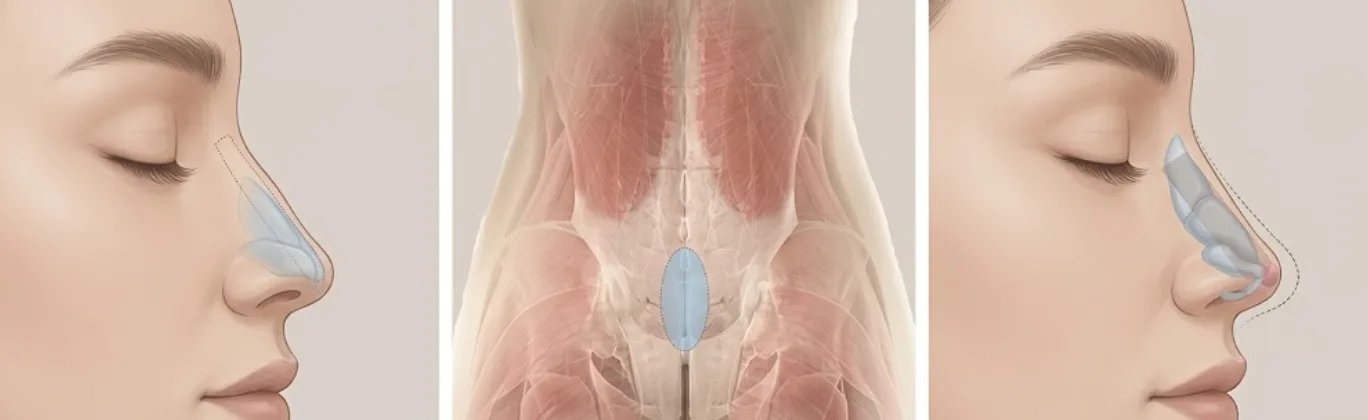
Illustration: instead of an implant, the bridge and tip are built from the patient's own tissue, shaped into the nasal framework (blue). The dashed line shows the original contour.
It also suits people whose goal is a natural, refined nose without a dramatic transformation. Because the bridge is built from your own ear cartilage, which is curved and limited in volume, the realistic gain in height is moderate. For a patient who wants their nose to look like a better version of itself (straighter, more defined, but unmistakably theirs), that moderate gain is exactly what they are after.
Finally, it suits patients who value the way an all-cartilage nose ages: it warms, moves and softens like the rest of the nose because it is living tissue, with no firm edges to show through the skin over time. If a natural feel matters more to you than maximum height, you are likely a good fit. Our comparison guide weighs that trade-off in detail.
Thin skin
Why thin skin often points this way
Skin thickness is one of the most useful predictors of who suits implant-free rhinoplasty. Over thin skin, a silicone implant is more likely to become subtly visible at its edges or to look slightly artificial, especially with age as skin thins further. Your own cartilage has no hard edges to telegraph, so it tends to sit invisibly beneath thin skin and stay natural-looking over the long term.
This is why patients with thin or fair skin, and those planning decades ahead, are so often guided toward an all-cartilage approach. It is not that an implant cannot work over thin skin, but that the margin for a natural result is smaller, and the long-term risk of visibility is higher. If your skin is thicker, both options remain genuinely open and the decision rests more on how much height you want.
Skin is something a surgeon can only judge properly in person, by examining and feeling your nose. That is part of why candidacy is settled by examining the nose in person. Photos still give a strong starting impression.
Cartilage
Having enough cartilage to build with
Because implant-free rhinoplasty uses no manufactured material, it depends entirely on having enough of your own healthy cartilage to work with. The bridge is built from cartilage taken from the bowl of the ear, through a small hidden incision, and the tip is shaped with cartilage from the septum inside the nose. Most people have ample cartilage at both sites, but the surgeon still checks it in every case.
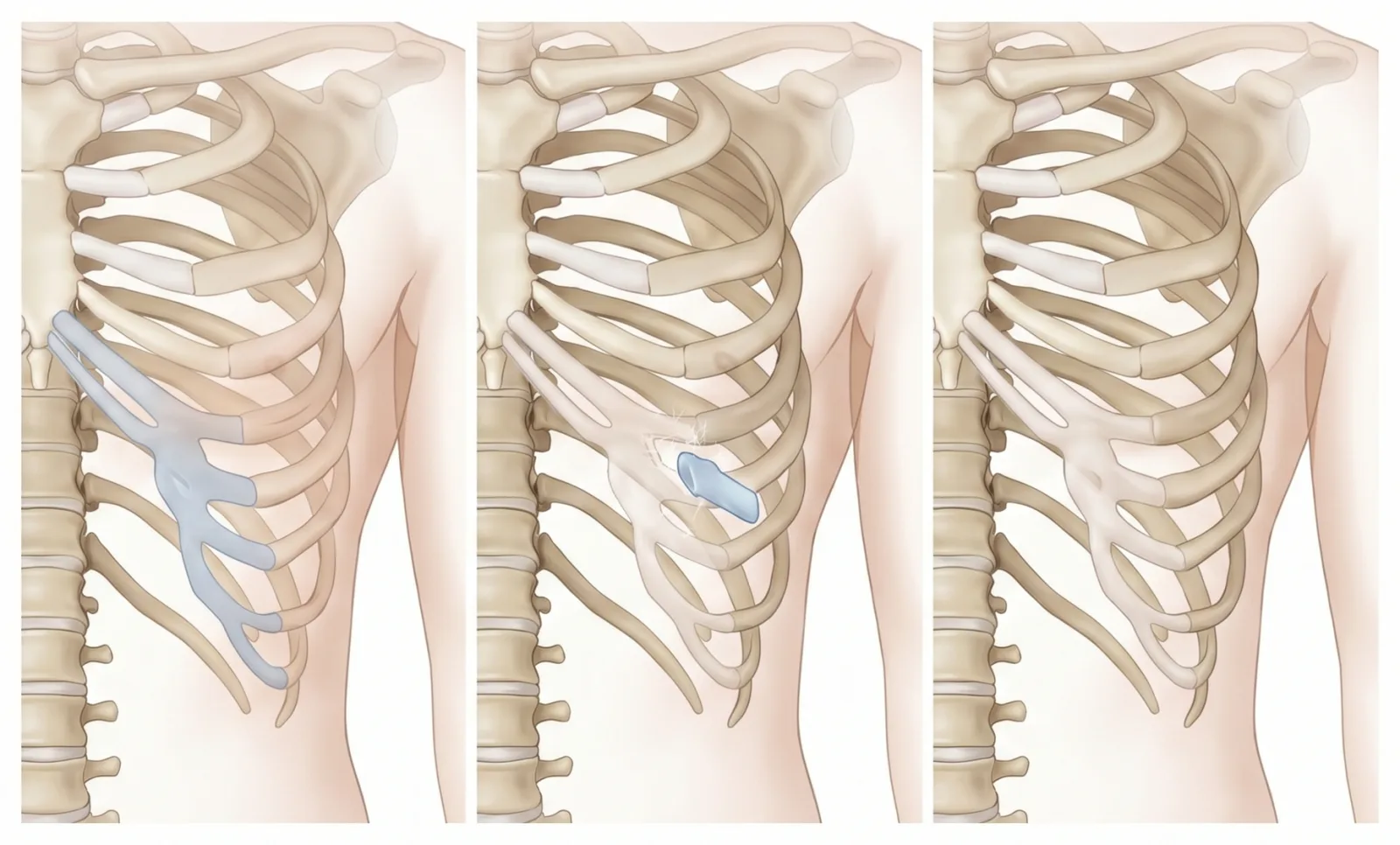
Illustration: where rib cartilage (blue) sits on the chest wall, and the small segment taken to build a stronger nasal framework.
Some patients have a weak or previously harvested septum, or a thinner reservoir of ear cartilage than their goals would need. In those cases an all-ear-and-septum approach may not provide enough framework, and a surgeon might discuss other autologous options, for example using rib cartilage for a stronger, larger framework, which is still implant-free but a more involved operation. The material is chosen to fit your nose, and your nose is not forced to fit a single technique.
At Garnet the ear donor site heals quietly, with ear sutures removed at around 10 days and nose sutures at about 7 days. Whether your own cartilage is sufficient, and from which sites, is one of the central things the surgeon checks when assessing you.
Revising
Moving from an implant to all-cartilage
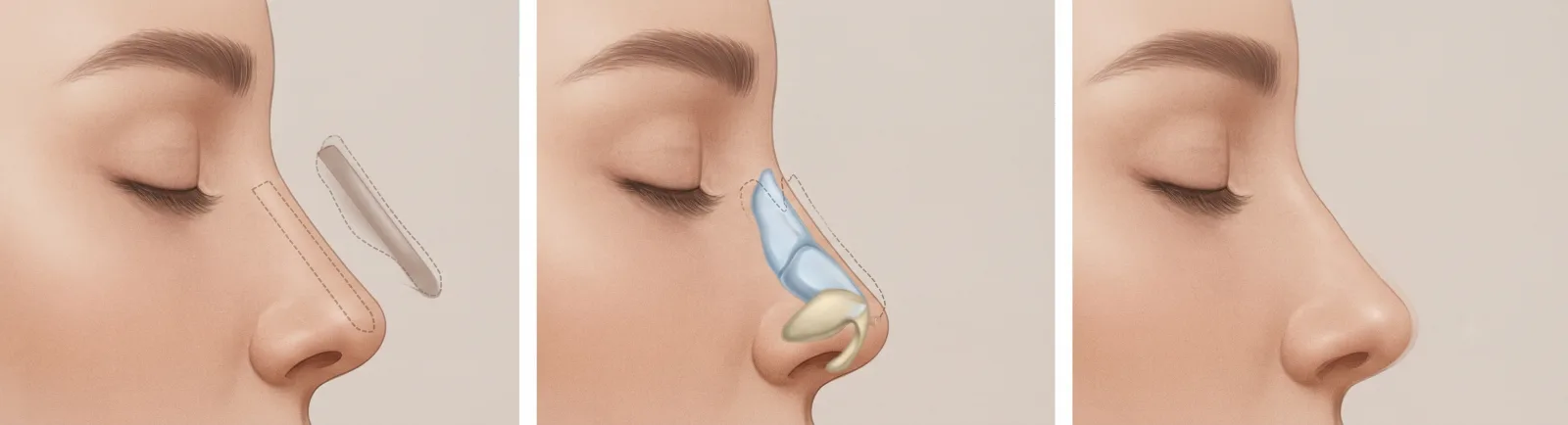
A common and well-suited candidate is someone who already has a silicone implant and wants to move away from it, because it has shifted, become visible, caused recurring problems, or simply because they no longer want a foreign material in their nose. Replacing an implant with your own cartilage is a natural reason to choose an implant-free approach.
Illustration: the previous implant (outlined) is removed and the framework is rebuilt with the patient's own cartilage for support.
This becomes a revision rhinoplasty, which is more demanding than a first operation: scar tissue from the previous surgery, a possibly depleted septum, and the need to rebuild support all make it more complex. Material is then chosen per case: septal and ear cartilage where they suffice, or rib cartilage where a stronger framework is required. The assessment tells you which is realistic for your nose.
If you are revising an earlier nose, candidacy is less about whether you want all-cartilage in principle and more about what your tissue can support after a previous operation. That is a judgement only an in-person examination can make reliably, and the surgeon will be frank about what a second operation can and cannot achieve.
Not for
When implant-free rhinoplasty is not recommended
Implant-free rhinoplasty does not suit everyone, and the surgeon will tell you if it does not suit you. If your goal is a very tall, dramatically higher bridge, your own ear cartilage may not be able to provide enough height safely, and a silicone implant or a larger rib-cartilage framework could suit you better. Wanting maximum projection is a legitimate reason to consider an implant.
It may also not be the ideal fit if you have insufficient healthy cartilage at the ear and septum, certain medical conditions that affect healing, or expectations that surgery cannot realistically meet. As with any operation, unrealistic goals are a reason to pause. A surgeon who tells you a procedure will not give you what you are picturing is doing you a service. Garnet's approach is to address only the area you came for, with no over-recommendation, so you are never pushed toward an operation that does not fit.
Being told you are not an ideal candidate for one technique does not mean you are out of options. It usually means a different approach suits you better, and a careful consultation points you to the operation that fits your nose. Our guide on whether plastic surgery in Korea is safe covers the questions that protect you here.
Confirming
How candidacy is confirmed
No web page can tell you for certain if you are a good candidate. That depends on your skin thickness, your existing nasal structure, how much cartilage you have available, and the result you actually want. The same board-certified surgeon who assesses you at Garnet, Dr. In-Soo Baek, is the one who would perform the operation and follow you up, so the plan you agree on is the plan that is carried out.
You can begin before travelling. Send photos through an online consultation and Dr. Baek will give a pre-assessment of whether implant-free rhinoplasty suits your nose, what it could realistically achieve, and whether another approach might fit you better. The final decision comes when he examines your nose in person.
If it turns out an all-cartilage nose is right for you, the next questions are usually how the procedure works and what it costs. Our cost guide explains what drives the price and what a proper quote includes, so you can plan with realistic expectations on every front.
Prices
Price at Garnet
Revision rhinoplasty
From₩4,000,000 + VATExcluding VAT (10% VAT is added at payment)Book now
Same price as Korean patients. Prices shown exclude 10% VAT; your written quote, issued after the in-person consultation, shows the full amount payable.
Dr. In-Soo Baek
Director & sole operating surgeon
Korean medical licence no. 77407
Operate on what you came for. Trained at Korea University Medical Center. Every case planned, performed and reviewed by the same hands.
1Operating surgeon
~2Surgeries per day
7Registered techniques
Board-certified plastic surgeon
Plastic surgery training at Korea University College of Medicine & graduate school
Korean Society of Plastic and Reconstructive Surgeons member, in its facial-contour, eye & rhinoplasty groups
Consults, operates and follows up each case himself
Peer-reviewed papers behind the facts on this page. Each describes findings in its own study group — not results at Garnet — and none predicts your own outcome.
Drake VE et al. Outcomes of Autologous Versus Irradiated Homologous Costal Cartilage Graft in Rhinoplasty. Facial Plastic Surgery & Aesthetic Medicine. 2024. doi:10.1089/fpsam.2023.0334
McGuire C et al. Prevention of Autologous Costal Cartilage Graft Warping in Secondary Rhinoplasty. Journal of Craniofacial Surgery. 2020. doi:10.1097/scs.0000000000006429
Vila PM et al. Comparison of Autologous vs Homologous Costal Cartilage Grafts in Dorsal Augmentation Rhinoplasty. JAMA Otolaryngology–Head & Neck Surgery. 2020. doi:10.1001/jamaoto.2019.4787
FAQ
Common questions
Who is a good candidate for implant-free rhinoplasty?
Someone who wants no silicone implant in their nose, often because of thin skin or a preference for their own tissue, who is happy with a natural, moderate increase in bridge height, and who has enough healthy ear and septal cartilage to build with. An in-person look at your skin, nasal structure and goals settles candidacy.
Am I suitable if I have thin skin?
Thin skin often points toward implant-free rhinoplasty, because your own cartilage has no hard edges to show through and stays natural over time, whereas a silicone implant can become visible over thin skin, especially with age. A surgeon confirms this by examining your nose, though photos give a strong starting impression.
Do I need to have enough cartilage?
Yes. Because no implant is used, the surgery depends on having enough healthy ear and septal cartilage to build the bridge and shape the tip. Most people have ample, but it is a real requirement. If your cartilage is limited, the surgeon may discuss other autologous options such as rib cartilage.
I want a much taller bridge. Is this for me?
Possibly not, on ear cartilage alone. Ear cartilage is curved and limited in volume, so it gives a moderate, natural lift to the bridge. If you want a very tall bridge, a silicone implant or a larger rib-cartilage framework may suit you better, and the surgeon will explain why.
Can I switch from a silicone implant to all-cartilage?
Often yes, and it is a common reason patients choose implant-free. It becomes a revision rhinoplasty, which is more demanding because of scar tissue and possibly limited remaining cartilage. An in-person assessment confirms what your tissue can support after a previous operation.
When is implant-free rhinoplasty not recommended?
When you want a very tall bridge beyond what your own ear cartilage can safely provide, when you do not have enough healthy cartilage at the ear and septum, when a condition affects healing, or when expectations are not realistic. In those cases the surgeon will suggest a better-suited approach.
Does taking ear cartilage change my ear?
No. Cartilage is taken from the bowl of the ear through a small hidden incision behind or inside it, leaving no visible change to the ear's shape. At Garnet the ear sutures are removed at around 10 days and the nose sutures at about 7 days.
Will being told I'm not a candidate mean I can't have surgery?
Usually not. It typically means a different approach suits you better, for example an implant or a rib-cartilage framework. A careful consultation points you to the operation that fits your nose.
Can I find out if I'm suitable before flying to Korea?
Yes. Send photos through an online consultation and Dr. Baek will give a pre-assessment of whether implant-free rhinoplasty suits your nose and what it could realistically achieve, with final confirmation when he examines your nose in person.
Who decides whether I'm a candidate?
The board-certified surgeon who assesses you, by examining your skin, structure and available cartilage against your goals. At Garnet the same surgeon who assesses you, Dr. In-Soo Baek, is the one who operates and follows you up, so the plan you agree on is the one carried out.
My mom recently had a brow lift and lower blepharoplasty with Dr. Baek, and our experience has been wonderful so far. The Garnet team was incredibly kind and welcoming, with Kelly assisting us as our English consultant—she made everything…
I’m so happy I chose this clinic for my lower blepharoplasty. I was traveling from abroad by myself, so I was a little nervous, but from the beginning I felt comfortable and truly cared for. Everyone was kind, patient, and professional…
Came in for an in-person consult and ended up choosing Garnet and Dr.Baek for my non-incisional DES and tiplasty/alarplasty. I communicated with Kelly (English consultant) from the start till now (3 weeks post-op). She really help me feel…
My under-eyes have been sagging and folding for years... I tried to cover it up with makeup, but it actually got stuck in the wrinkles and made it stand out even more. While going for consultations, I noticed that the bigger the hospital…
Send photos and your question before you travel. An English-speaking coordinator reviews every enquiry and replies with guidance on whether implant-free rhinoplasty is appropriate for you, the likely plan and timing.
✓ Reviewed by the clinic coordinator, not a bot
✓ Photo-based pre-assessment before you fly
✓ Foreign-patient scheduling & after-care
✓ One surgeon for consultation, surgery and follow-up
Prefer to chat now? Reach the coordinator directly:







 T S7 months ago



