Rhinoplasty can refine a low bridge, a wide or droopy tip, or a nose that looks out of balance with the rest of the face. But it is not right for everyone. Strong candidates are people whose concern surgery can actually address and whose goals are realistic, and knowing if you fit matters more than knowing the technique.
The short answer
Good candidates have a specific structural concern (bridge height, tip shape, width or balance) that surgery can address, and goals that match what their nose can realistically become.
Physical readiness matters: you should have finished facial growth, be in good general health, have stopped smoking around surgery, and have enough of your own cartilage if an implant-free approach is planned.
Realistic expectations are the strongest predictor of satisfaction. Rhinoplasty refines your nose to suit your face; it does not transplant someone else's nose onto yours.
A careful surgeon will sometimes say surgery is not the right answer. A single-surgeon clinic, where the same board-certified surgeon assesses and operates, makes that advice easier to trust.
Most people who consider rhinoplasty are bothered by one of a few things. The first is the bridge: a low or flat dorsum that they would like raised into a smoother, more defined line, which is among the most common requests for East Asian noses. A standard rhinoplasty raises the bridge with a soft silicone implant, while an implant-free approach builds it from the patient's own cartilage.
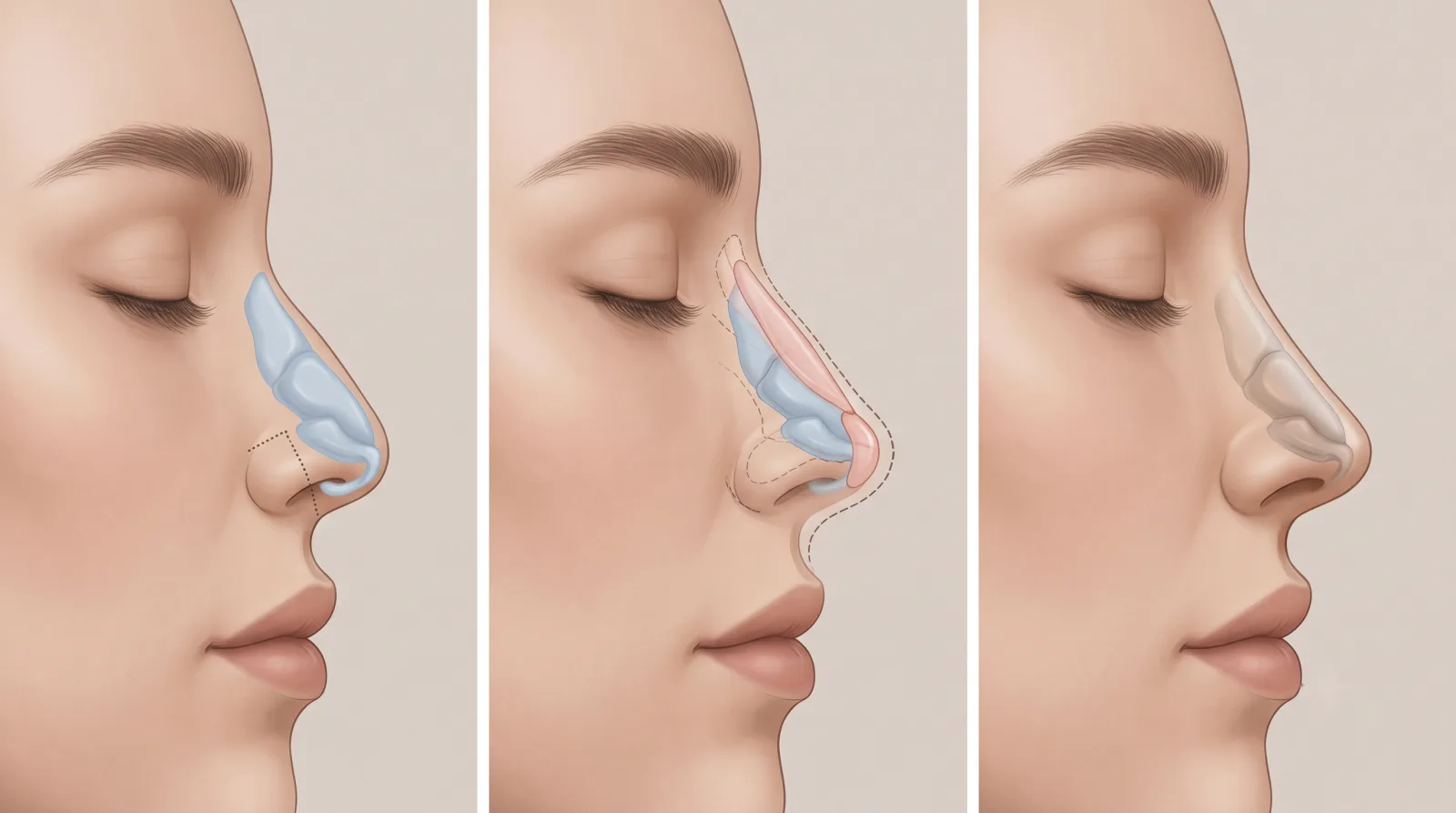
Illustration: the nasal framework (blue) is reshaped to raise the bridge and refine the tip. The dashed outline shows the original contour.
The second is the tip: a bulbous, wide, droopy or under-projected tip that the patient wants refined, lifted or narrowed. Tip work is delicate because the skin there is thin and mobile, and it is done with the patient's own septal or ear cartilage in either approach. Many noses need both bridge and tip work together to look balanced.
Beyond bridge and tip, rhinoplasty can address a nose that looks too wide, slightly deviated, or simply out of proportion with the eyes and chin. The aim in every case is balance: a nose that suits your face. There is no single ideal shape. Understanding which of these concerns is actually yours is the first step in deciding whether surgery fits, and it shapes whether an implant or an implant-free approach is the better route.
Good candidate
What makes someone a good candidate
A good candidate has a concern that surgery can genuinely change, and an idea of the result that fits their own anatomy. If you can point to a specific feature (“my bridge is too low”, “my tip droops when I smile”, “my nose looks too wide for my face”) and a surgeon agrees the structure can be altered to address it, you are likely a reasonable candidate. Vague dissatisfaction with no clear target is harder to satisfy with surgery.
Your tissue matters as much as your wishes. Skin thickness affects how visible refinements will be and which technique suits you; thin skin shows detail clearly but can reveal an implant edge over time, while thicker skin softens definition. If an implant-free nose is planned, you also need enough healthy septal and ear cartilage to build with. These are things only an assessment can confirm.
Finally, good candidates are doing this for themselves. Wanting a nose that better balances your face is a sound motivation; seeking surgery to satisfy someone else, or to copy a specific celebrity nose that does not suit your face, tends to lead to disappointment. A thoughtful candidate comes with a concern and an open mind about how best to address it.
Readiness
Physical and timing readiness
There are practical conditions that make surgery safer and recovery smoother. You should have finished facial growth, generally meaning the late teens at the earliest, so the result is not altered by ongoing development. You should be in good general health, with any chronic conditions well controlled, and you should disclose all medications and supplements, some of which increase bleeding and need pausing around surgery.
Smoking is worth singling out. Nicotine impairs healing and raises the risk of complications, especially in a nose where delicate tissue must heal well, so stopping for a period before and after surgery is strongly advised. Realistic recovery planning matters too: nose sutures typically come out around seven days, and if an implant-free approach is used there is also a small ear donor site, with those sutures out around ten days.
Timing around travel deserves thought for international patients. You will need to be in Korea long enough for surgery, suture removal and an initial review before flying, and you should plan your trip with swelling and dressing changes in mind. Our guides on how long to stay in Korea and when you can fly after surgery cover this in detail, and a good candidate plans the trip around healing.
Realistic goals
Realistic goals and expectations
The patients who are happiest are those whose expectations match what surgery can do. Rhinoplasty refines and rebalances your nose; it works within your skin, your cartilage and your facial proportions. It can make a meaningful, natural improvement, but it cannot place a completely different nose onto your face or guarantee an exact millimetre outcome, because living tissue heals in its own way.
Swelling also shapes expectations. A nose looks its most swollen in the first weeks, settles substantially over the following months, and continues to refine, especially at the tip, for up to a year or more. A candidate who understands that the early result is not the final one, and who is patient through the settling phase, is far more likely to be satisfied than one expecting the finished nose immediately.
The most useful mindset is collaborative. Bring your concern and the look you hope for, then listen to what your anatomy allows; the result you want comes from a plan agreed between a candid surgeon and a realistic patient. If your goal is achievable, a good surgeon will say so plainly, and if it is not, they should tell you that too.
Not right
When rhinoplasty is not the right choice
Sometimes the answer for your nose is no. If your concern is very minor and surgery would risk more than it would gain, a conservative surgeon may advise against operating. If your expectations cannot realistically be met by your anatomy, for example a dramatic change your skin or cartilage will not support, proceeding is likely to disappoint. A good surgeon will say so and decline the case.
Certain situations call for caution or delay: unfinished facial growth, unstable health conditions, active smoking that has not been paused, or expectations driven by external pressure instead of your own wish. Body-image concerns that surgery is unlikely to resolve also warrant a careful, open conversation before any operation is planned. None of these is a personal judgement; they are about doing right by the result.
This is exactly where who assesses you matters. A clinic under pressure to fill operating slots has an incentive to say yes; a surgeon who only takes two cases a day, and addresses only what you came for, has room to say “this surgery may not help you”. That kind of candid no is a sign of a clinic worth trusting. It is the same principle behind choosing a single-surgeon clinic.
At Garnet
Finding out whether it's right for you at Garnet
Garnet is a single-surgeon clinic in Apgujeong, Seoul. Dr. In-Soo Baek is a board-certified plastic surgeon (Korean medical licence no. 77407) and the only operating doctor, so the surgeon who assesses whether rhinoplasty suits you is the same surgeon who would operate and follow you up. The clinic caps the day at two surgeries and there is no consultation or CT fee, which leaves time for an unhurried, frank assessment with no sales pitch.
The approach is to address only what you came for, and to tell you plainly if surgery is not the right answer for your nose or your goals. You can start with a no-obligation online assessment: send front and side photos of your nose, describe what concerns you, and you will get a frank view of your candidacy and, if surgery fits, whether an implant or an implant-free plan suits you. All of this comes before you commit to travel.
Real Results
Before & After
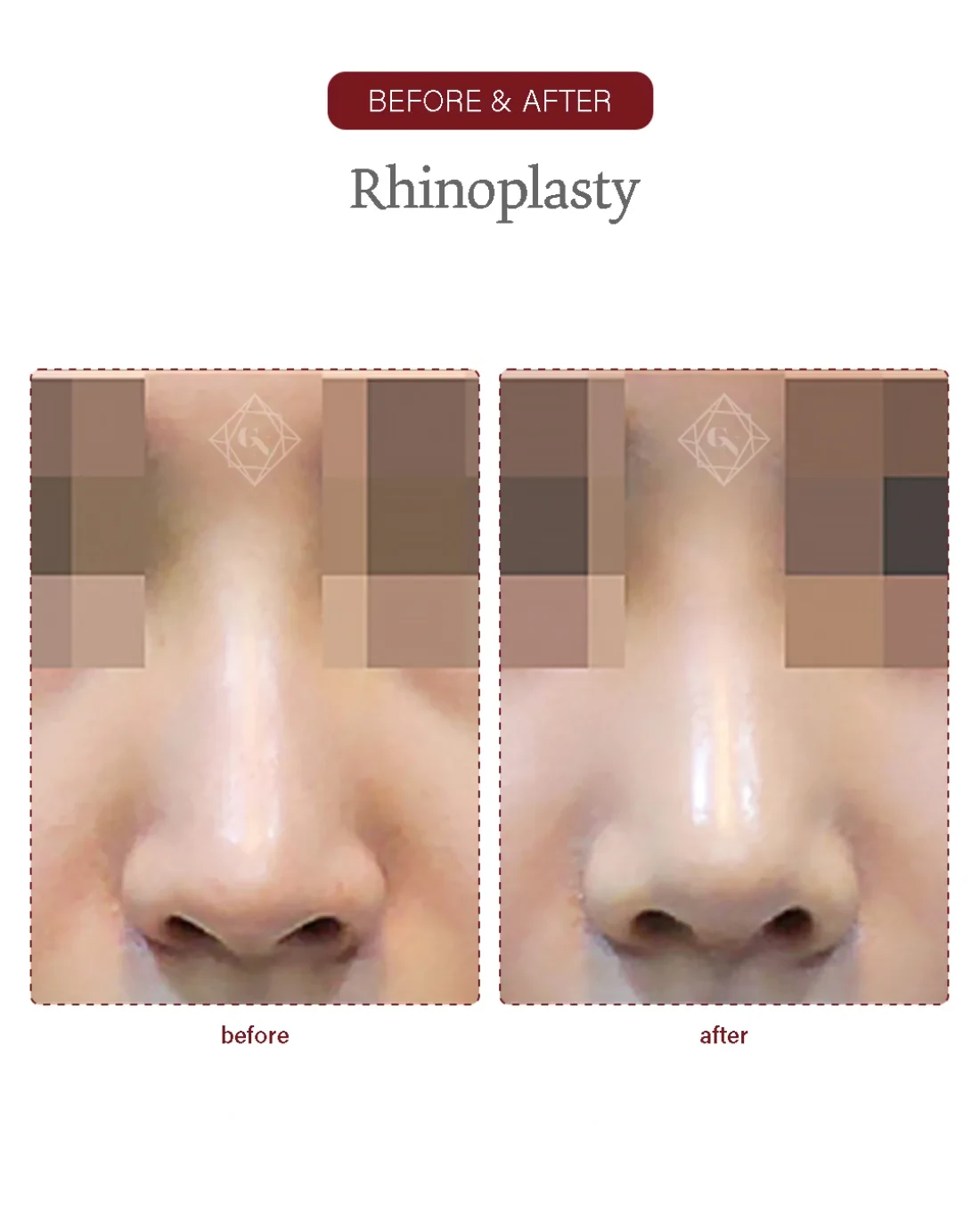
Rhinoplasty result of an actual Garnet patient (published with consent). Date, procedure and clinic (Garnet Plastic Surgery, Apgujeong) are labelled on the image, with the usual same-condition disclaimer. Results, recovery and suitability vary by individual and are not guaranteed.
Dr. In-Soo Baek
Director & sole operating surgeon
Korean medical licence no. 77407
Operate on what you came for. Trained at Korea University Medical Center. Every case planned, performed and reviewed by the same hands.
1Operating surgeon
~2Surgeries per day
7Registered techniques
Board-certified plastic surgeon
Plastic surgery training at Korea University College of Medicine & graduate school
Korean Society of Plastic and Reconstructive Surgeons member, in its facial-contour, eye & rhinoplasty groups
Consults, operates and follows up each case himself
Peer-reviewed papers behind the facts on this page. Each describes findings in its own study group — not results at Garnet — and none predicts your own outcome.
Jin HR et al. Rhinoplasty in the Asian Patient. Clinics in Plastic Surgery. 2016. doi:10.1016/j.cps.2015.09.015
Li D et al. An Overview of Asian Rhinoplasty. Annals of Plastic Surgery. 2016. doi:10.1097/sap.0000000000000841
Nassif PS et al. Asian Rhinoplasty. Facial Plastic Surgery Clinics of North America. 2010. doi:10.1016/j.fsc.2009.11.018
FAQ
Common questions
Who is a good candidate for rhinoplasty?
Someone with a specific structural concern surgery can address (a low bridge, a wide or droopy tip, width or imbalance) who has finished facial growth, is in good general health, and has realistic goals. Having enough of your own cartilage also matters if an implant-free approach is planned. An assessment confirms suitability.
Am I suitable for rhinoplasty?
It depends on your concern, your anatomy and your expectations. If a surgeon agrees that the feature bothering you can be changed, your health is sound, and your goals fit what your nose can realistically become, you are likely suitable. The most reliable way to know is a pre-assessment with the operating surgeon.
When is rhinoplasty not recommended?
When the concern is very minor and surgery would risk more than it gains, when expectations cannot realistically be met by your anatomy, during unfinished facial growth or unstable health, while still smoking, or when the wish is driven by outside pressure. A conservative surgeon will sometimes advise against operating.
What problems can rhinoplasty fix?
It can raise a low bridge, refine a bulbous, wide, droopy or under-projected tip, narrow a wide nose, and improve balance with the rest of the face. Many noses need both bridge and tip work together. The aim is a nose that suits your face.
Is there an age limit for rhinoplasty?
You should have finished facial growth, which generally means the late teens at the earliest, so the result is not altered by ongoing development. There is no strict upper limit; what matters more is good general health and well-controlled chronic conditions, which an assessment will check.
Do I need enough cartilage to be a candidate?
If an implant-free, all-cartilage approach is planned, you need enough healthy septal and ear cartilage to build the bridge and support the tip. If a silicone implant is used for the bridge, less of your own cartilage is needed. A surgeon assesses this when deciding which approach suits you.
Will rhinoplasty give me an exact result I choose?
It refines and rebalances your own nose within your skin, cartilage and proportions; it cannot place a completely different nose onto your face or guarantee an exact millimetre outcome, because living tissue heals individually. Realistic, collaborative goals are the strongest predictor of satisfaction.
Does smoking affect whether I'm a good candidate?
Yes. Nicotine impairs healing and raises the risk of complications in a nose, where delicate tissue must heal well. Stopping for a period before and after surgery is strongly advised, and continuing to smoke can make surgery inadvisable until you have paused.
How long after rhinoplasty until I see the final result?
A nose looks most swollen in the first weeks, settles substantially over the following months, and continues to refine, especially at the tip, for up to a year or more. A good candidate understands the early result is not the final one and is patient through the settling phase.
Can my nose be assessed from photos before I fly to Korea?
Yes. You can send front and side photos of your nose, describe your concern, and get an online pre-assessment of your candidacy and, if surgery fits, of whether an implant or implant-free plan suits you, before you commit to travel.
My mom recently had a brow lift and lower blepharoplasty with Dr. Baek, and our experience has been wonderful so far. The Garnet team was incredibly kind and welcoming, with Kelly assisting us as our English consultant—she made everything…
I’m so happy I chose this clinic for my lower blepharoplasty. I was traveling from abroad by myself, so I was a little nervous, but from the beginning I felt comfortable and truly cared for. Everyone was kind, patient, and professional…
Came in for an in-person consult and ended up choosing Garnet and Dr.Baek for my non-incisional DES and tiplasty/alarplasty. I communicated with Kelly (English consultant) from the start till now (3 weeks post-op). She really help me feel…
My under-eyes have been sagging and folding for years... I tried to cover it up with makeup, but it actually got stuck in the wrinkles and made it stand out even more. While going for consultations, I noticed that the bigger the hospital…
Send photos and your question before you travel. An English-speaking coordinator reviews every enquiry and replies with guidance on whether surgery is appropriate, the likely plan and timing.
✓ Reviewed by the clinic coordinator, not a bot
✓ Photo-based pre-assessment before you fly
✓ Foreign-patient scheduling & after-care
✓ One surgeon for consultation, surgery and follow-up
Prefer to chat now? Reach the coordinator directly:









 T S7 months ago



