For most patients a mini facelift is more uncomfortable around the cheeks and jawline than it is painful. You feel nothing during the operation, and the days afterwards are dominated by tightness, swelling and a feeling of pressure, with little sharp pain. Almost all of it is well controlled and fades as healing settles.
The short answer
A mini facelift is performed under anaesthesia, so you feel no pain during the operation itself.
The dominant after-surgery sensation is tightness, pressure and swelling around the cheeks and jawline, without sharp pain, and it eases over the first one to two weeks.
Discomfort is managed in stages: anaesthesia during surgery, prescribed pain relief in the early days, and a settling phase as swelling resolves and sutures come out at around 10 days.
At Garnet, the same board-certified surgeon plans your anaesthesia and reviews your comfort personally at follow-ups at 1, 3 and 6 months.
A mini facelift is a surgical procedure, so it is always done with anaesthesia. You are never expected to feel the surgery. Depending on the extent of the lift and what is most appropriate for you, it is typically performed under local anaesthesia combined with sedation, or under general anaesthesia. With sedation you are relaxed and drowsy and feel nothing at the surgical site; under general anaesthesia you are fully asleep. Either way, the goal is the same: a comfortable, pain-free operation.
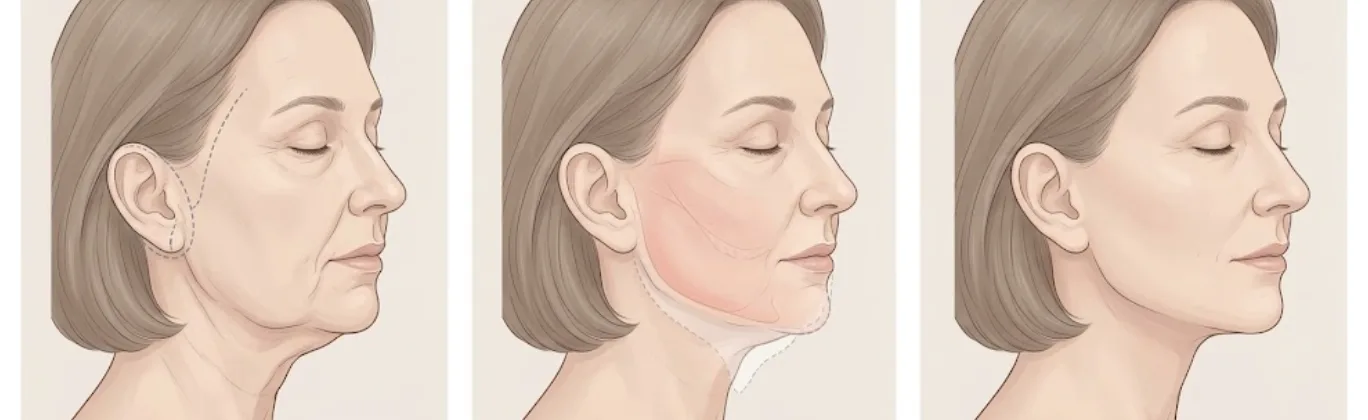
Illustration: through a shorter incision in front of the ear (dotted line), the lower face and jawline (shaded) are lifted.
Which approach is right for you is a clinical decision made in consultation, taking into account the planned extent of the lift, your medical history and your own preference. Because a mini works through a short pre- and post-auricular incision with a more superficial dissection than a full lift, it is often well suited to sedation-based anaesthesia, but this is decided case by case for your face and health.
It is worth asking, in advance, who administers and monitors your anaesthesia and how you are watched during the procedure. A clinic should be able to answer this clearly. At Garnet you can raise anaesthesia questions before you travel in an online consultation from abroad, so there are no surprises on the day.
During surgery
What you feel during the surgery itself
During the operation you feel no pain. Under sedation you are in a relaxed, twilight state (many patients remember little or nothing of the procedure), and the surgical area is fully numbed, so there is no sensation of cutting or pulling. Under general anaesthesia you are asleep for the whole operation and aware of nothing until you wake in recovery. The mini facelift itself is a comparatively contained procedure, which is part of why anaesthesia for it is generally straightforward.
The first thing most patients notice is not pain but the transition out of anaesthesia: a groggy, heavy feeling as it wears off, often with a snug dressing around the face and a sense of pressure. This is expected and settles over the following hours. You are monitored through this early recovery period before you are allowed to leave.
Because the surgery is pain-free, the part worth preparing for mentally is the recovery, not the operation. Knowing that the discomfort comes afterwards, and that it is tightness and swelling without sharp pain, helps most nervous patients feel far calmer about the day itself.
First days
Discomfort in the first few days after surgery
The first two to three days are when you notice the most, and the accurate description is pressure and tightness, without severe pain. Your cheeks and jawline feel swollen and snug, the skin feels stretched, and there may be a dull ache and some bruising. Most patients are surprised that it is more uncomfortable than painful, and that prescribed pain relief keeps it well within manageable limits.
Swelling and bruising usually peak within the first two to three days and then steadily improve. Sleeping with your head elevated, using cold compresses as advised, and resting all help the swelling come down faster and ease the feeling of pressure. Numbness or odd tingling around the incisions and cheeks is also common early on and is part of normal nerve recovery. It is not a sign of pain to come.
By the end of the first week most patients describe the area as tight and a little tender more than painful, and many are off stronger pain relief well before then. The mini facelift's recovery is generally lighter than a full lift precisely because the dissection is more superficial. The broader timeline, including sutures out at around 10 days, is covered on the mini facelift recovery timeline page.
Tightness
Why the post-op tightness is normal and temporary
The tight feeling after a mini facelift is one of the most common worries, and it is almost always normal. The lift repositions tissue and the skin is redraped, so in the early weeks the area genuinely is tighter. On top of that, swelling adds to the sense of fullness and pressure. The combination can feel firm or even stiff when you smile, eat or turn your head, but it is a stage of healing, not the final result.
As swelling resolves over the following weeks and the tissue settles, that tightness softens steadily. Most patients find the firm feeling eases substantially within the first few weeks, with the area continuing to relax and feel more natural over the following months. It is this settling process that gives the final, natural look a mini facelift is designed for.
There is a distinction worth knowing: tightness and a feeling of pressure are expected, whereas escalating, sharp or one-sided pain is not. The first is part of recovery; the second is something to report. Knowing this in advance makes the early weeks much less anxious, because you can recognise the normal sensations for what they are.
Managing pain
How discomfort is managed at each stage
Pain management is planned in stages. The first stage is the anaesthesia itself, which makes the operation pain-free. The second is the early recovery period, where you are given prescribed pain relief to keep the first days comfortable; most patients find this more than sufficient and step down to milder relief quickly. The third stage is the settling phase, where tightness and swelling, more than pain, are the main sensations, managed mostly by rest, elevation and cold compresses.
Following the after-care instructions closely is the most effective thing you can do for your own comfort. Keeping your head elevated, avoiding strenuous activity, not bending or straining, and protecting the incisions all reduce swelling and therefore the feeling of pressure. Taking pain relief as directed, ahead of discomfort, keeps the early days smooth.
Just as important is knowing when to speak up. Pain that climbs instead of fading, marked swelling on one side, increasing redness, heat or discharge, or anything that feels clearly out of step with normal healing should be reported promptly. A clinic that builds in proper follow-up makes this easy: you have a clear point of contact and do not have to guess, which matters especially once you have flown home.
At Garnet
Comfort, anaesthesia and follow-up at Garnet
Garnet is a single-surgeon clinic in Apgujeong, Seoul, where Dr. In-Soo Baek, a board-certified plastic surgeon (Korean medical licence no. 77407), personally consults, plans the anaesthesia approach, performs the surgery and reviews your recovery. Because the same surgeon sees you throughout, your comfort is assessed by someone who knows exactly what was done, and the clinic caps the day at two surgeries so each patient has unhurried time in recovery.
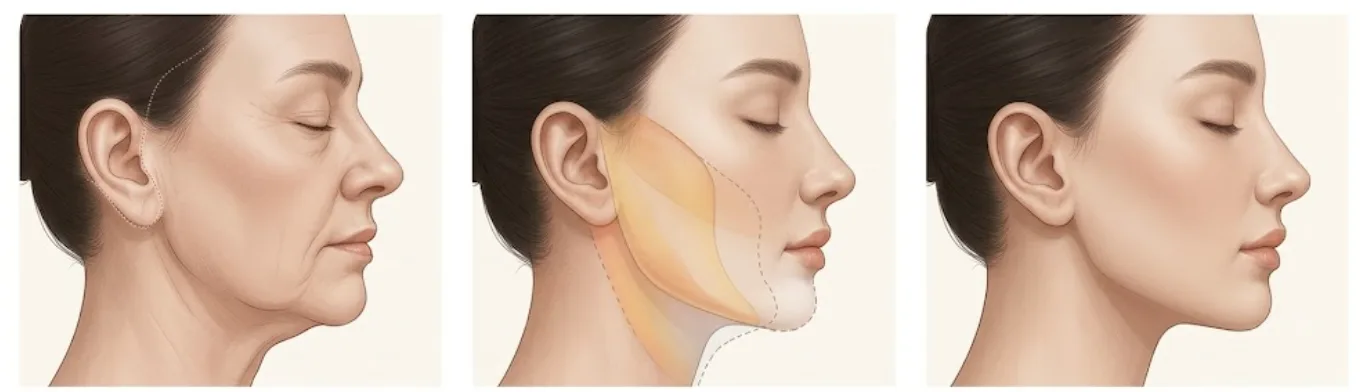
Illustration: the deeper facial layer (SMAS, shown in yellow) is released and repositioned as one unit with the skin, rather than pulling the skin alone.
Your anaesthesia plan is decided with you in consultation, based on the extent of your lift and your medical history, and explained so you know what to expect on the day. The same surgeon then reviews how your comfort and tightness are settling at structured follow-ups at 1, 3 and 6 months, so the early weeks of tightness are monitored and you are not left to interpret them alone.
If you are an international patient, you can raise every pain and anaesthesia question before you commit to travel. Garnet is registered with Korea's foreign-patient programme, and you can send photos and ask about anaesthesia, recovery and after-care in an online consultation. If you are weighing a lighter option, comparing the recovery of a mini against a full deep-plane facelift is part of that conversation.
Dr. In-Soo Baek
Director & sole operating surgeon
Korean medical licence no. 77407
Operate on what you came for. Trained at Korea University Medical Center. Every case planned, performed and reviewed by the same hands.
1Operating surgeon
~2Surgeries per day
7Registered techniques
Board-certified plastic surgeon
Plastic surgery training at Korea University College of Medicine & graduate school
Korean Society of Plastic and Reconstructive Surgeons member, in its facial-contour, eye & rhinoplasty groups
Consults, operates and follows up each case himself
Peer-reviewed papers behind the facts on this page. Each describes findings in its own study group — not results at Garnet — and none predicts your own outcome.
Morrissette M et al. In-Office Surgical Procedures for Prejuvenation. Facial Plastic Surgery. 2026. doi:10.1055/a-2898-5952
DeJoseph LM et al. Local Anesthetic Facelift. Facial Plastic Surgery Clinics of North America. 2020. doi:10.1016/j.fsc.2020.03.012
Chaudhry O et al. Lateral SMASectomy. Clinics in Plastic Surgery. 2019. doi:10.1016/j.cps.2019.06.003
FAQ
Common questions
Is a mini facelift painful?
For most patients it is more uncomfortable than painful. You feel nothing during the operation because it is done under anaesthesia, and the days afterwards are dominated by tightness, pressure and swelling with little sharp pain, almost all of it well controlled by prescribed pain relief and easing over the first one to two weeks.
What anaesthesia is used for a mini facelift?
A mini facelift is done under anaesthesia (typically local anaesthesia with sedation, or general anaesthesia), decided in consultation based on the extent of the lift, your medical history and your preference. Either way you feel no pain during surgery. Because a mini is more contained than a full lift, sedation-based anaesthesia is often suitable, but this is decided case by case.
Does it hurt during the surgery?
No. Under sedation the surgical area is fully numbed and you are in a relaxed, drowsy state, often remembering little of the procedure. Under general anaesthesia you are asleep throughout. You should feel no pain during the operation itself. The discomfort comes afterwards and is mostly tightness and swelling.
How much discomfort is there after a mini facelift?
The first 2 to 3 days bring the most: a feeling of pressure, tightness, swelling and a dull ache without severe pain, with some bruising. Prescribed pain relief keeps this manageable, and most patients step down to milder relief within a few days. By the end of the first week the area usually feels tight and a little tender more than painful.
Why does my face feel so tight after surgery?
Tightness is normal and temporary. The lift repositions tissue and redrapes the skin, and swelling adds to the feeling of fullness, so the area genuinely is tighter in the early weeks. It softens steadily as swelling resolves and the tissue settles over the following weeks and months. This settling is what produces the final natural result.
How is the pain managed?
In stages: anaesthesia makes the surgery pain-free; prescribed pain relief covers the early days; and the settling phase is managed mostly with rest, head elevation and cold compresses as swelling and tightness ease. Taking relief as directed, ahead of discomfort, and following after-care instructions keeps the early days smooth.
Is numbness around the face after a mini facelift normal?
Yes. Numbness, tingling or altered sensation around the incisions and cheeks is common in the early weeks and is part of normal nerve recovery as the area heals. It typically improves gradually over weeks to months. It is not a sign of pain to come, but you can always mention it at follow-up.
When should I be worried about pain after a mini facelift?
Tightness and pressure are expected; pain that climbs instead of fading, marked or one-sided swelling, increasing redness, heat, or discharge are not. Report anything that feels clearly out of step with normal healing promptly. With proper follow-up you have a clear point of contact and do not have to guess, which matters most once you have travelled home.
How long until the discomfort goes away?
Swelling and bruising usually peak within the first two to three days and then steadily improve; most patients are off stronger pain relief well before the end of the first week. The tight feeling softens substantially over the first few weeks and continues to relax over the following months as the result settles.
Can I ask about anaesthesia before I travel?
Yes. At Garnet you can raise every anaesthesia, pain and after-care question in an online consultation before you commit to travel, so your plan is clear in advance. The same board-certified surgeon who consults you also performs the surgery and reviews your comfort at follow-ups.
My mom recently had a brow lift and lower blepharoplasty with Dr. Baek, and our experience has been wonderful so far. The Garnet team was incredibly kind and welcoming, with Kelly assisting us as our English consultant—she made everything…
I’m so happy I chose this clinic for my lower blepharoplasty. I was traveling from abroad by myself, so I was a little nervous, but from the beginning I felt comfortable and truly cared for. Everyone was kind, patient, and professional…
Came in for an in-person consult and ended up choosing Garnet and Dr.Baek for my non-incisional DES and tiplasty/alarplasty. I communicated with Kelly (English consultant) from the start till now (3 weeks post-op). She really help me feel…
My under-eyes have been sagging and folding for years... I tried to cover it up with makeup, but it actually got stuck in the wrinkles and made it stand out even more. While going for consultations, I noticed that the bigger the hospital…
Send photos and your question before you travel. An English-speaking coordinator reviews every enquiry and replies with guidance on whether surgery is appropriate, the likely plan and timing.
✓ Reviewed by the clinic coordinator, not a bot
✓ Photo-based pre-assessment before you fly
✓ Foreign-patient scheduling & after-care
✓ One surgeon for consultation, surgery and follow-up
Prefer to chat now? Reach the coordinator directly:








 T S7 months ago



