Turning a monolid into a defined double eyelid can be done in more than one way, and the right method depends on your eyelid: its skin thickness, the amount of fat, and whether the eye-opening muscle is a little weak. A light buried-suture technique suits some eyes; a full incision suits others; and where ptosis is present, correcting the muscle can be part of the plan. This page explains how the methods differ and how a consultation decides which fits you.
The short answer
A crease can be created two main ways: a buried-suture (non-incision) method, or a full incision. They suit different eyelids.
Thin, less fatty lids with good skin often do well with the non-incision method; thicker or fattier lids, or those wanting a very defined, lasting crease, often suit an incision.
If a weak eye-opening muscle (ptosis) is contributing, ptosis correction may be combined so the eye opens fully as well as gaining a fold.
At Garnet the same board-certified surgeon assesses your lid and recommends the method that fits it. No single technique is applied to everyone.
A double eyelid is simply a fold in the upper lid: when you open your eye, the skin above the lashes tucks in and forms a crease. A monolid does not have this fold, or has a very faint one. Creating a crease surgically means forming a fixed connection between the skin and the underlying lid structures so that, as the eye opens, the fold appears in a consistent place. That connection can be made in 2 broad ways, with fine buried sutures or through a full incision, and each produces the fold by a slightly different mechanism.
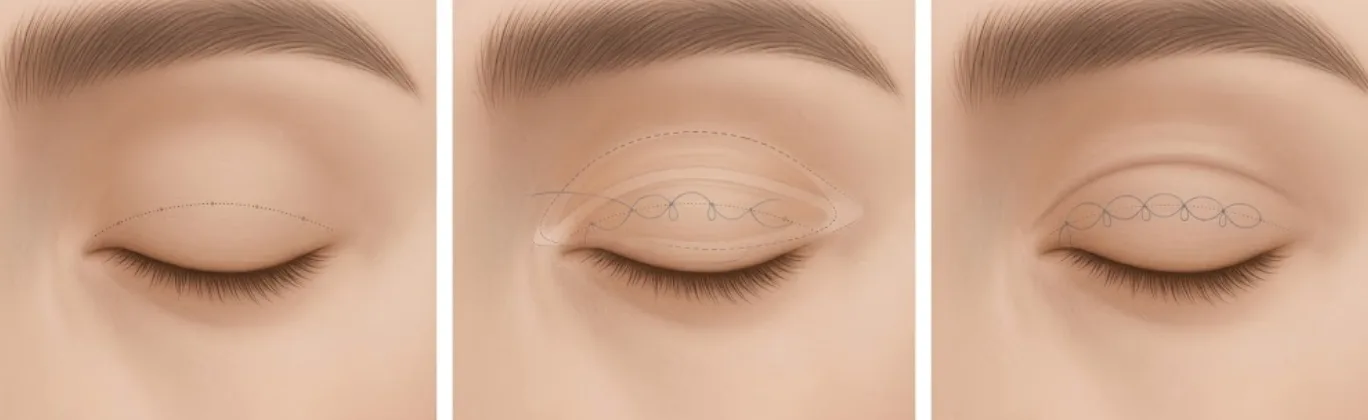
Illustration: a thin buried suture is looped along the planned crease through tiny points, with no skin incision, so the lid folds at the new line.
Neither method is universally “better.” They suit different eyelids, and the choice hinges on the thickness of your skin, how much fat sits in the lid, how firm the tissues are, and how defined and durable you want the crease to be. There is also a third factor that is easy to miss: whether the muscle that opens the eye is a little weak, which changes the plan.
The 3 routes below (the non-incision (buried-suture) method, the incision method, and ptosis correction where the muscle is weak) cover how a monolid is turned into a defined crease, and understanding them makes a consultation much easier to follow.
Non-incision
The non-incision (buried-suture) method
The non-incision method creates the fold without cutting the lid open. Fine sutures are buried through the eyelid to form a fixed adhesion line, and that line becomes the crease as the eye opens. Because there is no long incision, the swelling tends to be lighter and the recovery quicker, and at Garnet the sutures are removed at around five days. It is often chosen by younger patients and by those who want a softer, more natural-looking fold.
Its appeal is speed and subtlety, but it has clear limits. It works best on thinner lids with limited fat and good skin elasticity; on thick, fatty or heavier lids the buried sutures have more to hold and the crease may be less crisp or less durable over time. It also does not remove skin or fat, so it is not the tool for a lid that needs debulking.
For the right eyelid it is an elegant option; for the wrong one it can be a crease that fades or loosens. That is precisely why the method is chosen against your anatomy and not by preference alone.
Incision
The incision method
The incision method creates the fold through a full incision along the intended crease line, which lets the surgeon adjust or remove a little skin and fat and form a firm, well-defined crease that tends to be more durable. At Garnet it is a full upper-lid incision with sutures removed at around seven days. It is the usual choice for thicker or fattier lids, for lids where skin needs tidying, and for patients who want a clearly defined, lasting fold.
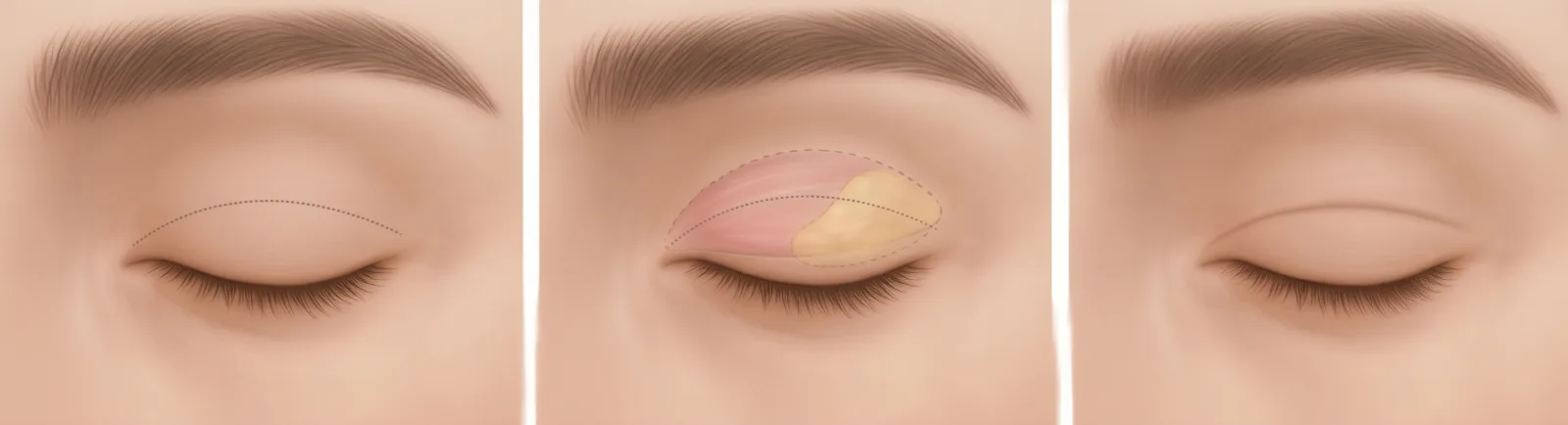
Illustration: the crease is set through an incision along the planned fold; the tissue beneath (muscle in pink, fat in yellow) is adjusted so the crease holds.
The trade-off compared with the buried-suture method is a slightly longer recovery and, because there is a genuine incision, a fine line along the crease. That line is placed within the fold, so once healed it typically settles into the crease and becomes difficult to see. Because the technique can also address fat and skin, it handles eyelids the non-incision method cannot.
Notably, the incision method also allows ptosis correction to be added in the same operation if the eye-opening muscle is weak, which is a common reason it is chosen over the buried-suture route.
Ptosis
When a weak eye-opening muscle is involved
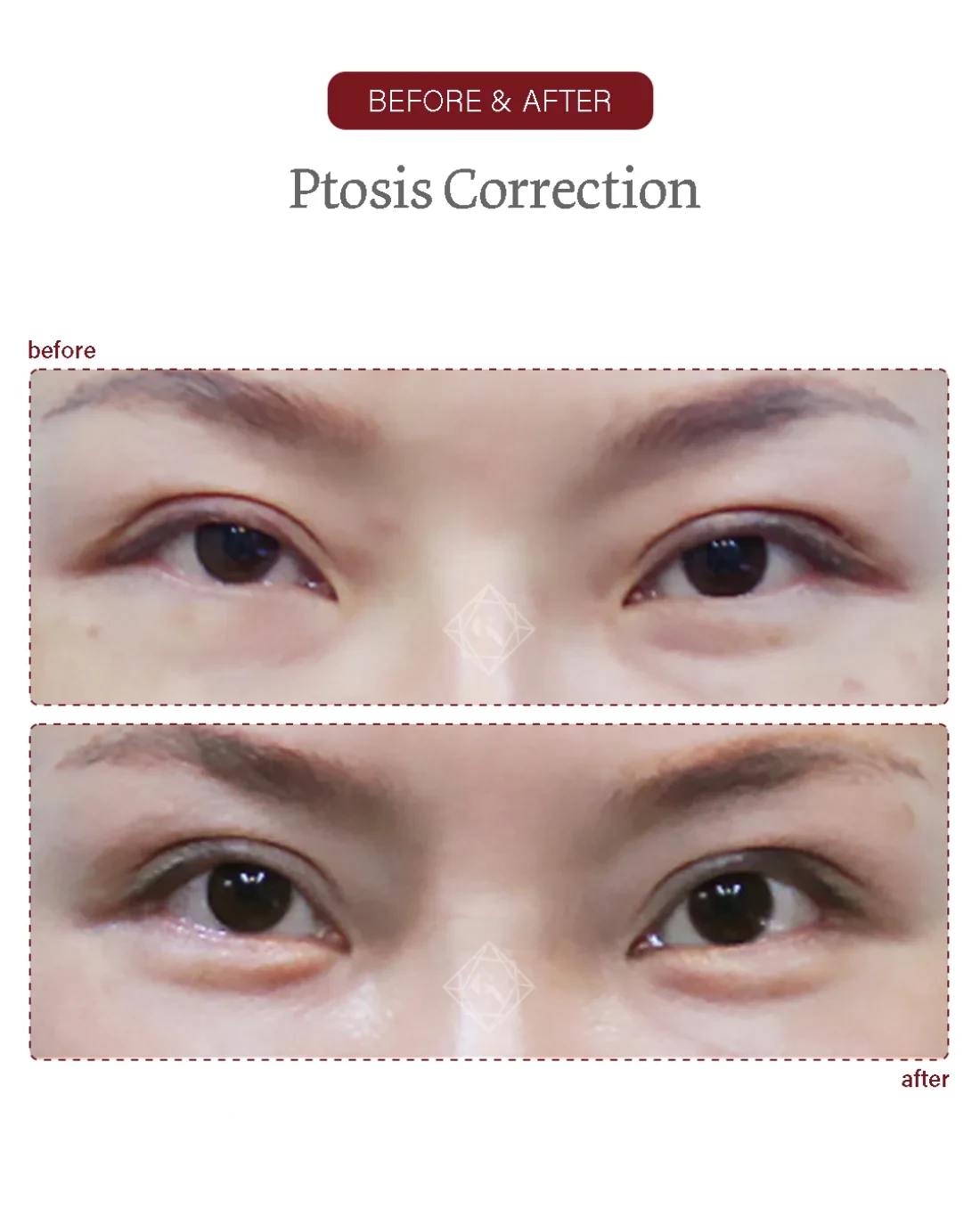
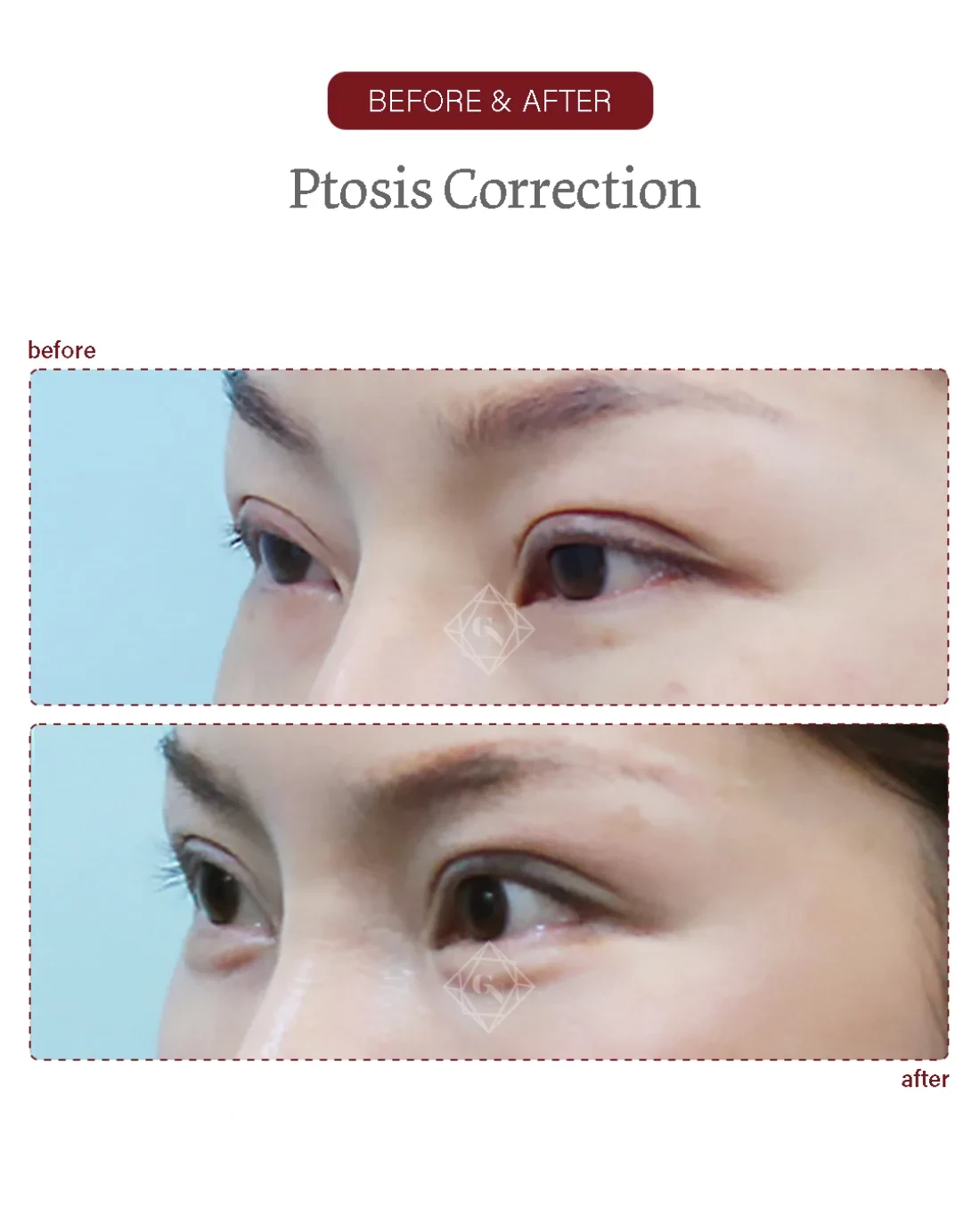
Many people who want a double eyelid also have a degree of ptosis: the muscle that opens the eye is a little weak, so the lid margin sits low and the eye looks sleepy. If you create a crease but leave that weakness untreated, the eye can still look half-closed even with a lovely new fold, and the two eyes may look uneven. In these cases ptosis correction (adjusting the strength of the eye-opening muscle through the same crease incision) is combined with the double-eyelid surgery so the eye both gains a fold and opens more fully.
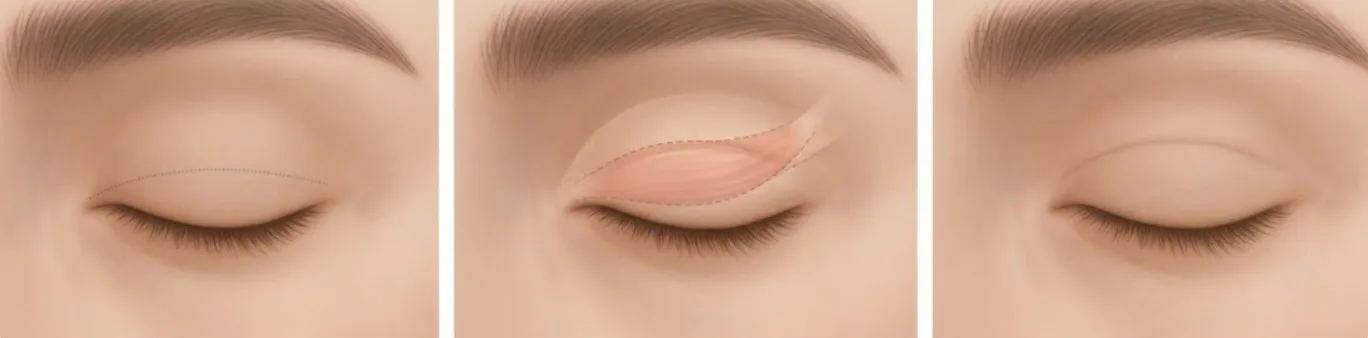
Illustration: through the crease line, the muscle that opens the eye (shown beneath the lid) is tightened so the lid rests higher.
This is one of the most important reasons an assessment matters before choosing a method. A person may ask simply for a crease, when the more complete answer is a crease plus a small muscle adjustment. Because ptosis correction is done through an incision, it naturally pairs with the incision double-eyelid method. The buried-suture method has no incision to work through.
Not everyone with a monolid has ptosis, and adding muscle work when it is not needed is over-treatment. The consultation exists to work out whether your eye needs only a fold, or a fold and a muscle adjustment together.
Which method
Which method suits your eyelid
The choice comes down to your anatomy: thin lids with limited fat, firm skin and no muscle weakness often do beautifully with the light non-incision method; thicker or fattier lids, lids needing a little skin or fat adjusted, or patients wanting a firmly defined and durable fold generally suit the incision method; and where the eye-opening muscle is weak, ptosis correction is added. Neither method is superior; the question is which fits your lid.
This is a hands-on judgement about skin thickness, fat volume, tissue firmness and muscle strength, and it is not something you can settle from a photo or a trend. A careful surgeon will sometimes steer you away from the method you arrived asking for, because your eyelid would hold a better, longer-lasting result with the other one. A crease height and shape that suit your face are also part of the discussion. A natural, in-fold crease reads very differently from a high, dramatic one.
A candid consultation may tell you that a subtle, natural fold is likely to suit your monolid better than a bold one, and that is a good sign.
At Garnet
How Garnet decides the method
Garnet is a single-surgeon clinic in Apgujeong, Seoul. Dr. In-Soo Baek is a board-certified plastic surgeon (Korean medical licence no. 77407) who examines your lid thickness, fat, skin and eye-opening muscle, then recommends the buried-suture method, the incision method, or an incision with ptosis correction depending on what your eyelid actually needs. He also discusses a crease height that suits your face instead of a trend. The same surgeon who assesses you performs the surgery and reviews you at follow-up, so the plan and the result stay consistent.
With the schedule capped at two surgeries a day, the consultation is unhurried, and the aim is a natural-looking crease that reads as your own eye. Garnet is registered with Korea's foreign-patient programme, so you can begin with an online consultation: send photos of your eyes open and closed, describe the look you have in mind, and get a clear view of which method is likely to suit you before you plan any travel.
Real Results
Before & After
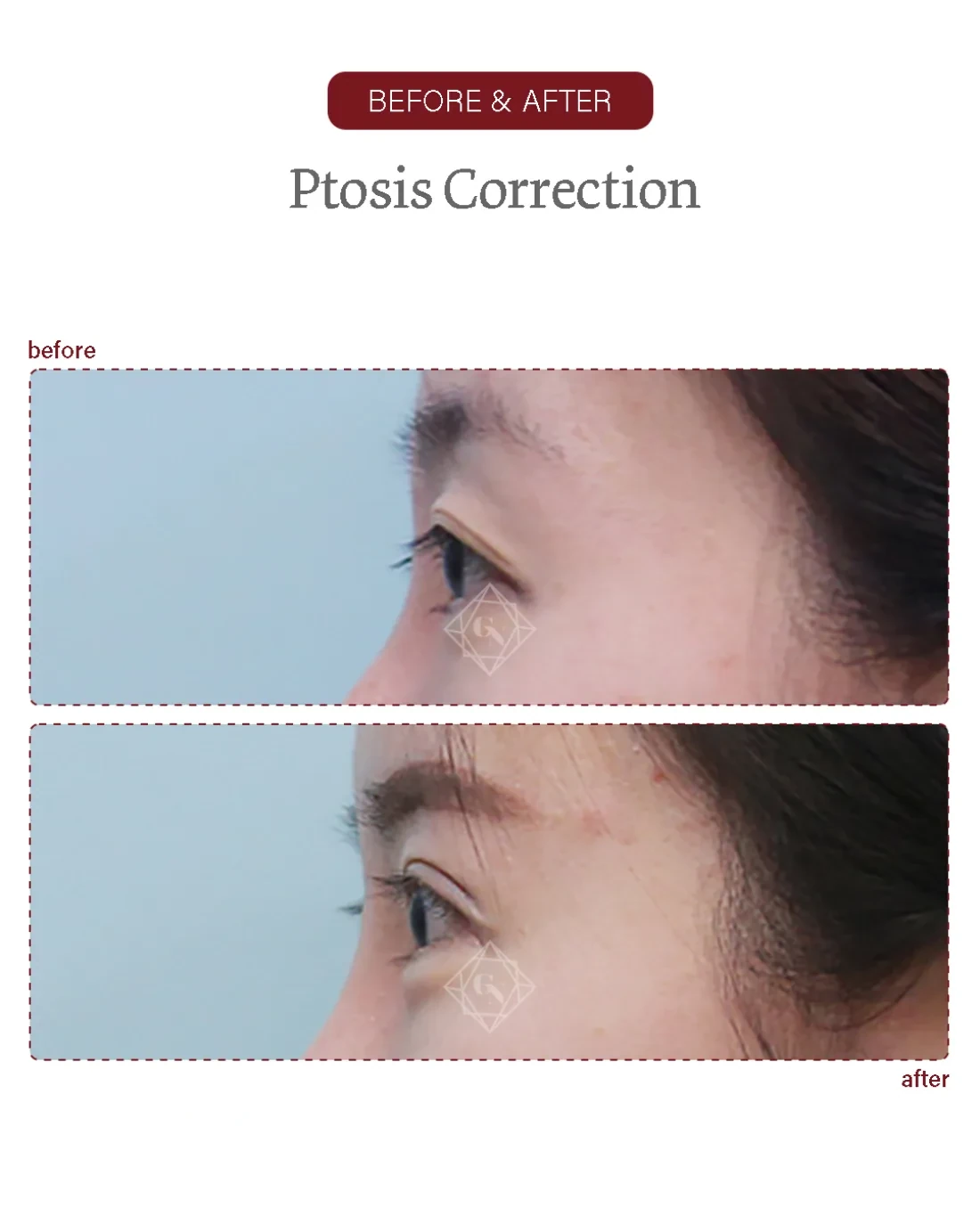
Ptosis-correction before/after examples of actual Garnet patients (published with consent). Results, recovery and suitability vary by individual and are not guaranteed; the right approach is decided at an in-person consultation.
Dr. In-Soo Baek
Director & sole operating surgeon
Korean medical licence no. 77407
Operate on what you came for. Trained at Korea University Medical Center. Every case planned, performed and reviewed by the same hands.
1Operating surgeon
~2Surgeries per day
7Registered techniques
Board-certified plastic surgeon
Plastic surgery training at Korea University College of Medicine & graduate school
Korean Society of Plastic and Reconstructive Surgeons member, in its facial-contour, eye & rhinoplasty groups
Consults, operates and follows up each case himself
Peer-reviewed papers behind the facts on this page. Each describes findings in its own study group — not results at Garnet — and none predicts your own outcome.
Lam SM. Asian Blepharoplasty. Facial Plastic Surgery Clinics of North America. 2014. doi:10.1016/j.fsc.2014.04.002
Okumura K et al. Effect of Upper Eyelid Fat Removal on Reoperation Rate and Long-Term Stability in Buried Suture Double Eyelid Surgery: A 4.5-Year Retrospective Cohort Study. Aesthetic Plastic Surgery. 2025. doi:10.1007/s00266-025-05492-6
Jinghe Z et al. Three Mini-Incision Double-Eyelid Blepharoplasty. Annals of Plastic Surgery. 2014. doi:10.1097/sap.0b013e318264fd40
Shi J et al. Orbicularis–levator–tarsus fixation suturing in buried suture double-eyelid blepharoplasty. Journal of Plastic, Reconstructive & Aesthetic Surgery. 2022. doi:10.1016/j.bjps.2021.11.012
FAQ
Common questions
Can a monolid become a double eyelid?
Yes. A crease is created by forming a fixed connection between the eyelid skin and the underlying structures, either with buried sutures (the non-incision method) or through a full incision. If the eye-opening muscle is also weak, ptosis correction can be added. Which method suits you depends on your eyelid, confirmed at a consultation.
Incision or non-incision for a monolid?
It depends on your lid. Thin lids with limited fat and firm skin often do well with the non-incision (buried-suture) method, which recovers faster. Thicker or fattier lids, or those wanting a very defined, durable crease, usually suit the incision method, which can also adjust skin and fat. A hands-on assessment decides between them.
How is an eyelid crease created?
By fixing the eyelid skin to the deeper lid structures so a fold forms as the eye opens. The non-incision method does this with fine buried sutures; the incision method does it through a full crease incision that can also tidy skin and fat. Both aim for a consistent, natural-looking fold.
Does non-incision double eyelid last?
It can hold well on suitable eyelids: thinner, less fatty lids with good elasticity. On thicker or heavier lids the buried sutures have more to hold and the crease may loosen or fade over time, which is why the incision method is often preferred for those lids. Suitability is assessed at consultation.
Will the crease leave a visible scar?
The non-incision method has no long incision, so there is no external scar line. The incision method leaves a fine line along the crease, but because it sits within the fold, it typically settles into the crease once healed and becomes difficult to see. Which applies depends on the method chosen for your lid.
Do I need ptosis correction with my double eyelid?
Only if the eye-opening muscle is weak. Many people who want a crease also have some ptosis, and correcting it at the same time lets the eye open fully as well as gaining a fold. But if the muscle is strong, adding muscle work is unnecessary. A consultation confirms whether it applies to you.
How long is recovery after double-eyelid surgery?
The non-incision method is lighter, with sutures removed at around five days and quicker settling. The incision method has sutures out at around seven days, with swelling and bruising easing over roughly two to three weeks and fine settling over a few months. Your surgeon gives a timeline for your chosen method.
Can I choose how high my crease is?
The crease height and shape are discussed at consultation, balancing what you'd like with what suits your eye and face. A natural, in-fold crease looks very different from a high, dramatic one, and a careful surgeon will advise on what is likely to look natural on you, without simply following a trend.
Can I get an assessment before flying to Korea?
Yes. Garnet is registered with Korea's foreign-patient programme and offers an online consultation: send photos of your eyes open and closed, describe the look you have in mind, and get a clear view of which method is likely to suit you before you commit to travel.
Will the same surgeon who assesses me do the operation?
Yes. Garnet is a single-surgeon clinic, so the board-certified surgeon who examines your eyelids and recommends the method is the one who performs the surgery and reviews you at follow-up. That continuity keeps the plan and the result aligned.
My mom recently had a brow lift and lower blepharoplasty with Dr. Baek, and our experience has been wonderful so far. The Garnet team was incredibly kind and welcoming, with Kelly assisting us as our English consultant—she made everything…
I’m so happy I chose this clinic for my lower blepharoplasty. I was traveling from abroad by myself, so I was a little nervous, but from the beginning I felt comfortable and truly cared for. Everyone was kind, patient, and professional…
Came in for an in-person consult and ended up choosing Garnet and Dr.Baek for my non-incisional DES and tiplasty/alarplasty. I communicated with Kelly (English consultant) from the start till now (3 weeks post-op). She really help me feel…
My under-eyes have been sagging and folding for years... I tried to cover it up with makeup, but it actually got stuck in the wrinkles and made it stand out even more. While going for consultations, I noticed that the bigger the hospital…
Send photos and your question before you travel. An English-speaking coordinator reviews every enquiry and replies with guidance on whether surgery is appropriate, the likely plan and timing.
✓ Reviewed by the clinic coordinator, not a bot
✓ Photo-based pre-assessment before you fly
✓ Foreign-patient scheduling & after-care
✓ One surgeon for consultation, surgery and follow-up
Prefer to chat now? Reach the coordinator directly:







 T S7 months ago



