Many patients travelling to Korea for work on the nose, eyelids or a sagging jawline want a modest change. They want to look rested and a little younger while staying unmistakably themselves, and they are quietly worried about coming home looking "done." A natural result is less about a single technique and more about a philosophy: restraint, respecting your existing features, and a surgeon who plans conservatively and stands behind the plan.
The short answer
A natural look is an approach with no guaranteed outcome. It comes from conservative planning that preserves your identity; no single "secret" technique produces it.
Overdone results usually trace back to over-correction: too much removed, lifted or added, or several aggressive procedures stacked at once.
When the same surgeon consults, operates and follows up on every case, the conservative plan agreed at consultation is the plan actually carried out.
The strongest signal you will get a subtle result is a surgeon willing to advise less, or to advise against surgery altogether.
"Natural" is best understood as an approach, and no surgeon can guarantee it. It means the result works in harmony with the rest of your face (your bone structure, your expressions, the way you have always looked in photographs), so that people notice you seem well and do not notice surgery. The goal at Garnet is captured in a single idea: younger, but still yourself. Nobody's face is symmetrical or "perfect" to begin with, and chasing an idealised template is exactly how results start to look generic and worked-on.
A subtle outcome usually comes from doing less. A conservative surgeon removes a little less skin, projects a nose tip a little less, grafts a little less fat than the maximum a face could technically take, because a small, well-judged change reads as natural, while an aggressive one announces itself. Restraint also leaves room: it is far easier to refine a result that was slightly under-done than to reverse one that was over-corrected.
This is why a natural result should never be sold as a fixed promise. Skin quality, healing, age and anatomy all vary between patients, so a careful surgeon talks about a realistic range for you specifically and avoids promising a single idealised outcome. If you want the fuller picture of how to avoid a worked-on appearance, our companion guide on avoiding an overdone look goes deeper into the warning signs.
The overdone look
Why some results look overdone
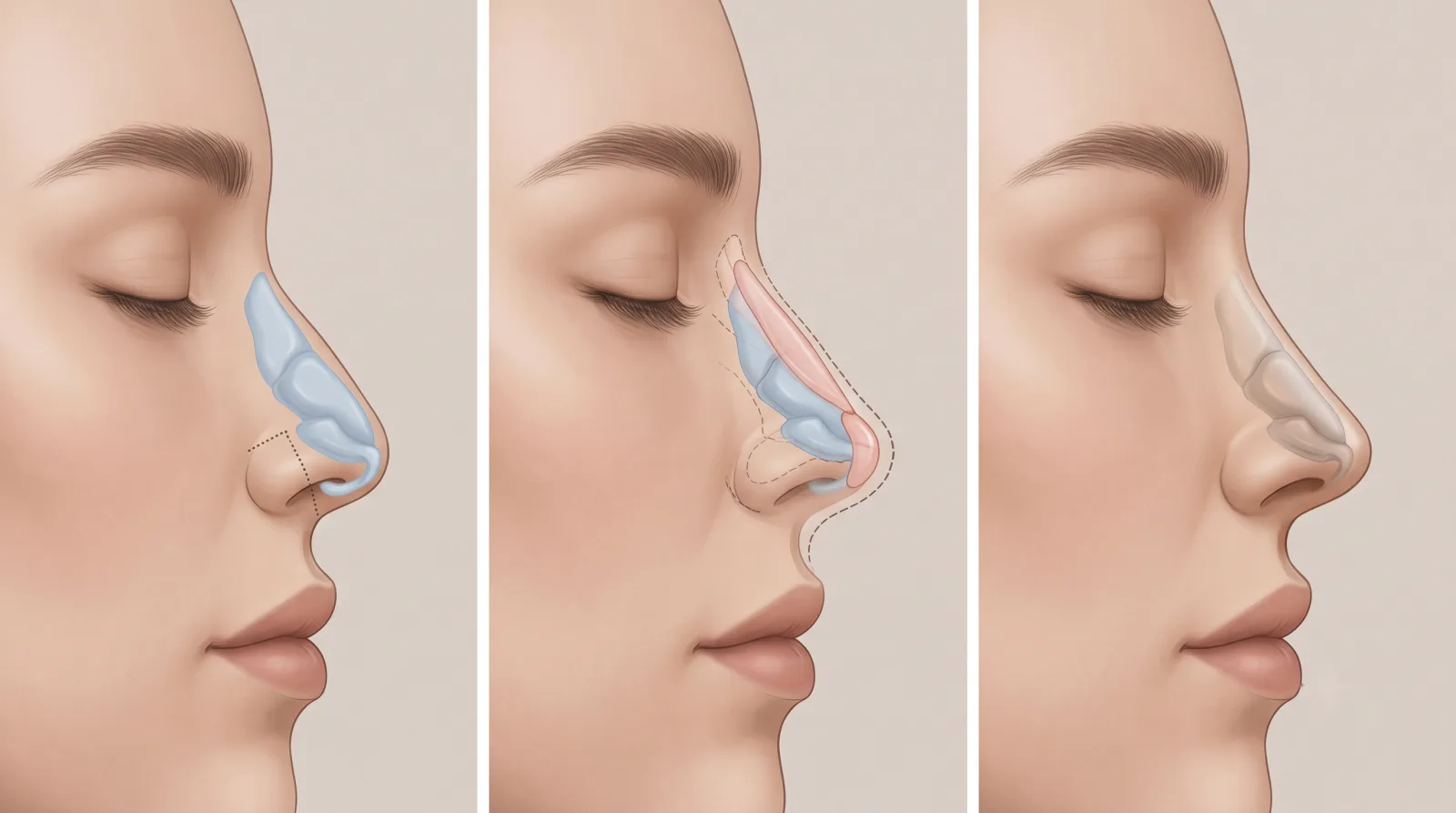
An overdone look is rarely bad luck. It almost always traces back to over-correction, the surgical decision to take the change too far. In the nose, an over-projected or over-narrowed tip using too much implant or cartilage can look pinched and unnatural; a more balanced rhinoplasty that combines a modest dorsal line with the patient's own tip cartilage tends to sit more quietly on the face.
Illustration: the nasal framework (blue) is reshaped to raise the bridge and refine the tip. The dashed outline shows the original contour.
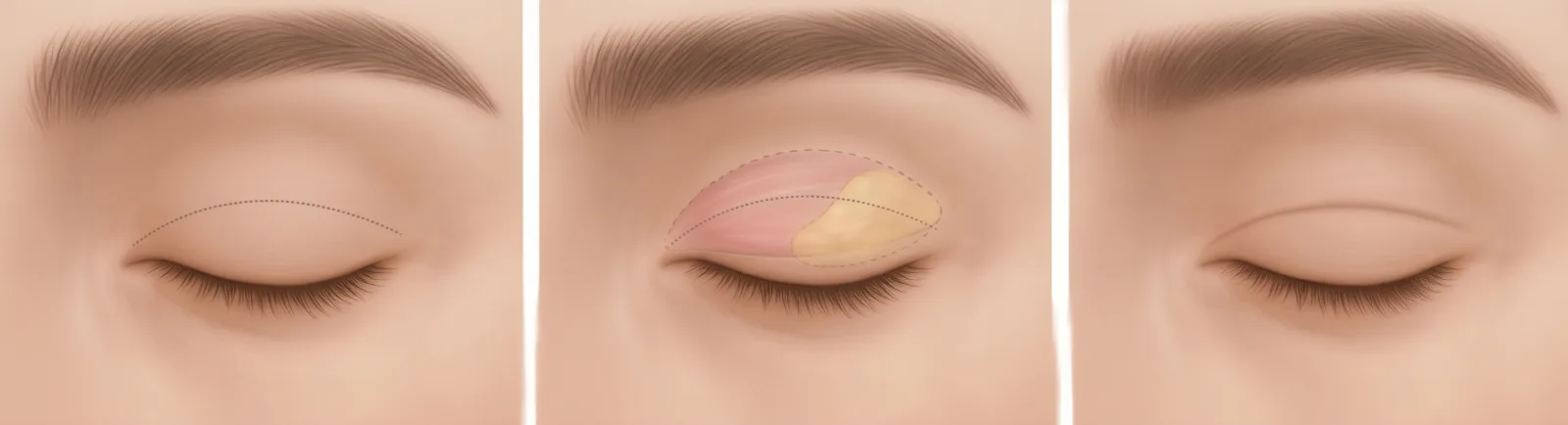
The same pattern shows up around the eyes. An incision double-eyelid crease set too high or too deep can create a permanently startled, "operated" appearance, whereas a crease matched to your own eye shape reads as natural. In facial lifting, skin pulled too tight produces the classic swept, wind-blown look; a modern deep-plane facelift repositions the deeper SMAS layer so the skin is redraped without tension. And with fat grafting, over-filling leaves cheeks looking puffy or heavy where they should look softly restored.
The other common cause is stacking: several aggressive procedures done at once, each pushed to its limit, so the changes compound into a face that no longer looks like the person who booked the surgery. Restraint on each individual procedure, and a willingness to stage or decline some of them, is what keeps the overall result recognisably you.
Single-surgeon care
Why one surgeon supports a subtle result
A conservative plan is only worth as much as the certainty that it will actually be carried out. In some clinics the surgeon who consults you is not the surgeon who operates, and care is rotated across staff and rooms. The careful, restrained plan you agreed can then drift in the operating room. That gap between consultation and surgery is one reason results sometimes come out more aggressive than a patient expected.
Garnet is a single-surgeon clinic in Apgujeong, Seoul. Dr. In-Soo Baek, a board-certified plastic surgeon (Korean medical licence no. 77407), is the only operating doctor: he consults, plans the conservative approach, performs the operation himself, and reviews every follow-up. The clinic caps the day at two surgeries, roughly one patient per hour, so no case is rushed and fine judgement is not traded for volume.
That continuity matters for subtlety in a very practical way. The person weighing exactly how much to lift, remove or graft during surgery is the same person who assessed your face and understood what you wanted to preserve. If you want to be sure this is how a clinic works, confirming in writing who operates is the single most useful question you can ask, and our guide to ghost surgery and single-surgeon care explains why.
Where restraint matters
Where restraint matters most, procedure by procedure
Different procedures fail to look natural in different ways, so a surgeon's restraint has to be procedure-specific. In rhinoplasty, a natural nose usually comes from a modest silicone dorsal augmentation combined with the patient's own septal or ear cartilage at the tip. A tall, over-defined bridge tends to dominate the face. The aim is a nose that suits your other features.
Illustration: the crease is set through an incision along the planned fold; the tissue beneath (muscle in pink, fat in yellow) is adjusted so the crease holds.
For the eyes, an incision double-eyelid looks most natural when the crease height and depth are chosen to match your own eye and brow position, subtle enough that friends simply see brighter eyes. In facial ageing, a deep-plane facelift restores the position tissues held years ago by releasing and repositioning the deeper layer, so the correction comes from underneath, with no tension on the skin surface.
Volume is its own discipline. Fat grafting can soften hollows in the under-eye, temples or cheeks, but a natural result depends on placing conservative amounts in the right planes. Over-filling is one of the most common reasons a restored face looks heavy or puffy instead of simply rested. Across all of these, the right surgical answer is sometimes to treat only one area, or to graft or lift less than the maximum, because the sum should still read as you.
Choosing a surgeon
How to choose a surgeon who works this way
You can usually tell a conservative surgeon from the consultation itself. They ask what you want to keep as well as what you want to change; they talk in terms of a realistic range; and they are comfortable recommending less surgery, or none, when that genuinely serves you. A hard sell, a push to add extra procedures, or a promise of a "perfect" result all point the other way. Our guide on avoiding an overdone look lists more of these signs.
Verify the fundamentals too. Confirm the surgeon is a board-certified plastic surgeon with specialist training beyond a general medical licence, and confirm in writing that this same surgeon will perform your whole operation and see you through recovery. Ask how many of your specific procedure they do, and how follow-up works after you fly home. These questions do more for a natural, safe result than any single technique on a clinic's website.
You do not need to travel to have this conversation. You can send photos and describe your concerns in an online consultation from abroad and receive a pre-assessment that includes, where appropriate, the advice that a smaller change, or no surgery, would suit you better. At Garnet the same board-certified surgeon then plans, operates and follows up at 1, 3 and 6 months, so the conservative plan you agreed is the plan you get.
Dr. In-Soo Baek
Director & sole operating surgeon
Korean medical licence no. 77407
Operate on what you came for. Trained at Korea University Medical Center. Every case planned, performed and reviewed by the same hands.
1Operating surgeon
~2Surgeries per day
7Registered techniques
Board-certified plastic surgeon
Plastic surgery training at Korea University College of Medicine & graduate school
Korean Society of Plastic and Reconstructive Surgeons member, in its facial-contour, eye & rhinoplasty groups
Consults, operates and follows up each case himself
Peer-reviewed papers behind the facts on this page. Each describes findings in its own study group — not results at Garnet — and none predicts your own outcome.
Kappos EA et al. Validating Facial Aesthetic Surgery Results with the FACE-Q. Plastic & Reconstructive Surgery. 2017. doi:10.1097/prs.0000000000003164
Klassen AF et al. FACE-Q Scales for Health-Related Quality of Life, Early Life Impact, Satisfaction with Outcomes, and Decision to Have Treatment. Plastic and Reconstructive Surgery. 2015. doi:10.1097/prs.0000000000000895
Sinno S et al. Face-Lift Satisfaction Using the FACE-Q. Plastic and Reconstructive Surgery. 2015. doi:10.1097/prs.0000000000001412
FAQ
Common questions
What makes plastic surgery results look natural?
Natural results come mostly from restraint and proportion: changing a little less than a face could technically take, and matching the change to your existing features instead of an idealised template. Techniques matter, but the bigger factor is a surgeon who plans conservatively and preserves what makes you look like you.
Is plastic surgery in Korea always dramatic?
No. Korea is known for high volume and for some dramatic transformations, but many Korean surgeons work in a conservative, identity-preserving style. Whether a result is subtle or dramatic depends on the individual surgeon's philosophy and the plan you agree together. The country does not decide it.
How do I avoid looking overdone?
Avoid over-correction and over-stacking: choose a surgeon who recommends less, who declines procedures that will not help you, and who talks about a realistic range for your face. Confirming that the same surgeon plans and performs your operation also helps the conservative plan survive into the operating room.
Can a natural result be guaranteed?
No responsible surgeon guarantees a specific outcome. A natural look is an approach. Healing, skin quality, age and anatomy all vary between patients, so a good surgeon discusses a realistic range for you specifically.
Which procedures most often look overdone, and why?
Rhinoplasty (an over-projected or over-narrowed tip), incision double-eyelid surgery (a crease set too high), facelifts (skin pulled too tight) and fat grafting (over-filling) are the common ones. In each case the cause is the same: taking the change too far. The procedure itself is not the problem.
Does a single-surgeon clinic really help with a natural look?
It helps because the surgeon who judged your face and agreed a conservative plan is the same one making the fine decisions during surgery. If a different doctor operates, the person who judged how much to change your nose, eyelids or jawline is no longer in the room. At Garnet, Dr. In-Soo Baek consults, operates and follows up himself, and the day is capped at two surgeries.
How do I know if a surgeon is conservative before I book?
Listen for how they consult. A conservative surgeon asks what you want to keep, offers a realistic range for your face, and is willing to recommend less surgery or none. A push to add procedures or a guarantee of perfection are signs to be cautious. You can gauge this in an online consultation before travelling.
Is a subtle result more expensive than a dramatic one?
Not inherently. A natural result comes from judgement and planning and is not a premium add-on. What affects value is the surgeon's experience, the appropriateness of the plan and the after-care. How dramatic the change is does not set the price. It is worth discussing what is included at consultation.
Can an overdone result from another clinic be softened later?
Sometimes, though revision is more complex than an original procedure and outcomes vary with the tissue involved. This is exactly why restraint the first time matters: an under-done result is far easier to refine than an over-corrected one. A conservative surgeon can assess an existing result candidly and explain what is realistic.
Does Garnet treat international patients who want a natural look?
Yes. Garnet is registered with Korea's foreign-patient programme and works in a conservative, identity-preserving style, with the same board-certified surgeon consulting, operating and following up at 1, 3 and 6 months. You can start with an online pre-assessment before planning any travel.
My mom recently had a brow lift and lower blepharoplasty with Dr. Baek, and our experience has been wonderful so far. The Garnet team was incredibly kind and welcoming, with Kelly assisting us as our English consultant—she made everything…
I’m so happy I chose this clinic for my lower blepharoplasty. I was traveling from abroad by myself, so I was a little nervous, but from the beginning I felt comfortable and truly cared for. Everyone was kind, patient, and professional…
Came in for an in-person consult and ended up choosing Garnet and Dr.Baek for my non-incisional DES and tiplasty/alarplasty. I communicated with Kelly (English consultant) from the start till now (3 weeks post-op). She really help me feel…
My under-eyes have been sagging and folding for years... I tried to cover it up with makeup, but it actually got stuck in the wrinkles and made it stand out even more. While going for consultations, I noticed that the bigger the hospital…
Send photos and your question before you travel. An English-speaking coordinator reviews every enquiry and replies with guidance on whether surgery is appropriate, the likely plan and timing.
✓ Reviewed by the clinic coordinator, not a bot
✓ Photo-based pre-assessment before you fly
✓ Foreign-patient scheduling & after-care
✓ One surgeon for consultation, surgery and follow-up
Prefer to chat now? Reach the coordinator directly:







 T S7 months ago



