A neck lift is done under anaesthesia, so you feel nothing during the operation, and the days afterwards are usually described as tightness and pressure around the neck more than sharp pain. For many people considering a neck lift, pain is a bigger worry than the result. Knowing what to expect, and how it is managed, takes most of the fear out of the decision.
The short answer
You feel nothing during a neck lift. It is performed under anaesthesia, typically sedation with local anaesthetic or general anaesthesia depending on the plan.
Afterwards, most people describe tightness, pressure and a stiff neck more than severe pain. This is a normal, expected part of the deeper layer being tightened.
Discomfort is usually managed well with prescribed pain relief and eases markedly over the first few days; sutures come out at around 10 to 14 days.
The tight, pulled feeling around the jaw and neck is a sign the platysma and deeper layer were supported. It loosens as swelling settles over the following weeks.
During the operation itself you feel nothing. A neck lift is performed under anaesthesia, so the surgery (the small incision under the chin and behind the ears, the tightening of the platysma muscle and the support of the deeper SMAS layer) happens while you are comfortably unaware of it. The fear of "feeling the surgery" is the most common worry patients raise, and it is precisely the part anaesthesia removes entirely.
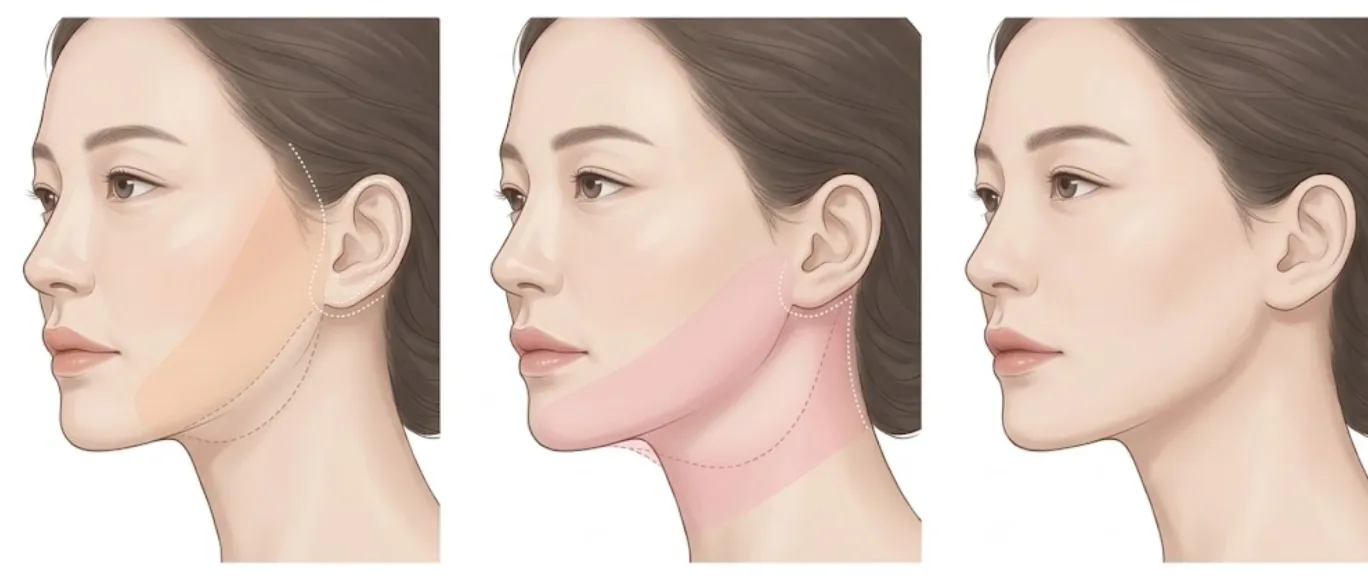
Illustration: through a fine line around the ear (dotted), the sagging lower face and neck are lifted up and back toward the ear (shaded); the dashed outline shows the old contour.
What patients are really asking about, then, is the time afterwards. The recovery from a neck lift is generally described in terms of tightness, pressure and stiffness, with little sharp or severe pain. It is real discomfort that deserves to be taken seriously and managed properly, but it is usually milder and more manageable than people fear before surgery.
Because the operation works on the deeper layer and does not rely on pulling skin, the sensations afterwards are dominated by that deeper tightening: a snug, pulled feeling around the jaw and neck. Understanding that this is expected, and not a sign that something is wrong, is half of what makes the recovery feel manageable.
Anaesthesia
The anaesthesia used for a neck lift
A neck lift is carried out under anaesthesia chosen to suit the extent of the operation and your medical assessment, commonly sedation combined with local anaesthetic, or general anaesthesia. Under sedation with local anaesthetic you are in a deeply relaxed, sleep-like state and the surgical area is numbed, so you feel no pain; under general anaesthesia you are fully asleep throughout. Which is appropriate depends on factors such as whether the neck lift is being combined with other work, and on your health, and it is decided with the surgeon before the day.
Either way, the goal is the same: that you experience none of the operation and that your safety is monitored throughout. The local anaesthetic also helps with comfort in the early hours after you wake, because the area stays numb for a time as you come round, easing the transition into recovery. This is a routine, well-established part of how the operation is delivered.
It is worth raising any past experience with anaesthesia, medications you take and your medical history at the consultation, because these shape the anaesthetic plan. At a single-surgeon clinic the surgeon who assesses you is the one planning your operation, so the anaesthesia is matched to you. You can ask exactly what will be used and why before you commit.
Afterwards
Pain and tightness after a neck lift
When the anaesthetic wears off, the dominant sensation for most people is tightness and pressure around the neck and jawline, with little sharp pain. The neck feels stiff and snug, turning your head feels restricted, and there is often a sense of fullness from swelling. Many patients say the strangeness of the tightness surprises them more than any actual pain. It is the feeling of the deeper layer having been firmly supported.
That tight, pulled feeling is normal and, in a sense, reassuring: it reflects the platysma and SMAS having been tightened, which is exactly what gives the operation its lasting result. It is not a sign that anything is wrong. Mild to moderate soreness, some bruising and swelling, and a stiff neck are all expected in the first days, and a dressing or support garment may add to the snug sensation while helping the tissues settle.
Everyone's threshold differs, so realistic ranges matter more than promises. Some people need very little pain relief; others rely on their prescribed medication for the first few days. What is consistent is that the discomfort is generally manageable with the medication provided and eases steadily. The tightness can feel intense at first, and it loosens as swelling subsides over the following weeks. Our guide on how long a neck lift lasts explains why that same deeper tightening is what makes the result durable.
Day by day
How discomfort eases day by day
The first day or two are when tightness and swelling peak. You will feel snug and stiff, may have some soreness, and are advised to rest with your head elevated, which helps reduce swelling and the pressure sensation. This is the point at which prescribed pain relief is most useful, and most people find it keeps them comfortable, without significant pain.
Over the next several days the picture improves noticeably. Soreness fades, bruising begins to change colour and recede, and the sharp newness of the tightness softens into a more tolerable snugness. Many people are off stronger pain relief within the first few days and managing with simple measures, even though the neck still feels tight and turning the head is not yet free. Sutures come out at around 10 to 14 days, by which point the most uncomfortable phase is well behind you.
From there the timeline is mostly about the tightness loosening. Over the following weeks, as swelling continues to settle, the pulled feeling around the jaw and neck gradually relaxes and movement returns to normal. A degree of tightness that lingers for a while is expected and is part of the tissues settling into their new, supported position. It is not pain, and it resolves with time. The same deeper support that causes it is what holds the result, so it is a normal stage of neck lift recovery.
Managing it
How discomfort is managed
Discomfort after a neck lift is managed in straightforward, well-established ways. You are given prescribed pain relief to take as directed in the early days, which for most people keeps them comfortable through the peak of tightness and soreness. Keeping your head elevated, resting, and following the aftercare instructions on activity all reduce swelling and therefore the pressure sensation, and any dressing or support garment is there to help the tissues settle while you heal.
Knowing what is normal is itself a form of pain management. The tightness, the stiff neck, the fullness and the mild soreness are expected, so they cause far less anxiety when you are told to expect them in advance. Clear guidance on what is normal versus what should prompt a question means you are not left wondering. Being able to reach your surgeon with a concern is reassuring in the first weeks.
After international patients return home, the same surgeon can continue to review recovery remotely, so questions about discomfort or the settling tightness are answered by the person who operated. Structured follow-up (at Garnet, at 1, 3 and 6 months) also means the easing of tightness and the final comfortable result are checked over time, and you are not left to judge alone.
At Garnet
Comfort and safety with a neck lift at Garnet
Garnet is a single-surgeon clinic in Apgujeong, Seoul. Dr. In-Soo Baek, a board-certified plastic surgeon (Korean medical licence no. 77407), is the clinic's only operating doctor. He assesses your neck, plans the anaesthesia to suit you, performs the neck lift himself and reviews every follow-up. Because one surgeon carries the case from consultation to recovery, the anaesthetic plan and your comfort afterwards are managed by the person who knows exactly what was done.
The clinic's unhurried model supports comfort directly: with a capped daily schedule, your operation is not rushed and your recovery is given proper attention. There is no consultation or CT fee and no pressure to book the same day, so you can ask in full what anaesthesia will be used, what the recovery feels like and how discomfort is managed before you decide anything. Garnet is registered with Korea's foreign-patient programme for international visitors.
If your main hesitation about a neck lift is the pain, the simplest reassurance is a direct conversation in a no-obligation online consultation from abroad. You can ask exactly what anaesthesia would be planned for you, what the first days realistically feel like and how the tightness eases, and send photos for a pre-assessment, all before you commit to any travel.
Dr. In-Soo Baek
Director & sole operating surgeon
Korean medical licence no. 77407
Operate on what you came for. Trained at Korea University Medical Center. Every case planned, performed and reviewed by the same hands.
1Operating surgeon
~2Surgeries per day
7Registered techniques
Board-certified plastic surgeon
Plastic surgery training at Korea University College of Medicine & graduate school
Korean Society of Plastic and Reconstructive Surgeons member, in its facial-contour, eye & rhinoplasty groups
Consults, operates and follows up each case himself
Peer-reviewed papers behind the facts on this page. Each describes findings in its own study group — not results at Garnet — and none predicts your own outcome.
Smith RM et al. Difficult Necks and Unresolved Problems in Neck Rejuvenation. Clinics in Plastic Surgery. 2018. doi:10.1016/j.cps.2018.06.009
Marten T et al. Short Scar Neck Lift. Clinics in Plastic Surgery. 2018. doi:10.1016/j.cps.2018.06.005
Jacono AA et al. Vertical Neck Lifting. Facial Plastic Surgery Clinics of North America. 2014. doi:10.1016/j.fsc.2014.01.006
FAQ
Common questions
Is a neck lift painful?
You feel nothing during the operation, as it is performed under anaesthesia. Afterwards, most people describe tightness, pressure and a stiff neck, with little sharp or severe pain. There is mild to moderate soreness in the first days, generally well controlled with prescribed pain relief, and it eases steadily as swelling settles.
What anaesthesia is used for a neck lift?
A neck lift is performed under anaesthesia chosen to suit the operation and your medical assessment: commonly sedation with local anaesthetic, or general anaesthesia. Under sedation with local anaesthetic you are deeply relaxed and the area is numbed; under general anaesthesia you are fully asleep. The plan is decided with the surgeon before the day.
Will I feel anything during the surgery?
No. Under sedation with local anaesthetic or under general anaesthesia you are unaware of the operation and feel no pain while it is carried out. The local anaesthetic also keeps the area numb for a time as you wake, easing the first hours of recovery.
How much discomfort is there after a neck lift?
Most people describe tightness, pressure and stiffness around the neck and jaw, with mild to moderate soreness; intense pain is uncommon. Thresholds vary. Some need very little pain relief and others use their prescription for the first few days, but the discomfort is usually manageable and eases markedly over the first several days.
Why does my neck feel so tight after a neck lift?
The tight, pulled feeling comes from the platysma muscle and the deeper SMAS layer having been tightened, which is exactly what gives the operation its lasting result. It is normal and expected, and it gradually loosens as swelling settles over the following weeks.
How long does the pain last after a neck lift?
Soreness is usually most noticeable in the first day or two and improves over the following several days, with many people off stronger pain relief within the first few days. The tightness lasts longer than the soreness, easing over the weeks as swelling subsides. Sutures come out at around 10 to 14 days, by which point the most uncomfortable phase is behind you.
How is the discomfort managed?
With prescribed pain relief taken as directed, rest with the head elevated to reduce swelling, and following the aftercare instructions; any dressing or support garment helps the tissues settle. Knowing what is normal in advance also reduces anxiety, and being able to reach your surgeon with a concern is reassuring through the early weeks.
Is a neck lift more painful than a facelift?
Both are generally described in terms of tightness and pressure more than severe pain, and both are performed under anaesthesia so the operation itself is not felt. A neck lift combined with a facelift is a larger operation and can involve more overall swelling and tightness. The realistic expectation is manageable discomfort that is well controlled with medication.
Can I ask about pain and anaesthesia before I travel?
Yes. In an online consultation from abroad you can ask exactly what anaesthesia would be planned for you, what the first days realistically feel like and how discomfort is managed, and send photos for a pre-assessment, all before you commit to any travel, so you go in knowing what to expect.
My mom recently had a brow lift and lower blepharoplasty with Dr. Baek, and our experience has been wonderful so far. The Garnet team was incredibly kind and welcoming, with Kelly assisting us as our English consultant—she made everything…
I’m so happy I chose this clinic for my lower blepharoplasty. I was traveling from abroad by myself, so I was a little nervous, but from the beginning I felt comfortable and truly cared for. Everyone was kind, patient, and professional…
Came in for an in-person consult and ended up choosing Garnet and Dr.Baek for my non-incisional DES and tiplasty/alarplasty. I communicated with Kelly (English consultant) from the start till now (3 weeks post-op). She really help me feel…
My under-eyes have been sagging and folding for years... I tried to cover it up with makeup, but it actually got stuck in the wrinkles and made it stand out even more. While going for consultations, I noticed that the bigger the hospital…
If the pain of a neck lift worries you, ask exactly what anaesthesia and recovery to expect in a no-obligation online consultation before you plan a trip.
Send photos and your question before you travel. An English-speaking coordinator reviews every enquiry and replies with guidance on whether a neck lift is appropriate for you, the likely plan and timing.
✓ Reviewed by the clinic coordinator, not a bot
✓ Photo-based pre-assessment before you fly
✓ Foreign-patient scheduling & after-care
✓ One surgeon for consultation, surgery and follow-up
Prefer to chat now? Reach the coordinator directly:









 T S7 months ago



