A neck lift uses real incisions under the chin and behind the ears, so it is fair to ask exactly where they sit, whether anyone will see them, and how they heal over time. The reassuring part is that these incisions are placed where the face naturally conceals them. Understanding the healing timeline is what keeps the early weeks from being a worry.
The short answer
Neck lift incisions sit under the chin (submental) and behind the ears (post-auricular). In both areas natural shadow and contour conceal a fine line.
A fresh scar looks its worst in the first weeks, then fades and flattens over months, so the early appearance is only a stage.
Sutures are removed at roughly 10 to 14 days, and keeping them in for the full window helps the lines heal without widening.
How a scar matures depends on placement, technique and your own skin. Sun protection and gentle scar care in the early months genuinely help.
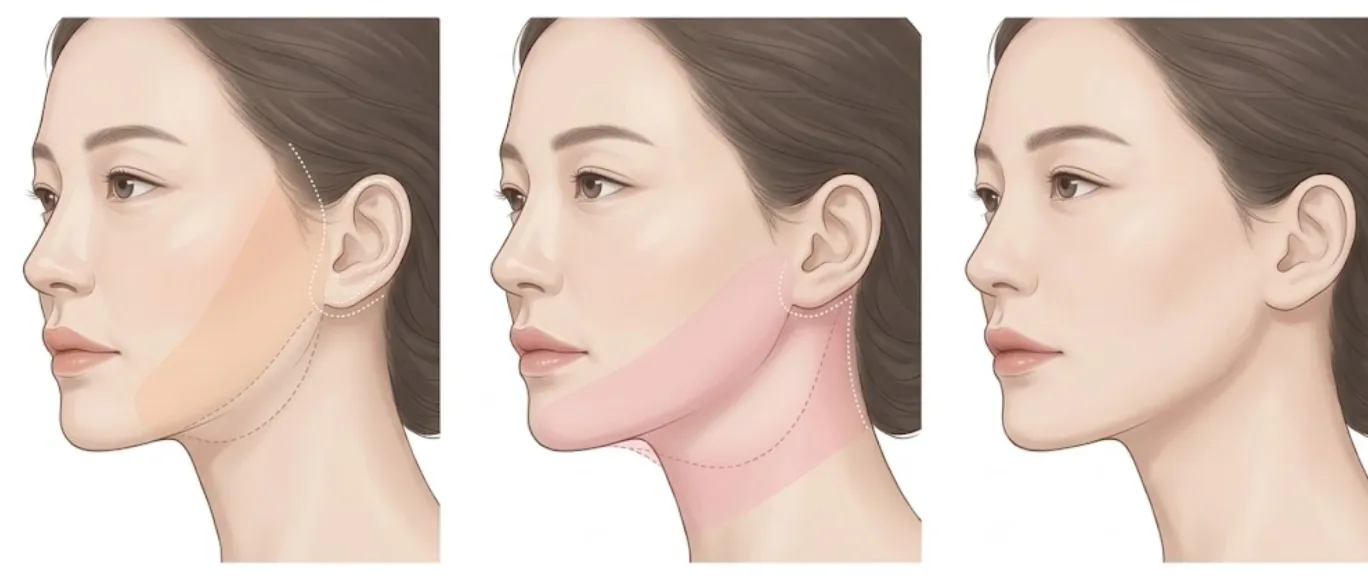
A neck lift uses two well-chosen locations. The first is a small incision under the chin, the submental incision, tucked into the natural crease where the chin meets the neck. This gives the surgeon access to tighten the platysma muscle bands in the midline, which is often what a corset platysmaplasty addresses. The second is behind the ears, the post-auricular incision, following the natural fold where the ear meets the head and curving into the hairline. This is where skin redraping and the deeper SMAS-platysma tightening that redefines the jawline are managed.
Illustration: through a fine line around the ear (dotted), the sagging lower face and neck are lifted up and back toward the ear (shaded); the dashed outline shows the old contour.
Neither incision sits on the front of the neck where it would be exposed. The submental line lives in the shadow under the jaw, and the post-auricular line hides in the crease behind the ear and the hair. Their placement is dictated by where the surgeon needs access to lift the deeper layers, and the locations happen to be the same ones the face uses to conceal a fine scar. The overall procedure is set out on the parent neck lift page.
Exactly how much of each incision is used depends on your anatomy: how much skin laxity there is, whether the platysma bands need bringing together in the midline, and how the jawline needs redefining. That is one reason the plan is confirmed in person and never promised from a photo, as covered in the international patient walkthrough.
Why hidden
Why those locations stay well concealed
The submental incision benefits from geography. It sits in the shadow under the chin, an area that is angled away from straight-on view and naturally shaded by the jaw. Once it has matured to a pale, flat line, it is genuinely difficult to spot unless someone tilts your chin up and looks for it deliberately, and in ordinary conversation no one is doing that.
Behind the ears, the post-auricular incision is concealed two ways at once: it follows the natural crease where the ear folds against the head, and the portion that runs into the hairline is covered by hair. The most visible part of a neck lift result, the cleaner jawline and neck contour, therefore comes without a scar anywhere people actually look. This is the trade a neck lift makes: short, hidden incisions in exchange for tightening the deeper layer as well as the surface.
To be realistic, though, a well-hidden scar is still a scar, and up close, in the first months, a fine line is there if you go looking. The point is that these locations are about as forgiving as facial incisions get, and as the line matures it becomes progressively harder to notice.
Healing timeline
How neck lift scars heal over the first year
Scar healing follows a predictable arc, and knowing it prevents unnecessary alarm. In the first one to two weeks the incisions are closed with sutures, which are removed at roughly 10 to 14 days; at this stage the lines are fresh and a little raised. Over the following weeks a maturing scar often goes through a pink or slightly firm phase. This is the body remodelling the tissue, and it is the stage people most often misread as a problem.
From around the second to third month the lines begin to flatten and the colour starts to fade. By 6 months most of the visible settling has happened, which is why a neck lift's follow-up runs to a 6-month review, and the scars are noticeably quieter than they were at 1 month. Full maturation continues to around a year, by which point a well-placed submental or post-auricular line has typically faded to a pale, flat mark in its concealed location.
This is also why what you see early should not be mistaken for the outcome. Just as the neck and jawline keep refining as swelling resolves (covered in when will I see neck lift results), the scars themselves are at their most noticeable in the first weeks and improve steadily from there. Judging either the contour or the scars at one month is judging an early stage.
Normal vs not
What is normal while neck lift scars heal, and what is not
Plenty of early appearances are entirely normal: some firmness or a ridge along the line, pinkness, mild itching as nerves recover, and a feeling of tightness around the neck and behind the ears. Slight numbness near the incisions in the early weeks is also common and usually settles. These are part of healing and improve over the timeline above.
Some things are worth flagging to the clinic instead of waiting out: increasing redness, warmth and tenderness that keeps getting worse, spreading or discharge, a wound edge that opens, or a line that becomes progressively raised, thickened and itchy beyond the usual remodelling phase. A scar that thickens this way can sometimes be helped if it is addressed early, which is exactly why ongoing review matters.
Because the same surgeon follows your recovery, including remotely by messenger for international patients, you have a straightforward way to check whether something is normal with the person who placed the stitches. That continuity is the practical value of the single-surgeon model described in ghost surgery and single-surgeon care.
What helps
What helps a neck lift scar settle
Most of what improves a scar is unglamorous and consistent. Keeping the wounds clean and following the after-care instructions in the first weeks gives the lines the ideal start. Once the incisions have healed over, gentle scar care, such as silicone-based products and light massage on the surgeon's guidance and timing, can support a flatter, paler result, though it helps without guaranteeing anything.
Sun protection genuinely matters. A fresh or maturing scar that gets repeated sun exposure can darken and stay discoloured, so shielding the submental and post-auricular areas from the sun through the first months is one of the more effective things you can do. This is especially relevant if you are flying home to a sunnier climate after surgery.
Beyond aftercare, the two biggest factors are outside your day-to-day control: where and how the incisions were placed and closed, and your own skin's tendency to scar. The first is a reason to choose the surgeon carefully; the second is plain biology that a good assessment will raise with you up front. For the broader picture of recovering well in the early weeks, see recovering in Seoul after surgery.
At Garnet
How Garnet approaches the incisions and healing
At Garnet a neck lift is performed through the submental and post-auricular incisions, tightening the SMAS and platysma layer so the jawline and neck contour are redefined while the lines stay in their concealed locations. Dr. In-Soo Baek is a board-certified plastic surgeon (Korean medical licence no. 77407) and the only operating doctor. He plans the incisions, performs the surgery himself and removes the sutures at the 10 to 14-day mark, so the same person sees each line from placement to healing.
Because Garnet is a single-surgeon clinic in Apgujeong with structured follow-up at 1, 3 and 6 months, continued remotely for international patients, your scars are reviewed by the surgeon who made them as they mature, and anything unusual can be caught early. If you have a specific concern about scarring with your skin or anatomy, you can raise it directly in a no-obligation online assessment before you commit.
Dr. In-Soo Baek
Director & sole operating surgeon
Korean medical licence no. 77407
Operate on what you came for. Trained at Korea University Medical Center. Every case planned, performed and reviewed by the same hands.
1Operating surgeon
~2Surgeries per day
7Registered techniques
Board-certified plastic surgeon
Plastic surgery training at Korea University College of Medicine & graduate school
Korean Society of Plastic and Reconstructive Surgeons member, in its facial-contour, eye & rhinoplasty groups
Consults, operates and follows up each case himself
Peer-reviewed papers behind the facts on this page. Each describes findings in its own study group — not results at Garnet — and none predicts your own outcome.
Marten T et al. Neck Lift. Clinics in Plastic Surgery. 2018. doi:10.1016/j.cps.2018.06.002
Smith RM et al. Difficult Necks and Unresolved Problems in Neck Rejuvenation. Clinics in Plastic Surgery. 2018. doi:10.1016/j.cps.2018.06.009
Marten T et al. Short Scar Neck Lift. Clinics in Plastic Surgery. 2018. doi:10.1016/j.cps.2018.06.005
FAQ
Common questions
Where are the scars after a neck lift?
A neck lift uses two incisions: one under the chin (submental), tucked into the natural crease where the chin meets the neck, and one behind the ears (post-auricular) that follows the ear fold and curves into the hairline. Neither sits on the exposed front of the neck.
Will neck lift scars be visible?
They are placed where the face naturally conceals them: in the shadow under the chin and the crease behind the ear, with part of the post-auricular line hidden in the hair. They are not invisible, especially in the first months, but once matured they fade to a pale, flat line that is hard to notice in everyday view.
How do neck lift scars heal over time?
A fresh line is slightly raised and may go through a pink or firm phase in the first weeks as the tissue remodels. From around two to three months the lines flatten and fade, most visible settling has happened by 6 months, and full maturation continues to about a year, by which point a well-placed scar is typically pale and flat.
When are the sutures removed after a neck lift?
Sutures are typically removed at roughly 10 to 14 days. Keeping them in for the full window helps the incision lines heal without widening, which is one reason international patients plan their stay around suture removal.
Is firmness or a ridge along the scar normal?
Yes, early firmness or a slight ridge along the line is a normal part of remodelling, as are pinkness, mild itching and some numbness near the incisions. These generally improve over the healing timeline. Increasing redness, warmth, discharge or a line that becomes progressively thickened is worth flagging to the clinic.
What helps a neck lift scar fade?
Keeping the wounds clean early, then gentle scar care such as silicone products and light massage once healed (on the surgeon's timing), and consistent sun protection through the first months. These support a flatter, paler result, though placement, closure and your own skin remain the biggest factors.
Does the way the incision is made affect the scar?
Yes. Where the incision is placed and how it is closed influence how the line heals, which is one reason to choose the surgeon carefully. Your own skin's tendency to scar also matters, and a careful assessment will raise that with you before surgery.
Can I see my scars settle if I live abroad?
Yes. At a single-surgeon clinic the operating surgeon follows your recovery remotely, so you can send photos by messenger and the same surgeon who placed the incisions reviews how the lines are maturing, with structured check-ins at 1, 3 and 6 months.
How long until neck lift scars are barely noticeable?
Most of the visible settling happens by around 6 months, and the lines continue to mature to roughly a year. By then a well-placed submental or post-auricular scar has usually faded to a pale, flat mark in a location the face naturally conceals, though timelines vary with individual skin.
My mom recently had a brow lift and lower blepharoplasty with Dr. Baek, and our experience has been wonderful so far. The Garnet team was incredibly kind and welcoming, with Kelly assisting us as our English consultant—she made everything…
I’m so happy I chose this clinic for my lower blepharoplasty. I was traveling from abroad by myself, so I was a little nervous, but from the beginning I felt comfortable and truly cared for. Everyone was kind, patient, and professional…
Came in for an in-person consult and ended up choosing Garnet and Dr.Baek for my non-incisional DES and tiplasty/alarplasty. I communicated with Kelly (English consultant) from the start till now (3 weeks post-op). She really help me feel…
My under-eyes have been sagging and folding for years... I tried to cover it up with makeup, but it actually got stuck in the wrinkles and made it stand out even more. While going for consultations, I noticed that the bigger the hospital…
Send photos and your question before you travel. An English-speaking coordinator reviews every enquiry and replies with guidance on whether surgery is appropriate, the likely plan and timing.
✓ Reviewed by the clinic coordinator, not a bot
✓ Photo-based pre-assessment before you fly
✓ Foreign-patient scheduling & after-care
✓ One surgeon for consultation, surgery and follow-up
Prefer to chat now? Reach the coordinator directly:









 T S7 months ago



