A neck lift is very manageable to plan from abroad, but the practical questions are specific: how long you need to stay, when the stitches come out at 10 to 14 days, and who looks after you once you have flown home. This page walks through a neck lift trip to Korea end to end, grounded in how the procedure is actually done.
The short answer
Most international patients plan around 10–14 days in Korea, because neck lift sutures are removed at roughly 10 to 14 days.
You can start with an online consultation and photos before you travel, so the plan is mostly settled before you book a flight.
At a single-surgeon clinic the same board-certified surgeon consults, operates and reviews your recovery, so you are not handed between doctors.
Follow-up continues by messenger after you return home, with structured reviews scheduled at 1, 3 and 6 months.
Start with an online consultation before you travel
For an international patient, the work of planning a neck lift begins long before the flight. The sensible first step is an online consultation: you send clear photos of your neck and jawline (front, both sides and a slight chin-down angle) and describe what bothers you: loose skin under the chin, a slack neck band, or a jawline that has lost its edge. From that, the surgeon can give a clear sense of whether a neck lift is the right operation for you, or if something less invasive would do as much.
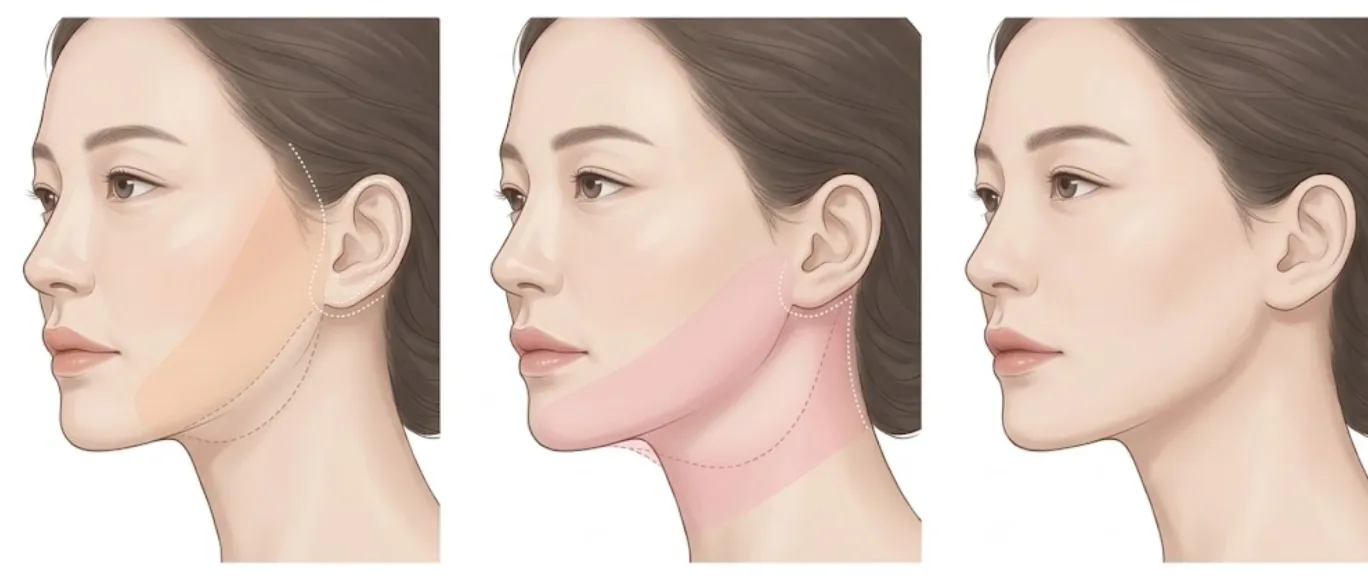
Illustration: through a fine line around the ear (dotted), the sagging lower face and neck are lifted up and back toward the ear (shaded); the dashed outline shows the old contour.
This matters because a neck lift is a real surgical procedure. At Garnet the incisions sit under the chin (submental) and behind the ears (post-auricular), and the technique tightens the deeper SMAS and platysma layer instead of just pulling skin. A photo assessment lets the surgeon flag, before you have spent anything on travel, whether your concern is mostly skin, mostly the platysma muscle band, or a combination. That changes what the surgery involves and what you can expect.
An online consultation is also where the awkward but important questions get answered: who performs the operation, how many of these the surgeon does, and what the realistic recovery looks like for someone flying in. Getting straight answers here, including "this may not be worth a trip for you", is far more useful than any reassurance once you have already arrived. You can read more about how a remote assessment works in the online consultation guide.
Length of stay
How long should you stay in Korea for a neck lift?
The length of your stay is driven almost entirely by one thing: when the stitches come out. After a neck lift the sutures are removed at roughly 10 to 14 days, and it is far better to have that done by the surgeon who placed them than to fly home with stitches still in and find a clinic abroad. As a working plan, most international patients should budget around 10 to 14 days in Korea for a neck lift, give or take a couple of days depending on how your healing looks.
A typical shape for the trip: arrive a day or two before surgery for the in-person consultation and any pre-operative checks; have the operation; spend the first few days resting nearby while the early swelling and bruising settle; attend a wound check in the first week; then return for suture removal before you fly. Building in a small buffer at the end is wise. It gives room for a slightly later suture-removal date without forcing you to change a flight at short notice.
If a longer stay is genuinely difficult, that is worth raising at the online consultation before you assume anything. There are scenarios where some stitches can come out a little earlier and the surgeon coordinates the rest, but this is a judgement call about your specific healing, with no fixed promise. For the wider logistics of timing a trip, see how long to stay in Korea for surgery and planning a plastic surgery trip to Korea.
In person
The in-person consultation and the surgery
Whatever was discussed online, the plan is confirmed in person before anything is decided for certain. The surgeon examines your neck directly (skin laxity, the platysma bands, the position of the hyoid, how much is fat versus loose muscle), because some of that simply cannot be judged from photos. This is also when the operative plan is finalised: where the incisions sit, whether a corset platysmaplasty is needed to bring the muscle bands together, and what is realistic for your anatomy.
The neck lift itself is performed through the submental and post-auricular incisions, tightening the SMAS and platysma layer to redefine the jawline and neck contour. Because Garnet is a single-surgeon clinic that caps the day at two operations, the surgeon you met is the one in the operating room from start to finish. There is no question of being passed to another doctor, which is the concern behind ghost surgery and single-surgeon care.
After surgery you will rest in Seoul and stay put. The first days are about keeping swelling down and the wounds clean; you are not sightseeing on day two. For what those early days are realistically like and how to set up your accommodation, recovering in Seoul after surgery covers the practical side, and the parent neck lift page sets out the procedure as a whole.
Suture removal
Suture removal and when you can fly home
Suture removal is the milestone that releases you to travel. For a neck lift the stitches typically come out at 10 to 14 days, and the submental and post-auricular wounds are checked at the same visit. Many people feel ready to be out and about well before that point, but the stitches staying in for the full window is what protects the incision lines and gives the scars the ideal chance to settle quietly — see neck lift scars and healing for how those incisions are placed and concealed.
Flying itself is a separate question from suture removal. Long-haul travel after facial surgery is generally timed once the early swelling has come down and the surgeon is satisfied with the wounds. That usually lines up reasonably well with the suture-removal window, but the surgeon gives you the date; you do not assume one. The general principles are in when can I fly after plastic surgery.
It is normal to still look swollen and a little tight when you fly home; that is not the finished result. The neck and jawline keep refining for months as residual swelling resolves, which is covered in detail in when will I see neck lift results. Knowing this in advance stops the post-flight mirror from being a disappointment.
Remote follow-up
Follow-up after you return home
The part international patients worry about most is what happens after they leave, and it is a fair concern: you cannot pop back for a quick check. At a single-surgeon clinic the answer is that the operating surgeon continues to follow your recovery remotely. You send photos by messenger as the weeks pass, and the same surgeon who operated reviews them and tells you whether what you are seeing is normal. No coordinator or different doctor is left guessing.
Garnet schedules structured reviews at 1, 3 and 6 months, which maps neatly onto the way a neck lift settles: the 1-month check is about early swelling and the incision lines; by 3 months the contour is much closer to final; and the 6-month review is where the neck and jawline have largely settled. Because the surgeon already knows your case, these remote reviews are genuinely useful.
It is also worth agreeing in advance who manages anything unexpected once you are home: what to watch for, when a message to the clinic is enough, and when you should see a local doctor. Having that plan before you fly is part of being looked after properly, and is one of the questions worth confirming in your online consultation.
At Garnet
How Garnet handles international patients
Garnet is a single-surgeon plastic surgery clinic in Apgujeong, Seoul, registered with Korea's foreign-patient programme. Dr. In-Soo Baek is a board-certified plastic surgeon (Korean medical licence no. 77407) and the only operating doctor. He runs your online consultation, examines you in person, performs the neck lift himself and reviews every follow-up, with the day capped at two surgeries so each case has unhurried time.
For an international patient that model removes most of the uncertainty: a dedicated coordinator stays with you from the first message through to recovery, the assessment tells you plainly whether a neck lift is worth the trip, and the same surgeon sees you through suture removal and the 1, 3 and 6-month reviews, including by messenger once you are home. If you are considering travelling for a neck lift, you can start with a no-obligation online assessment, or read the full neck lift overview first.
Dr. In-Soo Baek
Director & sole operating surgeon
Korean medical licence no. 77407
Operate on what you came for. Trained at Korea University Medical Center. Every case planned, performed and reviewed by the same hands.
1Operating surgeon
~2Surgeries per day
7Registered techniques
Board-certified plastic surgeon
Plastic surgery training at Korea University College of Medicine & graduate school
Korean Society of Plastic and Reconstructive Surgeons member, in its facial-contour, eye & rhinoplasty groups
Consults, operates and follows up each case himself
Peer-reviewed papers behind the facts on this page. Each describes findings in its own study group — not results at Garnet — and none predicts your own outcome.
Yellin S et al. Direct Cervicoplasty. Facial Plastic Surgery. 2014. doi:10.1055/s-0034-1383553
Keramidas E et al. Flying Following Breast Augmentation. How Safe is it? An Evidence-Based Report of 20 Years of Experience. Aesthetic Plastic Surgery. 2026. doi:10.1007/s00266-026-06028-2
Hamilton MM et al. Adjunctive Procedures to Neck Rejuvenation. Facial Plastic Surgery Clinics of North America. 2014. doi:10.1016/j.fsc.2014.01.008
Maltezou HC et al. Challenges with medical tourism. Current Opinion in Critical Care. 2024. doi:10.1097/mcc.0000000000001148
FAQ
Common questions
How do international patients get a neck lift in Korea?
Most start with an online consultation, sending photos of the neck and jawline for an assessment of whether a neck lift suits them. If it does, surgery is scheduled, the plan is confirmed in person on arrival, and the operation is performed during the visit. At a single-surgeon clinic the same surgeon handles the consultation, surgery and follow-up throughout.
How long should I stay in Korea for a neck lift?
Plan for roughly 10 to 14 days. Neck lift sutures are removed at about 10 to 14 days, and it is best to have that done by the surgeon who placed them before you fly home. Arriving a day or two before surgery and leaving a small buffer at the end is a sensible shape for the trip.
Can I start with an online consultation for a neck lift?
Yes. You can send clear photos (front, both sides and a slight chin-down angle) and a description of your concerns, and the surgeon will give a pre-assessment before you book any travel. It is also the right place to confirm who operates, the realistic recovery, and how follow-up works once you are home.
When can I fly home after a neck lift?
Flying is generally timed once the early swelling has settled and the surgeon is satisfied with the wounds, which usually lines up reasonably well with suture removal at 10 to 14 days. The surgeon confirms a safe date for your specific healing, so you do not need to guess one in advance.
Who looks after me after I return home?
At a single-surgeon clinic the operating surgeon continues to follow your recovery remotely. You send photos by messenger and the same surgeon reviews them, with structured check-ins scheduled at 1, 3 and 6 months. It is worth agreeing before you fly what to watch for and when to seek local care.
Will my neck lift look finished by the time I fly home?
No. It is normal to still be swollen and a little tight when you travel. The neck and jawline keep refining for months as residual swelling resolves, so what you see at the airport is an early stage of the result.
Where are the neck lift incisions and will the scars show after I travel?
The incisions sit under the chin and behind the ears, where they are concealed by the natural shadow under the jaw and the contour behind the ear. They are still settling when you fly home and continue to mature over months; keeping the sutures in for the full window helps the lines heal quietly.
Does Garnet treat international patients for neck lift?
Yes. Garnet is registered with Korea's foreign-patient programme and coordinates the online consultation, scheduling, in-person assessment and after-care for international visitors, with the same board-certified surgeon throughout and remote follow-up after you return home.
What if I cannot stay the full 10 to 14 days?
Raise it at the online consultation. In some cases the surgeon can adjust the timing of suture removal and coordinate the rest, but this is a judgement call about your individual healing and carries no fixed guarantee. It is best worked out with the surgeon who knows your case.
My mom recently had a brow lift and lower blepharoplasty with Dr. Baek, and our experience has been wonderful so far. The Garnet team was incredibly kind and welcoming, with Kelly assisting us as our English consultant—she made everything…
I’m so happy I chose this clinic for my lower blepharoplasty. I was traveling from abroad by myself, so I was a little nervous, but from the beginning I felt comfortable and truly cared for. Everyone was kind, patient, and professional…
Came in for an in-person consult and ended up choosing Garnet and Dr.Baek for my non-incisional DES and tiplasty/alarplasty. I communicated with Kelly (English consultant) from the start till now (3 weeks post-op). She really help me feel…
My under-eyes have been sagging and folding for years... I tried to cover it up with makeup, but it actually got stuck in the wrinkles and made it stand out even more. While going for consultations, I noticed that the bigger the hospital…
Send photos and your question before you travel. An English-speaking coordinator reviews every enquiry and replies with guidance on whether surgery is appropriate, the likely plan and timing.
✓ Reviewed by the clinic coordinator, not a bot
✓ Photo-based pre-assessment before you fly
✓ Foreign-patient scheduling & after-care
✓ One surgeon for consultation, surgery and follow-up
Prefer to chat now? Reach the coordinator directly:









 T S7 months ago



