Non-incision double eyelid surgery is one of the more comfortable eyelid procedures. It is done under local anaesthesia, the lid is numbed before anything begins, and most patients describe more pressure than pain. Asked "does it hurt?", most patients point to the brief sting of the numbing injection as the part they felt most; the rest is more manageable than people expect.
The short answer
Non-incision double eyelid surgery is performed under local anaesthesia, with light sedation available if you prefer.
Once the lid is numb you feel pressure and movement, not sharp pain; the numbing injection is the briefest uncomfortable moment.
Because no incision is made, post-operative discomfort is typically mild and short, managed with simple pain relief and cold compresses.
An unhurried, single-surgeon setting where the same surgeon numbs and operates tends to make the experience calmer and gentler.
For most people, it is far less painful than they fear. Non-incision double eyelid surgery forms the crease with a buried-suture fixation line and does not open the lid, so there is no incision to cut or close. That alone makes it one of the gentler eyelid operations: less tissue is disturbed, so there is less to ache afterward. Once the lid is numb, the procedure itself is comfortable.
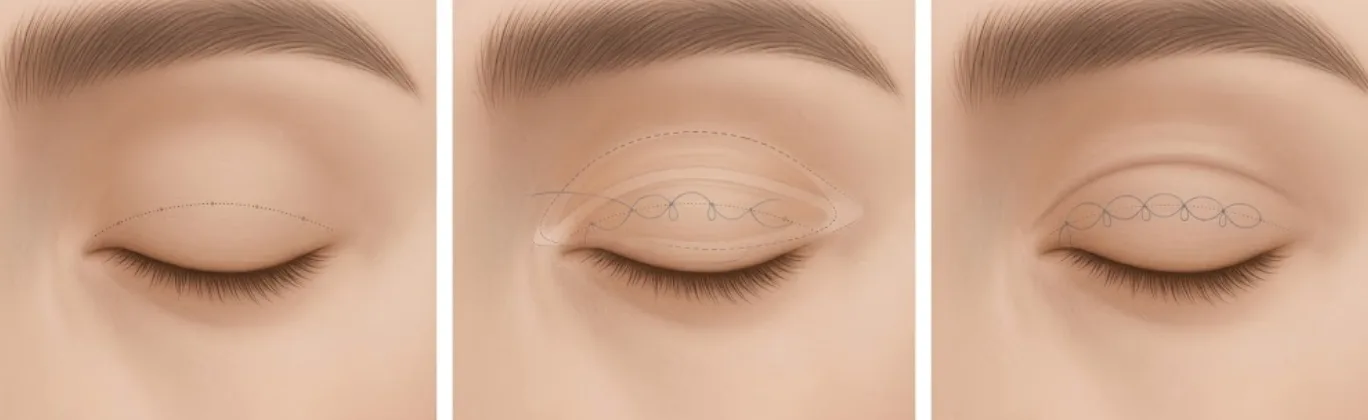
Illustration: a thin buried suture is looped along the planned crease through tiny points, with no skin incision, so the lid folds at the new line.
The moment patients actually feel is the numbing injection at the very start: a brief sting and a sense of fullness as the local anaesthetic goes in. It lasts seconds, and after it the lid is numb for the rest of the surgery. Almost everyone who was nervous beforehand says afterward that the anticipation was worse than the reality, which is the usual pattern for small, well-numbed eyelid procedures.
It helps to separate two different things people mean by "pain": the surgery, and the recovery. Both are mild for the non-incision method, but in different ways. During surgery you feel pressure more than pain; afterward you feel a light tenderness and tightness more than soreness. Neither is the sharp pain the word "surgery" tends to summon.
Anaesthesia
What anaesthesia is used for non-incision double eyelid
Non-incision double eyelid surgery is typically performed under local anaesthesia. The eyelid is numbed directly while you remain awake and comfortable. This is the standard approach because the procedure is short and confined to a small area, and it avoids the recovery and risks that come with general anaesthesia. You can talk to the surgeon during the procedure, which also helps with checking the crease.
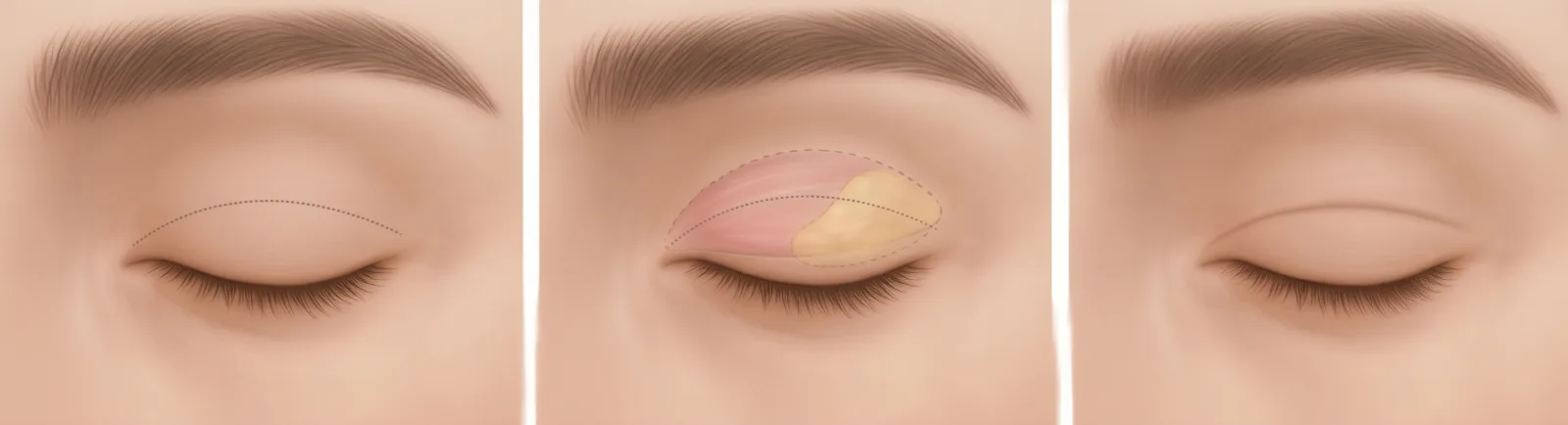
Illustration: the crease is set through an incision along the planned fold; the tissue beneath (muscle in pink, fat in yellow) is adjusted so the crease holds.
For patients who feel anxious, light sedation can usually be added so you are relaxed and drowsy without being fully asleep. It takes the edge off the experience for those who prefer not to be fully alert, while keeping the lighter, quicker recovery of local anaesthesia. Whether you have sedation is a personal preference; the procedure itself does not medically require it.
Local anaesthesia is also part of why this surgery is gentle to recover from. You are not waking from a general anaesthetic, so there is no grogginess, nausea or extended monitoring afterward — most patients are clear-headed soon after and able to leave once the surgeon is satisfied. If you are comparing eyelid options, the pages on incision double eyelid describe how a longer procedure can differ in its anaesthesia and comfort.
During surgery
What you actually feel during the procedure
After the numbing injection settles, the eyelid is fully anaesthetised and you should not feel sharp pain. What you do notice is pressure, touch and movement: a sensation of the surgeon working on the lid, with no feeling of being cut. Many patients say it feels like firm pressing around the eye. Because the buried-suture method places fixation points without making an incision, there is little of the tugging associated with longer eyelid operations.
The procedure is short, which keeps the whole experience contained. You lie still with the eye area draped, and the surgeon checks the crease as it forms. Being awake under local anaesthesia is actually useful here, since you can occasionally be asked to open and close the eye so the crease height and shape can be confirmed. That feedback is part of getting a natural, even result.
If at any point you feel more than pressure, the surgeon can simply add a little more local anaesthetic; the lid can be topped up easily. Knowing that beforehand settles most nerves: you are not expected to endure discomfort, and the comfort of the procedure is something the surgeon actively manages throughout. It is never a fixed quantity you have to accept.
Afterward
How much discomfort is there afterward?
Recovery from the non-incision method is one of its main advantages. As the anaesthetic wears off over the first few hours, most people feel a mild tenderness and a tight, slightly heavy sensation around the eyes, which is milder than real pain. There is usually some swelling and occasionally light bruising in the first days, but soreness tends to be modest and brief, far less than the word "surgery" implies.
Because no incision is made, the small entry points from the buried sutures are tiny, and the sutures themselves are removed at around five days. Discomfort generally peaks in the first day or two and then settles steadily. The tightness eases as swelling goes down, and most patients find simple, over-the-counter pain relief is more than enough. Many take little or none after the first day.
What you are managing in the early days is mostly swelling, with little pain. For a fuller picture of how the eyes settle day by day, the recovery timeline and the page on swelling and bruising walk through what is normal at each stage, so you know what to expect and need not worry about every sensation.
Keeping it comfortable
How comfort is managed before, during and after
Comfort is partly the method and partly the care around it. Before surgery, a calm consultation that explains exactly what you will feel removes most of the fear, because so much eyelid-surgery anxiety is about the unknown. Knowing that the only real sting is the numbing injection, and that the lid can be topped up at any time, changes how the whole experience feels.
Practical measures keep the early days easy: cold compresses in the first day or two reduce swelling and have a soothing effect, keeping your head slightly elevated helps the swelling settle, and simple pain relief covers any tenderness. Avoiding strenuous activity, rubbing the eyes, and alcohol for the first days lets the lid calm down quickly. None of this is demanding; it is the same gentle care the light recovery allows.
The setting matters too. An unhurried clinic where the surgery is not rushed, the surgeon numbs the lid carefully and there is time to top up anaesthetic if needed, tends to be a more comfortable experience than a high-volume room running to a tight schedule. You can ask exactly how the procedure and the after-care are handled in an online consultation before you decide.
At Garnet
How Garnet keeps non-incision double eyelid comfortable
Garnet is a single-surgeon clinic in Apgujeong, Seoul. Dr. In-Soo Baek is a board-certified plastic surgeon (Korean medical licence no. 77407) and the only operating doctor; he consults, numbs the lid, performs the surgery himself and reviews every follow-up. Because the same surgeon does each step, the local anaesthesia is given carefully and the crease is checked with you during the procedure, which keeps it gentle and unhurried.
The clinic caps the day at two surgeries, so your procedure is not rushed and there is time to top up anaesthetic or pause if you need it. The comfort of the experience is actively managed. Light sedation is available if you would prefer to be relaxed and drowsy. Garnet is registered with Korea's foreign-patient programme, and the same surgeon handles suture removal at around five days and your follow-up reviews. If you are nervous about pain, you can talk it through first in a no-obligation online assessment.
Dr. In-Soo Baek
Director & sole operating surgeon
Korean medical licence no. 77407
Operate on what you came for. Trained at Korea University Medical Center. Every case planned, performed and reviewed by the same hands.
1Operating surgeon
~2Surgeries per day
7Registered techniques
Board-certified plastic surgeon
Plastic surgery training at Korea University College of Medicine & graduate school
Korean Society of Plastic and Reconstructive Surgeons member, in its facial-contour, eye & rhinoplasty groups
Consults, operates and follows up each case himself
Peer-reviewed papers behind the facts on this page. Each describes findings in its own study group — not results at Garnet — and none predicts your own outcome.
Khoo LS et al. Simultaneous Orthognathic Surgery With Asian Double Eyelid Suture Blepharoplasty. Journal of Craniofacial Surgery. 2021. doi:10.1097/scs.0000000000007704
Wang Y et al. Cause and Management of Suture-related Ocular Complications after Buried-suture Double-eyelid Blepharoplasty. Journal of Plastic, Reconstructive & Aesthetic Surgery. 2021. doi:10.1016/j.bjps.2021.05.042
Baek JS et al. Comparison Between Continuous Buried Suture and Interrupted Buried Suture Methods for Double Eyelid Blepharoplasty. Journal of Craniofacial Surgery. 2015. doi:10.1097/scs.0000000000001984
FAQ
Common questions
Is non-incision double eyelid surgery painful?
Not for most people. It is performed under local anaesthesia, so once the lid is numb you feel pressure and movement instead of sharp pain. The most noticeable moment is the brief sting of the numbing injection at the start, which lasts seconds. Because no incision is made, there is little tissue trauma, and patients usually say the anticipation was worse than the reality.
What anaesthesia is used for non-incision double eyelid surgery?
It is typically done under local anaesthesia, with the eyelid numbed directly while you stay awake and comfortable. This suits a short, confined procedure and avoids the recovery and risks of general anaesthesia. Light sedation can usually be added for anxious patients so you feel relaxed and drowsy without being fully asleep.
Will I be awake during the procedure?
Yes, usually. Being awake under local anaesthesia is normal for this surgery and is actually useful, because the surgeon can ask you to open and close the eye to confirm the crease height and shape. You should feel only pressure and touch, without pain. If you prefer to be drowsy, light sedation is an option you can ask for.
Does the numbing injection hurt?
It is the part you feel most, but only briefly. There is a short sting and a sense of fullness as the local anaesthetic goes in, lasting seconds, after which the lid is numb for the rest of the surgery. Most patients agree this small moment is the worst of it and far milder than they had feared.
How much discomfort is there after non-incision double eyelid?
Generally mild and short. As the anaesthetic wears off you feel tenderness and a tight, slightly heavy sensation that is milder than real pain, with some swelling and occasionally light bruising in the first days. Discomfort tends to peak in the first day or two and then settles; simple pain relief is usually more than enough, and many patients take little after the first day.
How long does the discomfort last?
The tenderness usually fades within a few days as the swelling goes down, and the small sutures are removed at around five days. In the early days you are mostly managing swelling; pain plays a small part. Most people are comfortable in everyday activity quite quickly, though final settling of the crease takes longer than the discomfort does.
How can I reduce discomfort after surgery?
Cold compresses in the first day or two reduce swelling and soothe the area, keeping your head slightly elevated helps swelling settle, and simple pain relief covers any tenderness. Avoiding strenuous activity, rubbing the eyes and alcohol for the first days lets the lid calm down faster. Your surgeon will give specific after-care guidance.
Is non-incision less painful than incision double eyelid?
Usually, yes. Because the non-incision method places buried sutures and does not open the lid, less tissue is disturbed, so post-operative tenderness and swelling tend to be lighter and the sutures come out a little sooner. The incision method, which removes skin or fat, generally asks for a bit more recovery, though both are done under local anaesthesia.
What if I feel pain during the procedure?
The surgeon can simply add more local anaesthetic, as the lid is easily topped up. You are not expected to endure discomfort; comfort is actively managed throughout the procedure. Knowing this beforehand settles most patients' nerves.
I'm nervous about eyelid pain. Can I discuss it before booking?
Yes. You can talk through exactly what you will feel, and whether light sedation is right for you, in an online consultation before you decide. Much eyelid-surgery anxiety is about the unknown, so understanding each step, and that the lid can be topped up at any time, usually makes the experience far less daunting.
My mom recently had a brow lift and lower blepharoplasty with Dr. Baek, and our experience has been wonderful so far. The Garnet team was incredibly kind and welcoming, with Kelly assisting us as our English consultant—she made everything…
I’m so happy I chose this clinic for my lower blepharoplasty. I was traveling from abroad by myself, so I was a little nervous, but from the beginning I felt comfortable and truly cared for. Everyone was kind, patient, and professional…
Came in for an in-person consult and ended up choosing Garnet and Dr.Baek for my non-incisional DES and tiplasty/alarplasty. I communicated with Kelly (English consultant) from the start till now (3 weeks post-op). She really help me feel…
My under-eyes have been sagging and folding for years... I tried to cover it up with makeup, but it actually got stuck in the wrinkles and made it stand out even more. While going for consultations, I noticed that the bigger the hospital…
Send photos and your question before you travel. An English-speaking coordinator reviews every enquiry and replies with plain guidance on whether non-incision double eyelid surgery suits your lids, the likely plan and timing.
✓ Reviewed by the clinic coordinator, not a bot
✓ Photo-based pre-assessment before you fly
✓ Foreign-patient scheduling & after-care
✓ One surgeon for consultation, surgery and follow-up
Prefer to chat now? Reach the coordinator directly:








 T S7 months ago



