Non-incision double eyelid surgery is chosen largely for its short, gentle recovery. There is no skin incision (the crease is formed by buried sutures), so swelling and bruising are milder and downtime is shorter than the incisional method. The recovery still has a clear rhythm worth knowing: a quiet first few days, sutures out around day 5, and a crease that softens into its natural shape over the weeks that follow.
The short answer
Non-incision double eyelid uses buried sutures with no skin incision, so swelling and bruising are milder and downtime shorter than the incisional method.
Sutures are typically removed at around day 5, which is the milestone most patients plan their schedule around.
Many people feel presentable for everyday life within about a week, with subtle swelling continuing to fade for a few weeks beyond that.
The crease looks higher and tighter at first and softens to its natural position over the following weeks. This settling is part of the normal timeline.
Non-incision double eyelid surgery creates the crease with buried-suture fixation along an adhesion line, without any skin incision. Because nothing is cut open, the eyelid swells less, bruises less and heals faster than the incisional method. That is the main reason patients choose it for shorter downtime. The trade-off, covered in detail elsewhere, is that a buried-suture crease is generally better suited to thinner lids and is not as durable as a fully incised one. The full overview of the operation is on the parent cell, non-incision double eyelid.
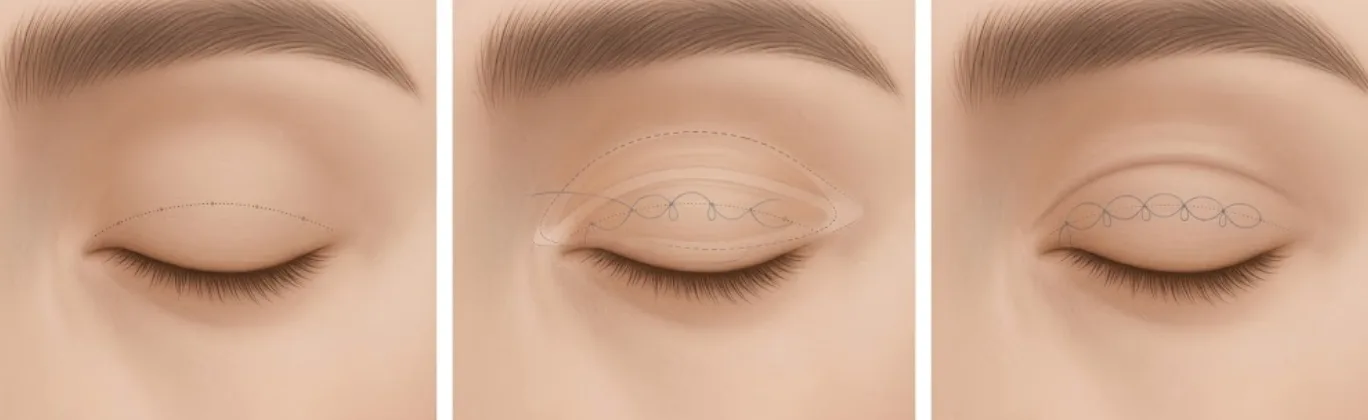
Illustration: a thin buried suture is looped along the planned crease through tiny points, with no skin incision, so the lid folds at the new line.
The recovery splits into two short chapters. The first is the quiet early phase of a few days, with mild swelling and tightness around the lid and the buried sutures settling in; the small securing stitches are typically removed at around day 5. The second is the few weeks afterward in which residual swelling fades and the crease softens from its high, slightly tight initial look down to its natural final position.
Compared with the open technique, the whole timeline is compressed. Where an incisional crease takes months to fully settle, a buried-suture crease usually looks natural within weeks. As with any eyelid surgery, though, it should not be judged in the first days when swelling is at its peak. The realistic expectation is a fast, undramatic recovery with steady week-by-week improvement.
First days
Days 1 to 5: the quiet early phase
In the first one to three days the eyelids feel tight and look swollen, and there may be mild bruising, though usually less than with an incision. Most discomfort is manageable and the swelling is at its most noticeable during this window. Cold compresses in the first day or two, keeping the head elevated, and avoiding rubbing or straining the eyes are the practical steps that help the lid de-swell on schedule. Pain is generally mild; the dedicated breakdown is on non-incision double eyelid pain and anaesthesia.
The small securing sutures are typically removed at around day 5. By this point the most acute swelling has begun to ease, and the crease is visible but still sits high and looks tighter and deeper than it eventually will. This early appearance is expected and is driven by swelling around the buried sutures. The crease has not been set too high, and this is not the final result.
Through these first days the eyes can water, feel slightly foreign, and look briefly uneven as the two sides settle at different speeds. All of this is normal early healing. The key is to expect a high, firm-looking crease at suture removal and to understand it will soften over the weeks that follow.
Weeks
Week 1 to 4: the crease settles in
Once the sutures are out, the visible swelling fades steadily over the following one to two weeks, and the crease starts to look less harsh and more like a natural fold. Many patients feel comfortable in everyday social and work settings within about a week of surgery, which is a key reason the non-incision method is popular with people who cannot take long off. The eyelid is still subtly fuller than it will end up, and fine asymmetry between the two eyes is common and usually evens out as swelling resolves.
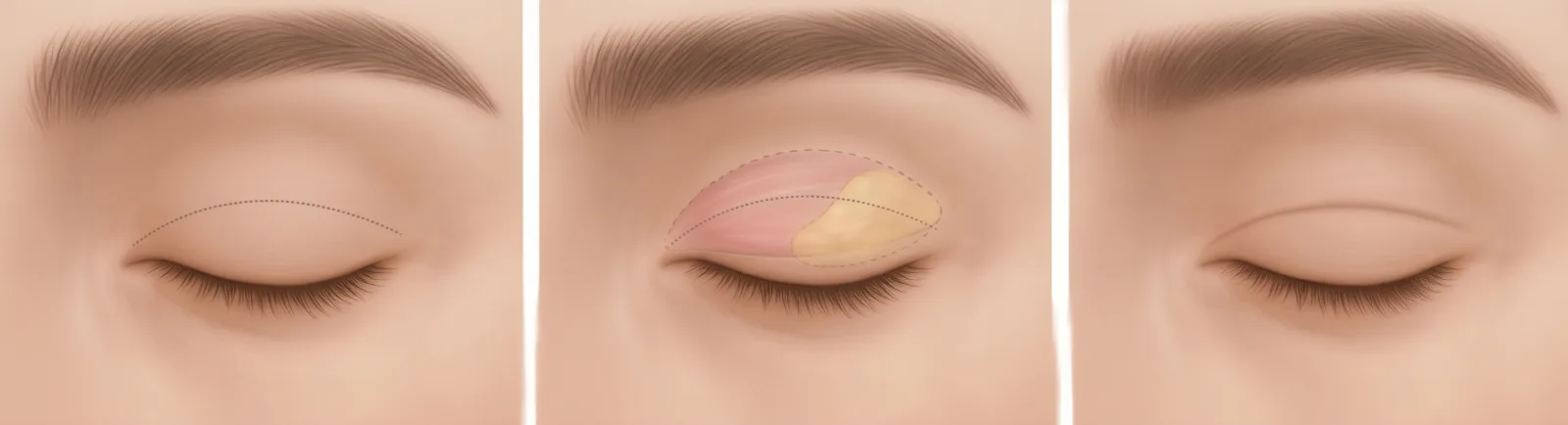
Illustration: the crease is set through an incision along the planned fold; the tissue beneath (muscle in pink, fat in yellow) is adjusted so the crease holds.
Over roughly the next two to four weeks the residual fullness finishes resolving and the crease drops slightly, softening from its high, tight early look toward its settled height. For most straightforward buried-suture cases the crease looks natural and close to final within a few weeks, a markedly faster timeline than the incisional method. Comparing your eyes against early post-operative photos is clearer than checking the mirror each day, and it is the best way to see this gradual settling.
Because the buried-suture line is gentler tissue work, there is no external scar to mature, so much of the wait is simply swelling leaving. If you are weighing this quicker recovery against the longer, more durable settling of the incision double eyelid crease, the trade-offs are laid out on non-incision vs incision double eyelid.
Aftercare
Aftercare and the red flags worth knowing
Good aftercare is mostly about leaving the lid alone while it settles. In the first days, use cold compresses as advised, sleep with your head elevated, avoid rubbing the eyes, skip eye make-up and contact lenses until cleared, and keep strenuous exercise, heavy lifting, alcohol and saunas out of your routine for the period your surgeon specifies. Sunglasses help with light sensitivity and discourage rubbing while you are out.
Most recoveries are uneventful, but a few signs warrant prompt contact with the clinic: pain that increases after the first few days, spreading redness or warmth around the lid, discharge, fever, sudden marked swelling on one side, or any change in vision. These are uncommon, but knowing them in advance means you can act early instead of waiting and worrying. The full recovery context is on the parent cell, non-incision double eyelid.
Because the same surgeon who operates also reviews recovery, anything that looks unusual can be checked against what is expected for your specific eyelid, including by messenger once you have returned home.
Work and flying
Returning to work and flying home
Many patients feel presentable for everyday work and social life within about a week, once the sutures are out and the most visible swelling has gone. The crease will still be subtly fuller and slightly higher than its final shape at that point, but it is generally easy to manage in daily life. People in highly visible roles sometimes prefer to allow a few extra days for swelling to fade further.
International patients usually plan their stay around the suture-removal visit at about day 5, so the clinic can remove the stitches and confirm healing before you fly. As a general guide, short-haul travel is often comfortable soon after that review, but the right timing depends on your healing and your surgeon's advice. General guidance on this is in the guide when can I fly after plastic surgery.
Planning your trip length around the day-5 review is the simplest way to avoid travelling before the clinic has seen the eyelid. You can ask exactly how long to plan for your case in advance through an online consultation.
At Garnet
Recovery support at Garnet
Garnet is a single-surgeon clinic in Apgujeong, Seoul. Dr. In-Soo Baek is a board-certified plastic surgeon (Korean medical licence no. 77407) and the only operating doctor — he consults, performs the surgery himself and personally reviews every follow-up. For a recovery like this, that continuity means the surgeon who placed the buried sutures is the one who checks the crease as it settles.
Follow-up is structured at 1, 3 and 6 months, and for a non-incision procedure the early reviews are where most of the settling is confirmed. For international patients these reviews can continue by messenger after you return home, so questions about swelling or the crease's height can be answered against what was planned. Garnet is registered with Korea's foreign-patient programme, and a dedicated coordinator stays with you from consultation through recovery.
If you want a realistic recovery and travel timeline for your own eyes before committing to a trip, you can send photos for a pre-assessment through an online assessment.
Dr. In-Soo Baek
Director & sole operating surgeon
Korean medical licence no. 77407
Operate on what you came for. Trained at Korea University Medical Center. Every case planned, performed and reviewed by the same hands.
1Operating surgeon
~2Surgeries per day
7Registered techniques
Board-certified plastic surgeon
Plastic surgery training at Korea University College of Medicine & graduate school
Korean Society of Plastic and Reconstructive Surgeons member, in its facial-contour, eye & rhinoplasty groups
Consults, operates and follows up each case himself
Peer-reviewed papers behind the facts on this page. Each describes findings in its own study group — not results at Garnet — and none predicts your own outcome.
Li L et al. Creating Natural Double Eyelids With Continuous Buried Suture and Mini-incision Technique Using Subcutaneous Absorbable Suture for Patients With Puffy Eyelids. JAMA Facial Plastic Surgery. 2014. doi:10.1001/jamafacial.2013.2512
Hwang K et al. Tension and Distortion of the Upper Double Eyelid by a Nonincision Method. Journal of Craniofacial Surgery. 2012. doi:10.1097/scs.0b013e31824e27dd
Munakata H et al. Comparison of One-Year Outcomes Between Younger and Older Patients Undergoing Continuous Buried Suture Double-Eyelid Surgery: A Retrospective Cohort Study of 788 Cases. Aesthetic Plastic Surgery. 2026. doi:10.1007/s00266-026-05765-8
FAQ
Common questions
How long does non-incision double eyelid recovery take?
The early swelling is mildest because there is no incision; sutures come out at around day 5, and many people feel presentable for everyday life within about a week. Subtle swelling continues to fade over the following few weeks, and the crease usually looks natural and close to final within a few weeks of surgery.
What is non-incision double eyelid recovery like day by day?
Days 1 to 3 bring mild swelling and tightness with little bruising; sutures are typically removed around day 5; the visible swelling fades over the following one to two weeks; and the crease softens to its natural height over roughly two to four weeks. The whole timeline is shorter than the incisional method.
When can I return to work after non-incision double eyelid?
Many patients return to everyday work and social settings within about a week, once the sutures are out and the most visible swelling has gone. The crease will still be subtly fuller than its final shape at that point, but it is generally presentable for daily life.
When are the sutures removed?
The small securing sutures are typically removed at around day 5. International patients usually plan their stay around this visit so the clinic can take the stitches out and confirm healing before they fly home.
Why does my crease look too high at first?
A high, deep, tight-looking crease in the first days is caused by swelling around the buried sutures, not by the crease being set too high. As the swelling subsides over the following one to four weeks, the fold softens and drops into its natural position. This early appearance is expected.
What aftercare follows non-incision double eyelid?
Use cold compresses in the first days, sleep with the head elevated, avoid rubbing the eyes, skip eye make-up and contacts until cleared, and keep strenuous exercise, heavy lifting, alcohol and saunas out of your routine for the period your surgeon specifies. Most recoveries are quiet and uneventful.
When can I fly home after non-incision double eyelid?
Most international patients plan their stay around the day-5 suture removal so the clinic can confirm healing before they travel. Short-haul flights are often comfortable soon after that review, but the right timing depends on your healing and your surgeon's advice. General guidance is in the flying-after-surgery guide.
How does non-incision recovery compare to incision double eyelid?
It is shorter and gentler. With no skin incision there is less swelling and bruising, sutures come out earlier, at around day 5 (day 7 for incision), and the crease settles in weeks, where the incisional crease takes months. The trade-off is durability and lid-type suitability, compared side by side on the non-incision vs incision page.
Does Garnet follow up during recovery?
Yes. The same board-certified surgeon who places the sutures reviews recovery at 1, 3 and 6 months, and for this procedure the early reviews confirm most of the settling. For international patients these reviews can continue by messenger after returning home.
My mom recently had a brow lift and lower blepharoplasty with Dr. Baek, and our experience has been wonderful so far. The Garnet team was incredibly kind and welcoming, with Kelly assisting us as our English consultant—she made everything…
I’m so happy I chose this clinic for my lower blepharoplasty. I was traveling from abroad by myself, so I was a little nervous, but from the beginning I felt comfortable and truly cared for. Everyone was kind, patient, and professional…
Came in for an in-person consult and ended up choosing Garnet and Dr.Baek for my non-incisional DES and tiplasty/alarplasty. I communicated with Kelly (English consultant) from the start till now (3 weeks post-op). She really help me feel…
My under-eyes have been sagging and folding for years... I tried to cover it up with makeup, but it actually got stuck in the wrinkles and made it stand out even more. While going for consultations, I noticed that the bigger the hospital…
Planning how many days to stay for a non-incision double eyelid? Send photos for a no-obligation pre-assessment and a realistic recovery and travel timeline before you book.
Send photos and your question before you travel. An English-speaking coordinator reviews every enquiry and replies with guidance on whether surgery is appropriate, the likely plan and timing.
✓ Reviewed by the clinic coordinator, not a bot
✓ Photo-based pre-assessment before you fly
✓ Foreign-patient scheduling & after-care
✓ One surgeon for consultation, surgery and follow-up
Prefer to chat now? Reach the coordinator directly:








 T S7 months ago



