Ptosis correction and double eyelid surgery are the two most commonly confused eye procedures, because a droopy-looking eye can come from either, or both. They fix different things: ptosis correction adjusts the muscle that actually opens your eye, while double eyelid surgery creates or defines the crease line on the lid. One is about how open the eye is; the other is about the fold above it. This side-by-side helps you tell which your eyes need, and why the two are so often done together.
The short answer
Ptosis correction adjusts the strength of the levator, the muscle that opens the eye. At Garnet this is done through a lid-crease incision, with sutures out at around 7 days. It treats an eye that does not open fully.
Double eyelid surgery creates or defines the crease on the upper lid. The incision method uses a full upper-lid incision (sutures out around 7 days); a non-incision buried-suture method forms the line without cutting (sutures out around 5 days).
The key distinction: ptosis is a muscle problem (a sleepy, half-open look), a double-eyelid concern is a crease problem (a monolid or unclear fold). They can occur separately or together.
They are frequently combined, because a droopy eye often has both a weak muscle and no clear crease. The same board-certified surgeon assesses your levator function and lid anatomy and tells you which you need.
This is the distinction that clears up most of the confusion. Ptosis correction works on the muscle that opens your eye, the levator. When that muscle is weak, the upper lid sits low and the eye does not open fully, giving a sleepy, half-open or tired look even when you are wide awake. At Garnet, ptosis correction is done through a lid-crease incision to adjust the strength of that eye-opening muscle, with sutures out at around 7 days. Crucially, it changes how open the eye is, beyond how it is creased.
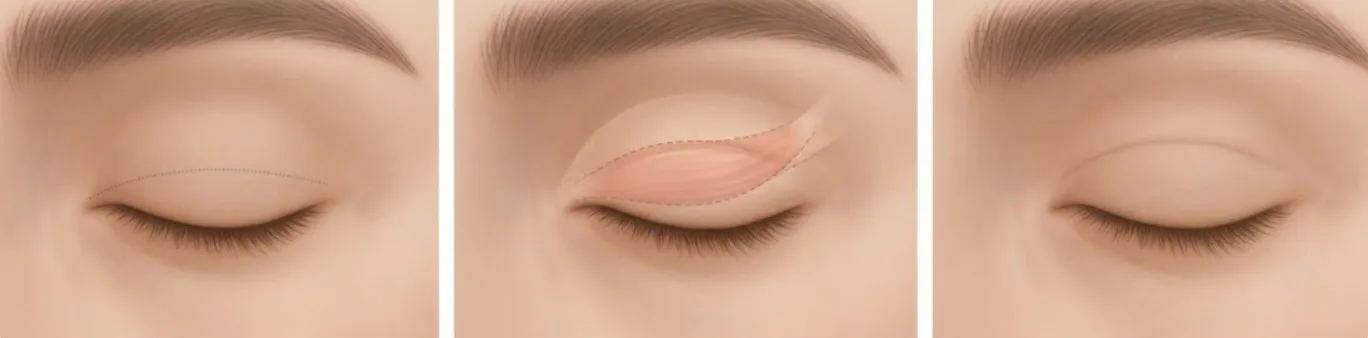
Illustration: through the crease line, the muscle that opens the eye (shown beneath the lid) is tightened so the lid rests higher.
Double eyelid surgery does something different: it creates or defines the crease (the fold) on the upper lid. The incision method uses a full upper-lid incision to form a lasting crease line, with sutures out at around 7 days, while a non-incision method uses buried sutures to form the line without cutting. Double eyelid surgery changes the shape and fold of the lid; on its own it does not make a weak muscle open the eye more. Ptosis correction opens the eye and double eyelid surgery creases the lid; a tired-looking eye can need one, the other, or both.
Who each suits
Who ptosis correction and double eyelid surgery each suit
Ptosis correction suits someone whose eye does not open fully: the upper lid sits low over the iris, you may raise your eyebrows or tilt your head to see better, and the eyes look sleepy or asymmetric. This is a functional muscle issue as well as an aesthetic one, and no amount of crease work alone will fix it. If your main concern is that your eyes look half-closed or one opens less than the other, that points toward ptosis correction over a crease procedure. Candidacy is covered in who ptosis correction is for.
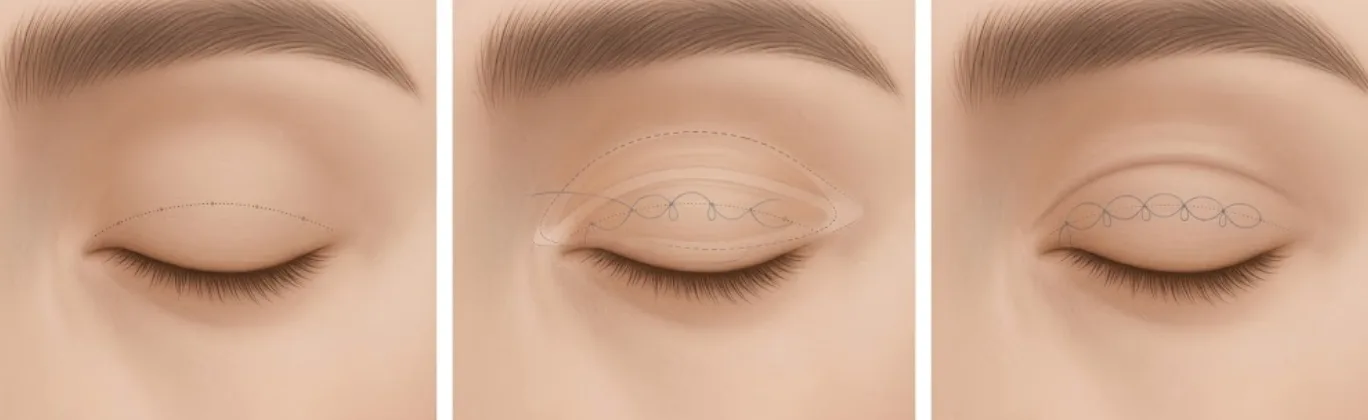
Illustration: a thin buried suture is looped along the planned crease through tiny points, with no skin incision, so the lid folds at the new line.
Double eyelid surgery suits someone whose eye opens well but has no clear crease (a monolid), an uneven or shallow fold, or a fold that they want defined or reshaped. Here the eye-opening muscle is working fine; the concern is the fold itself. If your eyes open normally but you want a defined crease or a more even fold, that points toward double eyelid surgery. Who incision double eyelid surgery is for walks through candidacy, and there is also a non-incision method for suitable lids.
How they differ
How ptosis and crease surgery differ in practice
The two act on different tissue. Ptosis correction reaches the levator muscle and adjusts its strength so the lid lifts higher; the visible change is an eye that opens more fully. Double eyelid surgery works on the skin and the crease-forming attachments of the lid; the visible change is a defined fold. Because of this, the assessments are different too: for ptosis a surgeon measures how far your lid actually rises and how the muscle functions, whereas for a double-eyelid concern the focus is on the fold, the skin and the shape you want. Getting this distinction right at the start is what prevents a disappointing result.
In recovery, both use lid-crease-level incisions with sutures out at around 7 days for the incision approaches, and the non-incision double-eyelid method has sutures out at around 5 days. Swelling settles over the following weeks and the crease and eye-opening continue to soften and mature for months. The point worth stressing is that the procedures are not interchangeable: choosing a crease operation for what is really a muscle problem leaves the eye still looking half-open, which is exactly why an accurate diagnosis matters more than the name of the procedure.
Combining them
Why ptosis correction and a crease are often combined
In practice the two are frequently done together, for a simple reason: many droopy-looking eyes have both a weak eye-opening muscle and an absent or unclear crease. Correcting the muscle opens the eye, and forming a crease at the same time gives a defined, natural-looking lid to match. At Garnet, ptosis correction can be added within an incision double-eyelid operation, so the crease and the eye-opening are addressed in one plan and neither is left visibly unbalanced.
But combining is not automatic. Some people need only muscle correction, others only a crease, and adding a procedure that is not needed is more surgery than the eye requires. The judgement of whether you need one, the other, or both comes from examining how your lid actually rises and how it is creased. A photo or a preference cannot settle it. If you are unsure which describes your eyes, an online consultation with photos is a sensible starting point before committing to anything.
How to decide
How to decide between ptosis correction and a crease
A simple orientation: look in the mirror with a relaxed forehead and ask whether your eyes open fully. If the upper lid sits low over the iris and your eyes look sleepy or you catch yourself lifting your brows to see, that suggests a muscle issue and points toward ptosis correction. If your eyes open normally but you have no clear crease or an uneven fold, that points toward double eyelid surgery. If both are true (a half-open eye and no defined crease), that is exactly the situation where the two are combined.
Self-assessment only goes so far, though, because eyebrow habits, skin heaviness and asymmetry can disguise a weak muscle or mimic one. The reliable answer comes from a surgeon measuring your levator function and lid anatomy directly. Neither procedure is superior. They treat different problems, and the aim is to match the procedure (or combination) to your eyes.
At Garnet
Muscle and crease assessment at Garnet
Garnet is a single-surgeon clinic in Apgujeong, Seoul. Dr. In-Soo Baek is a board-certified plastic surgeon (Korean medical licence no. 77407) who performs both ptosis correction and double eyelid surgery himself. Because one surgeon offers both, the recommendation is not steered toward whichever procedure a particular doctor happens to do. He can assess your eye-opening muscle and your lid crease together and tell you candidly whether your concern is the muscle, the crease, both, or neither yet.
Dr. Baek also handles the levator or crease follow-up himself at 1, 3 and 6 months, continuing by photo once patients from abroad are home, under Garnet's foreign-patient programme registration. The most useful next step is a no-obligation online assessment: send photos and get a clear read on whether ptosis correction, double eyelid surgery, or a combination fits your eyes before you plan a trip.
Real Results
Before & After
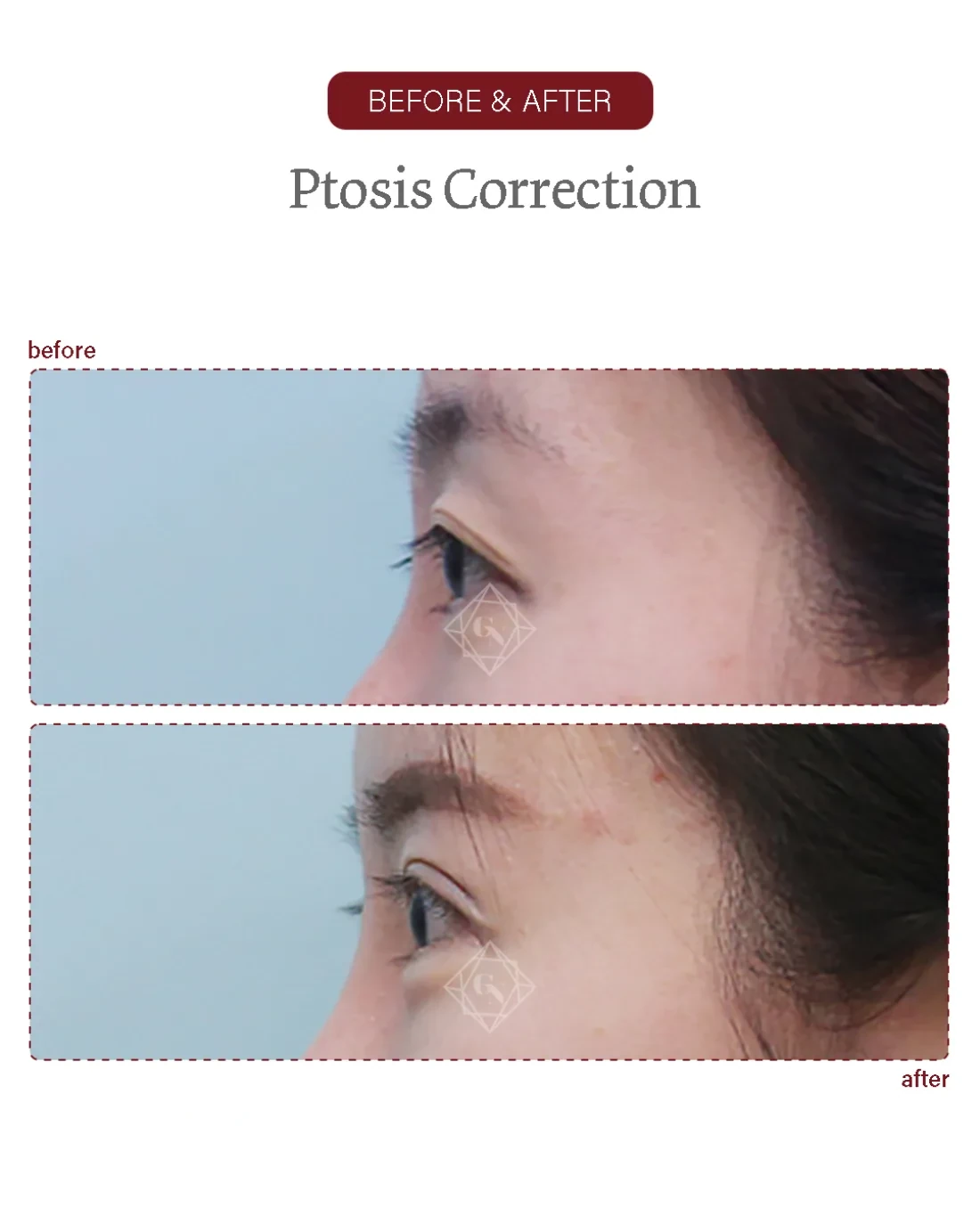
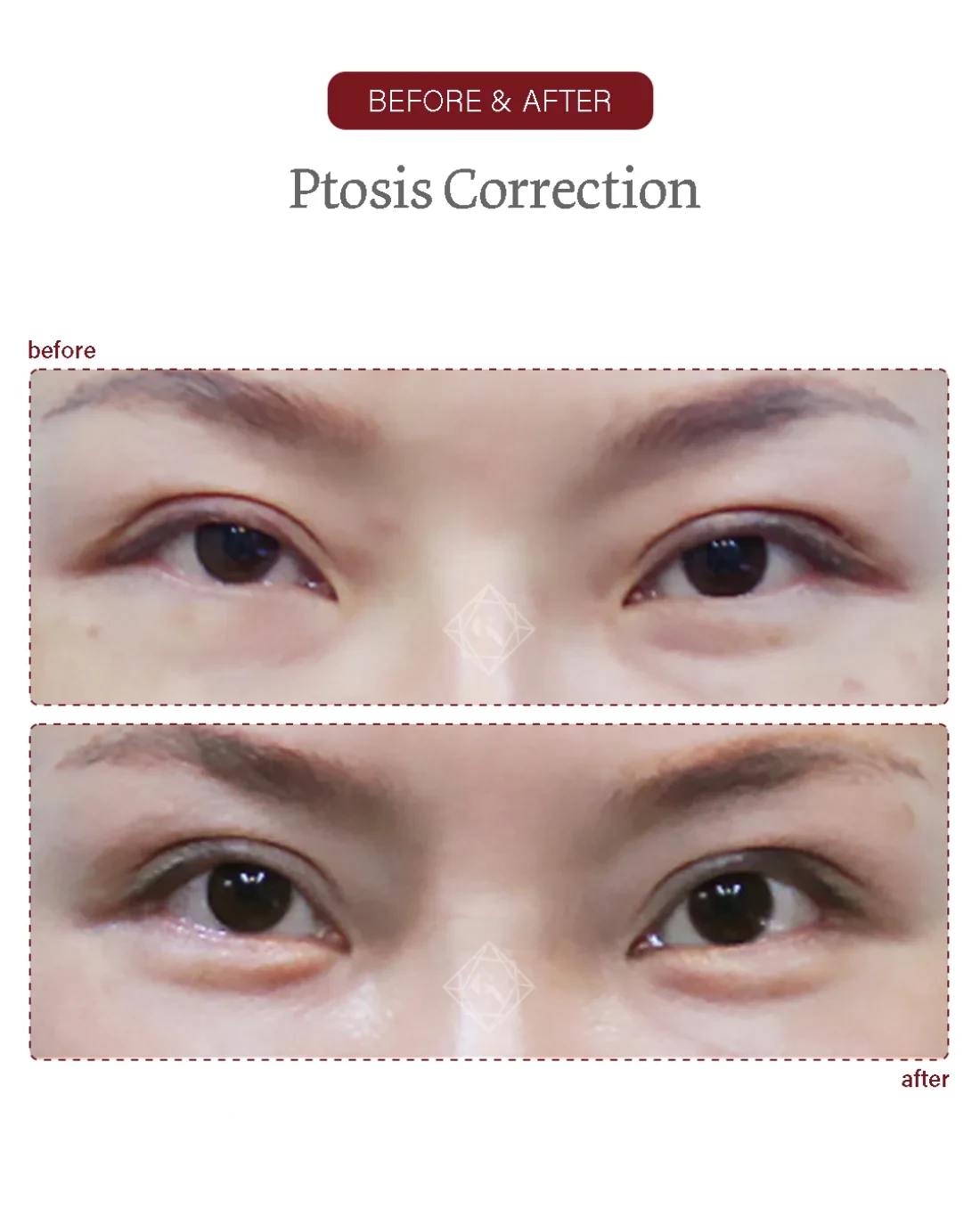
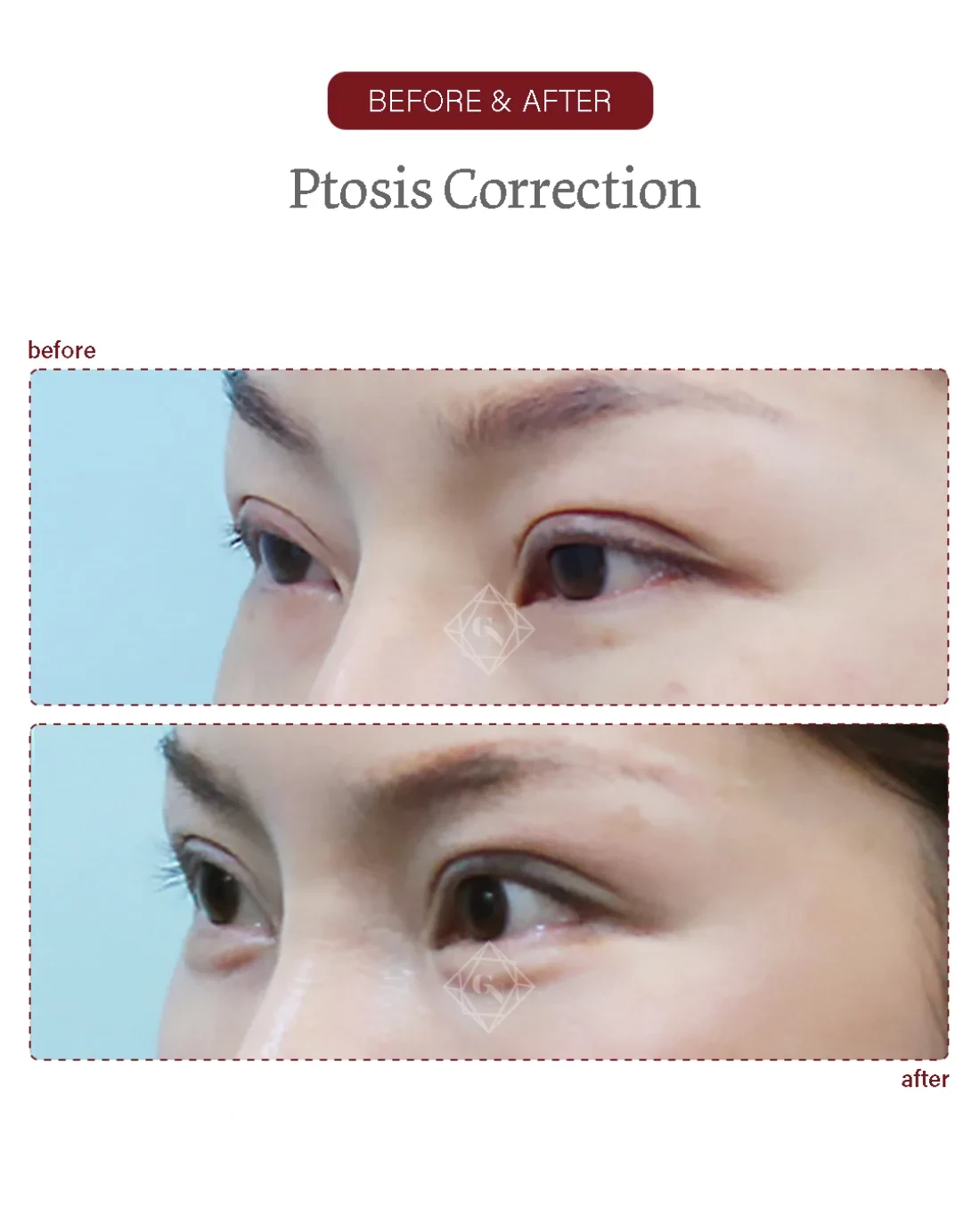
Ptosis-correction before/after examples of actual Garnet patients (published with consent). Results, recovery and suitability vary by individual and are not guaranteed; the right approach is decided at an in-person consultation.
Dr. In-Soo Baek
Director & sole operating surgeon
Korean medical licence no. 77407
Operate on what you came for. Trained at Korea University Medical Center. Every case planned, performed and reviewed by the same hands.
1Operating surgeon
~2Surgeries per day
7Registered techniques
Board-certified plastic surgeon
Plastic surgery training at Korea University College of Medicine & graduate school
Korean Society of Plastic and Reconstructive Surgeons member, in its facial-contour, eye & rhinoplasty groups
Consults, operates and follows up each case himself
Peer-reviewed papers behind the facts on this page. Each describes findings in its own study group — not results at Garnet — and none predicts your own outcome.
Shields M et al. Blepharoptosis correction. Current Opinion in Otolaryngology & Head and Neck Surgery. 2003. doi:10.1097/00020840-200308000-00009
Deenstra W et al. Correction of Severe Blepharoptosis. Annals of Plastic Surgery. 1996. doi:10.1097/00000637-199604000-00004
Finsterer J. Ptosis: Causes, Presentation, and Management. Aesthetic Plastic Surgery. 2003. doi:10.1007/s00266-003-0127-5
FAQ
Common questions
What is the difference between ptosis correction and double eyelid surgery?
Ptosis correction adjusts the levator, the muscle that opens the eye, so a low, half-open lid rises more fully. At Garnet it is done through a lid-crease incision with sutures out around 7 days. Double eyelid surgery creates or defines the crease on the lid. In short, ptosis correction opens the eye; double eyelid surgery creases the lid. A tired-looking eye can be one, the other, or both.
Is ptosis correction or double eyelid surgery better for me?
That depends on whether your levator or your crease is the issue. If your eye does not open fully and looks sleepy, that suggests ptosis correction. If your eye opens well but lacks a clear or even crease, that suggests double eyelid surgery. A surgeon measuring your levator function and lid anatomy is the only reliable way to tell which fits.
Can ptosis correction and double eyelid surgery be done together?
Yes, and they often are. Many droopy-looking eyes have both a weak eye-opening muscle and no clear crease, so ptosis correction can be added within an incision double-eyelid operation to open the eye and define the fold in one plan. Whether you need both is decided by examining how your lid rises and how it is creased.
Will double eyelid surgery fix a droopy eye on its own?
No, when the cause is a weak levator. Double eyelid surgery defines the crease but does not, by itself, make a weak levator open the eye more. If your eye sits low and half-open, ptosis correction is what raises it, and it can be combined with a crease procedure when both are needed.
How can I tell if I have ptosis or just need a crease?
With a relaxed forehead, check whether your upper lid sits low over the iris and whether you lift your brows to see; both suggest ptosis. If your eyes open normally but have no clear or even fold, that is a crease concern. Because brow habits and skin can disguise a weak muscle, an in-person measurement gives the reliable answer.
How do the recoveries compare?
Both use lid-crease-level incisions with sutures out at around 7 days for the incision approaches; the non-incision double-eyelid method has sutures out at around 5 days. Swelling settles over the following weeks, and the crease and eye-opening keep softening and maturing for months. The choice should be driven by which matches your concern, not by which recovery seems shorter.
Is ptosis correction a functional or cosmetic procedure?
It can be both. A weak eye-opening muscle is a functional issue (the eye does not open fully, and people often raise their brows or tilt their head to see), and correcting it also refreshes the look of the eyes. This is why an accurate diagnosis matters: a crease procedure alone will not resolve a genuine muscle problem.
Who decides which procedure I should have?
You do, after a careful assessment. Dr. Baek does both ptosis correction and crease surgery, so his advice is not limited to one of them. He measures your levator and your lid crease and tells you candidly which suits your eyes, sometimes advising a combination and sometimes advising against either.
Can I get this assessment before travelling to Korea?
Yes. You can send photos and discuss whether ptosis correction, double eyelid surgery or both fit your eyes in an online consultation before committing to travel. Once you are home, the levator or crease follow-up continues remotely through Garnet's foreign-patient programme support.
My mom recently had a brow lift and lower blepharoplasty with Dr. Baek, and our experience has been wonderful so far. The Garnet team was incredibly kind and welcoming, with Kelly assisting us as our English consultant—she made everything…
I’m so happy I chose this clinic for my lower blepharoplasty. I was traveling from abroad by myself, so I was a little nervous, but from the beginning I felt comfortable and truly cared for. Everyone was kind, patient, and professional…
Came in for an in-person consult and ended up choosing Garnet and Dr.Baek for my non-incisional DES and tiplasty/alarplasty. I communicated with Kelly (English consultant) from the start till now (3 weeks post-op). She really help me feel…
My under-eyes have been sagging and folding for years... I tried to cover it up with makeup, but it actually got stuck in the wrinkles and made it stand out even more. While going for consultations, I noticed that the bigger the hospital…
Send photos and your question before you travel. An English-speaking coordinator reviews every enquiry and replies with guidance on whether surgery is appropriate, the likely plan and timing.
✓ Reviewed by the clinic coordinator, not a bot
✓ Photo-based pre-assessment before you fly
✓ Foreign-patient scheduling & after-care
✓ One surgeon for consultation, surgery and follow-up
Prefer to chat now? Reach the coordinator directly:








 T S7 months ago



