Ptosis correction adjusts the muscle that lifts your eyelid, so the result you see on day 3 is not the result you keep. The eye opening settles over weeks, and knowing that timeline in advance is the difference between a calm recovery and a worried one.
The short answer
Ptosis correction tightens or repositions the levator (eye-opening) muscle through a lid-crease incision, so the lid sits where the muscle was set. Swelling hides that for the first weeks.
Sutures come out around day 7; the eyes look puffy and often uneven before then, which is normal and is not the final height.
A natural, reliable eye opening usually emerges over roughly 1 to 3 months as swelling resolves and the muscle settles into its new tension.
Final symmetry and the subtle details are judged at the later follow-ups, which is why the same surgeon reviews you at 1, 3 and 6 months.
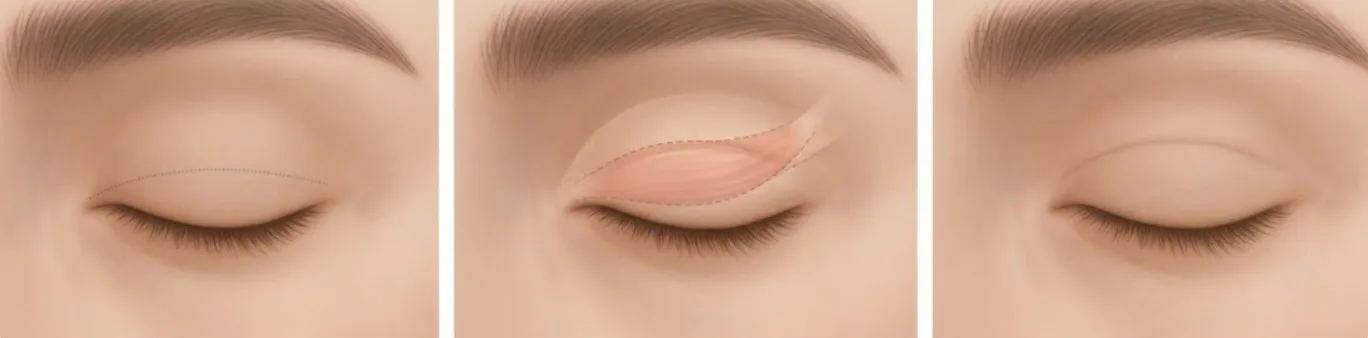
Ptosis correction works on muscle more than skin. It adjusts the strength of the levator, the muscle that lifts your upper eyelid, usually through a small incision along the lid crease (the same crease used in incisional double-eyelid surgery, which is why the two are often planned together). The surgeon sets the muscle so the lid opens to a natural height. The moment that tension is fixed, swelling begins, and swelling is exactly what hides the result.
Illustration: through the crease line, the muscle that opens the eye (shown beneath the lid) is tightened so the lid rests higher.
Because the eye opening depends on a muscle that has just been worked on, it behaves like any muscle after surgery: tense, a little reactive, and surrounded by fluid for a while. The lid may sit higher than expected at first because of post-operative tightness, or lower because of heaviness from swelling. Neither is your final height. This is the single most important thing to understand before you book ptosis correction: the early appearance is only a stage on the way.
The flip side is reassuring. Once you know the result forms over weeks, the puffy, slightly uneven eyes of the first fortnight stop being alarming and become simply expected: a phase you pass through on the way to a settled, natural opening.
First week
Days 1–7: swelling, bruising and an uneven look
The first few days are the most swollen. The upper lids feel tight and heavy, the eyes may look smaller than before surgery because of puffiness, and there can be bruising that spreads and changes colour. Cool compresses in the first 48 hours, keeping your head elevated when you sleep, and avoiding bending or straining all help the swelling come down faster. The usual experience is mild discomfort; real pain is uncommon.
It is completely normal in this week for the two eyes to look different from each other. They swell at different rates, bruise differently, and the lids open by different amounts day to day. Patients often photograph themselves on day 3 and panic at the asymmetry. Please don't: at this stage you are looking at fluid, and the muscle's true setting is still hidden.
Sutures are typically removed around day 7. Removing the stitches makes the lids look tidier and a little more open, but it does not reveal the final result. There is still meaningful swelling left to resolve. Most people feel presentable enough for low-key activity once the stitches are out and any bruising can be covered, though the eyes still read as 'recently done' up close.
Weeks to months
Week 2 to month 3: the eye opening settles
After the sutures are out, the change becomes gradual. Through the second and third weeks the bulk of the visible swelling fades, and the lids start to open more evenly. By around the 1-month mark most patients look natural to people who don't know they had surgery, even though the surgeon can still see fine swelling that the patient cannot.
From 1 to 3 months the result keeps refining. The levator settles into its new resting tension, residual fullness in the lid resolves, and the crease (if a double-eyelid line was made at the same time) softens and matures from a slightly high, surgical-looking fold into a natural one. Symmetry that wavered in the early weeks usually becomes steady and reliable across this window. If you had the procedure to address a tired or sleepy look, this is when the brighter, more awake appearance becomes consistent instead of coming and going with swelling.
It is worth planning your timeline around this. If you are travelling for surgery, the eyes will look good for everyday life well before three months, but the polished, fully-settled result that you'd judge in photographs is a few months out. Read our guidance on how long to stay in Korea and on recovering in Seoul to set expectations before you fly.
Final result
When ptosis correction is truly 'final'
Ptosis correction is usually judged final at around 3 to 6 months, with the last subtle changes (fine swelling, the exact lid height, the maturity of the crease) settling toward the 6-month point. Most of what you care about is visible by 1 to 3 months; the remainder is detail that only you and the surgeon, comparing carefully, would notice.
Lid height and symmetry are the two things that genuinely need this time. The muscle's set, the way both eyes open in concert, and how the result looks across different expressions all stabilise late. This is precisely why a careful clinic does not pass judgement on symmetry at the 2-week visit, and why a small adjustment, if one is ever needed, is considered only after the result has fully settled. During the swollen phase any assessment would be misleading.
If you have eyes that started markedly different from each other, expect the settling to take the longer end of that range, and expect the surgeon to talk to you about realistic symmetry; perfect mirror-image eyes are not a realistic target. A pre-assessment about what's achievable for your specific anatomy is something you can get in an online consultation before you ever travel.
Normal vs red flag
What's normal after ptosis correction, and what to flag to your surgeon
Normal in the first weeks: puffiness, bruising, the two eyes looking uneven, a lid that seems too high or too low, watering, mild dryness or a gritty feeling, and difficulty fully closing the eyes for a short period as the lid adjusts. These resolve as swelling settles. A lid that looks slightly over- or under-corrected at 2 weeks is usually swelling and does not show the muscle's final position.
Worth contacting your surgeon promptly: pain that increases after the first few days, spreading redness or warmth, discharge that looks like pus, fever, a sudden change in vision, or eyes you genuinely cannot close enough to protect the surface (which can cause painful dryness). These are uncommon, but they are the things to raise early.
The practical point for an international patient is having a clear line back to the person who operated. At a single-surgeon clinic the surgeon who did your operation is the one who answers these questions, including after you've flown home, so you are never guessing about what's normal.
At Garnet
How Garnet tracks your ptosis result
At Garnet, ptosis correction is performed by Dr. In-Soo Baek, a board-certified plastic surgeon (Korean medical licence no. 77407) and the clinic's only operating doctor. He consults you, performs the surgery himself and reviews every follow-up. The person assessing your settling result over the months is the same person who set the levator muscle, and no rotating team is reading a chart.
Garnet's after-care is structured around exactly the timeline above: review visits at 1, 3 and 6 months, which line up with when the swelling fades, when the eye opening settles, and when the result is genuinely final. For international patients who have returned home, the same surgeon can continue to review your progress by messenger, with clear guidance on what each stage should look like. Garnet is registered with Korea's foreign-patient programme and caps the day at two surgeries, so each case has unhurried time.
If you're trying to decide whether ptosis correction is right for your eyes, and what a realistic result and timeline would be for you specifically, you can send photos for a pre-assessment through an online consultation before planning any travel.
Real Results
Before & After
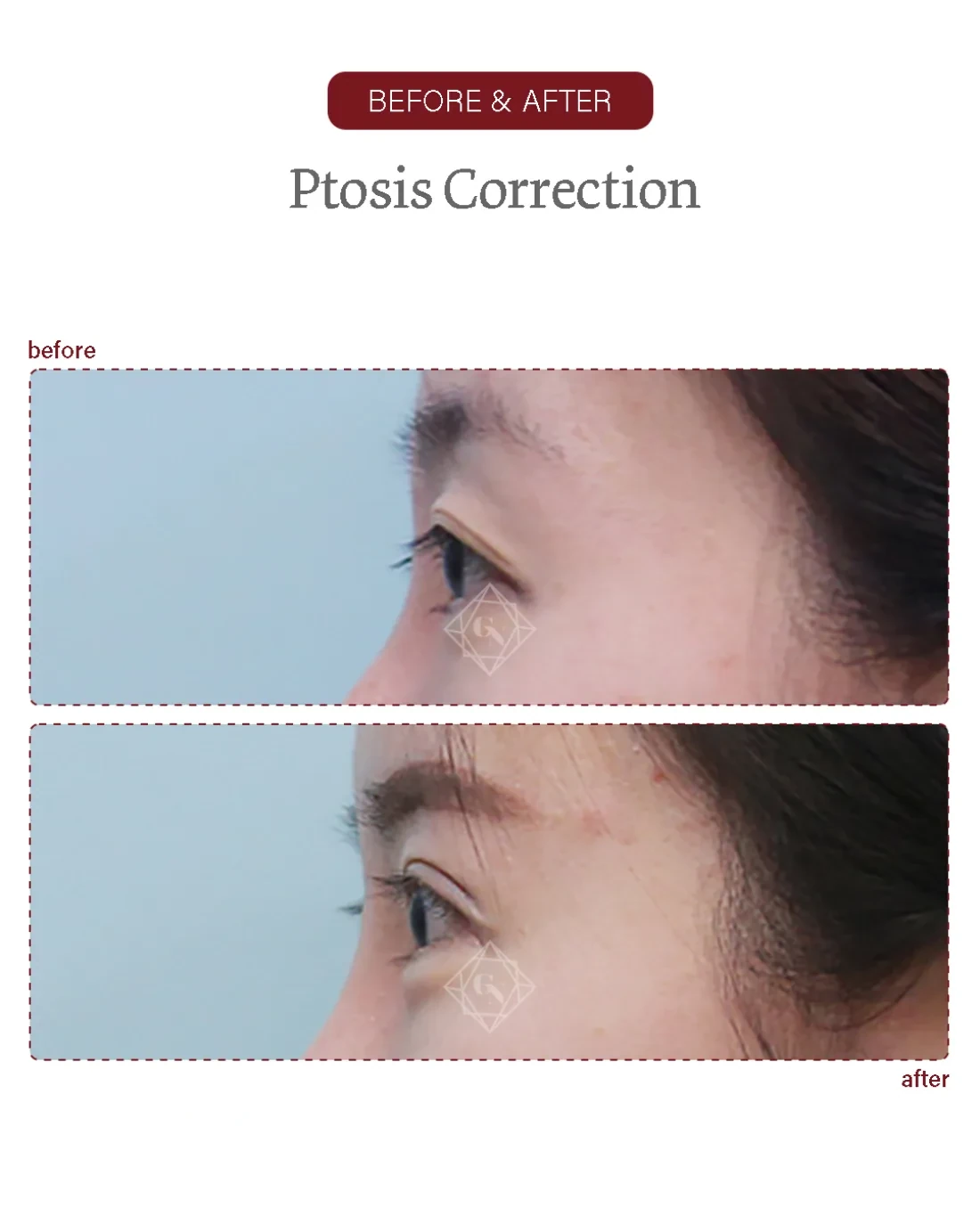
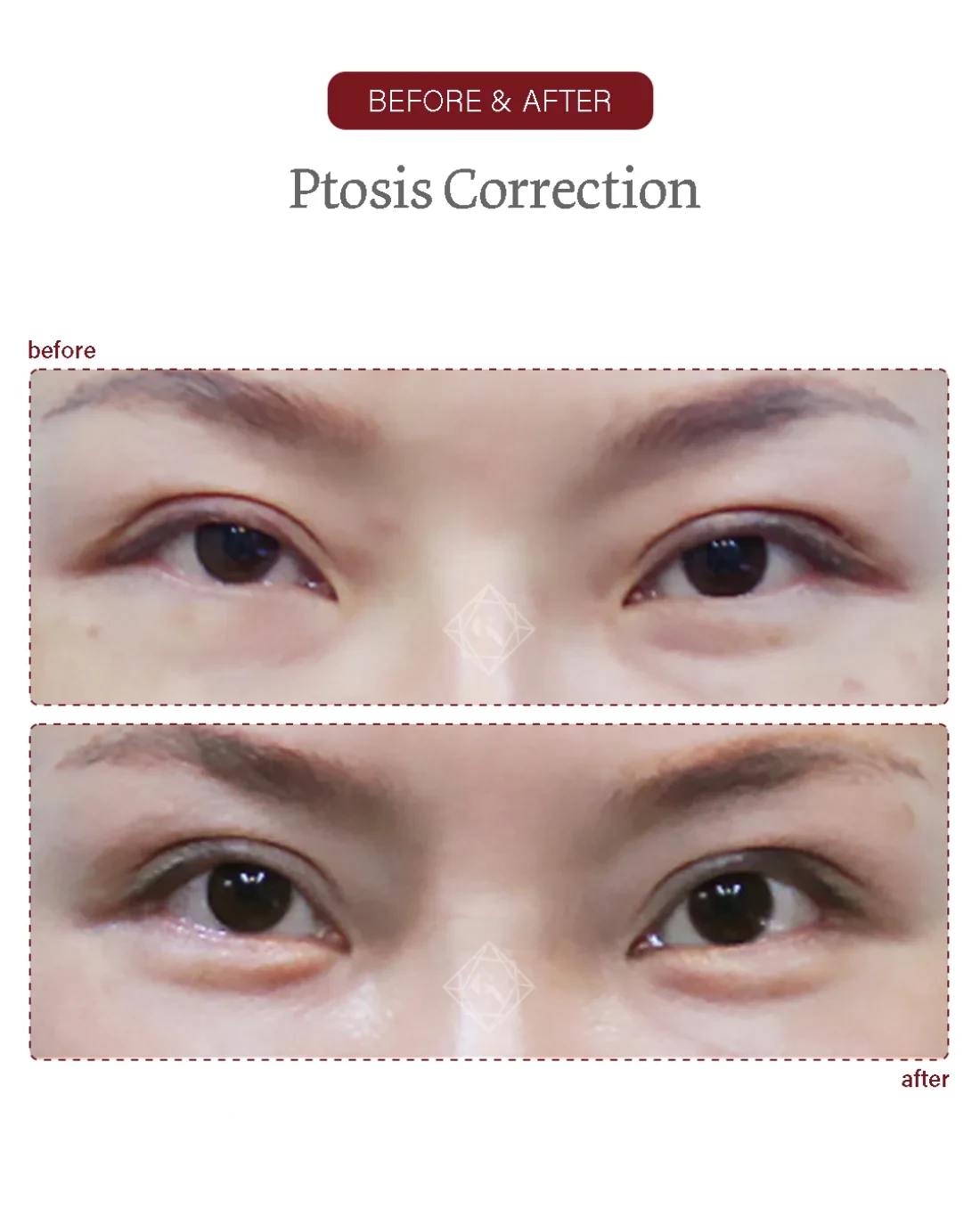
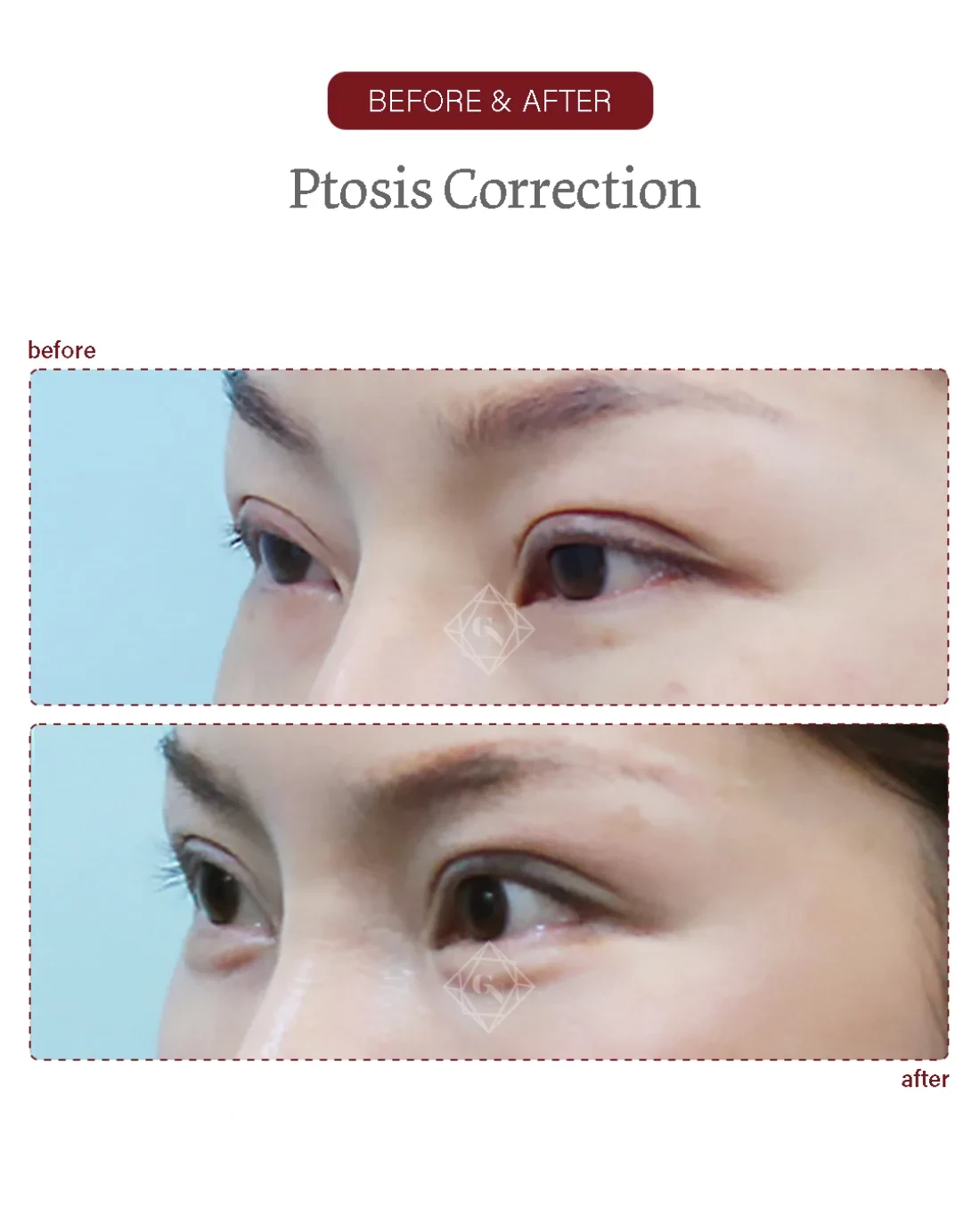
Ptosis-correction before/after examples of actual Garnet patients (published with consent). Results, recovery and suitability vary by individual and are not guaranteed; the right approach is decided at an in-person consultation.
Dr. In-Soo Baek
Director & sole operating surgeon
Korean medical licence no. 77407
Operate on what you came for. Trained at Korea University Medical Center. Every case planned, performed and reviewed by the same hands.
1Operating surgeon
~2Surgeries per day
7Registered techniques
Board-certified plastic surgeon
Plastic surgery training at Korea University College of Medicine & graduate school
Korean Society of Plastic and Reconstructive Surgeons member, in its facial-contour, eye & rhinoplasty groups
Consults, operates and follows up each case himself
Peer-reviewed papers behind the facts on this page. Each describes findings in its own study group — not results at Garnet — and none predicts your own outcome.
Pelton RW. Evaluation and Management of Blepharoptosis. Facial Plastic Surgery. 2022. doi:10.1055/a-1868-0986
Bacharach J et al. A review of acquired blepharoptosis: prevalence, diagnosis, and current treatment options. Eye. 2021. doi:10.1038/s41433-021-01547-5
Kokubo K et al. Comparison of postoperative recurrence rates between levator aponeurosis advancement and external Müller's muscle tucking for acquired blepharoptosis. Journal of Plastic, Reconstructive & Aesthetic Surgery. 2021. doi:10.1016/j.bjps.2021.03.086
FAQ
Common questions
When will I see the final results of ptosis correction?
Most of the result is visible by 1 to 3 months, once the swelling has faded and the eye-opening muscle settles into its new tension. The truly final result, including fine lid height and symmetry, is usually judged at around 3 to 6 months. The puffy, slightly uneven look of the first couple of weeks is normal and is not your final height.
How does the result of ptosis correction change over time?
Right after surgery the lids are swollen, often uneven, and may sit too high or too low because of post-operative tightness and fluid. Over the first weeks the swelling fades and the lids open more evenly; from 1 to 3 months the muscle settles and symmetry becomes reliable. The last subtle refinements continue toward the 6-month mark.
When is the swelling gone after ptosis correction?
The heaviest swelling comes down within the first one to two weeks, and most visible swelling is gone by around a month. Fine swelling that only the surgeon would notice can linger and resolve over the following months, which is part of why the final result is judged later than the 2-week visit.
Why do my eyes look uneven after ptosis correction?
In the early weeks the two eyes swell, bruise and open at different rates, so they commonly look uneven. This is fluid, and the muscle's final setting is not yet visible. Symmetry usually becomes steady and reliable between 1 and 3 months. A careful surgeon does not judge symmetry during the swollen phase, because any assessment then would be misleading.
When can I go back to work after ptosis correction?
Many people feel presentable for low-key activity once the sutures are out at about a week and any bruising can be covered, though the eyes still look recently done up close. If your work is camera-facing or you'd rather not explain swelling, planning around two weeks is more comfortable. The result keeps refining for weeks after you're back to normal life.
When are the stitches removed after ptosis correction?
Sutures are typically removed around day 7. Taking them out makes the lids look tidier and a little more open, but it does not reveal the final result; there is still meaningful swelling left to settle over the following weeks and months.
Is it normal for one eye to open more than the other at first?
Yes. Different swelling and bruising on each side mean the eyes often open by different amounts in the early weeks. This usually evens out between 1 and 3 months as the swelling resolves and the muscle settles. If it concerns you, raise it with your surgeon at a follow-up instead of judging it during the swollen phase.
What should I flag to my surgeon during recovery?
Contact your surgeon promptly for pain that increases after the first few days, spreading redness or warmth, pus-like discharge, fever, a sudden change in vision, or eyes you genuinely cannot close enough to keep comfortable. These are uncommon, but they're worth raising early.
Is my ptosis result followed up after I return home?
Yes. At Garnet the same board-certified surgeon who performed your operation reviews your follow-ups, with structured visits at 1, 3 and 6 months that line up with how a ptosis result settles. For patients who have travelled home, he can continue to review your progress by messenger with guidance on what each stage should look like.
My mom recently had a brow lift and lower blepharoplasty with Dr. Baek, and our experience has been wonderful so far. The Garnet team was incredibly kind and welcoming, with Kelly assisting us as our English consultant—she made everything…
I’m so happy I chose this clinic for my lower blepharoplasty. I was traveling from abroad by myself, so I was a little nervous, but from the beginning I felt comfortable and truly cared for. Everyone was kind, patient, and professional…
Came in for an in-person consult and ended up choosing Garnet and Dr.Baek for my non-incisional DES and tiplasty/alarplasty. I communicated with Kelly (English consultant) from the start till now (3 weeks post-op). She really help me feel…
My under-eyes have been sagging and folding for years... I tried to cover it up with makeup, but it actually got stuck in the wrinkles and made it stand out even more. While going for consultations, I noticed that the bigger the hospital…
To see what a realistic ptosis correction result and timeline would look like for your eyes, send photos for a no-obligation pre-assessment before you plan a trip.
Send photos and your question before you travel. An English-speaking coordinator reviews every enquiry and replies with guidance on whether surgery is appropriate, the likely plan and timing.
✓ Reviewed by the clinic coordinator, not a bot
✓ Photo-based pre-assessment before you fly
✓ Foreign-patient scheduling & after-care
✓ One surgeon for consultation, surgery and follow-up
Prefer to chat now? Reach the coordinator directly:









 T S7 months ago



