A septal and ear cartilage rhinoplasty reshapes the nasal tip with your own cartilage only, so the grafts integrate and are meant to stay permanently. Septal and ear cartilage behave differently, though: ear cartilage is softer, with a natural springiness, and the nose still ages around a lasting reshape.
The short answer
This approach uses only your own septal and ear (conchal) cartilage and no implant, so the grafts integrate and are meant to remain permanently, with nothing to exchange.
The two cartilages differ: septal cartilage is firmer and gives structural tip support, while ear cartilage is softer, curved and springy with a natural memory, ideal for natural contour.
Ear cartilage can settle gently or retain a slight curve as it heals, so careful shaping and support at surgery shape how it holds.
No rhinoplasty stops ageing, but a well-integrated cartilage nose is stable for the long term and ages gently from a reshaped starting point.
A septal and ear cartilage rhinoplasty refines and supports the tip using only your own tissue: septal cartilage from inside the nose and conchal cartilage from the ear. Because these are autologous grafts, they integrate with your body over the healing period and become a living part of your nose, meant to remain permanently. There is no artificial implant involved, so the long-term concerns that can attach to a silicone implant simply do not arise here.
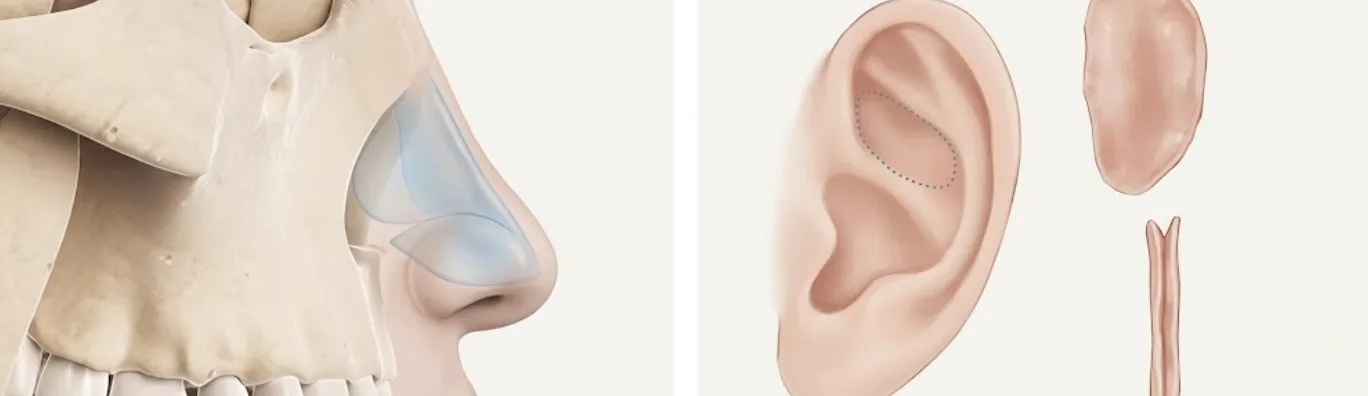
Illustration: two common sources of the patient's own cartilage: the septum inside the nose (blue) and the curved cartilage of the ear.
Once healed, this reshaping of the tip is a lasting structural change. You are living with your own integrated cartilage, with no foreign material that might one day need managing. That is the core of this approach's appeal for longevity. The direction of the result is durable: the grafts are your tissue, and they are meant to stay.
A lasting result still changes slowly over the years, and the two cartilages used behave quite differently. Understanding how septal and ear cartilage each hold up, including the particular softness of ear cartilage, is the key to a realistic expectation before surgery.
Septal vs ear
How septal and ear cartilage hold up differently
Septal cartilage is firmer, straighter and structurally strong, which makes it well suited to supporting tip projection and providing a stable framework for the tip. When available in sufficient quantity, it holds a defined result well because it resists deformation. It is the more structural of the two, and it is used where the tip needs reliable support.
Ear (conchal) cartilage is different by nature: it is softer, naturally curved and springy. That gentle curve is actually an advantage for creating a natural-looking, rounded tip contour without a sharp, over-defined look, which is why it is prized for a soft, natural result. Its trade-off is that this same softness means it provides less rigid support than septal cartilage, and it can settle slightly or retain a bit of its natural curve as it heals.
In practice the two are used together to balance their strengths: firmer septal cartilage for structural support, softer ear cartilage for natural contour. When each is used for what it does best and secured carefully, the combined result is both natural and stable. The longevity comes from that thoughtful pairing and from respecting the particular behaviour of ear cartilage, covered in the next section.
Softness and memory
Softness, springiness and cartilage memory
Ear cartilage has what surgeons sometimes describe as a natural memory, a tendency to return towards its original curved shape. Because conchal cartilage comes from the naturally curved bowl of the ear, it carries an inherent springiness. As it integrates it can retain a slight curve or settle gently; it does not sit perfectly rigid the way a harder material would.
This is not a drawback so much as a property to work with. Skilled shaping (carving, sometimes layering, and securing the graft so its curve works for the contour) turns that natural springiness into a soft, natural tip. The support given at surgery, often with firmer septal cartilage underpinning it, is what keeps the softer ear cartilage doing its job well over the long term.
The practical takeaway is that longevity here depends heavily on careful surgery that respects how ear cartilage behaves. Grafts that are well-shaped and properly supported hold their result naturally; work that ignores the cartilage's memory is more prone to gentle settling. This is why the approach rewards an experienced, unhurried hand. The durability is built in during the shaping, and planning for the softness of ear cartilage is part of that work.
How it ages
How the nose still ages after septal and ear cartilage rhinoplasty
As with every nose surgery, this does not stop the nose ageing, because ageing happens in the living tissue around the framework. Over the years the skin over the nose can thin or change texture, the tip may descend slightly as its support softens, and facial soft tissue shifts. These are gradual, normal changes that happen to everyone, operated or not, and the cartilage reshape resets the clock; it does not switch it off.
What surgery gives you is a reshaped starting point from which the nose ages gently. Years later your nose will reflect the cartilage reshaping, looking like an older version of that natural tip. It does not revert to how it began. Because the grafts are your own integrated tissue, the reshaped tip is well placed to endure while the surrounding tissue ages naturally.
The realistic framing is a lasting, natural reshape that then ages gently. A cartilage-only tip is designed to look and age naturally, so subtle changes over the years are expected and are no sign that anything has gone wrong. For a fuller picture of how a nose ages, our how long rhinoplasty lasts guide gives useful context.
Later on
If a septal and ear cartilage nose ever needs attention later
Because there is no implant, one of the most common long-term reasons for revisiting a nose does not apply to a cartilage-only result. Your septal and ear cartilage integrate and are meant to remain permanently, so most people with a well-healed result simply enjoy their natural tip for the long term without needing further surgery.
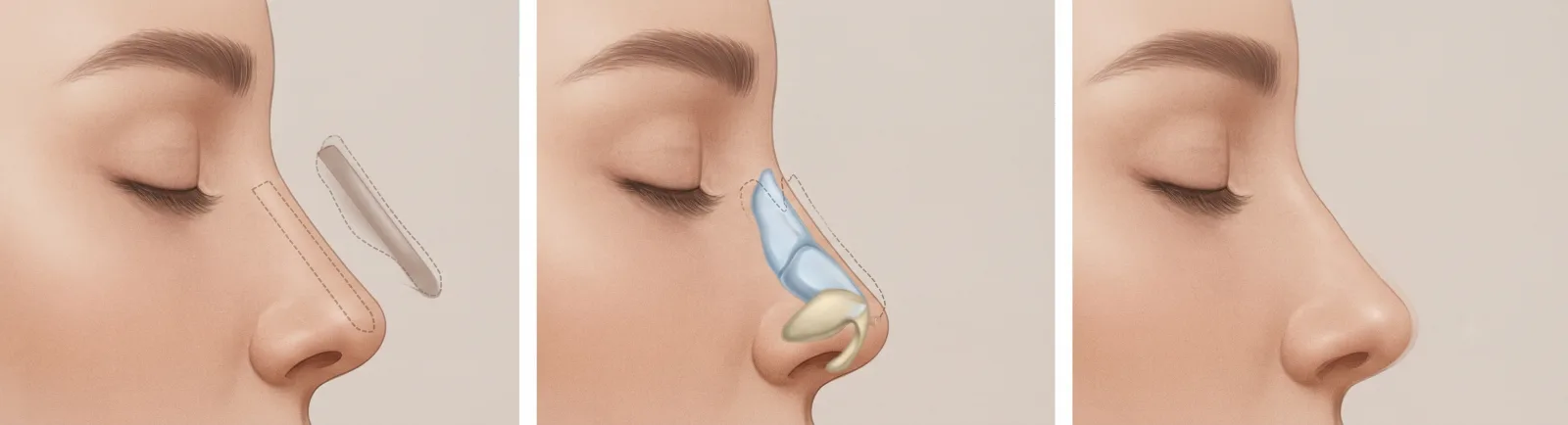
Illustration: the previous implant (outlined) is removed and the framework is rebuilt with the patient's own cartilage for support.
If attention is ever wanted years later, it is more likely to be a minor refinement, for instance addressing a small area of ear cartilage that settled or a tip change from ageing. There is no implant to manage. Where a nose needs more substantial correction after previous surgery, that becomes a revision rhinoplasty, which is its own considered undertaking and may draw on additional cartilage grafts.
After a septal and ear cartilage rhinoplasty, no further operation is pencilled in for you. A well-shaped cartilage nose is stable and ages naturally, and because it carries no implant, a major long-term prompt for revisiting a nose is absent. If anything is ever needed, it is best discussed with the surgeon who shaped your cartilage and knows exactly how your tip was built.
At Garnet
Garnet's approach to a lasting, natural result
Garnet is a single-surgeon clinic in Apgujeong, Seoul. Dr. In-Soo Baek is a board-certified plastic surgeon (Korean medical licence no. 77407) and the only operating doctor. He consults, harvests and shapes the septal and ear cartilage, performs the surgery himself and reviews every follow-up, and the clinic keeps to two surgeries a day so the meticulous shaping each case needs is never rushed. With over ten years focused on nose surgery, the emphasis is on cartilage work that integrates cleanly and holds a natural result over the long term.
Because durability here depends on how the cartilage is shaped and supported, that unhurried, single-surgeon model is directly relevant to how long the result lasts: the same surgeon carves the septal and ear cartilage, works with the ear cartilage's natural springiness and secures the grafts, then follows your healing (nose sutures out around 7 days and the ear donor site around 10) with structured reviews at 1, 3 and 6 months, and by messenger after you fly home. International visitors are covered by Garnet's registration with Korea's foreign-patient programme.
For a realistic view of how a septal and ear cartilage rhinoplasty could last for your nose, including how ear cartilage's softness is managed, the ideal first step is a no-obligation online assessment. Send photos of your nose and ask how the tip would be built and how long it should hold before you plan any travel.
Prices
Price at Garnet
Revision rhinoplasty
From₩4,000,000 + VATExcluding VAT (10% VAT is added at payment)Book now
Same price as Korean patients. Prices shown exclude 10% VAT; your written quote, issued after the in-person consultation, shows the full amount payable.
Dr. In-Soo Baek
Director & sole operating surgeon
Korean medical licence no. 77407
Operate on what you came for. Trained at Korea University Medical Center. Every case planned, performed and reviewed by the same hands.
1Operating surgeon
~2Surgeries per day
7Registered techniques
Board-certified plastic surgeon
Plastic surgery training at Korea University College of Medicine & graduate school
Korean Society of Plastic and Reconstructive Surgeons member, in its facial-contour, eye & rhinoplasty groups
Consults, operates and follows up each case himself
Peer-reviewed papers behind the facts on this page. Each describes findings in its own study group — not results at Garnet — and none predicts your own outcome.
Jang YJ et al. Tip Grafting for the Asian Nose. Facial Plastic Surgery Clinics of North America. 2018. doi:10.1016/j.fsc.2018.03.008
Suh YC et al. Septum-Based Nasal Tip Plasty: A Comparative Study between Septal Extension Graft and Double-Layered Conchal Cartilage Extension Graft. Plastic & Reconstructive Surgery. 2018. doi:10.1097/prs.0000000000003920
Coblens O et al. The Conchal Cartilage Butterfly Graft. Facial Plastic Surgery. 2016. doi:10.1055/s-0035-1570326
FAQ
Common questions
How long does ear cartilage rhinoplasty last?
Because the tip is refined with your own septal and ear cartilage, the grafts integrate and are meant to remain permanently; there is no implant to exchange. The reshaped tip is a lasting change. Ear cartilage is softer and springier, so it can settle gently as it heals, and the nose still ages, but a well-integrated cartilage result is stable for the long term.
Is septal and ear cartilage rhinoplasty permanent?
The reshaping is a lasting change and the cartilage grafts are your own tissue meant to remain permanently, so the result endures without any implant to manage. But nothing stops the nose ageing, and softer ear cartilage can settle or retain a slight curve as it integrates. It is fair to call it a lasting, natural reshape. Nobody can promise it stays unchanged forever.
Does ear cartilage last as well as septal cartilage?
Both integrate and are meant to remain, but they differ. Septal cartilage is firmer and gives structural tip support, so it holds a defined result well. Ear cartilage is softer, curved and springy. It is ideal for a natural contour but providing less rigid support, and it can settle slightly. Using them together balances natural shape with lasting structure.
What is cartilage memory and does it affect the result?
Ear (conchal) cartilage comes from the naturally curved bowl of the ear and has an inherent springiness, sometimes called memory: a tendency to return toward its original curve. Skilled shaping and support turn this into a soft, natural tip. It is why careful, experienced surgery matters, and why the softness is planned for from the start.
Does ear cartilage rhinoplasty change with age?
Yes, gently. The reshaped tip holds, but the living tissue keeps ageing: skin can thin, the tip may descend a little as support softens, and facial soft tissue shifts over the years. These are gradual, normal changes. Because the grafts are your own integrated cartilage, the tip ages slowly from a reshaped starting point and does not revert to how it began.
Why use ear cartilage if it is softer?
That softness is a feature for the tip. The natural curve of ear cartilage creates a soft, rounded, natural-looking contour and avoids a sharp, over-defined tip, which is why it is prized for a natural result. It is typically paired with firmer septal cartilage underneath for support, so the combination gives both a natural look and lasting structure.
Will I ever need the cartilage replaced?
There is no implant to replace, and your septal and ear cartilage integrate as tissue meant to remain permanently. Should your septal and ear cartilage tip ever need attention years later, the likely job is a minor refinement, such as addressing a small area that settled, and graft replacement is less likely. Most people with a well-healed cartilage nose never need to revisit it.
Does having the same surgeon help with long-term results?
It helps. When the same board-certified surgeon harvests, shapes and secures the septal and ear cartilage, working with the ear cartilage's natural springiness, and then follows your healing at 1, 3 and 6 months, the grafting is done and monitored as intended. It also makes any future refinement easier, because the surgeon knows exactly how your tip was built.
Can I get a longevity estimate for my nose before travelling?
Yes. In an online consultation from abroad you can send photos, and the surgeon can give a realistic view of both the likely result and how it may last for your nose, including how ear cartilage's softness is managed, before you commit to any travel.
My mom recently had a brow lift and lower blepharoplasty with Dr. Baek, and our experience has been wonderful so far. The Garnet team was incredibly kind and welcoming, with Kelly assisting us as our English consultant—she made everything…
I’m so happy I chose this clinic for my lower blepharoplasty. I was traveling from abroad by myself, so I was a little nervous, but from the beginning I felt comfortable and truly cared for. Everyone was kind, patient, and professional…
Came in for an in-person consult and ended up choosing Garnet and Dr.Baek for my non-incisional DES and tiplasty/alarplasty. I communicated with Kelly (English consultant) from the start till now (3 weeks post-op). She really help me feel…
My under-eyes have been sagging and folding for years... I tried to cover it up with makeup, but it actually got stuck in the wrinkles and made it stand out even more. While going for consultations, I noticed that the bigger the hospital…
Send photos for a no-obligation pre-assessment of how long an ear cartilage rhinoplasty could last for your nose, including how ear cartilage's softness is managed, before you plan a trip.
Send photos and your question before you travel. An English-speaking coordinator reviews every enquiry and replies with guidance on whether surgery is appropriate, the likely plan and timing.
✓ Reviewed by the clinic coordinator, not a bot
✓ Photo-based pre-assessment before you fly
✓ Foreign-patient scheduling & after-care
✓ One surgeon for consultation, surgery and follow-up
Prefer to chat now? Reach the coordinator directly:








 T S7 months ago



