In a rhinoplasty the reshaped bone-and-cartilage framework of the nose is a structural change that lasts. The full answer has more layers: the materials used, a silicone dorsal implant and your own tip cartilage, behave differently over the decades, and the nose still ages like the rest of the face.
The short answer
The structural reshaping of the nasal framework is lasting — once the bone and cartilage are set and healed, that change endures.
Materials age differently: a silicone dorsal implant is stable for many years but can, over a long span, need eventual exchange, while your own tip cartilage integrates and is meant to stay.
No rhinoplasty stops ageing. Skin thickness, tip support and soft tissue keep changing with time, so the nose still evolves slowly from a reshaped starting point.
When attention is ever needed later, it is usually a focused refinement of one part, and careful planning at the outset makes that easier.
The core of a rhinoplasty is a change to the underlying framework of bone and cartilage that gives the nose its shape. When a hump is reduced, a bridge is built up, or the tip is redefined, that structural reshaping is set during surgery and then heals into place. Unlike a treatment that fades, a framework change does not simply reverse over time. The reshaped structure is what holds the long-term result.
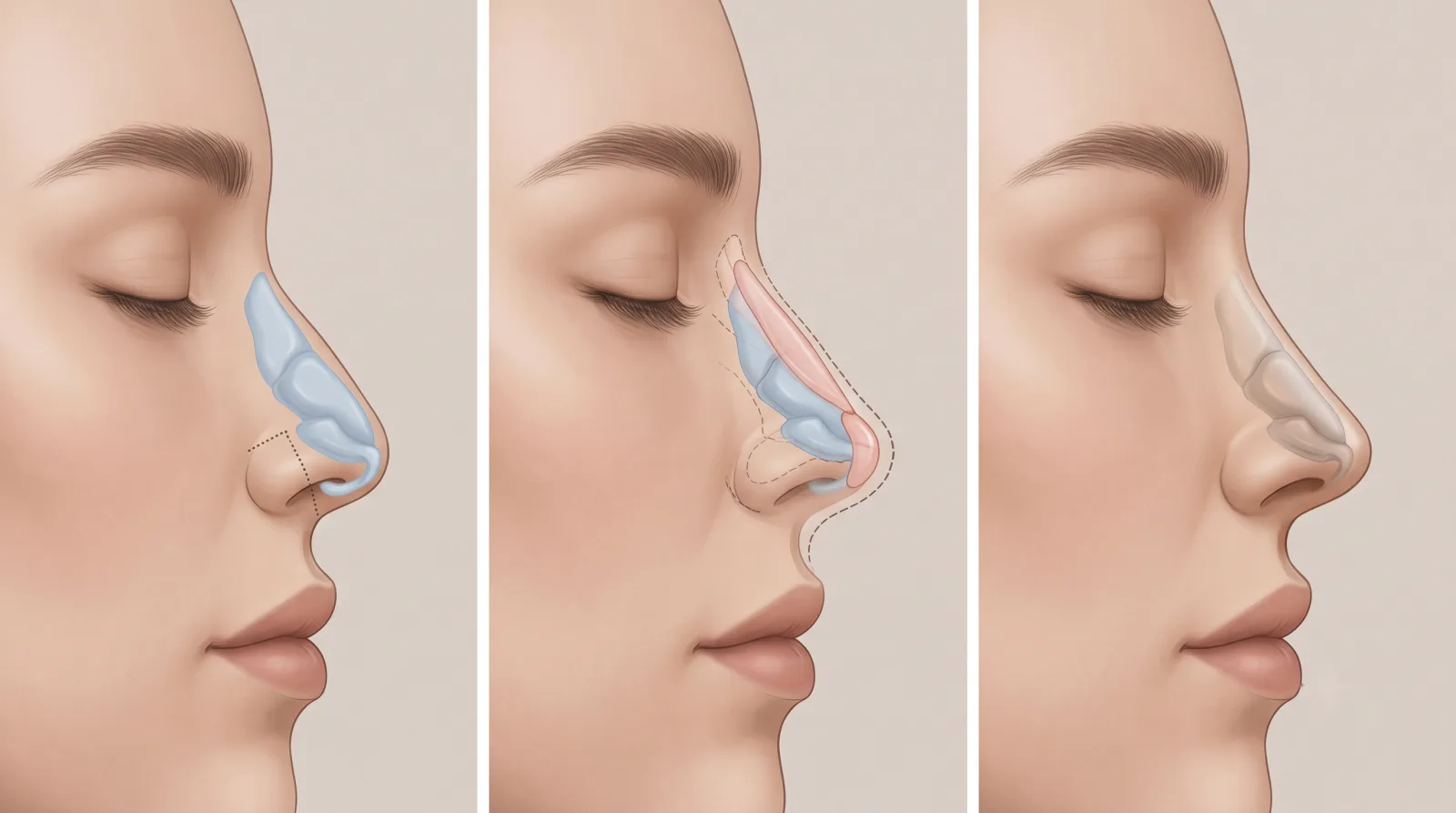
Illustration: the nasal framework (blue) is reshaped to raise the bridge and refine the tip. The dashed outline shows the original contour.
This is why rhinoplasty is described as a lasting procedure. Once the swelling settles over the first months and the framework has fully healed, the new shape is your nose's new baseline. The direction of the result is durable: you are not waiting for it to wear off, you are living with a reshaped structure that stays.
That said, a lasting result is still a living one. The framework endures, but the nose is a living structure covered in skin and soft tissue that continue to change. Understanding which parts are stable and which keep evolving is the key to a realistic expectation, and it starts with the materials used to build the result.
Implant vs cartilage
How the implant and your own cartilage age differently
At Garnet a standard rhinoplasty commonly combines a silicone implant to augment the bridge with the patient's own tip cartilage (septal or ear cartilage) to refine and support the tip. These two materials have genuinely different long-term stories, and you should know both. A silicone dorsal implant is a stable, well-established material that typically sits comfortably for many years, but over a very long span an implant can, in some people, eventually warrant exchange, and there are recognised long-term risks such as thinning of the overlying skin, shifting, or in rare cases exposure that would need attention.
Illustration: instead of an implant, the bridge and tip are built from the patient's own tissue, shaped into the nasal framework (blue). The dashed line shows the original contour.
Your own tip cartilage behaves differently. Because it is autologous tissue, it integrates with your body and is meant to remain permanently, with no material to exchange. Its trade-off is that cartilage can, occasionally, warp slightly or settle as it heals, which is one reason careful shaping and support at the time of surgery matters so much for how the tip holds up.
So whether a rhinoplasty is permanent depends partly on what was used. The structural change is lasting; the autologous cartilage is meant to stay; and the implant is durable but is the part most likely, over decades, to be the reason a nose is ever revisited. If avoiding an implant entirely appeals to you, our implant-free rhinoplasty uses cartilage alone.
How it ages
How the nose still ages after surgery
No rhinoplasty stops the nose from ageing, because ageing happens in the living tissue around the framework as well as in the framework itself. Over the years the skin can thin or change in texture, the tip may descend slightly as its natural support softens with age, and the soft tissue of the whole face shifts. These changes are gradual and normal, and they happen to everyone, operated or not.
What surgery gives you is a reshaped starting point from which the nose ages slowly and naturally. Years later your nose will still reflect the reshaping, but it will look like an older version of that reshaped nose; it does not revert to how it began. Thinking of it as a lasting reshape that then ages gently is far more accurate than picturing a fixed number of years.
This is also why anyone promising that a nose will look identical forever is overstating what surgery can do. A well-planned rhinoplasty is designed to age gracefully, so the changes over time are subtle and slow. If you would like to understand the whole recovery and settling process, our recovery timeline guide walks through how the result matures.
What affects it
What affects how long your result holds up
Several factors shape how a rhinoplasty holds up over time. Skin thickness is a big one: thicker skin behaves differently from thin skin as it ages, and both influence how crisp the tip stays. The quality and strength of your own cartilage, and how well the tip is supported at surgery, affect whether the tip keeps its projection for the long term.
Lifestyle plays a part too. Significant sun exposure ages the skin over the nose, and events like trauma to the nose, such as a knock or an accident, can affect a reshaped framework in a way that everyday life does not. None of these erase the result, but they influence how long it looks its best, and most are at least partly within your control.
Finally, the surgery itself matters enormously. A framework built with proper support, an implant placed at a sensible size and depth, and tip cartilage shaped and secured with care will hold up better than work that cuts corners. This is one reason it is worth understanding the cost of rhinoplasty in terms of the surgeon and the time given to the case. The durability is largely built during the operation.
Later on
If your nose ever needs attention later
If a nose ever does need attention years down the line, it is usually a focused refinement, and starting from scratch is rare. The most common long-term reason is the implant, for instance a wish to exchange it or to address thinning skin over the bridge, and that is a defined, planned procedure much smaller than a whole new rhinoplasty. Tip changes from ageing, if they bother you, can likewise be refined.
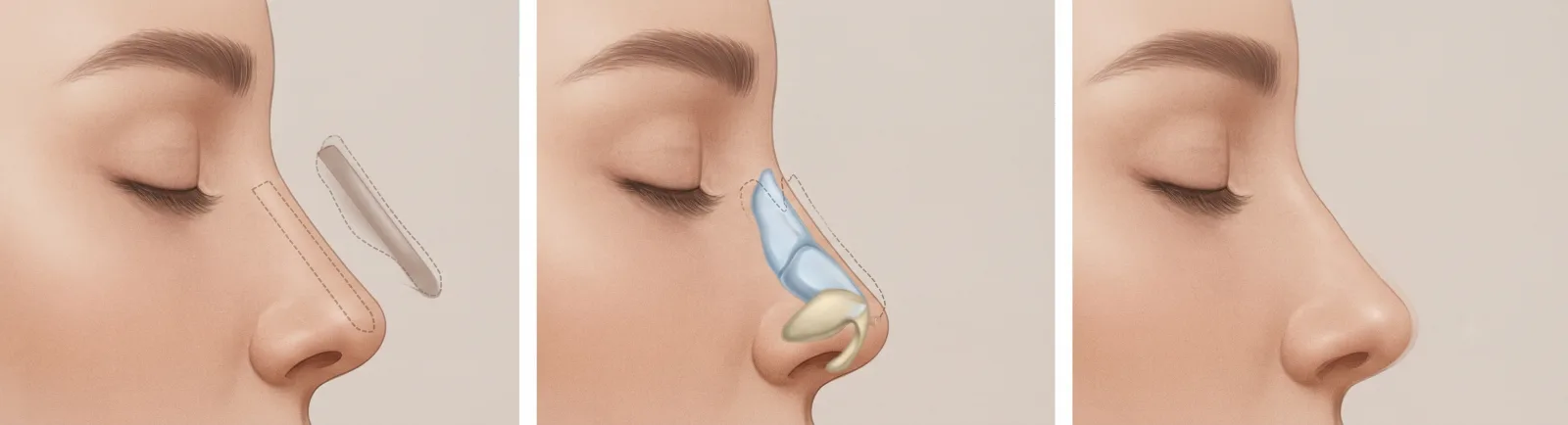
Illustration: the previous implant (outlined) is removed and the framework is rebuilt with the patient's own cartilage for support.
Where a previous nose surgery needs more substantial correction, that becomes a revision rhinoplasty, which is its own considered undertaking. But for a primary rhinoplasty that has healed well, most people simply enjoy the result for many years and never need to revisit it. The framework is doing its job.
There is no schedule you are obliged to follow, and no assumption that you will need further surgery. The structural change lasts, the implant is the part most likely to prompt a future step over a long span, and if that ever comes it is a manageable, planned refinement, best discussed with a surgeon who knows exactly what was done.
At Garnet
Garnet's approach to a lasting result
Garnet is a single-surgeon clinic in Apgujeong, Seoul. Dr. In-Soo Baek, a board-certified plastic surgeon (Korean medical licence no. 77407), is the one doctor who operates there. He consults, performs the rhinoplasty himself and reviews every follow-up, and the clinic keeps to two surgeries a day so each case has unhurried time. With over 10 years focused on nose surgery and a cumulative nose caseload in the tens of thousands, the emphasis is on building a framework that holds up over the long term.
Because durability is built during surgery, that single-surgeon model is directly relevant to how long your result lasts: the same surgeon plans the framework, selects and places the implant and shapes your own tip cartilage, then follows your healing with dressing changes on day 1 and 3, suture removal around 7 days, and structured reviews at 1, 3 and 6 months, plus messenger reviews after you fly home. For visitors from abroad, Garnet is a registered clinic under Korea's foreign-patient programme.
If you would like a realistic view of how a rhinoplasty could last for your nose specifically, including a frank discussion of implant versus cartilage, the ideal first step is a no-obligation online assessment. Send photos and get a straight answer about both the result and its longevity before you plan any travel.
Prices
Price at Garnet
Revision rhinoplasty
From₩4,000,000 + VATExcluding VAT (10% VAT is added at payment)Book now
Same price as Korean patients. Prices shown exclude 10% VAT; your written quote, issued after the in-person consultation, shows the full amount payable.
Dr. In-Soo Baek
Director & sole operating surgeon
Korean medical licence no. 77407
Operate on what you came for. Trained at Korea University Medical Center. Every case planned, performed and reviewed by the same hands.
1Operating surgeon
~2Surgeries per day
7Registered techniques
Board-certified plastic surgeon
Plastic surgery training at Korea University College of Medicine & graduate school
Korean Society of Plastic and Reconstructive Surgeons member, in its facial-contour, eye & rhinoplasty groups
Consults, operates and follows up each case himself
Peer-reviewed papers behind the facts on this page. Each describes findings in its own study group — not results at Garnet — and none predicts your own outcome.
Nassif PS et al. Asian Rhinoplasty. Facial Plastic Surgery Clinics of North America. 2010. doi:10.1016/j.fsc.2009.11.018
Toriumi DM et al. Asian Rhinoplasty. Facial Plastic Surgery Clinics of North America. 2007. doi:10.1016/j.fsc.2007.04.003
Frederick JW et al. Asian Male Blepharoplasty and Rhinoplasty. Facial Plastic Surgery Clinics of North America. 2024. doi:10.1016/j.fsc.2024.03.005
FAQ
Common questions
How long does rhinoplasty last?
The reshaped nasal framework is a structural change that lasts; once healed, it does not simply reverse. Your own tip cartilage integrates and is meant to stay permanently, while a silicone dorsal implant is durable for many years but is the part most likely, over a very long span, to eventually warrant exchange. The nose still ages gently around that lasting reshape.
Is rhinoplasty permanent?
The structural reshaping is lasting, and autologous tip cartilage is meant to remain permanently, so in that sense the result endures. But nothing stops the nose ageing, and a silicone implant, while stable for years, can in some people eventually need exchange over decades. It is accurate to call the framework lasting, but no one can promise it is unchanging forever.
Does a silicone implant need to be replaced?
Not on any fixed schedule. A silicone dorsal implant is a well-established material that typically sits comfortably for many years. Over a long span some people may want or need to exchange it, for example if the overlying skin thins or the implant shifts, but many never do. It is the part of the nose most likely to prompt a future step, which is why careful planning matters.
Does the tip cartilage last as long as the bridge implant?
Because the tip is refined with your own septal or ear cartilage, it is autologous tissue that integrates with your body and is meant to stay permanently, with nothing to exchange. Its trade-off is that cartilage can occasionally warp or settle slightly as it heals, which is why careful shaping and support at surgery matter for how the tip holds up long term.
Does rhinoplasty change with age?
Yes, gently. The framework holds, but the living tissue around it keeps ageing: skin can thin, the tip may descend a little as its support softens, and facial soft tissue shifts over the years. These changes are gradual and normal. Your nose ages slowly from a reshaped starting point and does not revert to how it began.
What makes a rhinoplasty last longer or shorter for one person?
Skin thickness, the strength of your own cartilage, and how well the tip is supported at surgery all influence how the result holds up. Sun exposure ages the skin, and trauma to the nose can affect a reshaped framework. Above all, careful surgery, with a well-placed implant and properly secured cartilage, builds durability in from the start.
Will I need a second nose surgery in the future?
Most people who have a well-healed primary rhinoplasty never need further surgery. If a nose does need attention years later, it is usually a focused refinement, often related to the implant, without starting over. Where a previous surgery needs more substantial correction, that becomes a revision rhinoplasty, which is a separate, considered procedure.
Does one surgeon building and following the nose make a difference over time?
It helps. When the same board-certified surgeon plans the framework, places the implant, shapes your cartilage and follows your healing at 1, 3 and 6 months, the work is done and monitored as intended. It also makes any future step easier, because the surgeon knows exactly what was used and how your nose was built.
Can my rhinoplasty longevity be judged before I travel?
Yes. In an online consultation from abroad you can send photos, and the surgeon can give a realistic view of both the likely result and how it may last for your nose specifically, including a frank discussion of implant versus cartilage, before you commit to any travel.
My mom recently had a brow lift and lower blepharoplasty with Dr. Baek, and our experience has been wonderful so far. The Garnet team was incredibly kind and welcoming, with Kelly assisting us as our English consultant—she made everything…
I’m so happy I chose this clinic for my lower blepharoplasty. I was traveling from abroad by myself, so I was a little nervous, but from the beginning I felt comfortable and truly cared for. Everyone was kind, patient, and professional…
Came in for an in-person consult and ended up choosing Garnet and Dr.Baek for my non-incisional DES and tiplasty/alarplasty. I communicated with Kelly (English consultant) from the start till now (3 weeks post-op). She really help me feel…
My under-eyes have been sagging and folding for years... I tried to cover it up with makeup, but it actually got stuck in the wrinkles and made it stand out even more. While going for consultations, I noticed that the bigger the hospital…
For a realistic view of how long a rhinoplasty could last for your nose, send photos for a no-obligation pre-assessment, including a frank discussion of implant versus your own cartilage, before you plan a trip.
Send photos and your question before you travel. An English-speaking coordinator reviews every enquiry and replies with guidance on whether surgery is appropriate, the likely plan and timing.
✓ Reviewed by the clinic coordinator, not a bot
✓ Photo-based pre-assessment before you fly
✓ Foreign-patient scheduling & after-care
✓ One surgeon for consultation, surgery and follow-up
Prefer to chat now? Reach the coordinator directly:








 T S7 months ago



