Corset platysmaplasty stitches the separated platysma muscle back together in the midline of the neck, so a good result is built to last. The neck still keeps ageing around the repair. Understanding what holds and what gradually changes is the difference between disappointment and a result you are happy with for years.
The short answer
Corset platysmaplasty re-tightens the platysma muscle in the midline, and that internal stitching itself is durable. It does not simply dissolve away.
The repair stays put, but skin, fat and underlying ageing continue, so the visible result softens gradually over years.
Most patients keep a clearly improved neckline for many years; the band correction does not need routine ‘topping up’.
No neck surgery is permanent. How long your result looks its best depends on tissue quality, weight stability and ageing; there is no fixed expiry date.
What corset platysmaplasty actually does — and why that matters for longevity
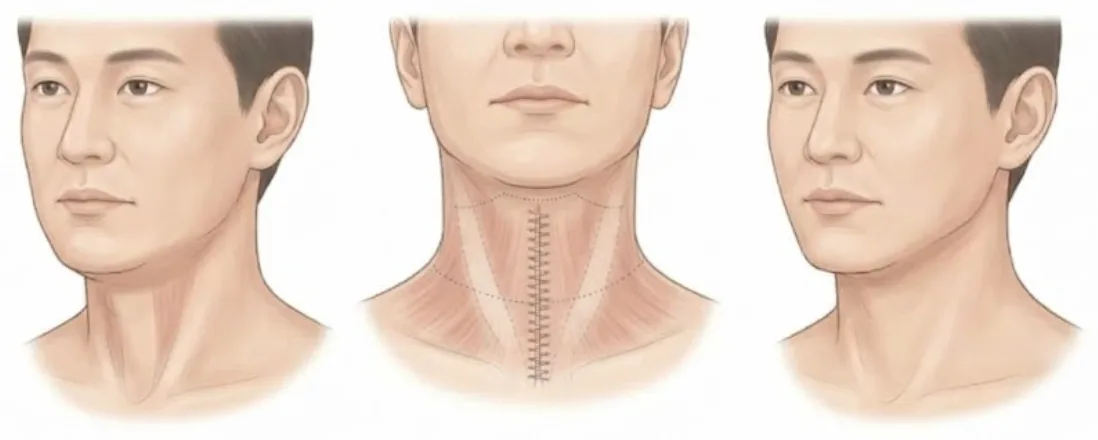
To understand how long the result lasts, it helps to know what the operation corrects. With age the platysma, the thin sheet of muscle across the front of the neck, separates down the midline, and its edges pull forward into the two vertical cords (‘bands’) people notice when they tense or speak. Corset platysmaplasty addresses this directly: through a small incision under the chin (submental), the surgeon sews the separated muscle edges back together in the midline, cinching the neck like the lacing of a corset. This is structural, internal work on the muscle layer. It is neither a surface treatment nor a temporary tightening of the skin.
Illustration: the neck muscle (platysma) is drawn back together along the midline, like lacing a corset, to firm the neck.
Because the correction is a permanent set of internal sutures re-approximating muscle, the platysmal cords do not simply ‘come undone’ a few months later the way a non-surgical tightening device fades. The supporting effect is meant to hold for the long term. That is the single biggest reason a surgical neck-band correction lasts so much longer than thread or energy-based alternatives, which is covered on the parent corset platysmaplasty page and in the comparison with a fuller neck lift.
What does not last forever is the appearance, because your neck keeps living and ageing around the repair. So ‘how long does it last’ has two answers at once: the muscle correction is durable, but the overall youthful look softens slowly as the rest of the neck changes. The sections below separate those two so you know what to expect at one year, five years and beyond.
The repair
Why the midline plication is durable
The corset effect comes from plication: folding and stitching the muscle edges together so the front of the neck is held in a tighter, flatter position. Once that muscle has healed in its new position, scar tissue forms along the repair and reinforces it, so the join becomes part of your own anatomy. This is why patients are not asked to come back for periodic re-tightening: there is no device to renew and no filler to replace.
The sutures used internally to hold the muscle are placed by the surgeon to keep the corset secure through the healing window, when the repair is most vulnerable. After that, your healed tissue carries the result. The technique at Garnet is a midline platysmal plication performed through the submental approach, with the same surgeon planning and carrying out the repair. That matters for longevity, because a clean, well-judged plication is what gives the correction its staying power.
It is worth being realistic about what the muscle repair can and cannot promise. It reliably reduces the vertical banding and sharpens the line under the jaw. It cannot stop the clock on the skin draped over it. So the durability you are buying is the band correction and the cleaner neck contour. That part tends to hold well for years, as the next section explains in the context of ongoing ageing.
Over time
What changes in the years after surgery
Your neck does not pause after surgery. Skin slowly loses elasticity, a little fat can return or shift, and the deeper ageing that created the bands in the first place continues at its own pace. None of this ‘undoes’ the plication, and the muscle stays repaired. The combined effect is that the very sharp early result softens gradually over the years. Most people describe their neck as still clearly better than before surgery, just maturing naturally with the rest of the face.
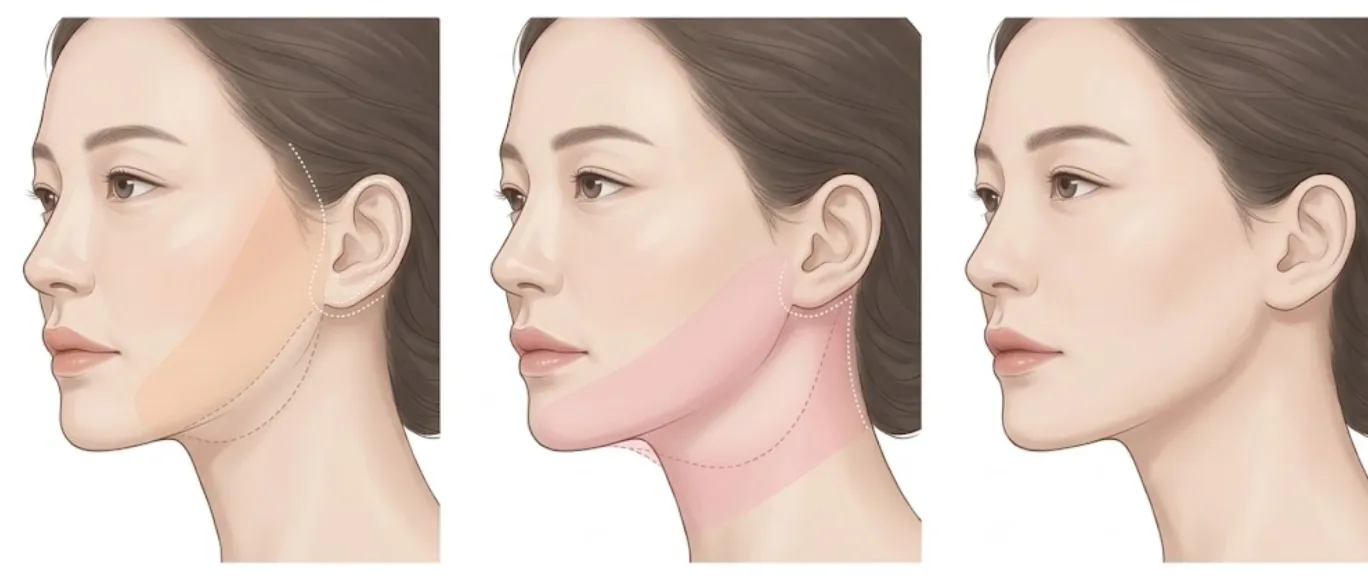
Illustration: through a fine line around the ear (dotted), the sagging lower face and neck are lifted up and back toward the ear (shaded); the dashed outline shows the old contour.
Genetics and lifestyle set the pace. Someone with thicker, more elastic skin and a stable weight will usually hold a crisp result longer than someone with thin, sun-damaged skin or significant weight swings. Posture habits, sun exposure and smoking all influence how the neck skin ages around the repair. This is the same biology that drives the timelines on the sibling recovery timeline page: early healing first, then long, slow tissue change.
It also matters that corset platysmaplasty corrects the muscle and leaves loose skin untouched. If skin laxity is the main concern, a muscle-only corset can look excellent at first and then show skin descent sooner, because the surgery did not remove or redrape skin. Patients whose ageing is more skin-driven are often better candidates for a fuller neck lift, and your candidacy for one approach or the other is discussed on the who is it for page.
What affects it
What affects how long your result lasts
There is no single number that applies to everyone, because longevity is set by the things below far more than by the operation itself. Skin quality is first: elastic, thicker skin redrapes and holds, while thin or sun-damaged skin loosens sooner. Age at surgery matters too. The younger and earlier the bands are corrected, the longer the head start before further ageing shows.
Weight stability is a major and often underrated factor. Gaining and losing weight stretches and deflates the neck repeatedly, which ages any neck contour faster; staying within a steady range protects your result. Sun protection, not smoking, and general skin care all slow the collagen loss that softens the result over time. None of these are gimmicks. They are the levers that decide whether your crisp early neckline lasts 5 years or considerably longer.
Finally, how well the surgery matched your anatomy in the first place affects durability. A correction that was the right operation for your neck (muscle work where the problem was muscle) ages gracefully, whereas the wrong choice can disappoint sooner. This is why a careful pre-assessment matters; you can begin that remotely through an online consultation before committing to travel.
Refreshing it
When might a result be refreshed or revised?
Because the plication itself is durable, most patients never need the muscle repair ‘redone’. What can come up after several years is skin laxity that the original muscle-only corset did not address. At that stage a skin-tightening neck lift, or a non-surgical maintenance treatment, may be discussed instead of repeating the plication. Future work is usually an addition for new ageing; it is rarely a repair of failed surgery.
Separately from long-term ageing, a small number of patients have an early concern, such as a residual band or asymmetry visible once swelling settles. That is a revision question, separate from longevity, and it is covered with realistic expectations; the surgeon discusses what is correctable and when on the sibling page about results. The key distinction is timing: early touch-ups address the initial result, while later refreshes address years of new ageing.
If you are weighing surgical durability against a lighter, more temporary route, the trade-off is straightforward. Non-surgical options need repeating and do less for true muscle banding; surgery does more and lasts far longer but is a one-time procedure with real recovery. The surgeon will walk you through that comparison, including who is genuinely better served by the bigger neck lift, without pushing you one way.
At Garnet
How Garnet plans for a result that lasts
Garnet is a single-surgeon clinic in Apgujeong, Seoul. Dr. In-Soo Baek is a board-certified plastic surgeon (Korean medical licence no. 77407) and the only operating doctor. He consults on your neck bands, performs the corset platysmaplasty himself and reviews every follow-up. For longevity that continuity matters: the surgeon who judged your neck and placed the plication is the same person assessing how it settles and ages, with structured reviews at one, three and six months.
Just as important is not over-operating. Garnet’s approach is to address only the area you came for and to recommend the right operation for your anatomy: a muscle corset where the problem is muscle, a fuller lift where skin is the issue. The bigger procedure is never the default. Choosing the correct operation is itself part of how long a result lasts, and a careful assessment protects against a correction that looks good briefly and then disappoints.
If you want to understand the likely durability for your own neck before you plan a trip, you can send photos for a no-obligation pre-assessment through an online consultation. International logistics (how long to stay, follow-up after you fly home) are set out on the international patients page.
Real Results
Before & After
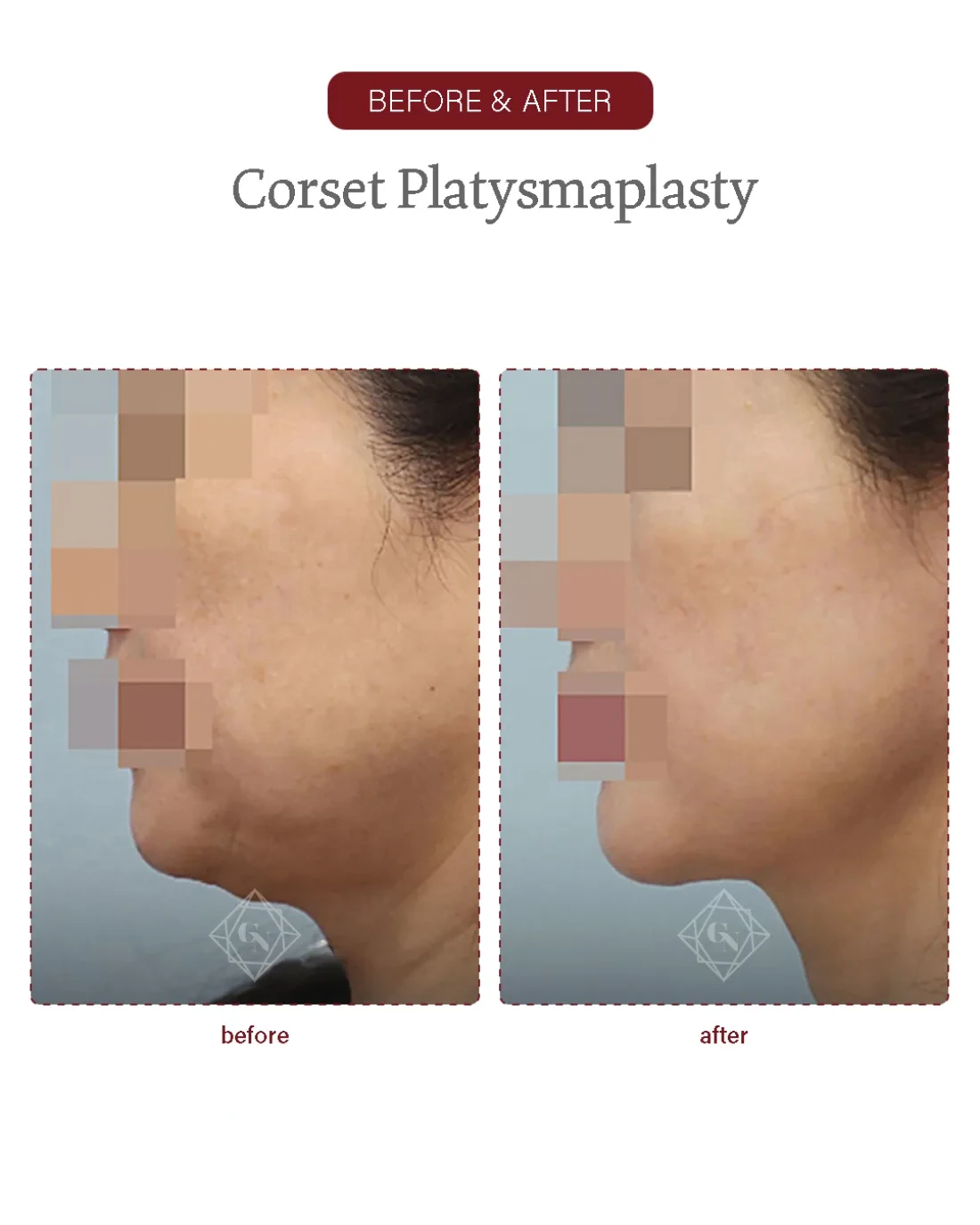
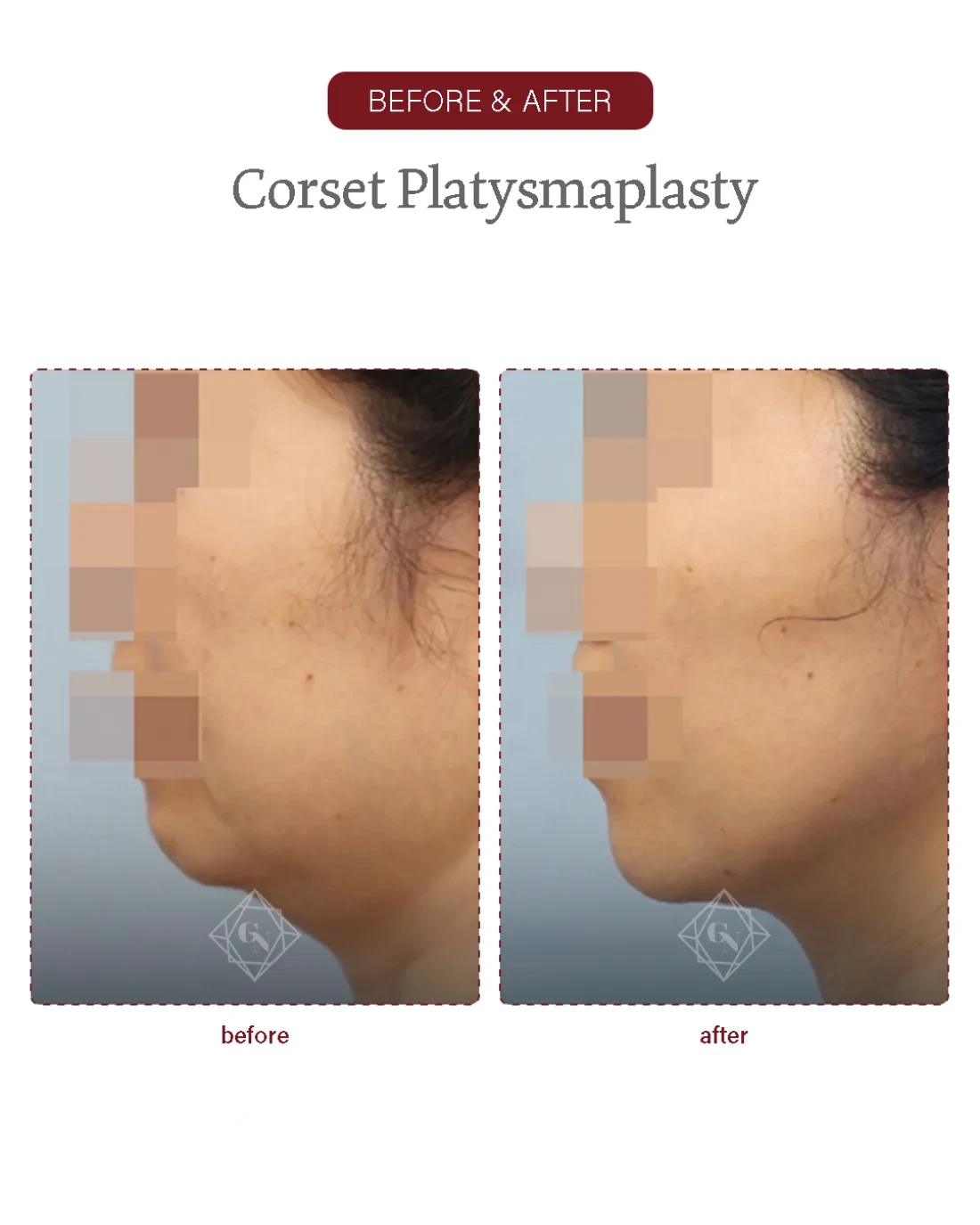
Corset platysmaplasty results of actual Garnet patients (published with consent). Results, recovery and suitability vary by individual, because skin quality, muscle laxity and neck shape differ, and outcomes are not guaranteed.
Dr. In-Soo Baek
Director & sole operating surgeon
Korean medical licence no. 77407
Operate on what you came for. Trained at Korea University Medical Center. Every case planned, performed and reviewed by the same hands.
1Operating surgeon
~2Surgeries per day
7Registered techniques
Board-certified plastic surgeon
Plastic surgery training at Korea University College of Medicine & graduate school
Korean Society of Plastic and Reconstructive Surgeons member, in its facial-contour, eye & rhinoplasty groups
Consults, operates and follows up each case himself
Peer-reviewed papers behind the facts on this page. Each describes findings in its own study group — not results at Garnet — and none predicts your own outcome.
Choi J et al. Modified Medial and Lateral Platysmaplasty. Journal of Craniofacial Surgery. 2020. doi:10.1097/scs.0000000000006515
Pelle-Ceravolo M et al. Complete Platysma Transection in Neck Rejuvenation: A Critical Appraisal. Plastic & Reconstructive Surgery. 2016. doi:10.1097/prs.0000000000002604
Paik Y et al. Complete Corset Platysmaplasty: Evolution of Addressing the Aging Neck. Facial Plastic Surgery. 2014. doi:10.1055/s-0034-1383561
FAQ
Common questions
How long does corset platysmaplasty last?
The muscle repair is durable and is designed to hold for the long term, so most patients keep a clearly improved neckline for many years. The crisp early result softens gradually as the skin and deeper tissues continue to age, but the plication itself does not simply ‘come undone’. It is internal stitching of your own muscle that heals into place.
Is corset platysmaplasty permanent?
No neck surgery is truly permanent, and no surgeon should promise that. The midline muscle correction is long-lasting and does not need routine re-tightening, but your neck keeps ageing around it. Think of it as a durable correction that ages slowly with you, without a fixed expiry date.
Will the platysmal bands come back?
The vertical bands are caused by the separated muscle edges, and corset platysmaplasty stitches them back together, so the banding correction tends to hold well. Some softening of the overall neckline happens with age, but a sudden return of prominent cords after a sound repair is uncommon. Persistent banding soon after surgery is a revision question and is separate from normal long-term ageing.
What makes the result last longer or shorter?
Skin quality, age at surgery, weight stability, sun exposure and smoking are the main factors. Elastic, thicker skin and a steady weight hold a crisp result longer; thin or sun-damaged skin and weight swings shorten it. Whether the corset was the right operation for your anatomy in the first place also matters, which is why a pre-assessment is worthwhile.
Will I ever need it redone?
Most patients do not need the muscle repair redone. What can come up after several years is new skin laxity that a muscle-only corset did not address, which may be managed with a skin-tightening neck lift or non-surgical maintenance instead of repeating the plication. Later work is usually an addition for new ageing.
How does it compare with thread lifts or non-surgical neck tightening for longevity?
Non-surgical options and thread lifts fade and need repeating, and they do less for true muscle banding. Corset platysmaplasty corrects the muscle directly and lasts far longer as a one-time procedure, but it involves real surgery and recovery. The right choice depends on what is actually driving your neck ageing, which the surgeon assesses in person.
Does corset platysmaplasty fix loose neck skin too?
Not on its own. It corrects the platysma muscle and leaves loose skin in place. If skin laxity is your main concern, a muscle-only corset can look excellent at first and then show skin descent sooner. Patients whose ageing is skin-driven are often better served by a fuller neck lift, and the surgeon will tell you which is right for your neck.
Can I do anything to make the result last?
Yes. Staying within a stable weight range, protecting your skin from the sun, not smoking and general skin care all slow the collagen loss that softens the result over time. None of this is a gimmick. These are the factors that decide whether a crisp neckline lasts five years or considerably longer.
How soon do I see the final result that then ‘lasts’?
Swelling settles over weeks to a few months, and the neck continues to refine after that, so the durable result you keep is the one you see once early swelling has fully resolved. The detailed timeline is on the corset platysmaplasty recovery page; longevity is measured from that settled point.
Can I find out how long it would last for me before travelling?
Yes. Send photos for a no-obligation online pre-assessment and the surgeon can give you a realistic sense of likely durability for your neck, based on your skin quality, the cause of your banding and whether a corset or a fuller neck lift is the better operation, before you plan any trip to Korea.
My mom recently had a brow lift and lower blepharoplasty with Dr. Baek, and our experience has been wonderful so far. The Garnet team was incredibly kind and welcoming, with Kelly assisting us as our English consultant—she made everything…
I’m so happy I chose this clinic for my lower blepharoplasty. I was traveling from abroad by myself, so I was a little nervous, but from the beginning I felt comfortable and truly cared for. Everyone was kind, patient, and professional…
Came in for an in-person consult and ended up choosing Garnet and Dr.Baek for my non-incisional DES and tiplasty/alarplasty. I communicated with Kelly (English consultant) from the start till now (3 weeks post-op). She really help me feel…
My under-eyes have been sagging and folding for years... I tried to cover it up with makeup, but it actually got stuck in the wrinkles and made it stand out even more. While going for consultations, I noticed that the bigger the hospital…
Send photos and your question before you travel. An English-speaking coordinator reviews every enquiry and replies with guidance on whether surgery is appropriate, the likely plan and timing.
✓ Reviewed by the clinic coordinator, not a bot
✓ Photo-based pre-assessment before you fly
✓ Foreign-patient scheduling & after-care
✓ One surgeon for consultation, surgery and follow-up
Prefer to chat now? Reach the coordinator directly:








 T S7 months ago



