Corset platysmaplasty tightens the neck from a small hidden incision under the chin, stitching the slack platysma muscle together like a corset. Recovery is steady and predictable for most people, but the neck moves through clear stages. Knowing them in advance makes the wait far less anxious.
The short answer
The work is done through one small submental incision under the chin, so there is no visible scar across the front of the neck.
Most swelling and tightness peak in the first 3–4 days, then ease noticeably through the first 2 weeks.
Many international patients feel presentable in public around 10–14 days; the deeper neck contour keeps refining for weeks to months.
Your neck is checked at 1, 3 and 6 months by the board-certified surgeon who tightened the platysma, the same person throughout.
Where the surgery happens — and why that shapes recovery
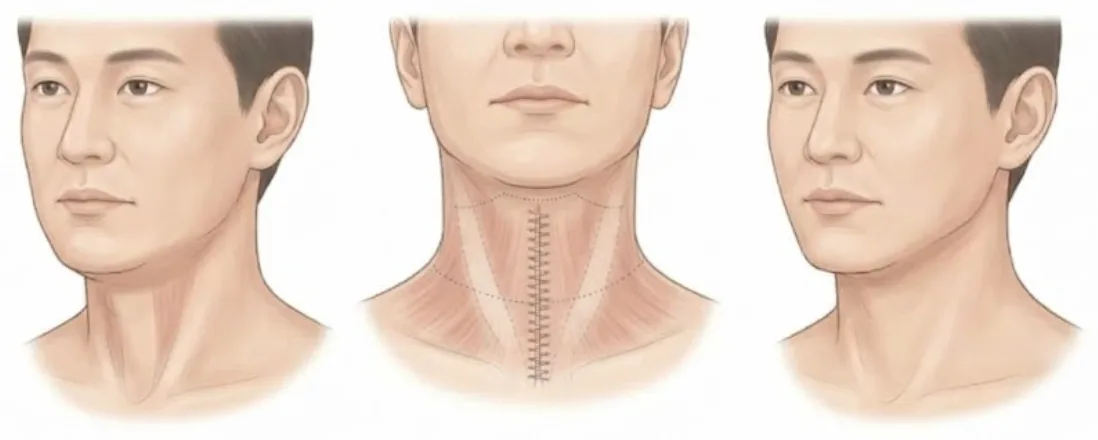
Corset platysmaplasty is performed through a single small submental incision, a discreet cut tucked into the natural crease under the chin. Through it, the surgeon draws the two edges of the platysma (the broad sheet of neck muscle that has separated and slackened with age) back to the midline and stitches them together, cinching the neck like the laces of a corset. Because the access point is small and hidden, your recovery is not dominated by a long visible wound; it is dominated by the muscle work underneath.
Illustration: the neck muscle (platysma) is drawn back together along the midline, like lacing a corset, to firm the neck.
That matters for what you will feel. The early sensations are tightness, firmness and mild swelling under the jaw and along the front of the neck. These are the signs of muscle that has been repositioned and is now holding the neckline taut. This is different from a full neck lift, which may also use incisions behind the ears to redrape skin; a corset platysmaplasty concentrates on the muscle sling itself, which tends to make for a more contained downtime.
Throughout this guide the timeline is the typical pattern for a healthy adult. Your exact pace depends on how much laxity was corrected, your skin and your healing. A personal estimate for your own neck is worth more than any general number.
Days 1–3
Days 1 to 3: the tightest, most swollen stretch
Day 1 is when the neck feels most foreign. Expect firmness and a banded, tight sensation under the chin, mild to moderate swelling, and possibly some bruising spreading toward the jaw or upper chest. A light supportive dressing or chin strap is usually worn to control swelling and support the new contour. Keep it on as directed, and sleep propped up on two or three pillows so fluid drains away from the neck and does not pool there.
Swelling and tightness generally peak around days 2 to 3. Discomfort is typically managed well with prescribed pain relief; most patients describe it as soreness and pressure, with little sharp pain. Speaking, smiling and big head turns will feel restricted; this is the corset doing its job. Eat soft foods, sip plenty of water, and avoid bending over, lifting or anything that sends blood rushing to the head.
Keep the incision clean and dry exactly as instructed, and do not pick at any tape or steri-strips. If you have travelled for surgery, this is the stage to stay near your accommodation and rest. The work of these days is simply to let the swelling crest and begin to turn the corner. You can read more about settling in for this phase in our guide to recovering in Seoul after surgery.
Week 1–2
Week 1 to week 2: the visible turning point
Through the first week the change is steady and encouraging. Swelling softens, bruising fades from purple toward yellow-green and then clears, and the worst of the tightness loosens enough that talking and eating feel more natural. By around day 7 many people feel like themselves again at home, even if the neck still looks fuller than its final shape. Sutures, when external, are typically removed in this window. For a related neck procedure the clinic removes them around 10 to 14 days, and your surgeon will confirm your own schedule.
By the end of week two, most international patients feel presentable in public. Makeup can usually be worn once the incision has sealed, and a scarf or high collar covers any residual firmness comfortably. Light walking is encouraged from early on to support circulation, but strenuous exercise, heavy lifting and anything that strains or flexes the neck should wait. A snug, tight feeling under the chin is completely normal at this stage and is not a sign that something is wrong; it is the repaired muscle still settling.
This is also the point where the neckline itself starts to read clearly: the jaw-to-neck angle looks sharper than before surgery, even though deeper swelling is still resolving. If you are weighing this recovery against other options for the neck, our overview of who corset platysmaplasty suits sets out how it compares to liposuction and a full lift.
Weeks to months
Weeks to months: the contour keeps refining
Recovery does not stop at two weeks. It simply becomes invisible to onlookers while continuing underneath. From weeks three to six the residual deep swelling drains, the neck softens from firm to natural, and the final tightness of the corset becomes the new baseline. Most people return to normal exercise progressively across this period, starting with light cardio and building back to full training only once the surgeon clears it, usually around the four-to-six-week mark.
The numbness or odd "tingly" sensation some patients notice over the front of the neck is normal and fades gradually as small nerves recover; this can take several weeks to a few months. Scar maturation follows its own slow curve: the hidden submental incision typically settles to a fine, well-concealed line over several months as it lightens and flattens. Sun protection and any scar care your surgeon recommends help it along.
The true final result of a corset platysmaplasty is usually judged at around three to six months, when all swelling has gone and the muscle repair has fully matured. That is why structured follow-up matters. At Garnet the same surgeon who operated reviews your neck at 1, 3 and 6 months, with no handover to a rotating team.
Normal vs not
What's normal, and the red flags worth a call
Normal: firmness and a corseted, tight feeling under the chin; swelling that peaks at days 2–3 then steadily improves; bruising that changes colour and fades over one to two weeks; mild numbness or tingling over the neck; and a few weeks of the contour looking fuller than its final shape. None of these mean anything has gone wrong. They are the ordinary signature of healing muscle and skin.
Worth contacting your clinic promptly: swelling that suddenly worsens after the first few days, especially on one side; increasing redness, heat or discharge around the incision; a fever; or pain that grows instead of easing despite your medication. Any difficulty breathing or rapidly expanding swelling of the neck is a reason to seek urgent local care immediately and then notify your surgeon.
Because you may be flying home before the neck fully settles, knowing who answers these questions is part of safe planning. At Garnet your operating surgeon and a dedicated coordinator stay reachable, and you can ask exactly how complications are handled before you ever book during your online consultation.
Flying & follow-up
When you can fly home after corset platysmaplasty, and how follow-up works
Most patients having a corset platysmaplasty are advised to stay in Korea for a short period after surgery so the surgeon can check the incision, manage early swelling and remove any external sutures before you travel. A common plan is to remain for roughly 1 to 2 weeks, but your exact stay depends on your healing and your surgeon's preference. Our guide on how long to stay in Korea walks through how to budget the trip.
Long-haul flights and reduced movement raise general post-surgical considerations, so timing your flight is a clinical decision as well as a logistics one. The principle in our guide to when you can fly after surgery applies here: fly when your surgeon confirms the early healing is on track, stay hydrated, and move your legs during the flight.
After you return home, recovery continues remotely. At Garnet the same board-certified surgeon, Dr. In-Soo Baek (Korean medical licence no. 77407), reviews your progress through the structured 1-, 3- and 6-month follow-ups, and the clinic can continue to check in by messenger so you are never guessing about whether your neck is healing as it should.
Real Results
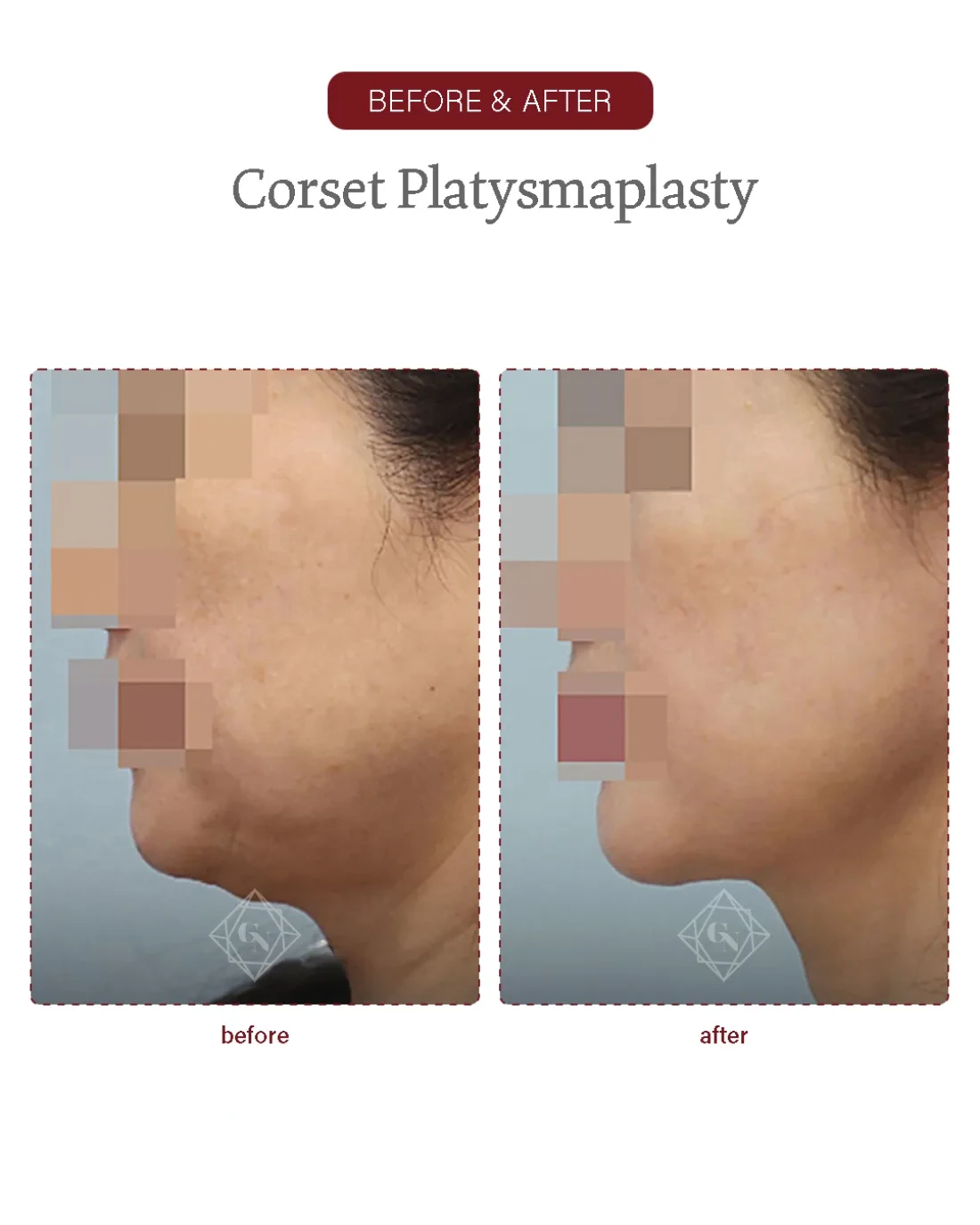
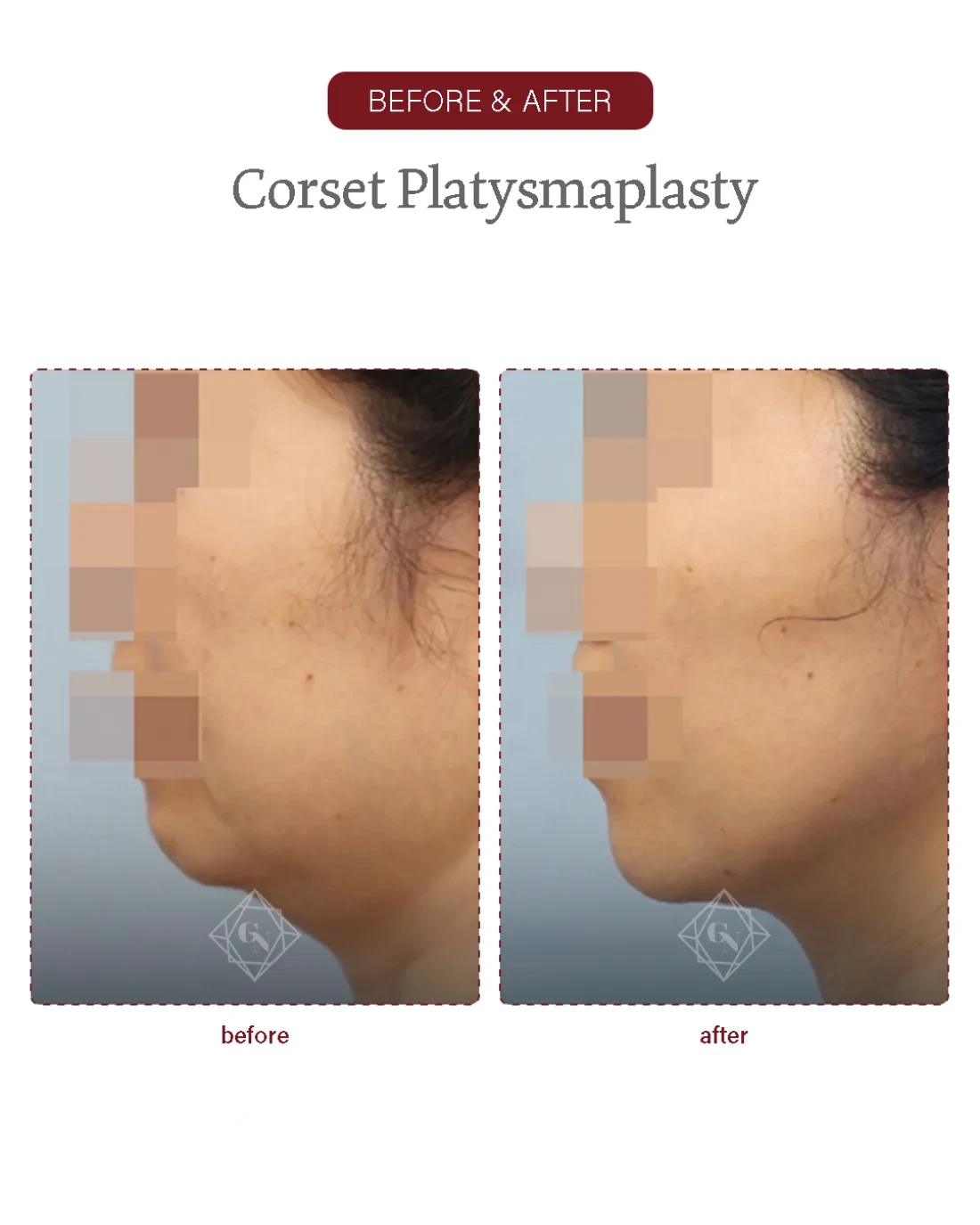
Before & After
Corset platysmaplasty results of actual Garnet patients (published with consent). Results, recovery and suitability vary by individual, because skin quality, muscle laxity and neck shape differ, and outcomes are not guaranteed.
Dr. In-Soo Baek
Director & sole operating surgeon
Korean medical licence no. 77407
Operate on what you came for. Trained at Korea University Medical Center. Every case planned, performed and reviewed by the same hands.
1Operating surgeon
~2Surgeries per day
7Registered techniques
Board-certified plastic surgeon
Plastic surgery training at Korea University College of Medicine & graduate school
Korean Society of Plastic and Reconstructive Surgeons member, in its facial-contour, eye & rhinoplasty groups
Consults, operates and follows up each case himself
Peer-reviewed papers behind the facts on this page. Each describes findings in its own study group — not results at Garnet — and none predicts your own outcome.
Fiore G et al. A Systematic Review and Meta-Analysis of the Role of Open Platysmaplasty in Facelift and Necklift Surgery: Comparative Outcomes of Closed- vs Open-Neck Rejuvenation With Liposuction Using FACE-Q Scales. Aesthetic Surgery Journal Open Forum. 2026. doi:10.1093/asjof/ojag140
Lellouch AG et al. Deep neck surgery in deep plane facelifts – learning from evidence and experience. Journal of Plastic, Reconstructive & Aesthetic Surgery. 2025. doi:10.1016/j.bjps.2025.06.036
Atiyeh B et al. Surgical Management of Platysma Bands: A Narrative Review of Evolving Concepts and Changing Techniques for Neck Rejuvenation. Aesthetic Plastic Surgery. 2023. doi:10.1007/s00266-023-03604-8
FAQ
Common questions
How long does corset platysmaplasty recovery take?
The early recovery is fairly quick: swelling and tightness peak in the first 3–4 days and ease markedly over the first two weeks, with many patients feeling presentable in public around 10–14 days. The deeper neck contour, however, keeps refining for weeks to months, and the final result is usually judged at three to six months once all swelling has resolved.
What is corset platysmaplasty recovery like day by day?
Days 1–3 are the tightest and most swollen, with firmness under the chin and a supportive dressing. Through week one swelling softens and bruising fades; by week two most people feel presentable. Weeks three to six see the residual swelling drain and normal exercise return, and the contour matures fully by around three to six months.
When can I return to work after corset platysmaplasty?
Many people with desk-based or remote work feel ready to return around 10–14 days, once the obvious swelling and bruising have settled and a scarf or collar comfortably covers any firmness. Physically demanding jobs that strain the neck need longer; follow your surgeon's specific clearance for your neck.
Will there be a visible scar on my neck?
The surgery is done through one small incision hidden in the natural crease under the chin, so there is no scar across the front of the neck. That submental incision typically matures into a fine, well-concealed line over several months as it lightens and flattens.
How much pain is there after corset platysmaplasty?
Most patients describe pressure, firmness and soreness, with little sharp pain, and it is generally well controlled with prescribed pain relief. The tight, banded feeling under the chin is the repaired muscle holding the neckline taut. It is expected and eases over the first couple of weeks.
How long do I need to wear the chin strap or dressing?
A light supportive dressing or chin strap is usually worn early on to control swelling and support the new contour. How long varies by patient and surgeon preference, so follow the specific instructions your surgeon gives you for the strap.
When can I exercise again after corset platysmaplasty?
Light walking is encouraged from early on for circulation, but strenuous exercise, heavy lifting and anything that strains the neck should wait. Most people rebuild activity progressively from around weeks four to six, and only once the surgeon clears full training.
How long should I stay in Korea after the surgery?
Most patients are advised to stay roughly one to two weeks so the surgeon can check the incision, manage early swelling and remove any external sutures before flying. Your exact stay depends on how your incision and swelling heal and on your surgeon's plan.
Is numbness in the neck normal after corset platysmaplasty?
Yes. Mild numbness or a tingly sensation over the front of the neck is common as small nerves recover, and it usually fades gradually over several weeks to a few months. Numbness that is worsening or paired with increasing pain or swelling is worth reporting to your clinic.
Who looks after my recovery if I live abroad?
At Garnet the same board-certified surgeon who performed the operation reviews your recovery, with structured follow-ups at 1, 3 and 6 months and the option to continue checking in by messenger after you return home. One surgeon tracks how your neck heals from start to finish.
My mom recently had a brow lift and lower blepharoplasty with Dr. Baek, and our experience has been wonderful so far. The Garnet team was incredibly kind and welcoming, with Kelly assisting us as our English consultant—she made everything…
I’m so happy I chose this clinic for my lower blepharoplasty. I was traveling from abroad by myself, so I was a little nervous, but from the beginning I felt comfortable and truly cared for. Everyone was kind, patient, and professional…
Came in for an in-person consult and ended up choosing Garnet and Dr.Baek for my non-incisional DES and tiplasty/alarplasty. I communicated with Kelly (English consultant) from the start till now (3 weeks post-op). She really help me feel…
My under-eyes have been sagging and folding for years... I tried to cover it up with makeup, but it actually got stuck in the wrinkles and made it stand out even more. While going for consultations, I noticed that the bigger the hospital…
Send photos and your question before you travel. An English-speaking coordinator reviews every enquiry and replies with guidance on whether surgery is appropriate, the likely plan and timing.
✓ Reviewed by the clinic coordinator, not a bot
✓ Photo-based pre-assessment before you fly
✓ Foreign-patient scheduling & after-care
✓ One surgeon for consultation, surgery and follow-up
Prefer to chat now? Reach the coordinator directly:









 T S7 months ago



